


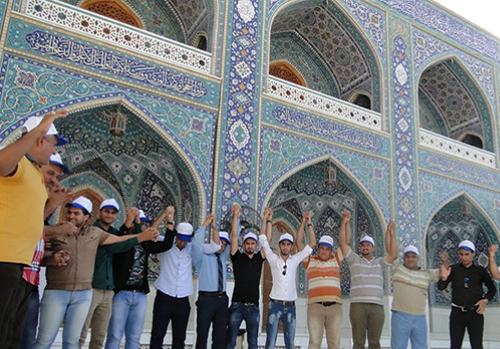
Each session ends with a visit to the holy places of a religion, so group members can become personally acquainted with them all and talk with their leaders. A session lasts a week and is followed by additional gatherings in which new members participate. This result is an expanding social network of relations among members of different sects and groups in a direct and continuous manner.
Al-Monitor met with members of Citizenship Ambassadors to learn more about their work. Lara said that thus far she has worked with 20 youths — including Christians, Yazidis and Shabaks. She presented them with information on minorities in Iraq, including those who are no longer around, such as Jews, and explained some of the misconceptions regarding the beliefs of various religions. She then took them to the monastery of Rabban Hormizd, near al-Qawsh, so they could meet with a Christian cleric, who talked to them about tolerance and love for the other in Christianity.
They then traveled to Lalish, in the northern Sheikan district, to meet with a Yazidi expert, who spoke about his religion and clarified some of the misconceptions regarding it. Next, they visited a mosque, where a sheikh explained to them that terrorism in Iraq is in no way connected to the Islamic faith. He informed them that those who carry out such acts are criminals far removed from the essence of the religion.
Seif told Al-Monitor that he views the Citizenship Ambassadors project as a microcosm of Iraq. He said that he and his friends are working to expand the group to include the largest number of people possible, from all the provinces and every affiliation. Speaking about the difficult security situation for such work in his home province, Anbar, Seif offered, "Despite the difficult challenges, we were able to hold preparatory workshops and then we visited the Shrine of Abu Hanifa al-Numan, the imam of the Hanafi school of Sunni jurisprudence, as well as the shrine of al-Kazim, the seventh imam for Twelver Shiites. Most of the participants were visiting the holy places of other religions for the first time in their lives to get to know the other directly, face-to-face."
Saad Salloum, the director of the Masarat Institute and the man behind the idea for Citizenship Ambassadors, told Al-Monitor that what these youths are doing is part of We Are All Citizens, a comprehensive program organized by his institute, in cooperation with a range of civil activists, to establish the bases of citizenship in society and bring together the elements necessary to reduce Iraq's escalating sectarian conflict.
Iraqi Youth Initiative Combats Sectarianism | Iraq Business News http://t.co/NG89d644fb
DTN Iraq: Iraqi Youth Initiative Combats Sectarianism: By Ali Mamouri for Al-Monitor. Any opinions expressed a... http://t.co/TI7K3caUar