


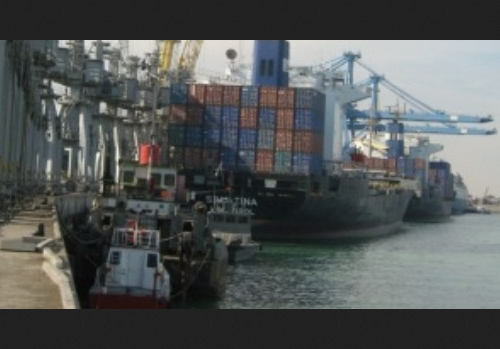
The vessels stuck on the ocean floor here are of many different shapes and sizes, with some in the Shatt al-Arab weighing in at 14,000 tons. Spillage of oil and other chemicals from the vessels has had an ongoing and detrimental effect on the surrounding environment.
In fact, recently Iraqi authorities announced they had managed to retrieve a 500 kilogram missile from out of the sea here.
And the wrecks also hinder the development of shipping lanes, al-Safi said. “Sunken tankers are in three major channels in Shatt al-Arab, Khor al-Zubair and Khor Abdullah. Their presence means the ports get less traffic than they should.”
It also means that the shipping channels have not been able to be dredged and deepened. Although the GCPI is expecting to take delivery of a Chinese-made crane with suitable capacity to help salvage some of the heavier tankers, the process is a long and slow one. And GCPI has lost a lot of revenue as a result, al-Safi notes.
And there are other issues too. The flow of water in the Shatt al-Arab is changing because of all the wrecks in the waterway that catch sediment. As a result, the shoreline on the Iraqi side is eroding downstream and the shoreline on the Iranian side of the Shatt al-Arab is growing. Additionally small islands are also forming in the waterway.
As a recent study, published in the ARPN Journal of Science and Technology, found “all of these factors act together to change the geomorphologic appearance of the channel”. The width of Shatt al-Arab river has decreased by as much as 300 meters in some areas and the islands are narrowing the shipping lanes. “Any change to the gross morphology of the island group can pose a distinct navigational hazard and/or have profound economic consequences,” the Basra-based researchers wrote.
No one care , no one want , no one gives a S...? where does it
end.