


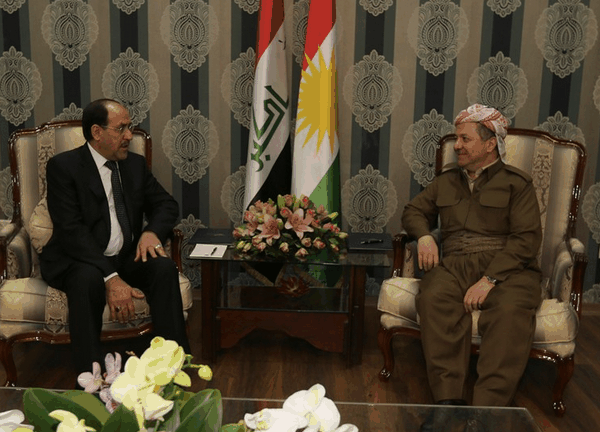
Furthermore, the problem has been fueled by the central government's delay in releasing the budget used to pay the salaries of public officials in Iraqi Kurdistan. This reached the point that KRG President Massoud Barzani described the measures as "a declaration of war" and claimed that the government was imposing a blockade on the region. These Kurdish accusations led Maliki to issue a statement on Feb. 28 denying the responsibility of his government for the delay of public employees’ salaries.
The statement asserted that in the last years these salaries were paid by the KRG from its budget allocations, but it offered to deliver February salaries as a temporal solution and to prevent some from exploiting this issue to “instigate nationalist feelings.”
It seems that negotiations between the two sides will continue, in light of each side sticking to its position and with the approach of the general elections scheduled for April of this year. Electoral seasons in Iraq usually push political forces to avoid flexible positions, to win the support of their constituencies. The KRG's rhetoric emphasizes the injustice the region is subjected to and focuses on the emotional aspect with regard to the interruption or delay in the payment of public servant salaries.
Yet, on the other hand, media outlets close to the central government speak of the need to confront the Kurds' attempts to get more of the budget than they deserve and fund their "semi-autonomous" region with oil from southern Iraq.
However, these positions do not hide the existence of divisions, particularly between the Kurdish forces themselves. Some members of parliament belonging to the Kurdistan Democratic Party (KDP) warned that Iraqi Kurdistan will make its "own decisions" if the central government does not change its stance, in reference to a threat to withdraw from the political process or secede.
Budget Problems go Beyond Erbil-Baghdad Crisis | Iraq Business News http://t.co/0AqkPInsvL