


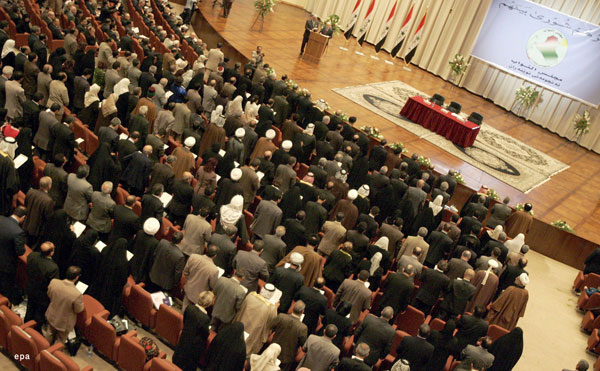
Sunni representation in Iraq is in a deep-rooted crisis that is connected to Sunnis leading the state for many decades. Following 2003, the conditions were favorable for the emergence of Shiite representation, which consisted of Islamist parties and religious authorities, and for the emergence of Kurdish representation in the form of nationalist parties and authorities. Both Kurds and Shiites got their piece of the cake early, leaving the Sunnis in search of representatives.
It cannot be said that the current Sunni political class represents the Sunni people based on electoral results. In actuality, another less visible class represents the Sunni politicians who have influence. They are either associated with the former regime, the Baath Party, religious orientations or linked to armed groups that fought the US forces, or those who, under Maliki rule, were held on charges of terrorism.
The nature and traditions of the Sunni sect prevent the emergence of traditional religious authorities that enjoy consensus or a decisive influence similar to that of Shiite religious authorities. Moreover, the nationalist side of the Sunni memory is linked to the Baath Party, which was excluded from the political scene after 2003.
Even the “tribes,” which are said to be representatives of the Sunnis, have no real credibility on the ground. They are sharply divided and have been engaged in internal conflict over representation. Political experiments throughout the 20th century have used this tribal conflict as a political tool.
The Maliki government, from 2006 to 2014, dealt with Sunni representation from a selective perspective, endorsing figures who were closer aligned with its policies, even if they did not meet the requirements of representations. Maliki's government also excluded those who opposed its policies, even if they did meet the requirements.
RT @iraqbiznews: Who Represents Iraqi Sunnis?: By Mushreq Abbas for Al-Monitor. Any opinions expressed are thos... http://t.co/Zv46QRARbM