


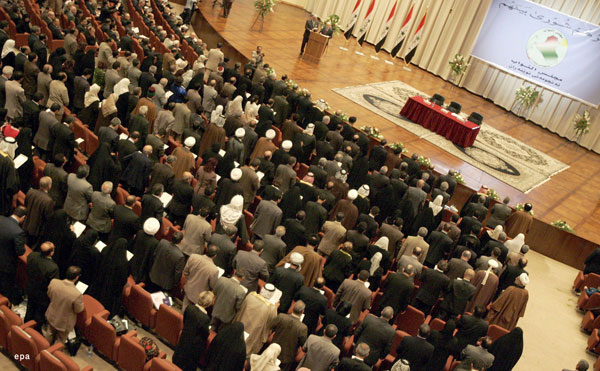
The Maliki government did not invest in the rare Sunni consensus, which could have brought about real reforms to reassure the Sunnis in the long term.
The Saadi phase has faded with the rise of IS and its control over entire Sunni cities. On Oct. 31, Saadi announced that he has stopped issuing fatwas because no one is listening to him. This is proof that the emergence of clear Sunni representatives in Iraq will continue to be an unresolved matter, and that the Sunni mood will always change in terms of its representatives.
The sensitivity of the Sunni issue is first linked to the future of the rule in Iraq, before it is linked with the expulsion of IS from Sunni cities. If Iraq is able to overcome the tripartite partition in the future and move toward becoming a national entity — which is becoming increasingly unlikely day after day — then the current Sunni situation will be able to adapt to an Iraq that is rebuilt based on this formula.
Nevertheless, if Iraq's state project heads toward partition and ethnic and sectarian differentiation, then local, regional and international political parties are tasked with supporting strong and true Sunni representation in Iraq that will have to force explicit partnerships with other components.
RT @iraqbiznews: Who Represents Iraqi Sunnis?: By Mushreq Abbas for Al-Monitor. Any opinions expressed are thos... http://t.co/Zv46QRARbM