


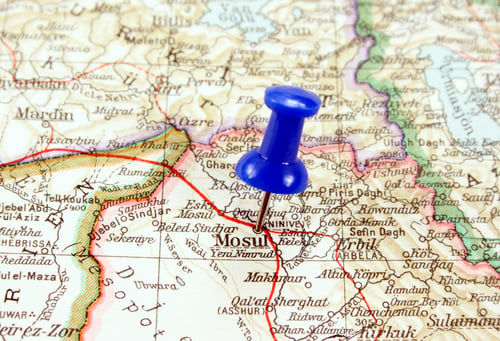
The success in liberating Tikrit presents Iraqi leaders with their next choice — determining when to begin operations to retake Mosul and Anbar. According to most predictions, the next battle will be in Anbar, because that confrontation does not require the degree of political consensus that will be necessary before the battle for Mosul can get underway.
Although the tribes in Anbar will partner with Iraqi forces, Mosul’s situation is more complex because of an overlapping of Kurdish peshmerga forces with units being trained by Atheel al-Nujaifi, the Mosul governor, with the help of Turkey and the United States. The participation of the popular mobilization forces at Tikrit required taking a number of factors into consideration.
It was difficult to devise an arrangement for coordinating the popular forces and the international support being provided. Developing an effective configuration of forces in Anbar will necessitate reaching understandings with the various tribes in the province.
There are additional military factors as well. IS controls most of Anbar's cities, while Iraqi forces control al-Baghdadi, Haditha and some areas of Amiriyat al-Fallujah, al-Karma and Ramadi. The cities of Anbar lie in a line along the Euphrates River, which will allow a distribution of roles among Iraqi government forces, popular mobilization forces and the tribes.
The Anbar tribes' are strongest in Ramadi, and this will be key to the battle. The clans can play a major role in securing their areas and turning them into launching pads for the liberation of Fallujah, southeast of Ramadi, and al-Qaim, northwest of Ramadi, IS' strongholds.
The battle of Anbar will not be easy. The province constitutes about one-third of Iraq territory and borders the provinces of Babil, Baghdad, Karbala, Najaf, Salahuddin and Mosul as well as Saudi Arabia, Jordan and Syria. Anbar has been a semi-permanent hub for extremist organizations since 2003.
Its geographic complexity, expansive deserts and multiple borders make the task of securing it difficult as well as risky.
The presence of civilians will be an important factor in determining how the upcoming battles will be carried out. Mosul is still densely populated by some 1.5 million people, so liberating it will also require trying to avoid civilian casualties. As in Salahuddin province, most inhabitants of Anbar's city centers have left.
(Map image via Shutterstock)
Army sets Sights on Fallujah, Mosul http://t.co/ct2de2tnSj #iraq
Army sets Sights on Fallujah, Mosul: By Mustafa al-Kadhimi for Al-Monitor. Any opinions expressed are those of... http://t.co/iS6ONPPVVP
Iraq: Army sets Sights on Fallujah, Mosul http://t.co/tZpaG0JFTr
#Iraq Business News: Army sets Sights on Fallujah, Mosul http://t.co/FuXVtTy6bG
DTN Iraq: Army sets Sights on Fallujah, Mosul: By Mustafa al-Kadhimi for Al-Monitor. Any opinions expressed ar... http://t.co/O0Z5Ziz7Ti
Army sets Sights on Fallujah, Mosul: By Mustafa al-Kadhimi for Al-Monitor. Any opinions expressed are th... http://t.co/eATP3VKMrG #Iraq
RT @IraqMonitor: #Iraq Business News: Army sets Sights on Fallujah, Mosul http://t.co/FuXVtTy6bG
RT @IraqMonitor: #Iraq Business News: Army sets Sights on Fallujah, Mosul http://t.co/FuXVtTy6bG