


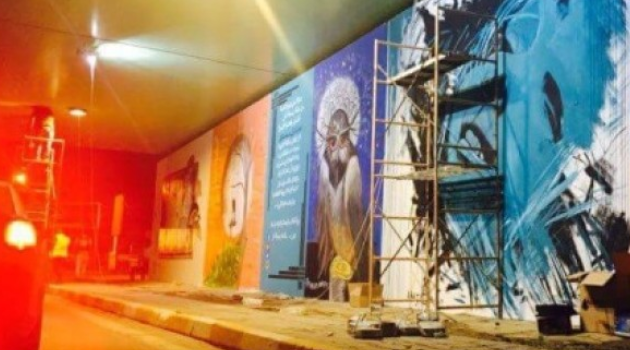
Sabri was very enthusiastic about the campaign and said he was happy to try and contribute something to his country even though, as he acknowledged, people make light of this kind of project in the middle of Iraq’s apparently unending conflict and violence. Even if it did nothing for anybody else, Sabri says that it gave himself and his friends hope.
“It also helps to showcase the talent of the people involved,” he added, “especially because the government does almost nothing to support this sector of society.”
Maha al-Qaisi has been taking part in the beautification campaign since it began and she’s left 13 paintings on walls around the city. Al-Qaisi says she is happy to have been able to leave what she describes as “a positive mark” on the city’s walls, a mark that aptly reflects her own ideological positions.
Al-Qaisi explains how the project works: At the end of each month the participants use the Facebook page to agree on a location for their next effort. After names are registered, volunteers each pay around IQD10,000 (about US$8.60) and this money is used to buy any materials needed. Al-Qaisi says the painting can sometimes take up to two weeks to finish and at the moment, the work usually starts after sundown to avid soaring summer temperatures in Iraq.
Large amounts of graffiti first started appearing on Baghdad walls in 2005, just before the height of a sort of sectarian civil war, following the 2003 US-led invasion of the country. Often the graffiti indicated the demographics of certain suburbs and whether it was safe for Sunni Muslims or Shiite Muslims to be in certain parts of town or not. The artists and volunteers want to replace this kind of thing with something more beautiful. Those working on painting the walls can choose whatever they want to paint although there are relaxed guidelines that suggest subject matter should be related to Iraq or Baghdad. “So for instance, palm trees and local landscapes,” al-Qaisi says.
Comments are closed.