


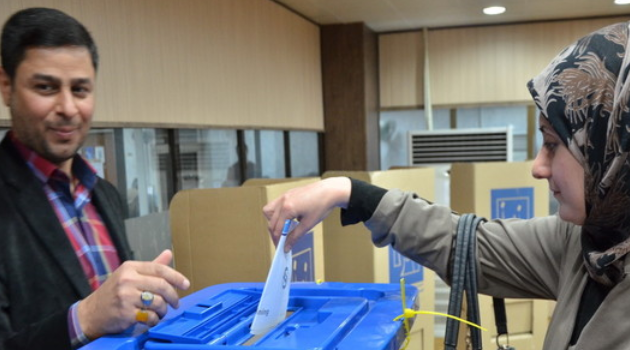
And last week Allawi said that most of the political parties in Iraq have agreed to the postponement in principal.
Clearly one of the most problematic issues is the ongoing security crisis. The extremist Islamic State, or IS, group is still in control of many towns and cities in the provinces of Anbar, Salahaddin and Ninawa and literally millions of Iraqis live under the group’s control. They will obviously not be able to take part in any elections.
The cities from which the IS group has been pushed out are also far from ready to hold elections. Many of the residents were displaced and continue to live in other parts of the country, or in camps. Many of the cities have been badly damaged by fighting between the IS group and pro-government forces and reconstruction is some way off.
The United Nations estimates that around 3.3 million people have been displaced by the security crisis in Iraq and Iraq’s Independent High Electoral Commission suggests that there are more than 1.5 million who will not be able to participate in elections.
“It is difficult to hold provincial elections while the IS group holds important cities like Mosul,” argues Abdul Rahman al-Luwaizi, the MP for Ninawa province, of which Mosul is the capital. “We should respond to this. Elections could be postponed until the extremists are eliminated and the displaced can return to their homes.”
One of the ideas that has been discussed behind closed doors is holding the provincial elections at the same time as the federal elections, slated for 2018, and it seems there is widespread support for this idea.
“Combining the local and the national elections would reduce the expense of holding elections,” explains Nahla al-Hababi, an MP for the Iraqi Prime Minister’s State of Law party. “Thanks to low oil prices Iraq is experiencing a financial crisis. Additionally, postponing the provincial elections for one year would give security forces a chance to completely push the IS group out of the areas they still control.”
Comments are closed.