


New Zealand to Close Embassy in Iraq
Posted on 20 June 2020 .
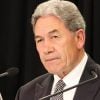
New Zealand's Foreign Affairs Minister, Winston Peters, has announced the closure of the New Zealand Embassy in Baghdad.
Mr Peters said:
"This decision to permanently close the Embassy was not taken lightly and is in no way an indication of any change in the value that New Zealand places on its relationship with Iraq.
"The Embassy was opened in 2015 to support the New Zealand Defence Force military deployment to Iraq and, with the withdrawal of the majority NZDF troops from Taji earlier this year, the primary rationale for the Embassy in Baghdad has been removed.
"New Zealand is proud of the partnership that has developed between the two countries through our contribution to the Coalition to Defeat ISIS, including the training of over 47,000 Iraqi Security Forces through the joint Australia - New Zealand Building Partner Capacity Mission in Taji.
"Although the Embassy is closing, our strong commitment to the global fight against terrorism remains. New Zealand will continue to contribute its other lines of effort against ISIS, including through a small number of military roles in the Coalition and the provision of stabilisation funding to Iraq."
New Zealand currently deploys four NZDF personnel to Coalition Headquarters in Iraq and Kuwait, and five operational support roles based in Qatar. The mandate for these roles has been extended until June 2022.
The Embassy in Baghdad will close at the end of June and New Zealand's formal accreditation to Iraq will transfer to the New Zealand Embassy in Abu Dhabi.
(Source: New Zealand First Party)
Posted in Iraq Industry & Trade News, Security Comments Off on New Zealand to Close Embassy in Iraq
Iraq Extends the Suspension on Scheduled Flights
Posted on 22 May 2020 .
By John Lee.
On May 21, the Government of Iraq extended the suspension on scheduled flights to and from Iraq until 8:00 p.m. on May 31.
Qatar Airways is offering a special flight from Baghdad on May 26. This flight is not organized by the Embassy.
(Source: U.S. Embassy Baghdad)
Posted in Iraq Transportation News Comments Off on Iraq Extends the Suspension on Scheduled Flights
Iraq Stock Market hits New Lows
Posted on 01 May 2020 .
Advertising Feature
Rabee Securities Iraq Stock Exchange (ISX) market report (week ending: 30th April 2020).
Please click here to download a table of listed companies and their associated ticker codes.
The RSISX index ended the week at IQD503 (-12.6%) / $522 (-12.6%) (weekly change) (-23.7% and -25.5% YTD change, respectively). The number of week traded shares was 2.3 bn and the weekly trading volume was IQD1.5 bn ($1.2 mn).
Note: ISX will be open three days a week (Sundays, Tuesdays, and Thursdays) next week, like this week. During that period, the lower daily price change limit will be 5% and the upper daily price change limit will be maintained at 10%.

ISX Company Announcements
- Asiacell (TASC) increased its customer base by 5% y/y to 14.8 mn as end of 1Q20 due to the good growth in data users, according to its parent, the Qatari company Ooredoo. The company said "Revenue is higher than last year driven by growth in DATA and VAS revenues; impacted by COVID-19 in March 2020." TASC increased revenues 1% y/y to QAR1,085 mn ($296 mn) in 1Q20. EBITDA increased 0.4% y/y to QAR473 mn ($129 mn) in 1Q20, and EBITDA margin stayed at 44%. (Ooredoo)
- The ISX will hold its AGM on Jun. 26, 2020 to discuss and approve 2019 annual financial statements, the board of governors' 2019 report on the ISX's activity, and to discuss ISX program for the year 2020.
- Al Taif Islamic Bank for Investment & Finance (BTIB) sent a letter to the CBI on Apr. 28, 2020 stating that due to the unexpected situations in the country and with imposing full curfew, the bank couldn't extend the subscription for additional 60 days to complete the subscription for full shares offered that started on Jan. 19, 2019 to increase their capital from IQD100 bn to IQD150 bn. BTIB will notify when the capital increase procedures are complete.
- Al Nibal Al Arabya for Money Transfer (MTNI) decided to decrease its capital from IQD45 bn to IQD5 bn in its AGM held on Feb. 25, 2020.
- Elaf Islamic Bank (BELF) resumed trading on Apr. 26, 2020 after discussing and approving 2018 annual financial statements in its AGM held on March 10, 2020.
- Erbil Bank for Investment and Finance (BERI) resumed trading on Apr. 26, 2020 after electing 7 original and 7 alternative board members in its GA held on Feb. 22, 2020.
Posted in Investment Comments Off on Iraq Stock Market hits New Lows
Airlines Continue Using Iraqi and Iranian Airspace
Posted on 21 January 2020 .
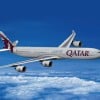
Qatar Airways, Emirates and several other Persian Gulf airlines still fly in Iranian and Iraqi airspace and to cities in both countries since Iran and the United States traded military strikes.
“Iranian airspace is important for all carriers in this region,” said Adil al-Ghaith, Emirates’ senior vice president, commercial operations, Persian Gulf, Middle East and Iran, Reuters reported.
Dubai-based Emirates and sister carrier flyDubai together serve 10 cities in Iran and Iraq, and have continued to use the airspace of both countries for other flights.
Kuwait Airways and Abu Dhabi-based Etihad Airways have also continued using Iranian and Iraqi airspace.
“We will continue to fly to Iran because Iran is an important country to us and it is our neighbor and we want to serve the people of Iran,” Qatar Airways Chief Executive Akbar al-Baker said on the sidelines of a Kuwait air show.
However, some regional carriers have changed their routes. Bahrain’s Gulf Air has redirected European flights away from Iraqi airspace and now flies longer, more fuel consuming routes over Saudi Arabia and Egypt.
“We want to take the safest option even if it costs us a little bit more for a period of time. We can live with that,” Deputy Chief Executive Waleed Abdulhameed al-Alawi said.
The UAE regulator told its carriers — Emirates, Etihad, flydubai and Air Arabia AIRA.DU — this month to “evaluate flight path risks” although it said it was up to the airlines to make the final decision on the routes they chose.
(Source: Tasnim, under Creative Commons licence)
Posted in Iraq Transportation News Comments Off on Airlines Continue Using Iraqi and Iranian Airspace
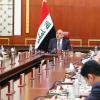
Cabinet pushes for Int'l Arbitration Convention
Posted on 28 November 2019 .
By John Lee.
The Cabinet held its regular weekly meeting in Baghdad on Tuesday under the chairmanship of Prime Minister Adil Abd Al-Mahdi, and:
- reviewed progress in implementing the reforms, initiatives and measures announced by the government to meet the legitimate demands of the protests;
- approved a draft law on the accession of the Republic of Iraq to the 2005 Protocol to the Convention for the Suppression of Unlawful Acts against the Safety of Maritime Navigation of 1988;
- authorised the Minister of Transport to negotiate and sign a draft maritime transport agreement between the Government of Iraq and the Government of the State of Qatar;
- approved a recommendation to the Council of Representatives (Parliament) to expedite the legislation on Iraq’s accession to the Convention on the Recognition and Enforcement of Foreign Arbitral Awards 1958 (the New York Convention), one of the key instruments in international arbitration.
(Source: Govt of Iraq)
Posted in Iraq Industry & Trade News, Politics Comments Off on Cabinet pushes for Int'l Arbitration Convention
Italy-UNESCO Agreement on Education in Iraq
Posted on 27 November 2019 .
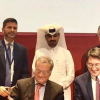
Doha: Signing of the Italy-UNESCO Agreement on children's education in Iraq
The Director General for Development Cooperation of the Ministry of Foreign Affairs and International Cooperation, Giorgio Marrapodi, and the Director of the UNESCO Office in Iraq, Paolo Fontani, signed an agreement today in Doha for the implementation of a joint cooperation project aimed at ensuring access to education for children in Iraq who currently cannot go to school.
The agreement is part of a broader program also funded by the Education Above All Foundation of Qatar. Italy will support the project with one million euros. The aim is to help remove some of the obstacles that limit access to education in Iraq.
The funds will be used by UNESCO to rehabilitate ten schools, conduct education campaigns, and enroll 17,000 boys and girls of the Governorships of Salah al-Din and Baghdad.
Director General Marrapodi commented:
"In the Iraqi context it is even more important than anywhere else to create synergies between the different sources of knowledge and experience: Iraq, Italy, Education Above All and UNESCO will each offer an important contribution to the activities of the project.
"We are confident that this project will be a starting point for a broader and more fruitful trilateral collaboration with Qatar, in Iraq and also in other contexts”.
At the signing ceremony of the agreement, Paolo Fontani, Director of the UNESCO Office in Iraq, said:
“UNESCO is particularly grateful to the Italian Government and to Educate A Child - the global programme of the Education Above All Foundation - for the support provided to the project. Improved access to education for excluded boys and girls is the best possible contribution to their future and to the future of Iraq."
Italy's Ambassador to Qatar, Pasquale Salzano, commented:
"We are pleased that the signing of this agreement takes place in Doha within the framework of the WISE Summit, and that it focuses, in particular, on access to education for children in disadvantaged countries.
"Italy has always been one of the major contributors to UNESCO and the project agreement signed today in Doha strengthens our commitment to promote access to education, alongside Qatar and the Education Above All foundation which is engaged in Iraq in Africa and in the world, providing education to over 10 million children living in crisis areas."
(Source: UNESCO)
Posted in Iraq Education and Training News Comments Off on Italy-UNESCO Agreement on Education in Iraq

Transparency in Iraqi Upstream Petroleum Sector
Posted on 30 September 2019 .
By Ahmed Mousa Jiyad.
Any opinions expressed are those of the authors, and do not necessarily reflect the views of Iraq Business News.
Transparency in the Arab Countries’ Upstream Petroleum Sector- Iraq as case study*
While upstream petroleum sector is either dominant or has significant importance in many Arab economies of MENA region, the transparency of the sector is alarmingly lacking; this is manifested by their “formal” association with Extractive Industry Transparency Initiative (EITI), which is extremely limited and their Resource Governance Index (RGI) and Corruption Perception Index (CPI) that are too poor.
This presentation comprises three parts;
The first part addresses, briefly, the essence of transparency and what it entails:
- Full disclosure & availability of and accessibility to related Data & Information;
- Openness, answerability, accountability;
- Multiplicity of involved, reporting or concerned entities;
- Objective, Independent & Verifiable Indicators;
- Transparency is not rhetorical claim; it is evidence-based;
- Reconciliation of data: Materiality, Identifiably, Measurability;
- Constitutional Premises (ownership) Right and Rights Based Development- RBD
Also, this part provides a selection of most known international entities specialized in the matter; these are EITI, Natural Resource Governance Institute (NRGI), Transparency International (TI), Publish What You Pay (PWYP) and the Fund for Peace. Each of these entities has its distinct methodology, working procedures and publications. In addition to them, this part refers to the IMF’ Fiscal Transparency Code.
The second part exhibits charts on the standing of the Arab countries based on the latest available data and information from three international entities: EITI, NRGI-RGI and TI-CPI.
As on September 2019 only Mauritania has “meaningful progress” standing with EITI; Iraq was “suspended” since October 2017 due to “inadequate progress” and Yamen was “suspended” on February 2015 due to “political instability”, then in October 2017, Yemen was “delisted” and, thus, could be invited to reapply to the EITI once conditions were again favourable for implementation.
Obviously, the above manifests extremely poor standing (in number of countries and their status) with EITI.
The NRGI’ RGI measures the quality of resource governance in countries that together produce 82 percent of the world’s oil, 78 percent of its gas and a significant proportion of minerals, including 72 percent of all copper. RGI is the product of 89 country assessments (eight countries were assessed in two sectors), compiled by 150 researchers, using almost 10,000 supporting documents to answer 149 questions.
NRGI’s RGI for 2017 (oil and gas only) covers 89 countries and provides their “Score” on a scale of 100 and “Rank” of 89. RGI 2017 classifies the standing of countries according to their scores into: Good (>74); Satisfactory (60:74); Weak (45:59); Poor (30:44) and Failing (<30).
All the 12 Arab countries covered by RGI scored less than 60 out of 100. Countries with Weak score are Tunisia, Kuwait and Oman. Those scored poorly are Qatar, UAE, Bahrain, Egypt, Iraq, Saudi Arabia, Algeria and Yamen. Finally, Libya scored failing.
TI’ CPI 2018 draws on 13 surveys and expert assessments to measure public sector corruption in 180 countries and territories, giving each a Score from zero (highly corrupt) to 100 (very clean) and their Ranks accordingly.
Syria, Yemen, Sudan, Iraq and Lebanon each scored less than 30; Egypt, Algeria, Kuwait, Tunisia, Morocco, Jordan and Saudi Arabia scored over 30 up to 50; Oman, Qatar and UAE scored over 50 to 70.
Since both RGI and PCI are composite indexes, there is strong correlation between Scores and Ranks: low scores are associated with high rank numbers; high rank number means at the bottom of the list.
In conclusion all the standing of Arab countries is alarmingly very poor and disappointing with EITI, NRGI and TI.
The third part of the presentation focuses on Iraq as a case study on transparency through its association and experience with EITI.
Briefly, Government of Iraq (GoI) launched (2007/8) the International Compact with Iraq (ICI) in cooperation with the UN and the WB. ICI specifically calls to, “Establish and implement mechanisms to ensure transparency of petroleum sector flows”.
The government publicly announced its commitment to work with all stakeholder groups at the 4th EITI Global Conference in Doha, Qatar, in February 2009, and then made formal commitment to EITI at the Iraq EITI (IEITI) launching conference on 10-11 January 2010; a month later the country was accepted, by EITI Board, as a Candidate.
The first validation report, prepared by EITI’ International Secretariat- IS staff, endorsed by Adam Smith International- ASI, prompted EITI Board to announce, on 12 December 2012, Iraq as “Compliant” country under EITI rules and process. On 3 April 2013, IEITI organized big event in Baghdad celebrating this achievement by Iraq.
A team from EITI-IS visited Iraq during 1-9 April 2017 and held numerous meetings in Baghdad and, also, in Dubai (UAE); IS Report presents the findings and initial assessment of the data gathering and stakeholder consultations and followed EITI usual and unified “Validation Procedures” and applied the “Validation Guide” in assessing Iraq’s progress with the EITI Standard.
Iraq was found to have inadequate progress in implementing the EITI Standard in October 2017. The country status as “compliant member” was suspended and, according to EITI rules, was given a grace period to rectify the shortcomings to achieve at least “Meaningful” progress on all identified requirements.
Why and what went wrong
The presentation highlights and discussed questions relating to why and what had led to such suspension under the following headlines:
- “Mission accomplished” and sense of complacency; frequency of MSG meetings and attendance curve
- Wrong understanding of what “compliant” status really means;
- Focus on “release on time” not on the quality and contents of the IEITI Annual Reports;
- IEITI Annual report mostly Copy & Paste; most Parts are prepared by MoO/ MIM officials and full of flaws and inaccuracies;
- Structure & composition of the MSG: dominated by Government representatives, IOCs not active, CSO lack understanding of Extractive Industry and language;
- Big Secretariat, weak national capacity contribution and complete reliance on the Administrator;
- Opposing domestic views: useless/invisible; event-base; abused by authorities and two extreme views (Rosy vs. UN full control!):
- Surprising passivism on Corruption!!!!!!;
- IEITI itself is a Black Box
- Limited impacts that led to diminishing international support and lack of funding e.g., NORAD; NRGI: from “priority country” to “Limited engagement” to only in “RGI”;
What are next and the way forward
In this part, the presentation reviewed responses and actions taken by the Iraqi authorities since the suspension: From the initial “muteness” and “passivism” October -2 November 2018,….., to 4 Nov 2018 alerting article; Committees & changes, …; February 2019 Baghdad Conference; EITI-IS second validation; EITI Global Conference, Paris- June 2019.
In case of re-instating Iraq “Compliant” status, IEITI still has to take specific necessary measures and actions for real impacts instead of making rhetorical statements; such measures and actions were proposed, justified and discussed during the presentation. The PowerPoint slides are attached herewith.
* Presentation delivered before the 12th Middle East and North Africa Oil & Gas Conference, organized by Target Exploration www.targetexploration.com, Imperial College, London, UK. 18 September 2019. I am very grateful to Target Exploration for sponsoring my participation.
Click here to download the PowerPoint slides presented at the conference.
Mr Jiyad is an independent development consultant, scholar and Associate with the former Centre for Global Energy Studies (CGES), London. He was formerly a senior economist with the Iraq National Oil Company and Iraq’s Ministry of Oil, Chief Expert for the Council of Ministers, Director at the Ministry of Trade, and International Specialist with UN organizations in Uganda, Sudan and Jordan. He is now based in Norway (Email: mou-jiya(at)online.no, Skype ID: Ahmed Mousa Jiyad). Read more of Mr Jiyad’s biography here.
Posted in Ahmed Mousa Jiyad, Iraq Oil & Gas News Comments Off on Transparency in Iraqi Upstream Petroleum Sector
Monetization Strategies for Development of Border Oil Fields
Posted on 24 September 2019 .
By Ahmed Mousa Jiyad.
Any opinions expressed are those of the authors, and do not necessarily reflect the views of Iraq Business News.
Monetization Strategies for Joint Development of Border Fields in MENA Region
Many hydrocarbons fields and exploration blocks, with billons barrels of petroleum, straddle sovereign borders (both onshore and offshore) in the Middle East and North Africa- MENA region, present significant development opportunities as well as potentially risk and source of conflict.
So far, they have been mostly source of conflicts, contentious and acrimonious relationship; it’s about time to pursue the other mutually beneficial approach whenever possible and feasible.
The number, prospects and potential of border fields in MENA Region indicate to billions barrels of oil equivalent -BOEs of proven hydrocarbon (oil, gas and condensates) reserves, with more to add through further exploration and technological advancement, generating billions of cash flows with attractive returns on investment.
Brief examples and as of today’s data and information are the following:
- Iraq has (24) border oilfields with Iran, Kuwait and Syria;
- Iran has (23) border fields/blocks with Iraq, Saudi Arabia, Kuwait, Qatar, UAE, Oman and Turkmenistan;
- Arabian Gulf Region is crowded with too many structures, including Saudi Arabia-Kuwait Neutral Zone (Al-Khafji & Al-Wafra);
- The Mediterranean: Lebanon vs. Occupied Palestine (Israel); Cyprus vs. Turkey; Egypt vs.....!!
- Red Sea: Egypt vs, Sudan (Halayib and Shalateen)
- Other MENA countries…….
Empirical evidence and analytical premises suggest that sovereign border hydrocarbons fields or exploration blocks could be developed either through “competitive” or “collaborative” strategies; the first follows “rule of capture” or “use it before losing it”, while the second adopts “feasibility & optimization”; the first is harmful to the field, its structure and reservoir(s) while the second adheres to efficiency considerations, prudent natural resource management and international best practices; the first is premised on “sovereign exclusivity” while the second is formulated on “Bi/trilateral inclusivity”; the first is “conflict-prone” while the second serves “mutuality of interests”; the first is “short-term focused” while the second has “phasic orientation” and finally, from investment vs. net revenue perspectives, the first is “own-risk” while the second is “burden and benefit-sharing”.
What should be highlighted is that collaborative development of a border field could be done through two broad (comprising various versions) distinct modalities with different investment, revenue structures and legal modalities: unitization (mostly trilaterally structured) or joint venture (mostly bilaterally structured).
For this purpose the presentation proposes TELG Approach for monetizing these resources, which basically integrates four fundamental broad spheres of professional knowledge-base and analysis and the needed institutional, managerial and governance setups applicable to the collaborative mode of border fields development in both modalities- unitization and joint venture.
TELG Approach is helpful for unitization requirements of both onshore and offshore across-sovereign borders as well as across contracted areas within each country.
After discussing the essence of cross-border fields exploitation as “Hotelling game”, basic contesting strategies, phases of unitization agreements and elaborate on TELG approach and its requirements, the presentations provides examples on the “ambiguity” of legal provisions on unitization in the Iraqi service contracts, the July 2019 Iraq-Kuwait contract with ERCE and a list of modalities governing UK-Norway unitization of fields.
The presentation ends with call upon Arab related entities such as OAPEC, ESCWA and the Economic and Social Council of the Arab League among others to take necessary and serious measures to address unitization, and request Arab petroleum professionals to produce international best-practice guide and formulate basic model for unitization agreement in efforts to help in efficient exploitation of such natural resources in a prudent and effective way and finally provide Illustrative Hypothetical Case for Unitization Negotiation Game.
This presentation was delivered before the 12th Middle East and North Africa Oil & Gas Conference, organized by Target Exploration at Imperial College, London, UK. 19 September 2019; I am very grateful to Target Exploration for sponsoring my participation.
Click here to download the PowerPoint slides presented at the conference.
Mr Jiyad is an independent development consultant, scholar and Associate with the former Centre for Global Energy Studies (CGES), London. He was formerly a senior economist with the Iraq National Oil Company and Iraq’s Ministry of Oil, Chief Expert for the Council of Ministers, Director at the Ministry of Trade, and International Specialist with UN organizations in Uganda, Sudan and Jordan. He is now based in Norway (Email: mou-jiya(at)online.no, Skype ID: Ahmed Mousa Jiyad). Read more of Mr Jiyad’s biography here.
Posted in Ahmed Mousa Jiyad, Iraq Oil & Gas News Comments Off on Monetization Strategies for Development of Border Oil Fields
Iraq Stock Market Report
Posted on 02 August 2019 .
Advertising Feature
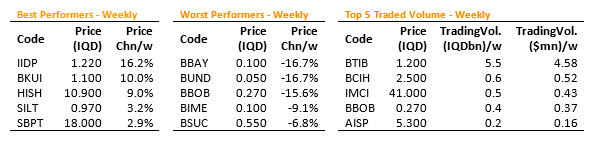
Rabee Securities Iraq Stock Exchange (ISX) market report (week ending: 1st August 2019).
Please click here to download a table of listed companies and their associated ticker codes.
The RSISX index ended the week at IQD629 (-3.1%) / $676 (-3.1%) (weekly change) (-4.6% and -4.7% YTD change, respectively). The number of week traded shares was 8.4 bn and the weekly trading volume was IQD8.4 bn ($7.0 mn).
ISX Company Announcements
- Zain announced 6M19 financial results in its website. According to Zain, Zain Iraq’s number of subscribers increased 4% y/y to 15.3 mn. In 1H19, revenues decreased 6% y/y to $522 mn mainly due to the intense competition affecting the top-line. EBITDA increased 13% y/y to $220 mn in 1H19 largely due to the positive contribution from IFRS 16 adoption and strong focus on cost optimization. Net profit increased by 39% y/y to $25 mn in 1H19. (Zain)
- Asiacell (TASC) has increased its customer base by 6% y/y to 13.9 mn as end of 1H19, according to its parent, the Qatari company Ooredoo. In its results for 1H19, the company said: “Despite intensifying price competition, Asiacell maintained stable revenues of QAR 2.2 bn during the first half of 2019 as compared with the same period last year. “EBITDA declined 9% to QAR 970 mn as a result of increased sales and marketing activities to expand customer base and data/fiber network cost. (Ooredoo)
- Gulf Commercial Bank (BGUC) will resume trading on Aug. 4, 2019 after discussing and approving 2018 annual financial results.
- Al-Khazer for Construction Materials (IKHC) will hold an AGM on Aug. 3, 2019 to discuss and approve 2018 annual financial results. The company has been suspended since Jul. 8, 2019 by an ISC decision for not disclosing financial results.
- Bank of Baghdad (BBOB) resumed trading on Jul. 29, 2019 after discussing and approving 2018 annual financial results.
- National Company for Tourism Investment (HNTI) resumed trading on Jul. 29, 2019 after discussing and approving 2018 annual financial results and deciding to distribute 18% cash dividend (IQD0.18 cash dividend per share, 1.96% dividend yield).
- Cross transactions: 4.6 bn shares of Al Taif Islamic Bank for Investment & Finance (BTIB) on Jul. 30, 2019, which represents 4.6% of BTIB's capital. 250 mn shares of Cihan Bank for Islamic and Finance (BCIH) on Jul. 29, 2019, which represents 0.1% of BCIH's capital.
Posted in Investment Comments Off on Iraq Stock Market Report
Asiacell Increases Customer Base
Posted on 30 July 2019 .
By John Lee.
Asiacell Iraq has increased its customer base by six percent in the first six months of this year, according to its parent, the Qatari company Ooredoo.
In its results for the first half of 2019, the company said:
"Despite intensifying price competition, Asiacell maintained stable revenues of QAR 2.2 billion during the first half of 2019 as compared with the same period last year.
"EBITDA declined 9% to QAR 970 million, impacted by costs incurred for network upgrades and expansion as Asiacell continues to increase its reach and capacity in order to meet the data demand of its customers.
"Asiacell's customer base increased 6% during the first half of the year to 13.9 million, a result of network expansion and enhanced sales and marketing activities."
(Source: Ooredoo)
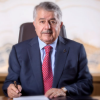
(Picture: Faruk Mustafa Rasool, Chairman of Asiacell)
Posted in Investment, Iraqi Communications News Comments Off on Asiacell Increases Customer Base