



ISX safe from Japanese fallout
Posted on 18 March 2011 .
So far the Japanese earthquake, tsunami, and nuclear disaster have had surprisingly little impact on emerging markets. While the Nikkei is down 13% since the quake (as of March 17), the MSCI emerging markets index has fallen only 3%. And in Iraq, Rabee Securities’ RSISX is actually up 0.4%.
Emerging markets could continue to slide, however. The main risk comes from the possibility of a global liquidity squeeze as Japan repatriates funds to finance reconstruction efforts. Post-quake moves in the yen:dollar exchange rate may be an early warning sign. The yen rose over 3% to levels around the post-World War II record high of 79.75 (reached in April, 1995) before being pushed back above 80 by the Bank of Japan's March 18 intervention.
This is one risk that ISX investors do not have to worry about, however. As most of the trading is still local, there just isn’t much foreign money to be pulled out. And the few foreigners in the market appear to be mainly individuals and dedicated country funds. The former are unlikely to be directly affected by the availability of yen-denominated financing. And the latter will generally be committed to staying fully invested and have lock-up periods of at least a year. Most will have only begun raising money last year, which means few of their investors could redeem now even if they wanted to.
Of course it is also conceivable that the crisis in Japan could trigger a global economic slowdown, which could potentially impact the ISX via the oil price. But while a downturn in the world economy would lead to slower growth in energy demand, it would almost certainly be accompanied by an increase in the share of fossil fuels in global power production. In the short term, Japanese demand for diesel can be expected to rise sharply as homes and businesses turn to generators to make up for electricity shortages. Longer term, a shift away from nuclear power to oil and natural gas is practically guaranteed, not only in Japan but in other countries as well. The net effect of the quake on the Iraqi economy is ambiguous and could even be positive.
Of course none of this is to say that the ISX is a safe place to put your money. My point is simply that, as long as there's not much foreign participation, the fallout from events overseas is likely to be limited.
Posted in Investment, Mark DeWeaver on Investments and Finance Comments Off on ISX safe from Japanese fallout

Shell Boss Expects Iraqi Gas Deal 'Soon'
Posted on 15 March 2011 .
Oil giant Shell hopes its plan to use the huge amount of associated gas expected to come from Iraq's oil output growth over the next decade will be approved soon, the company's chief executive Peter Voser said on Tuesday
According to the report from Reuters, he did not clarify what he meant by 'soon'. "We have made good progress", he said, "a little bit slower than anticipated".
Iraq has been working to finalise a $12 billion [14.6 trillion Iraqi dinar] joint venture between the state-owned South Gas Co, Shell and Mitsubishi since an initial agreement was signed in 2008.
Although the previous Iraqi government approved a deal in principle, it has yet to be finalised.
Iraq flares around 700 million cubic feet of gas every day at its southern oilfields -- energy it could harness to generate electricity and end the chronic power blackouts that still plague the country almost eight years after the U.S.-led invasion.
Voser said he particularly saw plenty of demand for power in the Basra area of Iraq.
(Source: Reuters)
Posted in Iraq Oil & Gas News Comments Off on Shell Boss Expects Iraqi Gas Deal 'Soon'
$40m Renovation of Kurdistan Hydroelectric Dams
Posted on 14 March 2011 .
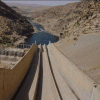
Two hydro-electric plants in Sulaimaniya province of Iraqi Kurdistan are being renovated at a cost of $40 million [48 billion Iraqi dinars], according to a report from AKnews.
Sirwan Mohammed Mahmoud, the media and relations director at Sulaimaniya electricity office, told the agency that the budget to renovate Darbanikhan (pictured) and Dokan dams comes from a share of the $500 million international loan that was allocated to the Iraqi government; Kurdistan was assigned $85 million of that loan.
Othman Abdul-Rahman, the director for Dokan plant, said at a recent press conference that the protection and control systems at Dokan were initially installed in 1987, and will be replaced with a digital system. Maintaining and finding replacement parts for the old system had become increasingly difficult.
An Italian company is implementing the changes for both plants, and word is expected to be completed within one year.
Darbandikhan plant was constructed in 1961.
(Source: AKnews)
Posted in Construction & Engineering In Iraq, Iraq Public Works News Comments Off on $40m Renovation of Kurdistan Hydroelectric Dams

It’s the rentier economy, stupid!
Posted on 11 March 2011 .
The protests in Iraq, while obviously inspired by those in other Arab countries, have a different focus. The latter have been primarily about politics. In Iraq the protestors’ demands center on economic problems. They want more jobs and electricity and less corruption.
Due to its natural resource endowment, Iraq is an example of what political scientists call a rentier state—a state whose main function is to distribute profits from resource exports. Productivity-based growth is relatively unimportant. What really matters is how fairly the resource pie is divided.
Thus the fundamental issue is quite straightforward: What is going to be done with Iraq’s coming oil bonanza? Ideally, everyone will benefit through the provision of subsidized services, government sinecures, and handouts of one sort or another. Alternatively, there could be a situation in which a small number of elites transfer the lion’s share of the new wealth to Swiss bank accounts while most people live in poverty.
By keeping the pressure on the politicians, perhaps the protestors can push the country a bit closer to the former of these two extremes.
Posted in Mark DeWeaver on Investments and Finance 1 Comment
Plans to Move Electricity Supply Underground
Posted on 11 March 2011 .
A spokesman for the ministry of electricity has reported that plans are being considered to move the national grid underground, in order to prevent citizens illegally taking power supplies directly from overhead distribution lines.
Musab al-Mudarres told AKnews that the practice of taking electricity directly from local power lines is widespread across Iraqi, and the ministry does not have the power or resources to prevent them.
“Underground networks have proved successful in some areas of Baghdad such as Zayouna and Yarmouk where they have replaced the overhead power lines,” Mudarres said, adding that similar projects have been set up in Sadr City and Adhamiya.
Last July the Iraqi government launched a campaign in the capital to put an end to the public theft of national power supplies in response to public protests over limited hours of domestic provision.
According to government figures, the energy available to Iraq is around 9 thousand megawatts of energy, while demand is estimated at up to 14 thousand megawatts during the summer months.
The Iraqi government has announced plans to increase the country’s generative capacity to 27,000 megawatts over the next four years, requiring an investment of between $3bn and $4bn per year.
The majority of households across the Iraqi provinces have between six and eight hours of national electricity each day.
This poor provision of electricity has been one of the main grievances of protestors in the wave of public demonstrations that have swept through Iraq over the past month.
(Source: AKnews)
Posted in Iraq Public Works News Comments Off on Plans to Move Electricity Supply Underground
Korean Investment in Mosul Infrastructure
Posted on 11 March 2011 .
[Update: The National Investment Commission (NIC) has issued a statement on 22nd March 2011 on behalf of the Chairman of the Nineveh Investment Commission, denying these reports of contracts signed with South Korean companies.]
The Chairman of the Nineveh Investment Commission said on Wednesday that it has signed investment contracts with 20 South Korean companies to build and rehabilitate the infrastructure in Mosul.
Mowaffaq al-Younis told AKnews that the board contracted with 20 South Korean companies specialising in electricity, sewerage, drainage, and the installation of drinking water supplies.
The infrastructure in Mosul suffered a marked decline over the past years as a result of military conflicts.
"We hope that these companies would start working next month ... the Commission expects that investment in Nineveh in various public areas would be around U.S. $ 12 billion until the end of 2015."
Korean companies have completed investment projects in Nineveh in 2010, including the reconstruction of Nineveh medicine laboratory (30 km north of Mosul), which was also equipped with modern Korean equipment, as well as establishing Wafah hospital for diabetes patients at a cost of 10 billion Iraqi Dinars.
(Source: AKnews)
Posted in Construction & Engineering In Iraq, Iraq Public Works News Comments Off on Korean Investment in Mosul Infrastructure

You Can't do Iraq on the Cheap
Posted on 10 March 2011 .
Hundreds of Iraqis protested against the government on Monday in a “Day of Regret” on the anniversary of the election that resulted in a second term for Prime Minister Nouri al-Maliki.
And in a move that has drawn criticism from many quarters, the security forces have shut down the offices of two small parties that helped to organise the demonstrations, the Iraqi Nation Party and the Iraqi Communist Party, neither of which have seats in parliament. According to reports, their offices were seized because the Ministry of Defense was “in the need of these buildings now”.
Whatever the truth behind these stories, Michael Corbin, US deputy assistant secretary of state for Iraq, has predicted a continuation of protests for several months, as the electricity shortage will clearly not be resolved before the heat of the Iraqi summer sets in.
Regarding moves in Congress to cut State Department funding, Corbin added: “One thing that we've learned in over eight years in Iraq is that you can't do Iraq on the cheap.”
For advice on the most cost-effective ways of doing business in Iraq, why not contact Gavin Jones at Upper Quartile and Adrian Shaw at AAIB.
Remember also that you can follow us on Twitter, and join our group on LinkedIn.
Posted in Blog Comments Off on You Can't do Iraq on the Cheap
Iraq to Issue Tender for New $388m Power Plant
Posted on 09 March 2011 .
Iraq is preparing to issue a tender for a $388.5 million power plant, according to a report from Bloomberg.
Ali Al-Dabbagh, a spokesman for the government, said on Tuesday that the Council of Ministers approved the plan to issue a tender for the plant in the Nineveh province, north of Baghdad.
The plant should be built within 21 months and generate 750 megawatts.
Iraq plans to almost triple power generation capacity to 17,000 megawatts by 2013, up from around 6,000 MW now, mostly through building new plants, an Electricity Ministry spokesman said in January.
Former Electricity Minister Karim Wahid quit in June amid violent street protests triggered by severe seasonal summer power shortages.
Posted in Construction & Engineering In Iraq, Iraq Oil & Gas News, Iraq Public Works News, Tenders Comments Off on Iraq to Issue Tender for New $388m Power Plant
Help MSMEs Rise to the Eco-Challenge
Posted on 07 March 2011 .
By T. Keyzom Ngodup, co-founder and Executive Director at Ideas sYnergy, an Iraq based private sector development consulting company.
I was pleasantly ‘perplexed’ to learn that Prime Minister Nuri al-Maliki, approved (on February 7, 2011) an agricultural project for developing biofuel from rotting dates. The ‘dates-to-biofuel’ project implemented by an unnamed company based in UAE, is seen as a way to encourage growth in Iraq’s crumbling farm sector, which has suffered from decades of sanctions, isolation and war, further confounded by severe droughts and dust storms, attributed mainly to climate change. Ironically, the farming sector is Iraq’s leading employer but contributes less than 3% to state revenues and gets little investments from the Government. According to United Nations Environment Programme (UNEP), Iraq is among the hardest-hit countries (reference to climate change).
There is nothing new in this analysis; in fact it has been repeatedly appearing as an introduction to Iraq. Instead, I want to focus on how we can convert the challenges of climate change and agriculture into opportunities to develop Iraq’s clean energy market, and the important role of MSMEs – micro-, small- an medium-sized enterprises – in facilitating local and indigenous insights to develop world-class solutions that support access to clean, modern energy services. ‘Clean energy’ refers to products and services that produce energy from renewable resources and emit fewer greenhouse gas emissions than does energy from conventional fuel sources. The lack of a reliable supply of power from the electricity grid and the availability of free and inexpensive fuels, such as wood and kerosene, are key influences on this market. Imagine a samoan (traditional Iraqi bread) shop at every street corner or one of the 1.2 million poor woman leaning over her mud-oven: they represent a huge segment of the clean energy market for MSMEs.
There are two areas of the clean energy market that are high-potential and represent high-growth for MSMEs: clean energy electricity systems and clean energy cooking and light products. Iraq needs MSMEs enabling access to solar lanterns, solar home systems, energy-efficient cookstoves, and electricity generated from decentralized sources, including small hydro power plants and biomass gasifier systems. Working either as ‘developers’ of new products (may not be necessary to re-invent the wheel if ‘right’ product is already present in the global market) or as ‘enablers’, Iraqi MSMEs can, for example, help install solar panels and provide Iraq’s rural population with access to clean electricity.
The Government of Iraq, donors and stakeholders have an important role to play here, to support MSMEs in meeting local energy demand, and contribute to a cleaner Iraq. They can operate focused lending schemes for promoting investment in clean production and energy efficient technologies and production processes, through lines of credit from donors/international development financiers such as OPIC and IFC. In addition, Iraqi MSMEs suffer from a dearth of knowledge on emerging best practices and technologies in this space: the government and donors can support a nation-wide ‘clean energy and MSME conference’, with a focus on partnership models that MSMEs can undertake to develop local capabilities and their impact.
At Ideas sYnergy, we believe that the first necessary step is to understand the energy-related consumption and expenditure habits of Iraq’s poor, un-banked, and ‘under-energy served’ population segments, as well as GoI’s (future?) policies and initiatives in how they interact and facilitate the clean energy industry in the country. Reading through, you may understand why I am ‘perplexed’ with Iraq’s prime-minister: did the (premature?) approval of dates-to-biofuel programme implemented by non-Iraqis set-up Iraqis at an unfair disadvantage? That, and in general the economic decisions taken by people in politics, is a question Iraqis should ponder.

T. Keyzom Ngodup is co-founder and Executive Director at Ideas sYnergy, an Iraq based development consulting company committed to economic and social development through market-based solutions that help build and scale innovative businesses for sustainable and inclusive private sector development.
Posted in Agriculture, Keyzom Ngodup 2 Comments
Hawrami Outlines Kurdistan O&G Resources
Posted on 06 March 2011 .
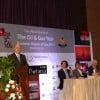
The last three years have been “exceptional” for the Kurdistan Region in terms of discoveries of both oil and gas, Dr Ashti Hawrami, the Minister of Natural Resources, told an audience of diplomats and international oil companies in Erbil today.
Dr Hawrami said that as a result of drilling activities from 2008 to 2010, the Kurdistan Regional Government’s Ministry of Natural Resources was constantly updating and reviewing the Region’s resource base estimates.
“We see our Region sitting on at least 45 billion barrels of oil and as much as 100-200 trillion cubic feet of gas and we expect that soon some of our reserve estimates will be included in that of Iraq’s overall reserves,” he said.
Speaking at the launch of The Oil & Gas Year Kurdistan Region of Iraq 2011, a book that focuses on the Region’s energy sector, Dr Hawrami also said production levels were steadily increasing and that exports of crude oil from the Region had already reached around 100,000 barrels per day.
“That figure will continue to rise throughout the year and we are very much on track to reach exports of 1 million barrels a day by 2015,” Dr Hawrami said. He added that he was pleased with the technical cooperation shown by the state-owned Northern Oil Company, which is responsible for the management of Iraq’s Kirkuk-Ceyhan pipeline.
Dr Hawrami said gas discovered in the Kurdistan Region would first help to solve Iraq’s chronic electricity shortages and then provide an important source of revenue for the federal government through exports to Turkey, to Europe and beyond.
“New gas discoveries to date total 20 trillion cubic feet,” he announced. “This is in addition to the previously discovered Khor Mor and Chamchamal fields which according to Iraqi estimates contain 4-5 trillion cubic feet and which remain a priority dedicated to serve the domestic market for current and future power generation.”
Dr Hawrami outlined the MNR’s support for plans to boost power-generation in the Region with the construction of three gas-fired power plants in the provinces of Dohuk, Erbil and Suleimaniah.
Dr Hawrami said the KRG was planning to develop 5000MW of electricity, in addition to the current domestic plan of 2000 MW. “This is for supply to both the KRG governorates and to our neighbouring provinces of Ninevah, Kirkuk and Salahadin,” he said.
Dr Hawrami said he was optimistic that the outstanding issues between Erbil and Baghdad would soon be solved. He said that he expected the federal parliament to pass a hydrocarbons law and a companion revenue-sharing law in the coming months.
“Iraq needs these laws. The region needs these laws,” he said. “They have already been delayed too long. We need to take the ideology out of oil policy and focus on getting results. After all, we are all working to the same end, which is to make our oil and gas work for all the people of Iraq, without exception.”
Picture: Prime Minister Barham Salih (standing) and Minister Ashti Hawrami (second from right).
(Source: KRG)
Posted in Iraq Oil & Gas News Comments Off on Hawrami Outlines Kurdistan O&G Resources