


Govt Responds to Demands; Possible Strike in Sulaimaniya
Posted on 01 March 2011 .
A representative of the protesters in Sulaimaniya said the anti-government campaigners have given the Kurdistan Regional Government 48 hours to respond officially to their demands or they will stage a general strike in Sulaimaniya city.
The parliament sent a 12-member delegation to hear the demands of the marchers on Monday, almost 12 days after the outbreak of violence.
Speaking to AKnews on Monday afternoon, Faruq Rafiq said it would be a peaceful strike: “The demonstrators will sit in and block all the streets of Sulaimaniya,” he said, explaining this is their way to “force the government to respond.”
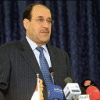
At the national level, on Sunday Prime Minister Nouri al-Maliki (pictured) gave his ministers a 100 day ultimatum to step up reforms or face the sack.
Thousands of Iraqis took to the streets on Friday to protest against shortages of electricity, food rations and jobs, and called for some provincial officials to step down.
Politicians, who have already tried to appease citizens by diverting money from fighter jets to food, giving out free power and cutting their own pay, were quick to act after Friday's "Day of Rage" when at least 10 people died and scores were wounded.
On Sunday, the governor of southern Babil province Salman al-Zarqani resigned, while parliament speaker Osama al-Nujaifi called for a new provincial vote within three to four months.
Provincial elections were held in 2009 and are not due before 2013.
A White House spokesman said, "we were deeply troubled by reports that Iraqi Security Forces detained and beat Iraqi journalists and civil society leaders during Friday's demonstrations".
(Sources: AKnews, Reuters)
Posted in Security Comments Off on Govt Responds to Demands; Possible Strike in Sulaimaniya

Turkish Company Considers Power Plant in Iraq
Posted on 27 February 2011 .
Turkey’s Tekfen Insaat, a construction company active in 12 countries, aims to build a power plant in Iraq together with a French company as Iraq’s risk profile improves, chief executive Umit Ozdemir said, according to the Kipp Report.
The company is looking into projects in the southern part of Iraq, ha told a conference in Istanbul.
Eight years after the U.S.-led invasion that ousted Saddam Hussein, the national grid supplies only a few hours of power per day, driving up costs for businesses and compounding summer heat, when temperatures reach above 50 degrees Celsius.
Iraq has big plans to install turbines and capture gas at oilfields to ramp up electricity production, and needs to spend $77 billion to improve the power sector by 2030, according to a government master plan.
Posted in Iraq Oil & Gas News Comments Off on Turkish Company Considers Power Plant in Iraq
Iraq Protests Continue on Saturday
Posted on 26 February 2011 .
Al Jazeera reports that at least 12 protesters were shot dead by security forces during Friday's 'day of rage', during which at least 17 demonstrations were held throughout Iraq.
Iraqi security forces detained hundreds of people, including prominent journalists, artists and intellectuals, according to a report from the Washington Post.
Four journalists described being rounded up well after they had left a protest at Baghdad's Tahrir Square, following which they were handcuffed, blindfolded, beaten and threatened with execution by soldiers from an army intelligence unit.
Protests continued on Saturday, with around 2,000 protesters rallying in central Sulaimaniya to protest against poor basic services.
Meanwhile, Grand Ayatollah Ali al-Sistani called on Iraq's government and parliament to take serious steps in improving electricity services, providing jobs and fighting corruption in the country, where progress remains slow eight years after the U.S. invasion.
(Sources: Reuters, Washington Post, Bloomberg, Al Jazeera)
Posted in Construction & Engineering In Iraq Comments Off on Iraq Protests Continue on Saturday
Decision Soon on Electricity Licensing Round
Posted on 23 February 2011 .
Iraq's Electricity Ministry has announced that 11 international companies presented investment projects under the first licensing round to develop the electricity sector in the country.
The Iraqi government set February 10th as the deadline for receiving offers under this first licensing round.
Musab al-Mudarres, the spokesman of the Electricity ministry told AKnews that the award will be given to two companies, one of which will develop Basra power station, the gas-fired station in the Shatt al-Arab which consists of 10 generating units, each of which generates 125 megawatts, giving a total capacity of 1,250 megawatts.
"The second station in Amara, where four generating units will be installed, each generating 125 megawatts, giving a total capacity of 500 megawatts."
A decision will be made in about four weeks.
(Source: AKnews)
Posted in Iraq Oil & Gas News, Iraq Public Works News 1 Comment

Al-Sadr Power Station Ready for Use
Posted on 22 February 2011 .
The Iranian Deputy Energy Minister Mohammad Behzad (pictured) has said the Iranian-built Al Sadr power-plant in Iraq is an important project which is now ready to come on stream.
IRINN quoted the minister as saying that the first unit of this 324 MW plant has been completed and is waiting for its fuel supply, and the second unit will ready in 45 days.
He said Iran's electricity export to Iraq will expand, adding that the Islamic republic is plans to build eleven more power-plant units and new transmission lines to the tune of 2 GW in that country.
“Currently we’re exporting 750-800 MW,” he said, adding, “With the construction of the 400 KW Karkheh-Al-Amarah power line, the amount of electricity exported to Iraq will climb to over one GW,” Behzad was quoted by IRINN as saying.
The Karkheh-Al-Amarah power line project is being carried out by Iran's Tavanir Company.
He added that the Iranian ministry of energy has plans to export electricity to Lebanon via Iraq and Syria.
(Source: Tehran Times)
Posted in Construction & Engineering In Iraq, Iraq Oil & Gas News, Iraq Public Works News Comments Off on Al-Sadr Power Station Ready for Use

Babil Investment Commission Attacks Baghdad Govt
Posted on 22 February 2011 .
AKnews reports that the Vice Chairman of the Babil Investment Commission has complained that Iraq’s investment law has been “paralyzed” by the state’s failure to implement it effectively in ministries and government departments.
Abbas al-Tai told the agency that Iraq is one of the best places in the world for investors as it lacks many basic commodities such as housing, sewerage systems and electricity, but the government’s delay in adopting the investment law has left foreign investors reluctant to implement projects in the country.
"Iraq depends mainly on its oil revenues and a large part of public expenditure goes on salaries that take the largest share of the state budget," he said.
"Investment is the best solution to address the deteriorating economic situation in Iraq and radically resolve the problem of unemployment” Tai continued, emphasizing that it would depend on “the state's encouragement and support to set up investment projects.”
Tai attributed the delays in effectively adopting the investment law to lengthy bureaucratic procedures and the long time periods required to attain administrative approval.
“The investment law is good,” he said, “but its implementation and activation are the problems we face in our work”.
Giving the example of a residential construction project approved by the Babil Investment Commission but rejected by the federal Ministry of Municipalities, Tai complained: “The Kawthar housing project was obstructed by all government departments in the province,” and that the Ministry of Municipalities “gave itself the right to decide about investment projects although the Investment Authority is the only party in the country authorized in this matter according to law.”
“The Ministry of Municipalities has hindered our projects completely.”
The solution to this problem according to Tai is the establishment and activation of an investment body that includes representatives of government departments and ministries that has the power to facilitate the implementation of investment projects.
In conclusion, Tai called on the federal government to "…take swift action to resolve this problem and instruct the relevant government institutions to adopt the investment law to avoid future consequences on investment in Iraq."
(Source: AKnews)
Posted in Investment Comments Off on Babil Investment Commission Attacks Baghdad Govt

Higher tariffs on hold
Posted on 21 February 2011 .
On February 14, the National Iraqi News Agency reported that the import tariff increases originally scheduled to go into effect on March 6 are being suspended until further notice. (The story is at http://www.ninanews.com/english/News_Details.asp?ar95_VQ=FFHEEK.) This is not surprising. With protestors already in the streets in some places, now can hardly be the best time to introduce new taxes on consumers.
In my last post, I argued that a case might conceivably be made for some of the new tariffs if they offset distortions elsewhere in the economy. Even if this were true, however, ordinary Iraqis would be unlikely to see things this way. All they would see is higher prices for food and appliances. And they would suspect, probably correctly, that officials were profiting from the situation by taking bribes from importers.
The government’s argument that the new tariffs are necessary to protect Iraqi industry would also be likely to fall on deaf ears. Consider the proposed tariff on window-type air conditioners (harmonized code number 84.15.10.20), for example. In the Arabic version of the schedule, this is given as 20%; the English version has 50%. (These schedules are available at: https://www.iraq-businessnews.com/2011/02/14/new-iraqi-import-tariffs-the-full-list/.)
An obvious beneficiary would be a company like Al Hilal Industries (ISX ticker IHLI), whose main product is evaporative coolers. Unlike most air conditioners, which use compressed refrigerants, an evaporative cooler is water based. The only moving part is a fan, which draws the outside air through wet pads to lower its temperature. (See the illustration, by Nevit Dilmen, downloaded from Wikimedia Commons.)
On one of Baghdad’s 110 degree summer days, I think I’d prefer a real air conditioner. But faced with higher prices for imports, some consumers would be forced to buy one of IHLI’s products instead. Eventually, perhaps, the tariff might make it possible for the company to develop a viable air conditioner business. But in the meantime, their customers—presumably already unhappy about electricity shortages—would find that even when the power was on they were still pretty hot.
If the government’s plan is to wait until the public is ready to accept situations like this before introducing the new tariffs, they may be on hold for quite a while.
Posted in Iraq Banking & Finance News, Mark DeWeaver on Investments and Finance Comments Off on Higher tariffs on hold
Iraq Finally Passes $83bn Budget
Posted on 21 February 2011 .
Iraq's parliament gave the final approval on Sunday to an $82.6 billion budget for 2011, according to Reuters. AKnews puts the Iraqi dinar amount at 96 trillion.
The budget is based on an average oil price of $76.50 per barrel, and 2.2 million barrels per day in crude exports.
The deficit was projected at $13.4 billion, although Iraqi officials have said the shortfall would be eliminated if world oil prices remain at current levels. About 95 percent of Iraq's government budget comes from oil revenue.
Iraqi officials have announced massive projects to build hundreds of thousands of new homes and to boost electricity generation, and the budget allocates a total of $25.7 billion for investments.
The 2011 budget also allocates $2.05 billion to pay oil firms' investment costs.
The budget foresees crude production of 100,000 bpd from Iraq's semi-autonomous northern Kurdish region.
Passage of the budget was held up for months by political haggling.
Iraq has been hit by a series of protests in recent weeks, many aimed at pressuring the government to improve power and other basic services, and to alleviate food shortages.
Politicians have taken a number of steps to ease public anger. They diverted $900 million from the purchase of F-16 combat jets to the national food ration programme, made big purchases of sugar and wheat to bolster rations, and proposed cutting lawmakers' salaries by 50 percent.
(Sources: Reuters, AKnews)
Posted in Iraq Industry & Trade News, Politics 9 Comments
Protester Killed, TV Station Torched
Posted on 21 February 2011 .
Hundreds of protesters inspired by unrest around the Arab world took to the streets of the northern Iraqi city of Sulaimaniya on Sunday and at least 48 people were injured, according to Reuters. Associated Press reports at least one person killed overnight.
A source told Iraq Business News that a massive demonstration is planned for Baghdad on Friday, to protest the lack of jobs, and shortages of electricity, water and food.
A police official in Sulaimaniya said security forces fired in the air when demonstrators chanting against corruption tried to approach the headquarters of the Kurdistan Democratic Party, where clashes on Thursday killed two people and wounded dozens.
"Hospitals in Sulaimaniya received 48 wounded people including 19 police and security forces," said a health official who asked not to be named. "There are 11 people wounded by gunshots."
Gunmen raided and set fire to a television station in the city, shutting down broadcasts of the protests, station and government officials said.
The protesters are seeking better public services, the ouster of local officials and other demands. Similar rallies took place in Falluja and other locations.
In Baghdad, the cabinet decided to have ministers visit demonstrators to soothe anger over corruption, shortages of food and electricity and other issues behind a series of protests that have triggered skirmishes with security forces.
Unlike their regional counterparts, Iraqi protesters generally have not been calling for the removal of their elected government, installed just two months ago after months of tense negotiations between political factions. Dictator Saddam Hussein was swept away by the U.S.-led invasion in 2003.
The raid on NRT satellite channel in Sulaimaniya was carried out by 50 masked gunmen wearing security force uniforms who sprayed the station with gunfire, smashed equipment, wounded a guard and lit fires, Twana Othman, the station's manager, said.
NRT had aired coverage of violent protests in Sulaimaniya last week.
Bahrouz Mohammed, the local governor, condemned the attack and promised to bring the perpetrators to justice.
"Those saboteurs who attacked the TV station are trying undermine stability in Sulaimaniya," he said in a statement.
In the western city of Falluja, about 300 protesters demanded the firing of the governor and provincial council members in Anbar province. Dozens of people rallied for jobs in the southern province of Nassiriya, Abdul Hadi Mohan, deputy head of the provincial council, said.
The cabinet decision to reach out to protesters underscored politicians' concerns over growing unrest.
(Source: Reuters, Associated Press)
Posted in Security Comments Off on Protester Killed, TV Station Torched
Hyundai Power Station Deal Signed
Posted on 16 February 2011 .
The Iraqi Ministry of Electricity said on Tuesday it had signed a contract with Hyundai, of South Korea, for the construction of four new power generating stations at the al-Quds [al-Qudus] Gas Plant.
Musaab Mudarris, the spokesman for the ministry, said the construction of the four new stations with a capacity of 125 megawatts (MW) each, 500 MW in total, is expected to get underway immediately. The project, valued at $219m [264 billion Iraqi dinars], is to be completed within 18 months.
Turbines for the project have already been bought by the Iraqi government from General Electric (GE).
The al-Quds plant, north of Baghdad province, currently produces 900 MW.
Iraq suffers from electricity deficiency, despite the many contracts signed to improve the condition. The lack of basic services, including electricity, has led to public demonstrations recently.
(Source: AKnews)
Posted in Iraq Oil & Gas News Comments Off on Hyundai Power Station Deal Signed