


Kurdistan Imports 400 Generators from Iran
Posted on 12 October 2010 .
AKnews reports that 400 electrical generators have been imported from Iran.
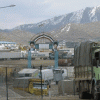
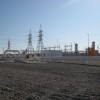
Salam Arab, the director of the customs department at Haji Omaran (pictured) , told AKnews that since the beginning of 2010 some 400 full-size electricity generators have been imported into the Region.
He added most electronic equipments are imported from Iran, not Turkey, because the tariffs are lower at the border with Iran.
Diar Baban, the Region's power generating director, said it is the private sector which has mainly imported the generators. "We have imported generators from Turkey and Italy, not only Iran, all through tenders."
The official reiterated that his ministry has not signed contracts with any specific country for importing generators, adding "even the generators imported by the private sector should satisfy the standards [required] by the ministry."
Kurdistan's power generating capacity is estimated at 750 megawatt. The government cannot provide round the clock electricity for the citizens, who depend on their own generators, or generator in their local neighborhoods.
(Source: AKnews)
Posted in Iraq Industry & Trade News Comments Off on Kurdistan Imports 400 Generators from Iran
$900m Power Plant Contracts Awarded
Posted on 11 October 2010 .
Iraq is to get new power plants in order to boost its energy capacity by 2,500 megawatts, reports Reuters. This will significantly add to its meagre total current production, which is around 5,500 megwatts.
All the contracts for the 20 gas turbines, which were bought from General Electric, have been awarded to three Turkish companies. The contracts are due to be signed this week.
Iraq's Electricity Ministry said on Sunday it has awarded more than $900 million in contracts to three Turkish companies to install 20 gas turbines that will boost Iraq's power generating capacity by 2,500 megawatts.
Calik Enerji has the biggest contract for $446m and will build 10 turbines in Karbala. Insaat will build six in Nineveh in a deal worth €268m dollars, and Eastern Lights will build four more turbines in an existing plant in Baghdad for €205m.
An official told Reuters the turbines should be installed inside 24 months.
(Source: Reuters)
Posted in Construction & Engineering In Iraq Comments Off on $900m Power Plant Contracts Awarded
Kurdistan Development to Continue Unabated
Posted on 11 October 2010 .
Urban and economic progress in Kurdistan continues with many relatively stable areas and regional policy both being attractive to foreign investment. Developments in oil, too, will not be affected by delays in forming the next Iraqi government, the local government says.
The Kurdistan Regional Government points to its profit-friendly legislation including ten-year tax breaks and land set aside for investment. It states that estimates for investment in the region currently total more than $14bn, including housing, banking, health, tourism, telecommunications, education, agriculture and sports, and over 31,000 acres of land have been allocated for investment projects.
Erbil has the most investment projects at 122, with 70 more in Sulaymaniyah and 40 in Dohuk.
Big investors have so far incuded Egypt, Kuwait, Lebanon and Turkey, and others taking advantage of the investment climate include Austria, France, Germany, India, New Zealand, Sweden, South Africa, the UAE, the UK and the USA.
Kurdistan has broadened its investment focus recently. Dr. Haider Mustafa of Kurdistan's Regional Investment board, said: "You know that we have inherited a devastated country from the former regime...At the outset, especially between 2007 and 2008, we focused on infrastructure projects because they were the most affected...but after 2009, the attention focused on the development of other sectors , especially the industrial and agricultural sectors.
Dr. Mustafa takes on the concerns of foreign investors, saying: "The foreign investor has always been focused on large industrial projects and strategy in contrast to the domestic investor...According to our plan, we are working in the next phase to focus on major strategic projects, especially in the industrial sector, and this is what allows a greater opportunity for foreign investors. We need after this stage to strengthen the economic structure with the establishment of factories and large plants. We have developed a map specific to our basic needs in this sector, for example, the petrochemical industry, manufacturing and automobile assembly, machinery and mechanisms, and industrial electrical equipment, and paper, glass...bridges, tunnels, mills, iron, steel, and leather factories, and soap and detergents, and factories producing machinery, agricultural machinery, and plants producing electricity poles, weaving, vegetable oils and cotton wool, etc., and our doors are open to all investors to enter the market competition in these areas."
Dr. Ali Hussain Balou, adviser to Kurdistan's Ministry of Natural Resources, also reassures oil investors with an announcement that it will continue its oil policy despite continuing delays to form the next Iraq government. The 42 oil companies from 17 countries in the region will be able to continue to drill for oil in accordance with their contracts.
The Kurdistan Regional Government states that one of the most important differences that need to be resolved on the way to working with a new Iraq government is their differences over oil policy. After five years the issues still aren't resolved, but Dr. Balou said: "The implementation of the Kurdish demands need to be taken seriously," and that the incoming government must "fully abide by them."
He said that signing of contracts and development of oil will go ahead and not be affected by the delay in forming a government.
Read more on Kurdistan investment in Stewart Blair's blog: Construction and Investment in Iraq.
(Source: Kurdistan Regional Government)
Posted in Investment Comments Off on Kurdistan Development to Continue Unabated
Weekly Security Update For 7th October 2010
Posted on 07 October 2010 .
National Overview
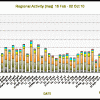
The total number of officially reported hostile incidents nationally increased very slightly from 112 to 115. Once again hostile activity in Baghdad accounted for approximately half of all incidents, making Baghdad by far the most dangerous part of the country for five weeks running. Assassination attacks against Iraqi Security Forces and Government of Iraq personnel continued to blight the security situation, though there was a decrease in targeting of United States Forces.
The number of hostile incidents in the north central region remained relatively low again this week, as Al Qaeda in Iraq and Associated Movements are still likely to be re-grouping following heavy Iraqi Security Forces attrition. However, the assessment that their capability will be restored in the near future remains pertinent.
Hostile incidents in the south east region increased this week and included the first indirect fire attack against Basra Contingency Operating Base since 22 August. Activity in the south central region largely focused on U.S. Forces, with the number of incidents remaining consistent with expected activity levels. Insurgents in the northern region continue to be frustrated by national security forces activity as the discovery of a vehicle borne improvised explosive device in Mosul illustrates.
Political Overview
Prime Minister Nouri al-Maliki’s success in winning over key factions of the Iraqi National Alliance, namely the Iranian influenced Sadrists was confirmed on 01 October, as Falih 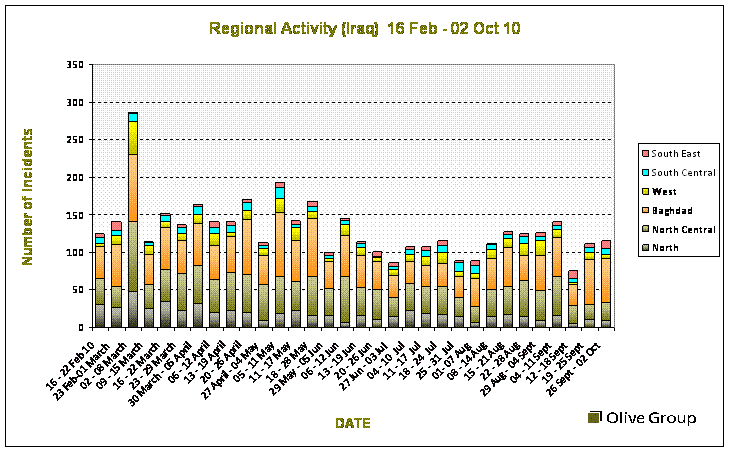 al-Fayadh, an INA lawmaker announced Maliki’s nomination for the position of Prime Minister by the INA at a news conference. However, Maliki did not secure support from all of the INA factions, notably the Islamic Supreme Council of Iraq (ISCI) and the Fadhila Bloc rejected the nomination, as the head of the latter group, Hassan al-Shimari, stated “this announcement does not represent all INA parties… This is a deal between Sadrists and the State of Law.” Iraqiyyah have been quick to cite this lack of overall consensus across the INA factions as a sign of weakness. Senior Iraqiyyah member Osama al-Nujaifi referred to the fate of the INA stating, “It’s finished… It is disassembled,” seeing an opportunity provided by Maliki’s nomination for Iraqiyyah to join up with INA dissenters who are reluctant to support the incumbent.
Regardless of Iraqiyyah’s claims to a constitutional right to rule derived from their success at the polls, the odds are now stacked in Maliki’s favour. Iranian support of his candidacy for the role of Prime Minister, embodied in the Sadrist Bloc’s backing, has given Maliki command of somewhere between 124 – 135 seats. He needs to secure 163 seats for his extended tenure to reach ratification. The Kurds will now come into play in their role as kingmakers as their support could give Maliki the seats he requires to rule and no other bloc would be able to provide these seats.
The only chance the opposition has of obstructing Maliki’s rule will be to assemble a credible alliance between Iraqqiyah, the Kurds, the Islamic Supreme Council of Iraq and/or Fadhila. These groups combined would number about 158 seats, requiring them to win over some fence sitters to make up the rest. This anti-Maliki option faces some significant difficulties. It would be difficult to achieve an alliance between Iraqqiyah and the Kurds due to underlying issues between the two, whereas the Kurds are part-way to accepting a humbled Maliki. There is now both Iranian and U.S. pressure on members of this alternative bloc, namely the Kurds and the ISCI to link up with the Maliki bloc. Should Maliki succeed, Iran’s role in Iraq will definitely expand throughout the country, including in the Kurdish Regional Government area. This will subtly affect regional dynamics and could potentially stall some Gulf investment in Iraq.
The political negotiations are now in endgame, though the agreements may take another month to reach ratification, possibly even longer. Following on from ratification will be the ministerial negotiations which may be drawn out, but the government formation process is reaching conclusion now.
Baghdad
The number of officially reported incidents in Baghdad remained at 59 for the second consecutive week. There were no mass casualty attacks in Baghdad during the reporting period, 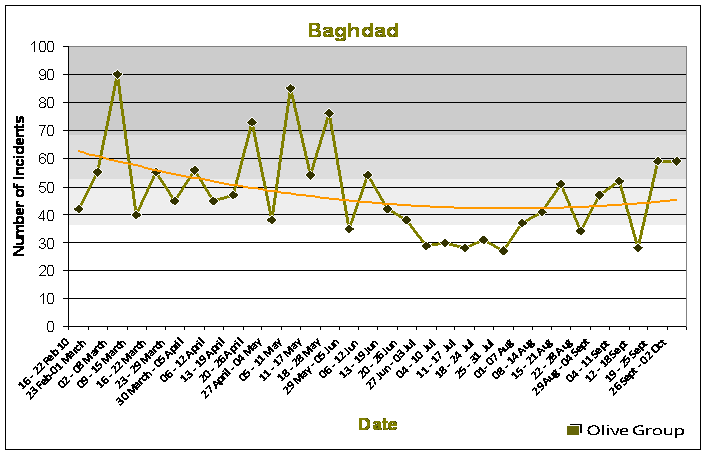 although attacks could have been planned. A cache of suicide vests were discovered in the Adamiyah district on 28 September and open sources reported the discovery of several vehicles prepared as vehicle borne improvised explosive devices in Tarmiyah on 29 September. The review period was characterised by a series of targeted assassinations utilising under vehicle improvised explosive devices and small arms fire, which accounted for more than half of the attacks.
The threat from close quarter shootings has steadily risen in recent months and the use of silenced weapons has become more prevalent. Open source reporting has even claimed that the problem is so severe that a representative of Grand Ayatollah Sistani addressed the issue in a recent sermon. Such attacks are difficult to prevent as pistols and silencers are easy to smuggle through check points. There is a possibility that these attacks are not being perpetrated solely by Al Qaeda in Iraq and associated movements. Assassination attacks against the national security forces and government personnel require target selection and reconnaissance and traditionally Al Qaeda in Iraq and associated movements are far less discriminating. It is therefore assessed that these attacks may be perpetrated or aided by the disaffected members of the Sunni community and former Ba’athist elements.
The number of improvised explosive attacks against the U.S. Forces dropped significantly, as have attacks on the International Zone during the reporting period. Only one known indirect fire attack took place against the International Zone on 29 September. The decrease in attacks is probably due to a combination of factors; Shia insurgents may be awaiting a re-supply and secondly the U.S. Forces have increased air patrols. While continued indirect fire attacks against the International Zone are expected, in the short term it is unlikely that they will reach the frequency achieved between 19 – 25 September this year. The success of the Shiite blocs in forming the next government should also see a decline in Shia insurgency, as the cause for their resistance will be diminished.
Basra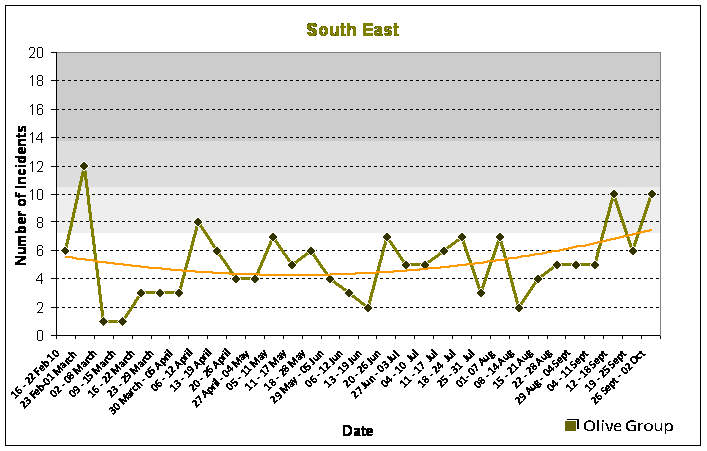
The number of incidents in south east region increased to ten in this reporting period. On 01 October Contingency Operating Base Basra was targeted with two rounds of indirect fire. One round impacted within the base; however no casualties or damage to assets was reported. The indirect fire attack consisted of two 107mm rockets and the point of origin was located approximately five kilometers to the south east of the base where one metal rail, two tubes and a digital timer were found. One individual was also detained in connection with the attack. Although this was the first attack against the base since 22 August, rockets on rails were discovered on two separate occasions during September and were believed to be targeting the base.
Basra’s police chief has been subject to interrogations following a series of security incidents in the province. Basra council will make a decision regarding the Chief of Police by 04 October, following a session held on 30 September where General Adel Daham submitted his answers to the committee. Vice President of Basra council, Ahmad al-Salieti, said they were questioning the Basra Police Chief in light of the lack of protection afforded to the council members during demonstrations held in protest at the lack of electricity.

Posted in Security Comments Off on Weekly Security Update For 7th October 2010
Kurdistan Gas Targets Pushed Out
Posted on 05 October 2010 .
Dana Gas PJSC, Crescent Petroleum, Mol Nyrt and OMV will produce 300 million cubic feet a day of gas from its project in Iraq’s Kurdistan region in 2012, a year later than expected.
The production rate is currently 200 million cubic feet a day, Dana Gas said in a statement today.
The production rate was expected to reach its target in the first quarter of 2011, Chief Financial Officer James Dewar said in August, almost two years later than the company had originally expected.
Existing production is used to power two regional electricity plants, in Erbil and Chemchemal.
They say they have invested $850 million in the project so far. That included building a 110-mile (180-kilometer) pipeline across mountainous and land-mined terrain.
(Source: BusinessWeek)
Posted in Iraq Oil & Gas News Comments Off on Kurdistan Gas Targets Pushed Out

World Bank Financing Iraq's Power Generation
Posted on 03 October 2010 .
A second tranche of a World Bank loan to Iraq, amounting to $741 million [890 billion Iraqi dinars], will be allocated for the improvement of the country’s electricity sector, an Iraqi academician and economist said on Sunday.
“The agreement between Iraq and the World Bank offered Iraq a $3.6-billion credit, the first tranche of which reached $440 million and was allocated to finance reconstruction projects, while the second tranche of $741 million, was allocated to rehabilitate the electricity sector,” Hilal al-Ta’an told Aswat al-Iraq news agency.
The World Bank credit would have a positive impact on the Iraqi economy in general and the service sector in particular, Ta’an said.
“Iraq had already met its commitments towards the World Bank terms in order to get that credit at the lowest possible interest rate, not exceeding 1%,” he said.
He added that Iraq would get the third tranche of financing three months after receiving the second.
(Source: Aswat al-Iraq)
Posted in Iraq Oil & Gas News, Iraq Public Works News 1 Comment
250 Iraqi State-Owned Plants to be Privatised
Posted on 29 September 2010 .
Iraq issued tenders to redevelop "more than 10" industrial plants as part of a plan to revamp 250 state-owned facilities through private investors, an industry ministry official said, according to a report from Bloomberg.
Deputy Minister Mohammed Abdullah Mohammed said the plants are mainly producing cement, petrochemicals, steel and pharmaceuticals, and the contracts are for joint strategic partnerships on a 15-year production-sharing basis.
“Our vision is to limit state ownership and turn almost all the 250 plants over to the private sector by 2020,” Mohammed said. “We want the ministry to become just a regulating and monitoring authority, and not a holding company running 60 companies.”
The Ministry of Industry and Minerals owns a total of 60 companies that run 250 facilities in six sectors; chemical and petrochemical, pharmaceutical and food, engineering and steel, textile, construction materials, and industrial utilities and services, he said.
Posted in Iraq Industry & Trade News Comments Off on 250 Iraqi State-Owned Plants to be Privatised
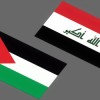
Jordan Hoping to Triple Oil Imports from Iraq
Posted on 28 September 2010 .
Jordan is hoping to triple oil imports from neighbouring Iraq to help meet domestic demand, the Jordanian energy minister, Khalid Irani, has said.
The country currently imports almost all of its energy needs, and has asked Iraq to increase supplies of crude transported by truck from the current level of 10,000 barrels a day to 30,000 barrels a day, the Minister told Bloomberg.
“This is within the terms of the agreement that we already have between Jordan and Iraq; we are awaiting their response.”
This would account for about a third of Jordan's needs, but its consumption is expected to rise by more than 30% over the next ten years.
The Middle Eastern country projects its electricity consumption to almost double in the next 10 years to 5,200 megawatts.
Jordan also wants to increase imports of natural gas, build a nuclear plant and develop its own oil shale and renewable energy projects.
Jordan has the world’s fourth-largest reserves of oil shale and has signed accords with Royal Dutch Shell Plc and Estonia’s Eesti Energia AS for the extraction of shale oil to feed power plants.
(Sources: Bloomberg)
Posted in Iraq Oil & Gas News 2 Comments
Russian/Swiss Firm to Build 2 Power Stations in Amara
Posted on 27 September 2010 .
The local administration in the province of Maysan [Missan] has reportedly agreed a deal with a Swiss-Russian firm to set up two power stations in the city of al-Amara, according to Aswat al-Iraq.
“The Missan local government agreed today (Sept. 25) with Russia’s Wintercroft Capital to build two steam-operated power stations with capacities of 650 megawatt and another gas-operated plant with a capacity of 500 megawatt,” Amer Nasrallah, Missan provincial council’s energy committee chairman told the news agency.
“The two power plants, to be carried out by means of deferred payment over a period of 8-10 years, would solve many of the electricity-related problems in the province and with even provide a surplus of more than 650 megawatt,” added Nasrallah.
Missan’s actual power needs are estimated at more than 400 megawatt. It gets only 200 megawatt now from neighboring provinces through the transformer station 400 KV, set up in 2008 and lies near the al-Kahlaa power station.
A delegation from Wintercroft Capital arrived in Maysan on Wednesday (Sept. 22) to activate a memorandum of understanding signed with the Missan provincial council in April this year.
IBN has so far been unable to find any background information on this "Wintercroft Capital".
(Source: Aswat al-Iraq)
Posted in Construction & Engineering In Iraq, Iraq Public Works News Comments Off on Russian/Swiss Firm to Build 2 Power Stations in Amara

Erbil Shows Baghdad Path Out of Political Impasse
Posted on 27 September 2010 .
By Eugen Iladi.
The opinions expressed here are those of the author, and do not necessarily reflect the views of Iraq Business News.
The inability of Iraqi political elites to form a government more than six months after the March elections is hardly surprising given the fragmented poll results and deep divisions separating top leaders. All major parties and their representatives seem determined to hold onto power as a matter of political, economic and perhaps even physical survival.
The stalemate is aggravating the security and economic situation and threatens to drive the war-ravaged country further into political instability and massive unrest. An uptick in violence since March could signal renewed sectarian divides and a new impetus for the insurgency.
But things don’t have to escalate to that level and Baghdad need only look in its own backyard for models of a better arrangement.
Erbil, the capital of the autonomous region of Iraqi Kurdistan, has transformed itself into a haven of safety, functionality and prosperity by regional standards. The Kurdistan Regional Government, while not free of infighting and political maneuvering, is by far a more efficient administrator of local resources and services compared to the overall situation elsewhere in Iraq.
Instead of opposing further Kurdish autonomy and self-reliance, Baghdad could learn from the region and emulate some of its successes. Incorporating functional elements that work in Erbil would not only help the entire country move forward but could also foster a bond and a sense of shared values between the regions that form the emerging federal democracy of Iraq.
The two dominant political parties of Kurdistan, the Patriotic Union of Kurdistan (PUK) and the Kurdistan Democratic Party (KDP) have between them monopolized most aspects of life in Kurdistan based on their historical and heroic fight against Saddam Hussein’s regime. When a new challenging opposition movement, Gorran, gained the second highest number of seats in the 2009 local elections, none of the players resorted to overt violence to overcome their opponents. Instead, they expressed their differences and fought at the polls.
Another stark contrast between the thriving Kurdistan region and the rest of the country is its ability to provide basic services for the population. While Baghdad continues to be plagued by massive power shortages, Erbil enjoys a constant flow of electricity with only minor interruptions. In fact, Kurdistan consumers get an average of 20 hours of constant electricity per day and projections call for closing that gap by early next year when new power plants are due to come on line.
This is in large part due to investment programs and incentives that attracted foreign operators to build generating facilities in the autonomous region, taking advantage of its vast oil and gas resources. Kurdistan estimates its oil reserves at about 45 billion barrels and its natural gas reserves at 20 trillion cubic meters.
Erbil is also welcoming of investment from abroad. The German Chamber of Commerce chapter in Erbil promotes business ties and attracts major German companies to the region. Italian, French, Austrian, American, Russian Turkish and other Arab energy, construction, apparel, and manufacturing companies are also investing in the region at an accelerated pace. RWE, Rosneft and a slew of smaller but significant players clamor for a piece of the action in this most stable of all Iraqi regions. Turkey is emerging as the premier trading partner of Kurdistan with economic ties expected to push towards $10 billion by next year, a significant development given the uneasy historical relations between Ankara and Erbil.
Cultural and travel ties are also increasing with Erbil stealing the lime light from Baghdad. France maintains a cultural center in Erbil and the German School reopened its first location in the country earlier this month after its previous Baghdad school was closed down in 1990. Austrian Airlines has a direct Vienna-Erbil link and Lufthansa resumed its Erbil route this spring, after a two-decade hiatus, while postponing indefinitely the resumption of Baghdad flights.
The Erbil Stock Market is scheduled to start trading during the first quarter of 2011 with a startup capital of nearly $10 million. With an open attitude towards investment and a legislation to match it, the KRG is forging ahead with major oil and gas, commercial and residential construction projects worth several billion dollars.
The new Baghdad central government, when one is formed again, would be well served to learn from Erbil.
The opinions expressed here are those of the author, and do not necessarily reflect the views of Iraq Business News.
Posted in Blog Comments Off on Erbil Shows Baghdad Path Out of Political Impasse