


Weekly Security Update for 4th November 2010
Posted on 04 November 2010 .
National Overview
The national total number of officially reported hostile incidents remained at 119. There was no change to the modus operandi of assassinations in Baghdad during the reporting period; however the seniority of the targets increased and included senior figures in key government ministries. Attacks against the United States Forces - Iraq were minimal; however there was at least one indirect fire attack against the International Zone.
Hostile activity in the north central region was on par with last weeks figures. Balad Ruz in Diyala Province was targeted with a mass casualty attack which killed at least twenty one people. In the northern region activity was consistent as hotspots such as Mosul witnessed the most activity with two vehicle borne improvised explosive device attacks, although they were largely ineffective. The south east’s incident levels remained the same as the last reporting period though there was evidence of an uptick in insurgent intent to launch attacks against security forces in Basra. Explosively formed projectiles and improvised explosive device attacks were aimed at U.S. Forces and private security company targets respectively and a U.S. soldier was wounded in a small arms fire attack in al Amarah, Maysan province. There were very few incidents in the south central area with most of them being improvised explosive device finds. The operational tempo of Sunni insurgents in the western region was rather muted this week.
Political Overview
The deadline set by the Iraqi Federal Supreme Court for the conclusion of the open session of parliament will have lapsed at the end of this week, by which time a parliamentary speaker should have been elected. In an effort to resolve the crisis politicians have been organising an increasing number of meetings, hoping to produce something resembling an official agreement.
Neither of the king makers, the Sadrists and the Kurds, are committed to any one option from the government contenders, with both appearing malleable to the possibility new offers. The Sadrist bloc has made it clear to Prime Minister Maliki that they would be willing to support Adel Abd al-Mahdi should he garner enough support from the Shiite movements and that they wish to see the Islamic Supreme Council of Iraq (ISCI) and Allawi’s Iraqiyyah included in the final construction of government. The Kurds are currently looking to the highest bidder for their support, which seems to be the ISCI at the moment, though the National Alliance and Iraqiyyah are not far behind. For Iraqiyyah however, a few of the Kurds main demands, for example, that the Presidency be set aside for them, are undesirable. Members of Iraqiyyah apparently released statements declaring their willingness to “settle” for the post of President instead of Prime Minister, stating they would not stand in the way of Maliki’s extended tenure. A government containing Iraqiyyah, ISCI and Adel Abd al-Mahdi might be more rewarding for the Kurds than one with the National Alliance as the latter are less likely to deliver on their promises despite their current enthusiasm for the Kurdish “shopping list” of demands.
So where does this leave our timeline for the government formation process? The process of seating a new government will take a long time and it is now looking likely that it will not be completed by 2011, despite recent developments in the negotiating process. This is partly due to a number of upcoming religious festivals that will stall administrative proceedings. If a parliamentary speaker is elected at the end of the week Maliki’s position would be strengthened as his “caretaker government” would be more constitutionally sound and could therefore remain in power in the absence of an alternative. In response to this Maliki’s opponents might try to pursue the dissolution of parliament but this would jeopardize all MPs income, something unanimously undesirable. What is clear is that many of the key influences on the government formation process are touting unachievable aims that are either constitutionally impossible or merely implausible. As these wildly variant demands enter negotiations the goal of a government of everyone becomes increasingly unattainable, leaving Maliki’s extended tenure as the most plausible option.
Baghdad
The number of officially reported incidents in Baghdad remained at 49 last week. There was no change in modus operandi as assassination attacks utilizing improvised explosive devices 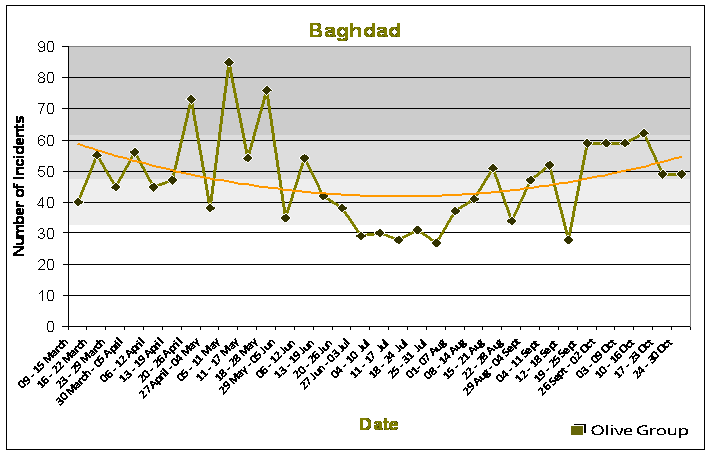 and under vehicle improvised explosive devices made up the bulk of the insurgent operations. On 25 October the Director General of the Electricity Ministry was shot dead in the south west of the city on his way to work. The following day Mahdi al Allaq, the Undersecretary of the Iraqi planning Ministry escaped assassination when an improvised explosive device detonated against his convoy in central Baghdad. Two days later the deputy assistant of the Interior Minister General Hussein Mahdi Goumaa was wounded when an improvised explosive device struck his motorcade in the al Jihad district. An Iraqi Police Colonel was killed by a under vehicle improvised explosive device in Sadr City on the same day.
Besides these high profile targets several other government ministry workers were killed and injured. Once again the rank and file Iraqi Security Force members in Baghdad were targeted with improvised explosive device and small arms fire attacks while on patrol and static at check point locations with civilian collateral damage occurring. There were many attacks against the Iraqi Security Forces throughout the city in the review period; however, there was little evidence of insurgent targeting of U.S. Forces. There was one indirect fire attack reported on the International Zone on 26 October. There were also unconfirmed reports of Baghdad International Airport being targeted with indirect fire; however the validity of these reports could not be corroborated.
High profile violent robberies continued during the reporting period possibly indicating insurgents’ lack of funds. An armed group attacked a vehicle carrying the salaries of the Education Directorate in the east Rusafa area of Baghdad. The group got away with $1.2 million.
Basra
The number of officially recorded incidents in south east this week remained at ten though there was a definite increase in insurgent intent in Basra Province during the reporting 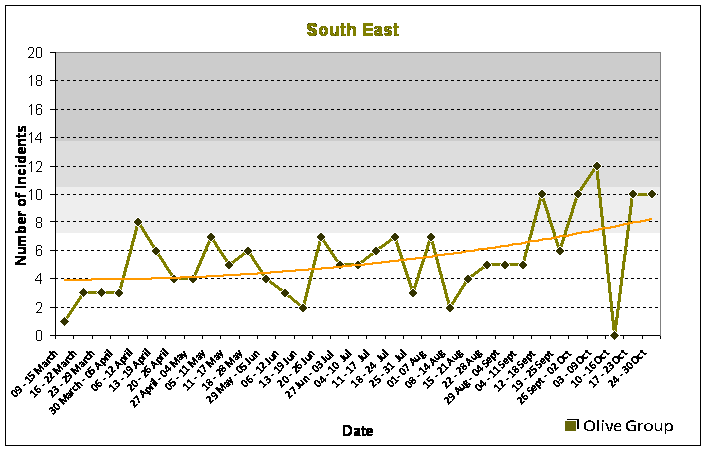 period.
On 26 October insurgents ineffectively targeted a U.S. Forces vehicle with an explosively formed projectile on route Minden to the east of Basra City. The Iraqi explosive ordnance disposal team initially stated that the device was an improvised explosive device; however U.S. Forces later reported that the device was a poorly constructed explosively formed projectile. Another explosively formed projectile was found three days later close to an Iraqi Security Forces check point on route Topeka near the cloverleaf junction. The device was reported to have been well constructed. The following day a private security company was targeted by an improvised explosive device to the north east of Az Zubayr which resulted in minor damage to a vehicle.
The increase in hostilities this week can possibly be attributed to the lack of progress in the government formation process. The Sadrist bloc had expressed its support for Maliki’s second term in office providing their demands were met. A deadline for the demands has now passed and an increase in Shia insurgent activity may well be resultant from this. It is likely that indirect fire attacks against Basra Contingency Operating Base will recommence soon due to the frustrations felt at political negotiations.
On 28 October an under vehicle improvised explosive device targeted a Southern Oil Company engineer in the centre of Basra City. The man was seriously injured and it is believed that the attack was related to a tribal dispute rather than targeting of oil workers. This was the first under vehicle improvised explosive device attack in the city since June and follows two under vehicle improvised explosive device finds in the past two weeks.

Posted in Security, Weekly Security Update Comments Off on Weekly Security Update for 4th November 2010
Scandal of Iraq's Politicians: Overpaid and Underperforming
Posted on 01 November 2010 .
According to a report from Associated Press, Iraq's 325 members of parliament have collected their $90,000 stipends, are claiming $22,500 a month in salaries and allowances, and are spending free nights in Baghdad's finest hotel.
That's what they get for attending the only session of parliament since the March elections, a session that lasted about 20 minutes. To cap it all, they haven't passed a single law!
In contrast, a mid-level government employee makes around $600 a month.
As the parliament prepares to hold what will be only its second session since the inconclusive election in March, lawmakers' lavish salaries and privileges are reportedly deepening resentment among Iraqis struggling to make ends meet and frustrated with the political deadlock.
The Shiite religious leadership has warned politicians against living the high life while ordinary people lack basic services, such as electricity and water.
In a mosque sermon Friday, an aide to Iraq's top Shiite cleric urged parliament to lower their salaries when they next meet.
"Iraqi politics has turned into business," said Wael Abdul-Latif, an independent Shiite politician and former lawmaker from Iraq's second largest city of Basra. "Many of the lawmakers would not even have bothered to run for the parliament" if salaries were not so high, he said.
Posted in Blog 2 Comments
Basra Council Approves "ID 288 bn" Energy Project
Posted on 30 October 2010 .
Basra's Council approved an energy project worth 288 billion dinars [$246m] on Thursday, a vice president of the Basra council told Aswat al-Iraq news agency.
“The council approved during its regular session an energy project to establish four generating units with a production capacity of 400kv (sic) at the al-Najiebiya electricity plant,” Ahmad al-Salieti is reported as saying.
These figures do not make sense to IBN - we're guessing they meant 288 million dinars to build 400 KW of capacity.
(Source: Aswat al-Iraq)
Posted in Construction & Engineering In Iraq, Iraq Public Works News Comments Off on Basra Council Approves "ID 288 bn" Energy Project

125 Companies Bidding to Build 1 Million Houses in Iraq
Posted on 27 October 2010 .
The Chairman of the National Investment Commission, Dr. Sami Al- Araji, announced that 125 companies of various nationalities have submitted offers to implement the 'One Million Housing Units' project [National Housing Project] throughout Iraq, and says that 35 companies from that list will be chosen.
Dr. Araji explained that the project will be built on an area of 80,000 donums [20,000 hectares] over a period of two years.
Companies bidding for the work came from America, France, Spain and Korea, in addition to 12 major Turkish companies.
Dr. Araji also said that the NIC is currently evaluating the companies on technical and economic basis before starting the implementation phase, referring that the commission had also informed the investing companies about the importance of cooperation with specialized companies to provide the such infrastructure as electricity, water, sewerage, communications and other important services.
Posted in Construction & Engineering In Iraq 2 Comments
Karbala Council Rejects New Electricity Tariffs
Posted on 27 October 2010 .
Karbala Council has issued an appeal to its citizens not to pay the new domestic electricity tariffs introduced by the Ministry of Electricity this month, according to AKnews.
The head of Karbala’s energy and fuel commission, Zuhair Samil al-Da’mi, told the agency that the ministry’s ten-fold increase was “completely unfair” in the light of the poor levels of service and supply.
“Why should the prices rise so much when electricity supplies have not improved?” he asked.
Da’mi complained that electricity supplies in Karbala this summer, when temperatures soared above 50 degrees, were so bad that only two hours in six were covered by the national grid.
“Therefore, we call on the people not to pay their bills until the service improves”, he said.
Da’mi added that all of the councils in Iraq’s Middle Euphrates region had gathered in Najaf this week and unanimously decided to reject the ministry’s new domestic tariffs and to demand that they be cancelled.
The federal Ministry of electricity issued the new tariffs to be effective from the beginning of this month in all Iraqi provinces with the exception of the Kurdistan Region.
The 1000% increase in domestic energy pricing was part of a move to encourage the population to consume national energy supplies more responsibly, the ministry said.
(Source: AKnews)
Posted in Iraq Industry & Trade News, Iraq Public Works News 1 Comment

Iraq Likely to Sign Shell Gas Deal by End of 2010
Posted on 26 October 2010 .
Iraq is meeting with Royal Shell Dutch to finalise a draft of a $12 billion deal to develop a gas-structure project in southern Iraq, and may sign a deal by the end of this year, a senior Iraqi oil official told Dow Jones Newswires on Tuesday.
"There is a meeting being held in Basra to agree on a final draft contract," Asri Mousa, an Iraqi Oil Ministry technical advisor said. It could be the last meeting before sending the draft to the cabinet for approval.
"We are expecting to sign the project with Shell by the end of this year," he said.
Asked why the project was delayed, Mousa said the two parties needed to agree on some legal wording of the draft contract and they had done so.
As we reported last month, the Iraqi cabinet delayed the finalisation of the project with Shell and Japan's Mitsubishi Corp. to capture gas from Basra's oilfields because of legal issues related to the joint venture. The cabinet already had approved the planned investment in June, but it is now waiting to sign the final draft once it is resubmitted by the oil ministry.
Posted in Iraq Oil & Gas News Comments Off on Iraq Likely to Sign Shell Gas Deal by End of 2010
$28m Alstom Deal to Repair Iraq Power Plant
Posted on 25 October 2010 .
Reuters reports that French engineering group Alstom has signed a 20 million euro ($27.83 million; 33 billion iraqi dinars) contract with Iraq on Monday to rehabilitate a unit at one of its power plants.
Alstom, maker of industrial power plants and high-speed trains, said in a statement it would rehabilitate a unit at the gas-fired power station in Iraq's holy Shi'ite city of Najaf.
The unit, which has been out of operation for five years, is expected to be reconnected to Iraq's electricity grid by summer in 2011, Alstom said.
Iraq's power infrastructure has been badly damaged by decades of war and sanctions, and 7-1/2 years after the U.S.-led invasion, its national grid still only supplies a few hours of power a day. Intermittent electricity is one of the public's top complaints.
Posted in Construction & Engineering In Iraq, Iraq Public Works News Comments Off on $28m Alstom Deal to Repair Iraq Power Plant
New Dam Planned for Shaqlawa
Posted on 25 October 2010 .
The Kurdistan Regional Government has decided to construct a large dam in the village of Aqhoban in the Hiran region, in the district Shaqlawah [Shaqlawa].
The Ministry of Agriculture and Water Resources has allocated more than six billion dinars for the project, which will be implemented by the two companies; work will start in the coming days and is intended to be completed within 730 days.
The objectives of the dam are to collect rain water and water from nearby springs to irrigate arable land and raise the level of groundwater, and to generate electricity.
The Ministry of Agriculture and Water Resources has identified several locations in the Kurdistan Region that may be suitable for dams.
(Source: KRG)
Posted in Agriculture, Construction & Engineering In Iraq, Iraq Public Works News Comments Off on New Dam Planned for Shaqlawa
250 Generators to Improve Electricity in Missan
Posted on 18 October 2010 .
Aswat al-Iraq reports that 250 generators have arrived in Maysan [Missan] to improve the power network in the province.
“Fifty generators arrived in Missan on Friday (Oct. 15) as part of the Iraqi government’s $100-million grant to the province,” Hussein Aziz, media spokesman for the Missan electricity department, told Aswat al-Iraq news agency.
“The province had received earlier 200 generators, raising the total number of generators received to 400 [450?],” he added.
Missan needs more than 400 megawatts of electricity, while it receives only 150 megawatt from neighboring provinces.
(Source: Aswat al-Iraq)
Posted in Iraq Public Works News Comments Off on 250 Generators to Improve Electricity in Missan
$18bn Cut From 2011 Iraqi Budget
Posted on 15 October 2010 .
An Iraqi official said on Thursday that some $18 billion [21 trillion Iraqi dinar] will be reduced from Iraq's proposed budget for next year.
Speaking to AKnews, Fadhil Nabi, the deputy for the Iraqi finance minister said that the requested budget for 2011 amounts to over $87 billion but the income of the country falls short of the amount.
The general budget of the country reached over $71 billion in 2010 while, if ratified, the budget for the coming year may drop to $69 billion.
The education, interior, defense, oil and electricity ministries are prioritized in the budgetary allocations, he said. The budget must first be ratified by the council of ministers and then by parliament.
Iraq's income depends mainly on oil exports, customs tariffs and taxes.
(Source: AKnews)
Posted in Iraq Banking & Finance News Comments Off on $18bn Cut From 2011 Iraqi Budget