



Dunia Weekly Iraq Market Tracker
Posted on 16 January 2012 .
Iraq Business News is delighted to bring you the latest Iraq Market Tracker report from Dunia Frontier Consultants. The market tracker highlights the activities and market performance of a basket of publicly traded firms who derive a significant percentage of their revenues from operations in Iraq, but are traded on foreign exchanges: a proxy Iraq play as much as practicable. It also identifies and analyzes the primary political and security events that occur in country that have market-moving implications.
Companies Mentioned:
DNO, Exxon, Genel Energy, Gulf Keystone, Longford, WesternZagros
Action Calls:
- As Maliki consolidates power, all eyes turn to Kurds: As we expected, Iraq's future will be decided along Baghdad-Erbil axis.
- Gulf Keystone shares spike on PSC back-in rights: Not new news, unless someone actually knows specifics of a bid for GKP. But big win won't occur until Erbil-Baghdad is resolved.
- Genel boosts stake to 80%, becomes operator of Chia Surkh PSC: Genel, in not unexpected move, continues as consolidator in Kurdistan.
Headlines:
- Source: Kurds moving towards state in March: Persistent rumors, but at this point file under "negotiations positioning."
- Sonangol attacked in Ninewa: Most likely criminal attack, designed to extract money or concessions, not broader activity.
Calendar:
- 19 January - Parliament to reconvene, Iraqi budget on docket
- Next month - Reconciliation meeting
Please click here to access the report, or to add your email address to Dunia's mailing list.
Posted in DFC Market Tracker, Investment, Iraq Banking & Finance News Comments Off on Dunia Weekly Iraq Market Tracker
GKP Soars on Renewed Bid Rumours
Posted on 11 January 2012 .
Shares in Gulf Keystone Petroleum (GKP) closed up over 21% on Tuesday on renewed bid rumours, having been up as much as 40% in intraday trading.
The company, which issued an update on operations on Monday, last month denied that is was in takeover talks, following rumours that ExxonMobil was considering making a bid for the company at five times the market valuation.
Posted in Iraq Oil & Gas News Comments Off on GKP Soars on Renewed Bid Rumours

Exxon's Six KRG Oil Blocks Named
Posted on 10 January 2012 .
Kurdish oil minister Ashti Hawrami (pictured) has confirmed the names of the six exploration blocks awarded by the Kurdistan Regional Government to ExxonMobil:
- Al Qush, northwest of Erbil city and formerly assigned to Komet Group but withdrawn for lack of development;
- Bashiqa, southeast of Al Qush town;
- Pirmam in Erbil;
- Betwata;
- Qura-Hanjeer, southwest of Chamchamal; and,
- a sixth block located along the border with Iran near the Penlwin border crossing.
(Source: Dow Jones)
Posted in Iraq Oil & Gas News Comments Off on Exxon's Six KRG Oil Blocks Named

DFC Iraq Market Tracker
Posted on 10 January 2012 .
Advertising Feature
Iraq Business News is delighted to bring you the latest Market Tracker report from Dunia Frontier Consultants.
In This Report:
Companies Mentioned:
- DNO, Exxon, Genel Energy, Gulf Keystone, WesternZagros
Action Calls
- Maliki on way to de facto majority government
Stability in government, but watch Kurds for Exxon, future of oil in both Kurdistan and Iraq.
- Genel Energy to buy Longford's Chia Surkh oil stake
Genel continues consolidation drive in Kurdistan.
- Exxon payments deliberately delayed?
Distraction. Don't watch this - watch Kurds and Maliki.
Headlines
- Confusion surrounding Issawi “assassination attempt”
Maliki not likely behind this. Unfortunately, just de rigueur in Anbar.
- Multiple explosions rock Baghdad
Unfortunately, not unexpected: recent uptick in violence explainable as annual attack on Shiites during Ashura and Arbaeen.
Calendar
- January - Kurdish statements, continuing Maliki cabinet appointments
Watch the noise coming out of Erbil for an indication of how the Kurds' discussion with Maliki's government over regional rights is shaping up. This will be the prime indicator of the future of Kurdish autonomy over oil and territory, and therefore the future of oil contracts within Kurdistan and Iraq in general. Secondly, with the parliamentary crisis subsiding, look for Maliki to clean up his cabinet with appointments moving his rivals out of, and his allies into, key roles. However, don't expect a walkover for him, as the Sadrists' turning down Finance in favor of the existing Minister (and sometime Iraqiya PM) Issawi indicates that Maliki is being watched by his coalition in these appointments. (Which by the way is a good sign for the maintenance of plurality and minority rights in Iraqi government.)
Please click here to download the full report free of charge.
If you would like to sign up for a weekly email version of this newsletter please send an email to [email protected].
Posted in DFC Market Tracker, Investment Comments Off on DFC Iraq Market Tracker

Federal Oil and Gas Law: Viability, Coherence and Functioning Perspectives
Posted on 20 December 2011 .
By Ahmed Mousa Jiyad. Any opinions expressed are those of the author, and do not necessarily reflect the views of Iraq Business News.
Mr Jiyad is an independent development consultant, scholar and Associate with Centre for Global Energy Studies (CGES), London. He was formerly a senior economist with the Iraq National Oil Company and Iraq’s Ministry of Oil, Chief Expert for the Council of Ministers, Director at the Ministry of Trade, and International Specialist with UN organizations in Uganda, Sudan and Jordan. He is now based in Norway (Email: [email protected]).
Introduction.
The meetings between the federal and KRG delegations held in Baghdad in the last days of October 2011 resulted in an agreement to base their discussion on the February 2007 version of the federal oil and gas law-FOGL.
Detailed, thorough and article-by-article assessments of the February 2007 draft of the law have been done and published by known Iraqi oil professionals, including this writer. The consensus among them indicates the draft suffers from many very serious flaws that ought to be addressed, revised, and redrafted. Moreover, essential and fundamental provisions are, by now, have been overtaken by events that render them outdated, irrelevant and dysfunctional.
What is needed then a very serious look into every article and the entire proposed law from substantive, format and operational aspects to insure its viability, coherence and proper functioning. It would be a grave mistake to consider the “law” as “political deal” since all had learned that most if not all political deals, in Iraq, are easily forgotten and short live!
This intervention aims to shed light on the most important issues and matters of concerns, which should be taken into considerations during the process of negotiating and finalizing a proposed draft of this law.1
-
Time factor effects
Many very important developments have taken place since February 2007, which makes it imperative to revise seriously various articles in the law since these provisions have been overtaken by events and thus became almost obsolete or redundant.
First: Among these developments are the bid rounds concluded by the MoO that led to concluding long term service contracts. These have generated many major consequences, which have direct implications on the proposed law.
Second: All major oilfields (except few such Kirkuk, Bai Hassan, East Baghdad among others) have been already contracted for re-development and/ or development with IOCs involvement. Consequently, there could be no need to offer any of the remaining fields for IOCs in whatever way or method. These remaining fields could be legally (by this proposed law) earmarked for INOC (to be reinstated), as suggested below.
Third: The concluded service contracts with IOCs, if implemented as envisaged, together with the production from other fields would bring Iraq’s production and export capacities to very high and unprecedented levels, even at partial success of half the contracted production targets. The implications is that there are no compelling reasons for Iraq to expand the production capacities any further at least in the next 15-20 years. The law may suggest a moratorium on any “new” development of oil fields for no less than 15 years. Moreover, the law ought to emphases the proper development of the contracted fields in the most optimum way to ensure the constitutional principle of “highest benefits to the Iraqi people”. Accordingly, the field development plans (initial and final) are of paramount importance that they should be formulated by technically competent petroleum team, approved by and constantly monitored by petroleum central authority;
Fourth: All the bid rounds were based on a service contract type and modality. The law should clearly extend support and preference to this type of contracting by making it mandatory to use this type of contracting. To prevent any misinterpretation it might be advisable to have a specific article in the law to make it unlawful and unconstitutional to conclude Production Sharing Contract- PSC in petroleum upstream sub-sector. The law ought to prohibit PSC in any phase of exploration, or development and production activities, in compliance with constitutional basic principles of collective ownership of petroleum resources and the best interests of the Iraqi people.
Fifth: The service contracts have already established significant milestones that are superior to those envisaged under February 2007 version of this law regarding, interalia, fiscal regime, conservation measures particularly those relating to gas utilization, good vs. best international business practices, dispute settlement modalities etc. Accordingly, good number of articles in this proposed law need revision on the lights of what actually have been concluded and evolved since February 2007.
Sixth: The relationship between this law and the proposed laws for the Ministry of Oil, INOC, Revenue Sharing and finally the General Commission for Observing the Allocation of Federal Revenue have to be well coordinated and considered to ensure harmony and coherence.
Posted in Ahmed Mousa Jiyad 2 Comments
GKP Jumps on Takeover Rumours
Posted on 19 December 2011 .
Shares in Gulf Keystone Petroleum (JKP) jumped on Monday following yesterday's report that U.S. oil major ExxonMobil was considering a takeover bid at five times the company's closing share price on Friday.
The shares were up as much as 34% in early trading on Monday, but had given up half those gains by mid-afternoon.
Reuters reports that a source close to the situation downplayed the story, noting bidders rarely make offers at more than a 50 percent premium to targets' pre-bid share price.
Analysts dismissed the prospect of such a high bid from the financially disciplined Texas-based oil giant, which made headlines with its recent entry into the semi-autonomous Kurdish region of Iraq.
"We fear an element of yuletide wishful thinking may also be playing a part," Richard Savage, oil analyst at brokerage Mirabaud told Reuters.
One dealer said they were especially surprised by the report's claim that Gulf Keystone's board would not accept the estimated 800 pence/share bid that Exxon was considering and instead the Chief Executive, Todd Kozel, wanted a price tag over 10 billion pounds in total.
Gulf Keystone said in September it was seeking a buyer for its 20 percent interest in the Akri-Bijeel block in Kurdistan in order to help finance ongoing development of other assets.
(Sources: Reuters, Yahoo)
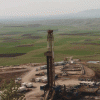
(Photo: Shaikan 2 rig site, March 2011)
Posted in Investment, Iraq Oil & Gas News Comments Off on GKP Jumps on Takeover Rumours
Exxon to Pounce on Gulf Keystone?
Posted on 18 December 2011 .
ExxonMobil is reportedly considering an $11 billion takeover of Kurdistan-focused explorer Gulf Keystone Petroleum.
Reuters, citing the Independent on Sunday newspaper, said that Exxon is considering making an estimated 800 pence per share bid for the British company, which has made huge oil finds Iraqi Kurdistan.
Neither company could be reached for comment by Reuters on Sunday.
Exxon has "sounded out" Gulf Keystone about the possible deal, said the report without citing its sources, adding that it is thought that the company would not accept an offer at the 800 pence per share level.
Shares in Gulf Keystone closed at 165.5 pence on Friday, valuing the firm at 1.4 billion pounds.
(Source: Reuters)
Posted in Investment, Iraq Oil & Gas News 2 Comments

Iraq "Won't Cancel ExxonMobil Deal"
Posted on 12 December 2011 .
Nouri al-Maliki has said that the iraqi Government has no intention to cancel the contract with ExxonMobil to develop the West Qurna 1 oil field.
"We haven't cancelled its contract in the south," said Mr. Maliki in an interview with The Wall Street Journal. "We are looking for a way for [ExxonMobil's] other contracts in any area to be within the legal contexts, but as for cancelling its contract in the south, no."
Maliki also said that Exxon has "frozen" its controversial contract with the KRG, and suggested that his government was willing to find a way to ultimately make the deal work.
"It [the contract] has a legal violation, it doesn't work unless Exxon comes back and negotiates with the Ministry of Oil in the presence of a representative of the Kurdistan region, then possible," Mr. Maliki said. "Even Exxon I think has frozen the project, now the contract is frozen and we will try to find a formula to remedy it."
So far, ExxonMobil has said nothing about the deal.
(Source: Wall Street Journal)
Posted in Iraq Oil & Gas News 1 Comment
Basra wants Bigger Say, More Autonomy
Posted on 09 December 2011 .
Officials in Basra are reportedly trying to cancel a $17 billion Shell gas deal because they want a bigger say, highlighting the pressure on central government to ease its control over the provinces.
According to the report from Reuters, the province is increasingly restless with the slow pace of development and wants more control over its natural resources and revenues.
Demands for more provincial power have simmered for years in Iraq, split by ethnic, sectarian and tribal tensions, but the Basra push and an autonomy drive from Salahuddin [Salahadin, Salah ad Din] province threaten to stir tensions as the last U.S. troops withdraw.
The contract with Shell and Mitsubishi to capture flared gas in three southern Iraqi oilfields was signed on Nov. 24 despite objections from the Basra local council that it was not included in talks or the deal's signing.
Officials from the Basra Provincial Council filed a lawsuit against the Iraqi Oil Ministry on Nov. 25 demanding the cancellation of the gas agreement.
"In principle, we don't have any problem with developing the gas but when the contract is signed, there has to be an article that shows the provincial council has agreed ... Unfortunately, we did not know anything about this contract," said Sabah al-Bazouni, head of the Basra Provincial Council.
"Basra is the most suitable province to become an autonomous region."
Regional autonomy would give the province more power over finances, administration and laws, and an upper hand in supervising public property, which could loosen Baghdad's grip on the oil and gas sector.
The legal case is unlikely to deter Shell and delay the project, but it raises concerns about future disputes over oil and gas rights in Iraq, which is struggling to rebuild after years of violence just as Washington prepares for a full troop withdrawal by the end of December.
Posted in Iraq Oil & Gas News, Politics Comments Off on Basra wants Bigger Say, More Autonomy

Exxon CEO Silent on KRG oil deal
Posted on 07 December 2011 .
ExxonMobil's Chief Executive, Rex Tillerson (pictured), refused on Tuesday to answer questions about the company's deal with the Kurdish Regional Government (KRG).
When asked at a World Petroleum Congress in Qatar if he thought the contracts would hold up under Iraqi law, Tillerson said, "I'm not in a position to comment on that".
At a press conference after the panel, Tillerson was again asked about the ramifications of the Kurdish contracts, and again declined to answer.
Last month, the U.S. State Department said it warned Exxon that any deals it signs with the Kurdish government may be annulled by Baghdad.
(Source: CNN)
Posted in Iraq Oil & Gas News Comments Off on Exxon CEO Silent on KRG oil deal