


OIR Spokesman: Counter-ISIL Progress Continues
Posted on 11 February 2016 .
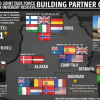
As Iraqi security forces make progress in the campaign to defeat the Islamic State of Iraq and the Levant, Canada’s vow this week to expand its contributions in the fight is a welcomed commitment, Operation Inherent Resolve spokesman Army Col. Steve Warren said on Wednesday.
Warren noted in his weekly counter-ISIL operational update via videoconference from Baghdad that the Canadian government announced on Feb. 8th that it plans to triple the size of its train, advise and assist mission. A move that is welcomed, the colonel added.
“Canada will increase its compliment of military personnel to approximately 830,” he said. “They will deploy troops at various headquarters to further support planning, targeting and intelligence. As part of these efforts, Canada will deploy medical personnel to train Iraqi medics and to provide medical support to coalition members.”
Warren added, “Canada will also provide equipment such as small arms, ammunition and optics to assist in the training of Iraqi security forces.”
The Canadians “have been a trusted and valuable partner of this coalition since the beginning of the campaign, whether it's providing aerial refueling and surveillance aircraft or trainers to advise and assist, they've shown great resolve and continue to enable this fight,” the colonel said.
Gains Continue, Despite Threats
As clearance operations continue in Iraqi-controlled Ramadi, “untold thousands of [improvised explosive devices]” remain in the city, Warren said, and threats persist from enemy harassing attacks and acts of terror.
Posted in Security Comments Off on OIR Spokesman: Counter-ISIL Progress Continues

Is the KRG heading for Bankruptcy?
Posted on 03 February 2016 .
By Amberin Zaman for Al-Monitor. Any opinions expressed are those of the author, and do not necessarily reflect the views of Iraq Business News.
When the Iraqi Kurds come to Washington, it is often to ask for guns to fight the Islamic State (IS). Now they are pleading for cash, warning that their campaign against the jihadis is threatened by an economic “tsunami” that has left their quasi-independent state teetering on the brink of collapse.
“Is this only our fight or yours, too?” asked Fuad Hussein, chief of staff of Iraqi Kurdistan Regional Government (KRG) President Massoud Barzani, after briefing top US officials in Washington last week.
The Iraqi Kurdish peshmerga warriors and the Syrian Kurdish People’s Protection Units are critical allies in the fight against IS, wresting back huge chunks of territories including the town of Sinjar in Iraq and the Tishreen dam in Syria. But Hussein cautioned that IS remains “a big threat” and could “regroup at any time.” Unless the Kurds’ allies step in with financial aid, the Kurds' capacity to fend off the jihadists will wane, he said. “You cannot win the fight when you can’t survive economically,” Hussein told Al-Monitor in an interview.
That message was driven home in back-to-back meetings at the State Department, the White House, the National Security Council and also on Capitol Hill, where the Kurds met with Sens. John McCain and Dianne Feinstein, among others. “We haven’t been going around asking people to pull out their checkbooks,” said Bayan Sami Rahman, the Kurdistan Regional Government’s (KRG) representative in Washington.
“But people don’t appreciate enough that this is an incessant fight,” she said in an interview with Al-Monitor. “Never mind the cost of running a war, our peshmerga don’t even have winter gear. The purpose of our mission here is to help our friends understand that this is not sustainable, that we need nothing less than a Marshall plan,” Rahman added.
Posted in Iraq Oil & Gas News, Politics Comments Off on Is the KRG heading for Bankruptcy?
New $100m Edible Oils Plant to Open end-2016
Posted on 23 January 2016 .
By John Lee.
Iraq's Etihad Food Industries will reportedly start production at its new $100-million edible oils refinery in Babylon by the end of the year.
Commercial Director Haidar Alnoumany told Reuters that the company started building the infrastructure two months ago, and when in production it will source crude (edible) oil from many origins like Argentina, Ukraine, Russia and the United States.
The refinery will process corn oil, sunflower oil, soybean oil, and palm oil, and aims to cover the needs of Iraq's trade ministry (around 456,000 tonnes a year) and the domestic private market.
It will have a capacity of 3,000 tonnes a day with a refined oil storage capacity of 90,000 tonnes.
The plant is close to the company's sugar refining plant, which started production last year and ramped up faster than expected, reducing the country's dependence on white sugar imports.
(Source: Reuters)
(Cooking oil image via Shutterstock)
Posted in Agriculture, Iraq Industry & Trade News Comments Off on New $100m Edible Oils Plant to Open end-2016

The Iraqi Shanty Town Between Two Oil Fields
Posted on 23 January 2016 .
This article was originally published by Niqash. Any opinions expressed are those of the author, and do not necessarily reflect the views of Iraq Business News.
Between Black Gold, Bleak Prospects: Visiting The Iraqi Shanty Town Between Two Oil Fields
NIQASH visits Wasit's Oil Town. But this is no wealthy area for oil billionaires. This shanty town between two oil fields is full of displaced people in shacks, with no sanitation or easily accessible drinking water.
It's a random neighbourhood, with barely any of the necessities one would normally find in a housing district. But somehow the Hay al-Naft neighbourhood, also known as “Oil Town”, located between the Ahdab oil field, run by the China National Petroleum Corporation (CNPC), and Russia's Gazprom-run field at Badra, has become a gathering place for those with nowhere else to go.
More than 50,000 residents live here and most of them were displaced by the previous or present sectarian conflict. Locals say the shanty town was named Oil Town either because of its proximity to oil fields or, some suggest, because it is thought there may be oil underneath the town.
A woman living there who wished to be known only as Um Ali, said she had come here in 2006 after she was forced out of her own neighbourhood by sectarian conflicts.
“We see oil around us in all directions,” the woman in her 60s, her face dark and creased, told NIQASH. “But we don't benefit from any of the oil. We only inhale the smoke and fumes and fear the diseases they bring. I am really afraid for the future of my four sons here. I wish we could go elsewhere where we could live in dignity.”
The houses here, roofed with wooden panels that don't hold out the rain or wind, are separated by streets full of sewage, dirty water and rubbish. It's a kind of a shanty town where every dwelling was built randomly and without any planning, another resident who wished to remain anonymous, told NIQASH.
Posted in Iraq Oil & Gas News Comments Off on The Iraqi Shanty Town Between Two Oil Fields

Can Exporting Natural Gas Save Iraqi Kurdistan?
Posted on 17 January 2016 .
This article was originally published by Niqash. Any opinions expressed are those of the author, and do not necessarily reflect the views of Iraq Business News.
A Pipeline In The Pipeline: Can Exporting Natural Gas Save Iraqi Kurdistan?
Beginning 2016 Iraqi Kurdistan will begin to build a new natural gas pipeline to Turkey. But analysts say if they use the same policies they do for oil, the pipeline will make things worse, not better.
Thanks to recent geo-political conflicts, the oil pipeline between the semi-autonomous region of Iraqi Kurdistan and the region's neighbour, Turkey, is becoming more important than ever. And this in turn has apparently made both Turkey and Iraqi Kurdistan decide to build a gas pipeline too.
Officials from the two capitals, Ankara and Erbil, have been discussing building such a pipeline to bring gas from Iraqi Kurdistan to Turkey, and then from there, onto Europe, for some time.
Turkey is increasingly concerned that the Russians will stop supplying them with gas, given the latest conflicts between them after Turkey shot down a Russian fighter jet in a disputed area. And Iraqi Kurdistan continues to labour under Iraq's financial crisis; the region desperately needs new sources of income.
The Iraqi Kurdish Ministry of Natural Resources note that their region contains around 3 percent of the world's reserves of natural gas. If the Kirkuk region, currently under the control of Iraqi Kurdish military thanks to the security crisis, is eventually annexed to the Iraqi Kurdish region too, then that number jumps to 6 percent. Given this huge amount of natural gas and the current political and economic crises, a gas pipeline looks like an increasingly useful and lucrative project for both parties.
Posted in Iraq Oil & Gas News Comments Off on Can Exporting Natural Gas Save Iraqi Kurdistan?
Air Strikes Decimate ISIS Oil Production
Posted on 31 December 2015 .
By Simon Kent.
When Coalition aircraft began targeting ISIS oil operations last year, they did so under strict rules of engagement that were designed to minimize civilian casualties: many of those transporting the oil were deemed civilians trying to earn a living under ISIS rule.
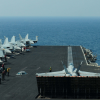
Tactics in the early days of the Tidal Wave II bombing operation involved targeting mostly modular refineries and oil wells, hitting the 200 wells in Syria and hammering ISIS oil production from 70,000 bpd to around 40,000 bpd.
In Iraq, the fields under ISIS control such as Qayyara near Mosul, produced only 8000 bpd of very heavy crude, and this is now thought to be an almost crippled operation, since fuel costs in Mosul are now extremely high.
Subsequently, oil fell from being a main source of cash for the group to being only a fragment of their income, a fact revealed by documents captured by a US Special Forces raid into Syria. That raid killed the chief of ISIS oil operations, known as Abu Sayyaf.
Things only got worse for the group as the US decided to finally target ISIS oil tanker trucks, dropping warning leaflets to the truckers instructing them to run from their vehicles. The raids hit hundreds of tankers near Al Qaim in Iraq in late November.
Russia soon joined these strikes, which probably destroyed the majority of available fuel trucks in ISIS territory.
ISIS has since been more reliant on small home made refineries that according to one US official, resemble pre-20th century production. The group struggles to get more than $20 per barrel for this oil, which is mostly sold within Syria and is probably hitting less than 30,000 bpd production.
(Various sources)
Posted in Security 5 Comments

Video: 12,000 Tankers and Trucks on Turkey-Iraq Border
Posted on 26 December 2015 .
From RT News. Any opinions expressed are those of the authors, and do not necessarily reflect the views of Iraq Business News.
Russian intelligence has spotted up to 12,000 tankers and trucks on the Turkish-Iraqi border, the General Staff of Russia’s armed forces has reported.
“The [aerial] imagery was made in the vicinity of Zakho (a city in Iraqi Kurdistan), there were 11,775 tankers and trucks on both sides of the Turkish-Iraqi border,” Lieutenant-General Sergey Rudskoy told journalists on Friday.
Posted in Iraq Industry & Trade News, Iraq Oil & Gas News, Security 5 Comments
Abdul Mahdi: Iraq to Watch non-OPEC Production
Posted on 21 December 2015 .
By Simon Kent.
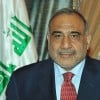
Iraq's oil minister Adel Abdul Mahdi (pictured) has spoken to Reuters regarding Iraq's position on OPEC's failure to agree on a production ceiling as the battle to drive out shale production continues.
Abdul Mahdi said that Iraq was now looking at the "real world" and that they would have to monitor production in countries such as Russia and the US, and potentially coordinate with those producers.
The alternative, he said, was for non-OPEC producers to risk cutting production and losing both production and cost if actions were not coordinated to defend prices.
(Source: Reuters)
Posted in Iraq Oil & Gas News 6 Comments

KRG Airports Closed Again
Posted on 07 December 2015 .
By John Lee.
The international airports at Erbil (pictured) and Sulaymaniyah have been closed due to Russian aerial operations against Islamic State (IS, ISIS, ISIL) militants in Syria, according to a report from BasNews.
Iraqi aviation authorities told the airports to close on Sunday evening for 48 hours -- flights are scheduled to resume on Tuesday December 8th at 23:00 (20:00 GMT).
(Source: BasNews)
Posted in Iraq Transportation News, Security Comments Off on KRG Airports Closed Again

Wood Group wins $90m Contract in Iraq
Posted on 27 November 2015 .
Wood Group has won a new contract worth approximately $90 million to deliver services to one of the world’s leading blue-chip international oil companies (IOC) in Iraq.
Wood Group PSN (WGPSN) will provide project management for an onshore facility under the three year contract, which is effective immediately.
Concept and FEED work for future projects will also be included in the contract, which creates more than 100 new positions and retains 20 jobs.
Personnel will be based in Wood Group offices in Iraq and Dubai.
David Buchan (pictured), WGPSN's Eastern Europe, Russia, Caspian and Middle East (ERC & MER) managing director said:
“This major contract builds on our strong partnerships with clients in Iraq. We look forward to leveraging Wood Group’s international knowledge and expertise towards the continued success and development of our client’s facility.
“Iraq is an area where we see significant growth opportunities for our broad service capabilities and building our presence in this region is a key objective for us.
"This is reflected in our creation of another office in Dubai, which adds to our presence in the Middle East and our commitment to developing local talent, creating job opportunities and building relationships with the supply chain in Iraq.”
(Source: Wood Group)
Posted in Construction & Engineering In Iraq, Iraq Oil & Gas News Comments Off on Wood Group wins $90m Contract in Iraq