


Iraq to Remove Ban on Iranian Cement
Posted on 24 May 2016 .
By John Lee.
The secretary of Iran's Cement Industry Employers Association has said that Iraq has promised to remove its ban on the import of Iranian cement.
Fars news agency quotes Abdolreza Sheikhan as saying that following several meetings between Iranian and Iraqi officials, Baghdad promised to give priority to Iranian exports, once general ban on cement import is removed.
He said Iraq's cement demand is currently met from domestic production.
Iran's cement and clinker exports fell by 20 percent in the Iranian year ended March 20, and stood at 15 million tons.
Iraq had previously accounted for 60 percent of Iran's cement exports.
Last year Baghdad increased tariffs on Iranian cement from $4 to $13.
Iran currently exports cement to some 24 countries including Azerbaijan, Turkmenistan, Afghanistan, Russia, Kazakhstan, Kuwait, Pakistan, Qatar, Turkey, the United Arab Emirates, Georgia, Oman, India, and China.
Last year, Sheikhan warned that Iran is gradually losing its domestic and foreign cement markets.
"Cement supply and demand is not balanced in the market and this has created problems for producers," he said.
(Source: Trend)
Posted in Construction & Engineering In Iraq 5 Comments
Why Shiites are divided over Iranian role in Iraq
Posted on 15 May 2016 .
By Ali Mamouri for Al-Monitor. Any opinions expressed are those of the author, and do not necessarily reflect the views of Iraq Business News.
On the night of April 30, the crowd that stormed the Green Zone gathered in the Great Celebrations Square inside the zone and chanted “Iran Out Out” and “Qasem Soleimani … Sadr is a divine person,” in reference to Shiite cleric Muqtada al-Sadr.
This indicates that feelings and political stances hostile to the policy that Iran has adopted in regard to Iraq since 2003 have been revived among the Shiites.
It is understandable that hatred for Iran prevails within the Iraqi Sunni community, due to sectarian considerations that are influenced by the current sectarian conflict in the region. Hatred for Iran, based on the Arab nationalist considerations hostile to Persian nationalism, which prevailed under the rule of Saddam Hussein, is also understandable.
Yet, what happened in Celebrations Square points to the unique reasons behind the feelings that prevail among the Shiites, which are supposed to be on the side of the Iranians in the current conflict.
The emergence of this new political stance away from the sectarian affiliation is an important development in the Shiite community’s political awareness, which has been a result of the Iranian bias and arrogance in dealing with the Iraqi issue after the fall of the Baath regime.
The criticism of the Iranian stances by Iraqi Shiite religious and political leaders is growing. On March 8, 2015, Ali Younesi, President Hassan Rouhani's adviser on ethnic and religious minorities affairs, said that Iraq is a part of the great Iranian civilization.
In response to these remarks, the spokesman for Iraq's top Shiite cleric Ali al-Sistani, Sayyid Ahmad al-Safi, said on March 13, 2015, "We are proud of our country, our identity, our independence and our sovereignty. While we welcome any help offered today from our brothers and friends in our fight against terrorism and thank them for it, it doesn’t mean that we would ignore our identity and independence in any way. For we are writing our history with the souls, wounds and blood that our sons from all constituents and ethnicities shed during the battles against terrorism.”
Posted in Politics, Security Comments Off on Why Shiites are divided over Iranian role in Iraq
ISIS Suffer New Funding Crisis
Posted on 19 April 2016 .
By Simon Kent.
A think tank has estimated that the so called Islamic State have suffered another major blow to their finances, losing another 30% of their income in the course of a year. The news comes after reports in January that the group slashed the salaries of fighters by over half.
In that respect, it may actually be good news for the group that they are suffering a manpower shortage.
Initially, many analysts and news reporters speculated that the group had huge income from local sources in the Summer of 2014, even in the absence of foreign terrorist financing.
For example, for a long time Coalition jets did not target ISIS controlled oil infrastructure, which was in part manned by "civilians". But as it became obvious that this was a major source of their cash (as much as $1.5 million per day in the summer of 2014) the Coalition hit ISIS oil hard, decimating their funds and dropping warning leaflets to oil workers to evacuate.
Then greater attention was turned to banks operating on the fringes of ISIS controlled territory, as well as other financing such as remitters. It now appears that loopholes have been gradually closed off in the shady world of money laundering and using the Dark Web to raise funds.
As such, the report by IHS inc. now puts ISIS income at around $50 million per month, a pathetic sum considering there are at most 6 million people in ISIS controlled territory. Additional ISIS financial losses have also come from a loss of territory, and Russian and US aerial bombardment, which has helped liberate Palmyra and Ramadi.
This has decimated the areas they can collect taxes in and confiscate property, but ISIS territory has also suffered catastrophic economic collapse from war and being shut out from international trade.
It is certainly an interesting report: at the beginning of last year, IBN blogger Robert Tollast argued that ISIS was on a losing streak, perhaps an over optimistic prediction at the time. But as time goes by, that is looking increasingly to be the case.
(Source: Foreign Policy.)
Posted in Construction & Engineering In Iraq 5 Comments
Iraq Takes Delivery of Ground Attack Jets
Posted on 19 April 2016 .
By Simon Kent.
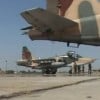
Iraq's Ministry of Defence has announced that a delivery of three SU-25 ground attack aircraft have arrived in the country for the fight against the so called Islamic State.
The Russian made SU-25, known by its NATO code name "Frogfoot," is a slow moving but heavily armed ground attack jet, and several are already in service in the Iraqi Air Force.
(Source: UPI)
Posted in Construction & Engineering In Iraq 5 Comments
Iraq has World's 3rd Lowest Oil Production Costs
Posted on 14 March 2016 .
By John Lee.
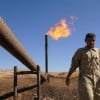
Iraq's Ministry of Oil quotes a report by Rystad Energy as saying that Iraq has the world's third-lowest-cost crude oil.
Kuwait came in lowest at $8.50 per barrel, with Saudi Arabia at $9.90, followed by Iraq at $10.70.
Fourth place went to UAE at $12.30, and Iran took fifth place with $12.60.
The United Kingdom was the most expensive at $52/barrel, followed by Brazil at $49 and Canada at $41.
The US cost averaged $36, and Russia $18.
(Source: Ministry of Oil)
Posted in Iraq Oil & Gas News Comments Off on Iraq has World's 3rd Lowest Oil Production Costs
Russian Ambassador Discusses Ties with KRI
Posted on 14 March 2016 .
By John Lee.
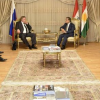
KRG Minister Falah Mustafa met with Russian Ambassador to Iraq Mr. Ilya Morgunov and Russian Consul General in Kurdistan Mr. Viktor Simakov on Sunday to discuss strengthening bilateral ties and challenges facing Kurdistan and the wider region.
Minister Mustafa and Ambassador Morgunov reviewed ways of strengthening bilateral cooperation between the Russian Federation and the Kurdistan Region in various fields.
Minister Mustafa briefed the Ambassador on the ongoing security, financial, and humanitarian challenges facing the KRG and requested continued support from the Russian Federation.
Ambassador Morgunov affirmed the commitment of his government to continue to provide military and humanitarian assistance to the Kurdistan Region.
He stressed that the international community has a shared responsibility to support the region in the fight against ISIS, as it poses a serious threat to international security and peace.
(Source: KRG)
Posted in Iraq Industry & Trade News, Security Comments Off on Russian Ambassador Discusses Ties with KRI
KRG calls for Conference on Reconstruction of Shingal
Posted on 10 March 2016 .
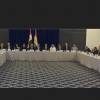
The Kurdistan Regional Government has hosted a special session for the KRG Minister of Interior and Mayor of Shingal to brief diplomats and representatives of UN agencies and INGOs based in Erbil on the needs of the city.
At the outset of the meeting, Minister Falah Mustafa, Head of KRG Foreign Relations called for a moment of silence to show respect for the victims of the atrocities committed against the Yezidi Kurds by the ISIS terrorists.
Minister Falah Mustafa, Head of KRG Foreign Relations, thanked diplomats and representatives of UN agencies and INGOs for attending the meeting. Minister Mustafa thanked the US-led Coalition for the support provided to Peshmerga forces in the liberation of Shingal. He stated that “Liberation of Shingal was very important to the people of Kurdistan and the civilized world.
The ISIS terrorists have committed grave crimes in Syria and Iraq but the most barbaric and heinous crimes were committed in Shingal. ISIS committed another Anfal against Kurds in Shingal.” The Minister called for urgent support from the members of international community in the reconstruction process of the city of Shingal, as eighty percent of the city has been completely destroyed.
KRG Minister of Interior and Acting Minister of Peshmerga, Mr. Karim Sinjari highlighted the role of Peshmerga forces and the contributions of the Counter-ISIS Coalition in the fight against ISIS. Minister Sinjari requeted the international community to allocate specific financial assistance to the KRG from the funds offered to the government of Iraq, to help KRG document the crimes committed against Yezidis, and to support KRG’s efforts to gain international recognition of the Yezidi genocide.
Posted in Construction & Engineering In Iraq, Security Comments Off on KRG calls for Conference on Reconstruction of Shingal
Carter Highlights Momentum in ISIL Fight
Posted on 01 March 2016 .
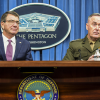
Momentum is on the side of the coalition fighting the Islamic State of Iraq and the Levant, Defense Secretary Ash Carter said today, noting significant gains in Iraq and Syria.
The secretary spoke in a joint news conference at the Pentagon with Marine Corps Gen. Joseph F. Dunford Jr., the chairman of the Joint Chiefs of Staff.
Forces on the ground in Iraq have retaken Ramadi and are making progress in Anbar, while the coalition is making "operationally significant strides" in Syria, he said.
"Because of our strategy and our determination to accelerate our campaign, momentum is now on our side and not on ISIL's," Carter said.
Gains Include Reclaiming Shadadi
The secretary highlighted how coalition forces recently reclaimed Shadadi, a town in northeastern Syria, that he described as a "critical node" for ISIL training, logistics and its oil enterprise. "As our partners take control of Shadadi, I believe we will learn a great deal more about ISIL's criminal networks, its criminal enterprise and what it does to sustain them," Carter said.
Shadadi is important in efforts to sever the "last major artery" between the Syrian city of Raqqa -- ISIL’s putative headquarters -- and the Iraqi city of Mosul, an "operation critical to dissecting ISIL's parent tumor into two parts," he said.
Accelerated Efforts Include Cyber
The campaign to defeat ISIL is being accelerated across Syria and Iraq, the defense secretary said.
Coalition members are bombing ISIL's banks and oil wells, he said, and cyber tools are being used to disrupt ISIL's ability to operate and communicate over the virtual battlefield.
The cyber efforts are being used, particularly in Syria, Carter said, to disrupt ISIL's command and control operations, cause the terrorists to lose confidence in their networks and to interrupt their ability to control the population and the economy.
Cyber is an "important new capability," he said. "This is something that's new in this war, not something you would've seen back in the Gulf War. It is an important use of our Cyber Command -- and the reason that Cyber Command was established in the first place."
ISIL is one of five challenges that must be addressed as part of DoD's mission to defend the nation, Carter told reporters.
The other challenges are Russian aggression in Europe, a rising China that is "behaving aggressively," and the threats of North Korea and Iran in their respective regions, he said.
(Source: US Dept of Defense)
Posted in Security Comments Off on Carter Highlights Momentum in ISIL Fight
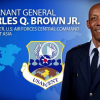
Air Power Vital to Counter-ISIL Success, Commander Says
Posted on 19 February 2016 .
As the U.S.-led coalition’s air campaign to counter the Islamic State of Iraq and the Levant in Iraq and Syria brings its capabilities to the fight, joint interoperability continues to degrade the terrorist organization, the commander of U.S. Air Forces Central Command said today.
Air Force Lt. Gen. Charles Q. Brown Jr., who also serves as Combined Forces Air Component commander for Operation Inherent Resolve, briefed Pentagon reporters on progress in the coalition’s counter-ISIL air operations via teleconference from an air operations center in Al Udeid, Qatar.
The interoperability among the coalition nations is built upon “years of combined training and multilateral exercises [that have] been key to our continued success in the air campaign,” Brown emphasized.
“There is no doubt coalition air power has and continues to dramatically degrade [ISIL’s] ability to fight and conduct operations,” he added.
While persistent air coverage continually exploits ISIL’s weaknesses, “we are more effective today than ever before,” the general said. “We're conducting the most precise air campaign in history, and we're able to attrit [ISIL] and its capabilities any time and anywhere.”
Targeting Areas for Defeat
Targeting ISIL logistics, command and control and weapons manufacturing are some of the areas in which the coalition has had increased success, he said.
Posted in Security Comments Off on Air Power Vital to Counter-ISIL Success, Commander Says
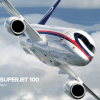
Russia ready to Sell Airliners to Iraq
Posted on 13 February 2016 .
By John Lee.
Reuters reports that Russia is ready to sell Sukhoi Superjet civil airliners to Iraq.
On a trade mission to Baghdad, accompanied by nearly 100 government and business officials, Deputy Prime Minister Dmitry Rogozin said Russia could provide Sukhoi Superjet airliners for Iraq's civil aviation, adding that Moscow would continue providing Iraq with military equipment.
Russian trade with Iraq last year was worth nearly $2 billion, mostly made up of Russian exports, according to TASS.
(Source: Reuters)
Posted in Iraq Industry & Trade News, Security Comments Off on Russia ready to Sell Airliners to Iraq