



Petrofac Wins Iraq Contract with KOGAS
Posted on 26 September 2017 .
UK-based Petrofac has been awarded a Front End Engineering Design (FEED) modification contract for the KOGAS AKKAS B.V. Nasiriya Gas Treatment Plant (GTP) in southern Iraq.
Petrofac’s scope of work includes the modification and application of an existing field design to meet the needs of the Nasiriya GTP, and an estimation for the engineering, procurement and construction (EPC) costs in line with the revised design requirements.
Steve Webber, Senior Vice President, Engineering & Production Services East, said:
“This award is testament to our engineering design capabilities, as well as our deep understanding of the market and supply chain in Iraq. KOGAS is a new client for us in a core market and we look forward to further developing our relationship through the successful delivery of this scope.
“Throughout the project, we will provide a robust FEED package for the execution of the Nasiriya GTP in alignment with KOGAS’ expectations, to ensure that it can maximise the total value of the field.”
(Source: Petrofac)
Posted in Iraq Oil & Gas News Comments Off on Petrofac Wins Iraq Contract with KOGAS

Kogas to Sell Stake in Akkas Field
Posted on 17 January 2016 .
By John Lee.
According to a report from Platts, South Korea's state-owned Korea Gas Corporation (KOGAS) plans to sell a 47 percent stake in its 100 percent-controlled Akkas gas field.
The company is under pressure from the Korean government to reduce its debts.
The project was originally awarded to a consortium of Kogas and KazMunaiGas (KMG), but KMG pulled out in 2011, leaving Kogas as sole investor and operator on new contract terms.
(Source: Platts)
Posted in Iraq Oil & Gas News Comments Off on Kogas to Sell Stake in Akkas Field

Akkas Pipeline Cancelled
Posted on 23 June 2015 .
By Robert Tollast.
Korean firm STX Heavy Industries has cancelled a proposed 500km pipeline to the Akkas gas field in Western Iraq, which is operated by state Korean gas firm KOGAS.
STX Heavy were working on the project with KOGAS Akkas B.V and work was due to be finished in 2017, however the project ran into trouble in early 2014 as security started to deteriorate in Anbar.
ISIL now control 80% of the province, and clearly work at Akkas is now untenable--it is located near the ISIL stronghold of Al Qaim.
STX Heavy has several other projects in Iraq, all of them located in the south where attacks are rare.
(Source: The Korea Herald.)
Posted in Construction & Engineering In Iraq 9 Comments

Capital Gain Tax on IOCs in Iraq
Posted on 10 February 2014 .
By Ahmed Mousa Jiyad.
Any opinions expressed are those of the author, and do not necessarily reflect the views of Iraq Business News.
Many countries impose capital gain tax on individuals, companies and corporations when a profit realized from the sale of assets. National and state legislation often has a large array of fiscal obligations and regulations regarding capital gains, however, these fiscal obligations may vary from jurisdiction to jurisdiction.
In other words capital gain tax is a normal component of taxation systems on both national and international levels, and thus has a significant contribution to the state revenues and fiscal policies. Iraq is no different and should consider doing the same.
In Iraq the signed service contracts provide the IOCs with a possibility to assign (sell) wholly or partly their participating interests as specified by a common clause in the signed contract, “any Company shall have the right to assign any of its Participating Interest, shares, rights, privileges, duties or obligations under this Contract to an Affiliate.” Such right for assignment is subject to and governed by a set of provisions outlined in the signed contract.
Due to the long duration of the contracts (the Term) that extend beyond 20 years, and due to the usual practice of Merger and Acquisition (M&A) in the international petroleum business it is highly probable that IOCs might “farm in” and “farm out” by acquiring, selling or exchange participation interests in the related petroleum field.
The transfer of participation interests between IOCs involves financial transactions or transfer of “asset” ownership between the concerned parties: the buyer and the seller. This assignment deal may (though highly likely) results in significant realized gain (profit) for the selling party compared to the actual cost (investment) it made as a consequence to its participation in the related upstream petroleum development project.
This realized gain is known to be “capital gain” and in most countries it is taxable. The “Capital Gain Tax” is imposed on individuals, companies and corporations and in many countries it is imposed in addition to other direct taxes such as “Property/Wealth Tax” and “Income Tax” among others. The percentage of Capital Gain Tax differs according to the taxation systems and fiscal policies across the world.
Posted in Ahmed Mousa Jiyad 3 Comments

Private Security Companies in Iraq
Posted on 07 February 2014 .
By Robert Tollast.
Robert Tollast is a consultant at Noorbridge, a Helsinki based consultancy with staff in London and Nasiriyah, Iraq. He has written extensively on security, politics and economic issues in Iraq for various publications, and is currently researching a modern history of Iraq with support from The Middle East Forum. email: [email protected] twitter: @roberttollast
Private Security Companies in Iraq: Think Again. An interview with Haider Abadi of the Al Sajer Security Company.
What comes to mind when you imagine private security firms in Iraq? At worst you might recall the leaked footage (from 2005) of Blackwater personnel firing wildly at civilian cars during the coalition occupation. We then heard of 2007’s infamous Nisoor square massacre, and Blackwater’s reputation hit rock bottom.
Sensationalist books such as License to Kill: Hired Guns in the War on Terror or Hollywood portrayals from The Green Zone and The Hurt Locker have not helped an industry widely perceived as mercenary. Perhaps you are a soldier reading this who served in Iraq and remember nothing but swagger, expensive sunglasses, caps and chinos and the knowledge that these men were making far more money than you.
These days the industry in Iraq is highly regulated, and after coming under significant pressure from the Iraqi government in 2012 it has reformed considerably. 2008 saw the advent of the Montreux document, an international agreement that now has 49 participating states, initiated by groups such as the Red Cross and the Geneva Centre for the Democratic Control of Armed Forces.
It would be hard to argue that from a tactical, strategic, ethical, reputational or business perspective, these regulations do not make sense. A community that is alienated by bad behaviour is more likely to be hostile, and incidents are often broadcast on the global stage in minutes thanks to the proliferation of smart phones.
Some private security companies have adapted to the extent that they are considerably reliant on local staff (not just Iraqi nationals, as specified by Iraqi law.) This bond with the community is often vital and is now happening in Al-Qaim: the town where the Abu Mahal tribe started the first uprising against al-Qaeda in 2005 that shattered the organization (before it was allowed to revitalize) lies close to the Akkas gas field in Anbar, currently being worked on by the Korean company KOGAS.
Haider Abadi, projects manager at Al Sajer Security explains that this could be one of the most dangerous private security jobs in the world. But with the Anbar council supporting the project and local tribal involvement, it is currently manageable. Haider Abadi’s work shows us that PSCs are not only securing their clients, but also Iraq’s economic future.
Posted in Iraq Oil & Gas News, Robert Tollast, Security Comments Off on Private Security Companies in Iraq

KOGAS may Sell Stake in Akkas
Posted on 07 February 2014 .
By John Lee.
The Korea Gas Corporation (KOGAS) is among the state-owned Korean energy firm that have come under heavy pressure from the country's new government to shed assets and pay off debt by 2017, reports Reuters.
Korea's Yonhap news agency says that the company is considering selling a 49 percent stake in its fully-owned Akkas gas field, in Anbar province, for $287 million.
Under the proposals, KOGAS would retain operating control of the project.
(Source: Reuters)
Posted in Iraq Oil & Gas News Comments Off on KOGAS may Sell Stake in Akkas

STX Wins More Iraq Business
Posted on 21 January 2014 .
Korea's STX Heavy Industries has announced another major contract win in Iraq.
The $99.5-million deal will see the company build a new gas treatment facility at the Gharraf [Garraf] oilfield.
Malaysia’s state oil firm Petronas holds 45 percent of the Gharraf project, Japan Petroleum Exploration (Japex) 30 percent, and Iraq’s North Oil Company (NOC) 25 percent.
STX said that the project is expected to be completed by the end of November 2015.
Earlier this month, the company announced a $449m order to build a 550km pipeline in the Akkas gas field.
(Source: ConstructionWeekOnline)
Posted in Construction & Engineering In Iraq, Iraq Oil & Gas News 4 Comments

STX Wins $449m Pipeline Order
Posted on 06 January 2014 .
By John Lee.
Korea's STX Heavy Industries has won a $449 million order to build a 550-kilometer gas pipeline in northwestern Iraq.
The pipeline, scheduled for completion in June 2017, will take gas from the Akkas gas field in Anbar, which is operated by Korea's KOGAS.
(Source: STX)
Posted in Construction & Engineering In Iraq, Iraq Oil & Gas News 2 Comments
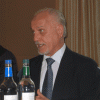
Big Oil to spend $25bn in Iraq Next Year
Posted on 11 November 2013 .
By John Lee.
Iraq's deputy prime minister for energy, Hussain al-Shahristani (pictured), has said that 'Big Oil' is about to spend over $25 billion next year to boost oil output towards record levels.
He predicted that the southern fields are expected to pump an extra 500,000 bpd in 2014, compared to just over 3 million bpd this year.
Additionally, Baghdad is increasing security at the smaller fields such as Najmah and Qayara -- operated by the Angolan company Sonangol in the al-Qaeda heartland of Nineveh -- and at the Akkas gasfield in Anbar, operated by South Korea's Kogas.
He told Reuters:
"We are definitely concerned about the upsurge in violence, but our concern is for the Iraqi people throughout the country. Iraq is trying its best to combat terrorism ...
"The security situation has not affected the oilfields in the south and central Iraq and we haven't noticed any hesitation or slow down in investment by the companies."
But Shahristani said he did not expect militants to inflict any lasting damage on Iraq's strategic oil network, which has helped generate revenues of nearly $60 billion this year.
"The security situation is not affecting our investment decisions," said an oil company source. "Iraq has such huge and easy to access resources: one way or another, the foreign oil companies will find a way to make money."
(Source: Reuters)
Posted in Iraq Oil & Gas News, Security 4 Comments
How Much Can Iraq Afford to Lose?
Posted on 01 August 2013 .
Amidst all the news of increased violence in Iraq, this week has seen many positive news stories, including a $700-million contract win for Daewoo at the Akkas gas field, and the shares of two oil explorers rebounding strongly.
But staying on energy matters, we cannot escape the continuing problem of reduced oil exports. Sabotage of the Kirkuk-Ceyhan pipeline, together with technical problems at the Southern ports, are keeping exports 500,000 barrels per day below budget.
That's roughly $50 million in lost revenue every day, $1.55 billion every month, or $18.25 billion over the year -- money that the Iraqi people cannot afford to lose.
Iraq needs a determined effort to solve these problems as a matter of urgency.
Posted in Blog, Iraq Oil & Gas News 6 Comments