


Good News For Foreign Investors in Iraq
Posted on 24 November 2010 .
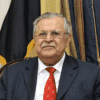
Iraq's newly-appointed President, Jalal Talabani (pictured), is apparently using his full allowance of 15 days to formally appoint a new Prime Minister, thus allowing the haggling over the details to continue. And while Nouri al-Maliki remains the 'agreed' candidate, we should never under-estimate the Iraqi parliament's ability to throw us a last-minute surprise.
If al-Maliki is appointed on Thursday as expected, he is then allowed 30 days in which to appoint a cabinet – based on progress thus far, we should not expect to see new name-plates on the doors much before Christmas.
Our information is that incumbent Oil Minister, Hussain al-Shahristani, will be re-appointed to that key position, but that other ministries are being hotly contested.
Also up for debate are the precise roles and powers of the National Council for Strategic Policy, to be headed by Ayad Allawi.
Foreign investors, meanwhile, can take some comfort from the creation of a new court to resolve disputes between foreign investors and Iraqi companies. If this is seen to operate in a fair and impartial manner, it should help to encourage foreign direct investment into the country.
But there is clearly more work for the new parliament to do in that area, especially with regard to the proposed new securities law, as our expert blogger Mark DeWeaver argues in his latest column.
If you're considering taking advantage of these new developments in Iraq, Upper Quartile and AAIB are here to help you. For more information please contact Gavin Jones or Adrian Shaw.
Posted in Blog, Iraq Industry & Trade News, Iraq Oil & Gas News Comments Off on Good News For Foreign Investors in Iraq
Three New Equity Funds in One Month
Posted on 04 November 2010 .
Project management specialists Parsons Brinckerhoff stated the obvious this week by saying Iraq is “risky, but full of opportunity”. After the war, the security and energy sectors were the most obvious risky opportunities. Re-building Iraq's decaying and war-torn infrastructure has come a close second. Since then, however, opportunities have snowballed into retail and agriculture, and broadened into education, pharmaceuticals and tourism.
Now the momentum continues as investment expands from direct corporate investment and private equity into the secondary market: the stock market.
Just days ago, Global Capital Investments announced its new Iraq Fund for listed equities, in addition to some private investment opportunities. Just like the businesses that invested earliest in post-war Iraq, it will be focusing on oil and infrastructure. In October, Invest AD launched a fund looking to take advantage of Iraqi equities as the country stabilises by entering the market early, and MerchantBridge launched its Mesopotamia Fund. That's three funds in the space of a month.
As usual then, there is a steady, inevitable stream of activity flowing towards Iraq. Take a look at Dr. Mark A. DeWeaver's economics blog and you'll see that as the world latches on to this excitement and piles into such a small stock market, it could bubble beyond all reason and burst before you know it. All the excitement of investing in a new and rapidly changing economy will be summarised in a few digits and ticker symbols on your screen.
If you are not in business in Iraq, risking the opportunities, whilst perhaps steadying your fever with some boring blue chip holdings, it may be that you are just in business with boring blue chips and are in need of adding some flavour. You could do this with a small holding in Iraqi listed companies on the ISX or the newer Erbil Stock Exchange which will start trading early next year, but, as we reported exclusively from Iraq, if you're not here, you're missing out on the real excitement.
Recent stock market blogs from Dr. DeWeaver:
- Iraqi Stocks Make New Highs
- How High can Iraqi Stocks Go?
- Will the ISX Join the Emerging Market Breakout?
If you're considering taking that step into the Iraqi market, Upper Quartile and AAIB are the perfect team to help you manage the risks and grasp the opportunities. For more information please contact Gavin Jones or Adrian Shaw.
Plus, keep an eye out for AAIB's new insurance service for tourists to Iraq, which will be launched in the coming days -- we'll bring you all the details as soon as we have them.
Posted in Investment Comments Off on Three New Equity Funds in One Month
Iraq Banks Told to Raise $7 Billion
Posted on 27 October 2010 .
The Central Bank of Iraq has instructed private banks to raise at least $7 billion in fresh capital over the next three years to be able to handle an expected oil-fueled construction boom, according to the Wall Street Journal.
Ahmed Ibraihi, Vice Governor of the Central Bank of Iraq, told the newspaper on Wednesday that these banks, numbering 32, now have a minimum capital requirement of 50 billion dinars each.
"We are taking these measures in order that companies which are implementing big projects in Iraq, including oil contracts, would start to deal with our banks," Mr. Ibraihi said.
[Click here to read Mark DeWeaver's take on the banks' new capital requirements.]
Iraq has clinched some 11 multi-billion dollar deals over the last 11 months with international oil companies to raise its crude-oil production capacity to 12 million barrels a day from the current 2.4 million barrels a day.
Mr. Ibraihi was in Istanbul to reassure the more than 20 international oil and gas companies who won these mega projects that they can deal with local banks to help them implement their projects in Iraq.
Posted in Construction & Engineering In Iraq, Iraq Banking & Finance News 1 Comment
Has Warka Bank Collapsed?
Posted on 20 September 2010 .
Speculation is rife that Iraq’s Warka Bank has collapsed, but its managing director said that it has not collapsed but has faced problems due to a recent decision of the Iraqi government to withdraw over $1.6 billion from the bank.
Our resident blogger on economic issues, Mark DeWeaver, recently reported on the mysteries of Warka's rights issue.
The Iraqi government recently decided to withdraw its money from all private banks, leading to media reports that Warka Bank had collapsed, according to a report from AKnews.
Speaking during a press conference in Sulaimaniya, Mohammed Hussein said, “Warka Bank has not collapsed. It is just some problems we are facing which will be resolved soon and we will resume our work in a better way.”
He said the Iraqi Trade Ministry owes $250 million to the bank but has failed to return the money because of the changes in the leadership of the ministry.
On his part, Dler Mohammed, the head of Warka’s branch in Kurdistan said the Iraqi minister of finance has agreed to give a loan of around $64 million to the bank.
He added several British and Lebanese companies have also agreed to buy shares in Warkaa but did not provide the names of the companies.
Mohammed said following the government’s decision, the Iraqi Public Vehicle Company withdrew around $680 million from the bank, and citizens withdrew around $1 billion.
“During talks with officials at Kurdistan’s Ministry of Finance, they promised us to return the pensions for retired government personnel to Warka Bank,” said Mohammed.
Warka bank was established in 1999 and currently is one of the largest private banks in Iraq with 120 branches all over the country.
Al Sumaria News quotes a spokesman for the bank as saying that the bank “is supported by the Central Bank of Iraq and can not talk about bankruptcy”, and added that the rumours were an attempt by the bank's competitors to tarnish its reputation.
(Sources: AKnews, Al Sumaria)
Posted in Iraq Banking & Finance News 4 Comments
Financial Sector Developing in Kurdistan
Posted on 13 July 2010 .
Both public and private sectors are working hand in hand to establish and develop a modern financial sector in the Region that can support the economic growth in the Region, measure up with international standards, and be connected to world markets, something that is key to the soundness and efficiency of this sector.
The sector is divided into two parts: the financial markets, where financial products are traded, and financial intermediaries--the banks--which channel funds among financial actors of the economy. In Kurdistan, currently there are efforts to develop both constituents of the sector.
There are plans to connect all the local banks and branches together and to the world financial system via the implementation of a modern electronic banking system; additionally, the Erbil Stock Exchange has officially been established, and its president and board members have been elected.
Regarding the banking sector improvements, director of Kurdistan Region's Harem Bank, Adham Karim Darwesh, says that after successfully completing the test period for the new system, the system will be implemented in all the Region's banks by the end of the year. An electronic system was implemented in four banks in Kurdistan for testing purposes, and it proved successful and practical, noted Darwesh.
"The electronic banking system is considered a development method to connect all the banks in the world," states Darwesh. "We have planned to expand other electronic systems in the local banks to further serve our customers in Kurdistan."
If this system is implemented, all the banks in the Region would be connected and transactions would become easy and smooth. The whole system would be connected to the international financial system, which allows customers of local banks to use their bank services all over the world, such as using their cards to withdraw cash from their Kurdistan bank accounts from automatic teller machines (ATMs) all over the world.
Kurdistan International Bank, a local bank operating on the Islamic banking system that has a number of branches in Kurdistan and Iraq, has signed a contract to design and implement a modern electronic banking system and to improve its services and facilitate access for customers via installing ATMs all over Iraq. There are currently 81 state and 53 private bank branches in Kurdistan Region, all of which will soon be using the new system.
Over the past few years and as the Region's economy has started growing fast, numerous banks have opened in the Region. Among those new banks, a number of foreign banks have also opened branches. In a recent development in that regards, three Turkish banks expressed their intention to open branches and launch services. This came as representatives of a number of Turkish banks visited Kurdistan Region along with the Turkish State Minister for Foreign Trade to participate in the KRG-Turkey Economic Forum.
Those bank branches are to support huge trade activities between Turkey and Kurdistan Region, which are expected to further increase after the visit of the Region's President Massoud Barzani to Turkey to meet with top Turkish authorities.
The representatives of the Turkish banks have applied for legal procedures to open their branches in the Region, and right now they are looking for buildings to open their offices, according to Kareem. "We encounter no issues with the Turkish companies, and some other banks have also applied to invest in the Region," he noted.
In an effort to develop the financial market of the Region, the shareholders of Erbil Stock Market Company met last week in Erbil to elect the board of directors and president after it finished the legal procedures of establishing the company.
The secretary of the high economic council of KRG, Izzat Mullah, states that the Kurdistan Regional Government has supported the idea and helped the establishment of the company to improve the economy of the Region.
"The KRG has continually insisted on creating an environment for local businessmen and traders to have shares in the local companies of Kurdistan," said Mullah. "Erbil Stock Market is possibly creating an opportunity for the local businessmen to use their money inside Kurdistan. On the other hand, it will be a secure place for the foreign investors to keep their money safe in Kurdistan." Currently, some local investors are investing their capital in foreign security markets due to lack of a stock market in the Region.
(Source: Kurdish Globe)
Posted in Iraq Banking & Finance News Comments Off on Financial Sector Developing in Kurdistan
Iraq's Risks and Rewards
Posted on 07 July 2010 .
The visit to Iraq last weekend by US Vice-President, Joseph Biden, may help to accelerate the process of forming the next government, but the frustrating delays in reaching an agreement highlight the risks of doing business in 'frontier' countries.
Often, though, our perception of risk can be out of step with reality, and what appears to be a safe blue-chip investment may be much more dangerous than was thought. So it was with many banks in developed economies over the past three years, for example.
As our regular contributor Mark DeWeaver points out, Iraqi banks may in fact be more secure than their counterparts in much of the rest of the world, as they have such low levels of lending. This lack of lending also has the effect of making the Iraqi economy less sensitive to interest rates, and more robust in the face of any tightening of liquidity.
Taking advantage of the huge opportunities afforded by the development of Iraq is not always easy, however. While funds are flowing into the country from all over the world, it ranks just 175th out of 183 countries surveyed by the World Bank for ease of starting a business.
For that reason, it's vital to get the best advice on risk management and business development. AAIB and Upper Quartile have all the experience you need to assist your business in Iraq – for more information please contact Adrian Shaw or Gavin Jones.

An Apocalypse with a Silver Lining
Posted on 27 May 2010 .
By Mark DeWeaver
Iraq faces a big downside risk from the European sovereign debt crisis—perhaps an even bigger risk than that of renewed sectarian violence.
While Iraq’s limited financial links to the outside world make it immune to contagion through the banking sector, sustained debt deflation in Europe would result in a big drop in oil prices. This would be bad news for the Iraqi economy, which is crucially dependant on oil to finance a state sector that accounts for the lion’s share of GDP and is the country’s largest employer.
 But the dark clouds that have gathered over Europe may yet have a silver lining—they make it much less likely that the Fed will be exiting its ultra-loose monetary policy any time soon. Nor are the odds of sustained European deflation really that high. What’s more likely is that the European Central Bank, faced with the alternative of having countries abandon the euro altogether, will try quantitative easing.
On balance, the effect of the crisis may well be positive for oil. While oil demand growth will obviously be slower than it otherwise would have been, since the end of 2008 oil prices seem to have been driven more by monetary conditions than anything else. (See chart)
This suggests that as long as the central banks continue to flood the world with liquidity the Iraqi economy should enjoy relatively smooth sailing.

Posted in Mark DeWeaver on Investments and Finance 1 Comment
Read our new Expert blogger on economics and finance starting this week
Posted on 26 May 2010 .
The sovereign debt crisis in Europe could be bad news for the Iraqi economy if it leads to a sustained bear market in oil. But a more likely outcome is that the crisis will cause central banks to continue their ultra-loose monetary policy, thereby benefiting Iraq by keeping oil prices high.
Our new expert Blogger, Dr Mark DeWeaver PhD, will take you on a fascinating journey as he negotiates the dangers and identifies the opportunities in this extraordinary emerging market which has such potential for investors. Read his first blog ‘An apocalypse with a silver lining’ here .
Profile
 Dr. Mark A. DeWeaver is a cofounder of Quantrarian Asia Hedge, an emerging markets fund focusing on listed equities and related index products. Established in 1999, the fund has taken positions in Thailand, Hong Kong, China, and Taiwan and is currently one of the largest foreign investors in the Iraq Stock Exchange. Dr. DeWeaver began his career as a research analyst in Shenzhen, China, where he worked from 1991 to 1995, first for W. I. Carr and later for Peregrine Brokerage. He received a PhD in economics from the University of Hawaii in 1998.
He can be contacted at [email protected]

Posted in Iraq Banking & Finance News, Mark DeWeaver on Investments and Finance 2 Comments

Investment Funds Start to Target Iraq
Posted on 12 May 2010 .
The business community in Iraq, and internationally, is focused on the task of rehabilitating the oilfields and re-building the country. This is hardly a surprise; quite apart from the investments to be undertaken directly by the oil companies, Iraq's National Development Plan foresees over $200 billion in investment in services, economic stimulus and environmental protection from 2010 to 2014.
For investors not directly involved in energy and construction, however, it has not been so easy to get exposure to the Iraqi economy. Yes, there is a stock market, but it is relatively small and companies tend to be thinly traded.
But as Mark DeWeaver, of Quantrarian Asia Hedge, points out, there are many parallels between Iraq and the frontier markets we have seen develop in recent years:
- Like Sir Lanka after 2001, a civil war is coming to an end;
- like Russia in the mid-‘90s, inflation has come down dramatically; and
- like Taiwan in the late-‘80s or, even better, Saudi Arabia ten years ago, exports are set to soar.
If that's really the case, and if the political factions can successfully conclude the ongoing election process in a peaceful and democratic manner, then it will be reasonable to expect the investment community to start taking more notice.
Both Northern Gulf Partners and Godvig Capital already operate Iraq-focused funds, while FMG's Special Opportunity Fund will soon give exposure to shares on the Iraqi stock market, in addition to shares in companies that derive a significant part of their business from Iraq. The fund can also hold Iraqi dinars, dollars, euros, and bonds.
Clearly this is at the high-risk end of the spectrum, and although the minimum investment is just $10,000, the fund is restricted to high-net-worth individuals. But if Iraq can stay on track this may be the first of many investment products to benefit from Iraq's future success.
Posted in Blog 2 Comments
A Perfect Storm for Iraqi Stocks
Posted on 11 May 2010 .
By Mark A. DeWeaver, of Quantrarian Asia Hedge
Two good rules for emerging stock market investors have always been: (1) buy crises and (2) buy export booms. The first would have worked well in Sri Lanka in the weeks following the Tamil Tiger suicide attack on the country’s main airport in July, 2001. Had you bought Sri Lankan stocks then and held them until February, 2007 you would have made about six times your money. Another case was Russia in April, 1995 when inflation was running at 229% and the communists seemed to have a good chance of winning the 1996 elections. By September, 1997, the market had gone up eight times as inflation fell to 13% and Yeltsin won another term as president.
As for rule two, consider the Taiwan market during the period from December, 1985 until February, 1990. The index rose about twelve times in local currency terms as exports doubled and the exchange rate strengthened from 40 to 26 New Taiwan dollars to the US dollar. Or more recently, think of the Saudi market, which went up ten times from December, 2000 to February, 2006 while exports tripled on increased oil production and a rise in the price from $30 to $70 a barrel.
Anyone trying to follow these two rules would find little to like about most of the emerging markets that make the headlines today. The crises (e.g. in the Chinese property sector) generally seem to be just beginning rather than nearing resolution while the export booms (e.g. in Brazilian resources) are for the most part old news. Surprisingly, however, one of the world’s least noticed markets not only combines features of all four of the above examples but is also open to foreign investors. Like Sir Lanka after 2001, a civil war is coming to an end; like Russia in the mid-‘90’s, inflation has come down dramatically; and like Taiwan in the late ‘80’s or, even better, Saudi Arabia ten years ago, exports are set to soar.
Yes, I’m talking about the Iraq Stock Exchange.
Blood in the streets
It’s easy to understand why Iraqi stocks aren’t on the radar screen of most foreign fund managers at the moment. While the third Baron Rothschild advised buying “when there’s blood in the streets,” no one wants that blood to be their own. And Baghdad, which is home to the stock exchange and the majority of the brokers and listed companies, remains a scary place to visit.
But conditions of travel for the investor aren’t really the best indicator of when it’s safe to invest. A more relevant signal is the fall in Iraqi civilian deaths from violence. At the height of the insurgency from mid-2006 to mid-2007, Iraq Body Count put the death toll at 2,500 – 3,000 a month. So far this year it’s been in the range of 200 – 300. While no one would argue that this is an acceptable state of affairs, it tends to be during just such transitions from the absolutely appalling to the merely awful that the big money in emerging markets gets made.
Naturally, things could get worse again. But this seems unlikely for the simple reason that restarting the sectarian civil war isn’t really in anyone’s interest. The Sunni insurgents effectively lost in 2007 and have no reason to expect a different outcome today. The Shia have found that political power is more likely to stem from the ballot box than the barrel of a gun (contrary to Chairman Mao’s famous dictum). And the Kurds are clearly better off as part of a unified Iraq than as citizens of an independent state that neither their neighbors nor, presumably, the US would recognize.
The threat from Al Qaeda-linked extremists seems to be receding as well. They no longer appear to have the capability to stage monthly mass casualty bombings—recently their attacks have only occurred every other month—and the deaths of the leaders of Al Qaeda in Iraq and the Islamic State of Iraq at the hands of Iraqi and American forces on April 18 may well turn out to be a turning point in the government’s “war on terror.”
From zero to hero
Equally important for stock market investors has been the drop in Iraqi inflation, which fell from 65% in 2007 to 6.8% in 2009. Year-on-year core inflation for February was just 3.35%. The currency has strengthened significantly as well—from 2,354 Iraqi dinars to the US dollar in April 2003, in the middle of the invasion, to 1,170 today.
This made it possible for the Central Bank of Iraq to lower its benchmark overnight rate from 20% in 2007 to 7% by the end of 2009. Effective April 1, this rate was cut again, to 6%, while at the same time the required reserve ratio was reduced from 25% to 20%. (The required reserve ratio is a percentage of deposits that commercial banks are required to hold as reserves at the central bank.)
Cuts in the central bank’s benchmark interest rate are particularly significant because cash, rather than loans, continues to be the biggest asset of the Iraqi banks. (Their main operating businesses consist of charging fees for services such as wire transfers.) Since there is little lending, either inter-bank or to nonfinancial companies and individuals, central bank reserves are the banks’ main source of interest income. Lowering the benchmark rate reduces this income stream, thereby forcing them to lend more.
While much of the rest of the world continues to deleverage, in Iraq the trend is thus in the opposite direction—from a state of practically zero leverage to one where the banks play their normal role as financial intermediaries. This is clearly positive for the stock market because a general increase in the supply of credit naturally means that more funds will be available for local investors to buy shares—either because they buy with borrowed money or because taking out loans frees up their existing cash holdings.
The coming oil bonanza
As if all this weren’t enough, Iraq is sitting on vast reserves of low-cost oil, which after three decades of war and sanctions remain largely unexploited. Since June of last year, international oil companies have won bids to develop over 10 million barrels a day in additional capacity. Added to current production of 2.6 million barrels a day in 2009, this new supply would allow Iraq to surpass Saudi Arabia as the world’s biggest producer.
While the Oil Ministry is hoping to get to this point in six years, many believe such a timeframe is unrealistic—for example, because it doesn’t allow enough time to build the pipelines and other facilities needed to transport such an enormous amount of oil. But even a doubling of Iraq’s oil output would still lead to a boom not unlike those experienced by the OPEC countries (including Iraq itself) during the 1970’s. The resulting fiscal surplus would quickly make its way into the economy via tax cuts, subsidies, and an increase in investment and salaries at the state-owned enterprises, which account for the lion’s share of Iraqi employment.
The effect on the stock market would be explosive. Rising oil exports would have a direct impact on the supply of funds available to speculators as repatriated US dollar revenues were converted into local currency. At the same time, listed company profits and dividends would rise rapidly as Iraq began a dramatic ascent from poverty to affluence.
A great story
The combination of reduced violence, increased leverage, and an impending oil windfall would seem to be a ‘perfect storm’ for Iraqi stocks. So far the market remains becalmed: the index is still at 2007 levels, recent daily trading values have been only about a million US dollars. But things could easily pick up long before the banks start lending or the new oil begins to flow.
Already a number of fund management companies are said to have started marketing the Iraq story to potential clients. It will be an easy story to tell—a crisis is ending and an export boom is beginning. And while there’s no way of knowing how much they will raise, in a pool of liquidity as small as the Iraq Stock Exchange even a relatively small inflow will seem like a storm surge.
Mark A DeWeaver, PhD, manages the hedge fund Quantrarian Asia Hedge (www.quantrarian.com), and can be reached at [email protected].
The opinions expressed here are those of the author, and do not necessarily reflect the views of Iraq Business News.
Posted in Blog 6 Comments