


Iraq's Southern Exports Hit 6-month High
Posted on 03 August 2011 .
Reuters reports that Iraq's oil exports from its southern ports jumped last month to a six-month high, reflecting efforts by foreign oil companies to boost production.
Exports from the Basra oil terminal and Khor al-Amaya averaged 1.77 million bpd in July, shipping data tracked by Reuters showed. That is the highest since 1.8 million bpd was exported from the south in January.
BP and CNPC have been developing the Rumaila field, where supply is running at about 1.3 million bpd, BP said last week, up from around 1.2 million bpd in May.
More Basra crude than normal is heading to Europe this and next month, according to trading sources, partly in response to a rise in the price of competing Russian Urals.
Iraq's exports overall actually fell in July from June. According to shipping industry sources, exports of Kirkuk crude shipped from the country's north averaged 445,0000 bpd, less than in June.
A senior Iraqi official on Monday cited growing local demand, because of hot weather, for the decline in exports overall.
Falah Alamri, head of Iraq's State Oil Marketing Organisation, said exports dipped to 2.164 million bpd from 2.275 million bpd in June as more crude was used domestically.
Posted in Iraq Oil & Gas News Comments Off on Iraq's Southern Exports Hit 6-month High

FMG Iraq Fund Reports First Year Results
Posted on 11 July 2011 .
The FMG Iraq Fund has grown by + 25% since it began in May 2010. Year to Date the fund is up + 10% and in the month of June it was up by an estimated + 4.1%.
The Fund invests mainly in stocks listed on the Iraq Stock Exchange (ISX) and to a lesser degree in off shore listed shares that derive a significant part of their business from Iraq.
Johan Kahm, founder of FMG, who visited Iraq in June 2011 and said upon his return:
“Iraq is turning the corner for the better. We are looking at a unique investment opportunity where we hope to make outsized returns over the next 5-10 years. Our decision to launch the Iraq Fund a year ago seems to have been well timed. Iraq sits as the third largest proven oil reserves in the world and has the potential to overtake Saudi Arabia as the world’s largest oil producer.”
Henrik Kahm, who is managing the Iraq Fund, said:
“Over the last year there has been a strong performance of the Iraq Fund thanks to the successful efforts to stabilise and rebuilt Iraq. The Fund offers investors an easy way to participate in the Iraqi growth story and is positioned to take advantage of the growth derived from post-war reconstruction and massive oil production expansion.”
The following facts are supporting the investment opportunities in the Iraq:
- Iraq is currently producing 2.7 million barrels of oil per day planning for 12 million by 2015.
- A country with 143 billion barrels of Proven Reserves - only 20% of Iraq has been explored for oil.
- Iraq has $46bn in Cash Reserves and growing.
- The Economy is expected to double (from $75bn to $150bn) by 2015. The new democracy is standing up well to its reconstruction challenges. $186 billion infrastructure spending plan. Should the price of oil be over $100 per barrel, then the infrastructure spending can be expected to increase significantly.
- Expected GDP growth of some 7% in 2011 (IMF).
- The current market cap of the Iraq Stock Exchange (ISX) is less than USD 4bn, compared to its neighbour Saudi Arabia, that has a market cap 85 times larger despite only 1.9 times more oil reserves.
- In 1995 FMG launched one of the very first Russia Funds and the early investors have now made 2000% returns. Today a similar opportunity has unfolded. Iraq is emerging as a very exciting frontier market.
Although usually only open to larger institutional type investors, FMG provides investors with the opportunity to invest with a minimum investment of US $10,000. (£6,000)
Investment into the Iraq Fund is an attractive proposition for UK investors, as gains will be taxed as capital gains at 28% and not as income tax rate at 50% as the fund has Her Majesties Revenue and Customs “Reporting Status”.
Previously called the FMG Special Opportunity Fund it has now been renamed due to the nature of the investments as the FMG Iraq Fund.
(Source: FMG)
Posted in Investment 2 Comments

Iraq - The Model ….. for Democracy and Private Sector Development
Posted on 26 June 2011 .
By Gavin Jones, Director of Iraq Business News, and Partner at consultancy firm Upper Quartile.
"Something we could not have predicted five months ago is that Iraq would emerge as the most advanced Arab democracy in the entire region. As messy as it is, when you think back to the months and months that it took to form a government, and the fact that the conflict was political, they weren't in the streets shooting each other. The government wasn't in the streets shooting its people." Bob Gates, US Defense Secretary.
Well, well ……………. given all the soul searching and some of the appalling misjudgments by various Governments involved in the reconstruction of Iraq followed by some the comments then made by the press over the management of the country by the Iraqi Government maybe the cynicism in the West is becoming a bit more muted.
Looking back to all the press speculation at the various game changing decision-points in the country’s development over the last 5 years it is astonishing how wrong all the experts were and – in many cases – still are. We have hosted Iraqi delegations to the UK on a number of occasions – on the first one a delegation of international oil companies dedicated time to explaining to the Iraqi Government that Service Agreements would never work; explaining (carefully) that if the Iraqi Government were looking to much-needed investment, they needed to come into line with the rest of the world and award Production Sharing Agreements (PSA’s) - or the international oil industry would walk right on by and invest elsewhere.
The press presented the 1st license round as a failure by the Iraqi Government who only allocated one license out of the ten bid ………… and publically forced BP to reduce their bid from $3.99 per barrel to $2. BP was hammered in the press for agreeing to take such a cut and the press talked about the oil community by-passing Iraq.
Where are we now; all licenses are awarded; BP’s agreement looks pretty shrewd with other service agreements being awarded at $1.39 per barrel and $1.15 in much smaller fields. And they are all there – Americans, Korean’s, Russians, Malaysia – and all contracted as service companies to the Iraq Government.
We watch the International Oil Companies - so used to being top-dog – coming to terms with their role of a sub-contractor …………. and some are taking a long time to adjust to this position.
The next issue to unfold will be whether Iraq holding out is going to change the way oil-rich countries allow companies to operate in their country is going to become embedded ………… eyes on Libya!
What Mr. Gates was in effect saying is that Iraq as a democtatic model is a potential bulwark for American interests in the Gulf. The private sector is piling in with eye-watering levels of investment - the Press (still) won't acknowledge that Iraq is looking pretty good but - generally: mission accomplished.
It leaves the question as to why the interventions in Libya are based on principles learnt in Afghanistan; it’s the wrong model stupid! Learn from Iraq ..... not Afghanistan.
Posted in Blog, Politics, Security Comments Off on Iraq - The Model ….. for Democracy and Private Sector Development

Eni Confirms Probe into Alleged Bribes
Posted on 26 June 2011 .
The Italian oil company Eni, and its Saipem subsidiary, said in a statement Wednesday that they are the injured parties in an investigation into alleged bribes related to contracts in Kuwait and Iraq.
BusinessWeek says Milan prosecutors are investigating whether executives took bribes from Italian engineering and construction firms for subcontracts in Iraq's Zubair oil field and Kuwait's Jurassic fields.
Mario Reali, the former head of Eni offices in Russia, told investigators about alleged payoffs related to contracts in Kazakhstan, and this led investigators in Milan to look into similar allegations related to the Jurassic oil field in Kuwait and the Zubair oil field in Iraq, Italian news agency Adnkronos International reports.
Eni said it has taken "immediate disciplinary and precautionary action against the individuals involved," and that it would take any necessary action to safeguard its own "interests and reputation."
Eni identified the two employees under investigation as an Eni manager in Iraq and a Saipem executive in Italy involved in a project in Kuwait. Eni confirmed their offices have been searched.
News reports said three mediators also were under investigation.
Eni and Saipem -- an oil contractor -- also are under investigation as entities that benefited from the alleged crimes.
Eni leads a consortium developing the Zubair oil field in Iraq, while Saipem has a contract for oil and gas treatment facilities in Kuwait.
(Sources: BusinessWeek, UPI)
Posted in Iraq Oil & Gas News Comments Off on Eni Confirms Probe into Alleged Bribes
Five Firms Shortlisted for West Qurna 2
Posted on 22 June 2011 .
Reuters reports that Iraq and its partners, Russia's LUKoil and Norway's Statoil, have shortlisted five companies to compete for the West Qurna Phase Two oilfield development contract.
An Iraqi oil official who asked not to be identified said on Tuesday that the oil service companies selected are Saipem , SNC Lavalin Group Inc , Punj Lloyd Ltd , Globalstroy Engineering and South Korea's Samsung Engineering.
"We are studying the commercial offers and we expect to select a winning company within two weeks," the official said.
Last September, Iraq and its partners issued four tenders for construction and energy projects at West Qurna II, a 12.9-billion-barrel supergiant oilfield in southern Iraq.
The official said seven companies submitted bids, but that two, Petrofac Ltd and Technimont, were rejected. He did not offer any reason for their exclusion.
The four tenders are for the construction of an oil export pipeline; a tank farm at Tuba; a power distribution station and an associated gas processing plant; and an oil gathering system, central processing facilities and a water supply system.
The tenders are part of the initial development plan set by LUKOIL and Statoil and approved by Iraq's oil ministry last year to start production at the untapped oilfield.
They are expected to help production at the field hit 150,000 barrels of oil per day (bpd) in January 2013, the Iraqi oil official said.
West Qurna Phase Two operator LUKOIL is selecting one company to work on an Engineering, Procurements and Construction contract (EPC) for building oil facilities.
(Source: Reuters)
Posted in Iraq Oil & Gas News Comments Off on Five Firms Shortlisted for West Qurna 2
Schlumberger Wins Gazprom's Badra Drilling Contract
Posted on 22 June 2011 .
Gazprom Neft has chosen Schlumberger to drill the first wells in the Badra oil deposit development project in Iraq, reports Oil Voice.
The contract will last three years, and will involve three drilling rigs, with the drilling of the first appraisal and development wells expected to be completed in early 2012.
A total of 11 wells are to be drilled over the three-year period, including one exploratory and three appraisal wells, which will later be converted into operating well stock.
The Badra oil deposit is located in the Wassit Province in Eastern Iraq with estimated reserves of 3 billion barrels of oil. The contract to develop the Badra oil deposit was signed with the Iraqi Government in January 2010 following a tender in December 2009.
Gazprom Neft, the oil arm of Russia's Gazprom, signed a deal for the Badrah field in January 2010 following a tender in December 2009, along with partners TPAO, KOGAS and Petronas.
The consortium is to invest $3.52 billion. Gazprom Neft holds 30 percent, KOGAS 22.5 percent, Petronas 15 percent, TPAO 7.5 percent and the Iraqi Oil Exploration Company (OEC) 25 percent.
Oil production at the deposit is expected to begin in 2013. Production is expected to reach 170,000 barrels per day (around 8.5 million tonnes a year) by 2017 and remain at this level for seven years.
Gazprom Neft completed a 3D field seismic survey at the deposit in early May 2011. The preparation of the front end engineering design (FEED) will be completed in summer 2011.
(Sources: Oil Voice, Iraq Energy)
Posted in Iraq Oil & Gas News Comments Off on Schlumberger Wins Gazprom's Badra Drilling Contract
Iraq Must Regulate Private Security Firms - UN
Posted on 17 June 2011 .
A UN working group said on Thursday that Iraq should tightly regulate private security firms to prevent abuses by their employees when they stay on in the country after a scheduled U.S. military withdrawal.
While the number of incidents involving private military and security companies in Iraq has decreased in recent years, the Government should continue to regulate and monitor their activities, a group of independent United Nations human rights experts said today.
“Providing security to its people is a fundamental responsibility of the State,” noted Faiza Patel, a member of the UN Working Group on the use of mercenaries, which just concluded a visit to the country.
“Outsourcing security creates risks for human rights and the Iraqi Government must remain vigilant and devote the necessary resources to ensure that security companies – whether international or Iraqi – are stringently regulated and that they respect the human rights of the Iraqi people.”
The recent decline in the number of incidents is attributed to several factors, including the decrease in the military-related activities of such companies in Iraq, stricter regulation by the Iraqi authorities, and United States efforts to tighten oversight of its private security contractors operating in Iraq.
“Despite this decrease in incidents, Iraq continues to grapple with the grant of legal immunity extended to private security contractors,” states a news release issued by the Group. This immunity prevented prosecutions in Iraqi courts. In addition, prosecutions in the home countries of such companies have not been successful.
The Group welcomed the fact that the 2009 Status of Forces Agreement (SOFA) between Iraq and the US contains a provision removing the immunity of some private foreign security contractors in Iraq.
“It is not clear, however, whether this removal of immunity covers all contractors employed by the United States Government and whether it is fully applied in Iraqi courts,” they said.
Among its recommendations, the experts urged the Iraqi Government to prioritize the adoption of legislation regulating security companies that has been pending since 2008.
The Working Group, which reports to the UN Human Rights Council, is composed of five independent experts serving in their personal capacities: José Luis Gómez del Prado (Chair-Rapporteur, Spain), Faiza Patel (Pakistan), Alexander Nikitin (Russia), Amada Benavides de Pérez (Colombia) and Najat al-Hajjaji (Libya).
(Sources: Reuters, United Nations)
Posted in Security Comments Off on Iraq Must Regulate Private Security Firms - UN
A Russian suitor for Warka?
Posted on 01 June 2011 .
In March ISX-listed Qimma Financial Investment (VQUF) announced that Warka Bank’s majority shareholder, Saad Al Bunnia, had appointed it to “begin a formal auction process following a due diligence report carried out by Price Waterhouse Coopers.” The announcement, which was posted on Qimma’s website, went on to say that Mr. Bunnia was “interested in entertaining offers” from banking groups “such as Russia’s Alfa Bank or UK-based Standard Chartered.” (Hat tip to “Kickabuck” for sending me this link.)
It’s hard to know what to make of this. For starters, while the one-paragraph announcement is worded like something copied from a news agency, it does not appear to have appeared anywhere else. Oddly, it also does not even explicitly say what Mr. Bunnia is selling, though presumably this would be a majority stake in the bank. And if an auction were being organized, you’d think that Warka itself would have made some official statement to this effect.
The mention of Alfa Bank as a possible buyer gives the story a ring of truth however. It seems a funny thing for someone to make up—why not just claim that Citibank might bid? And it’s also easy to believe that the Russian lender would be interested in an Iraqi acquisition. With cash and book equity both over USD 3 bn at the end of 2010, it shouldn’t be hard for it to take up the unsubscribed shares from Warka’s failed rights issue. (There's more on the rights issue here and here.) Its owners should also have little trouble seeing opportunity in a country that, like Russia in the 1990s, has huge unexploited oil reserves and is in the midst of becoming reintegrated into the global economy.
Another point in favor of the story: Alfa Bank is not without Iraqi connections. It has a close relationship with Russian natural gas giant Gazprom, which leads the consortium that won the Badra oil field concession in 2009. In 2002, the two companies entered into a strategic cooperation agreement including, among other things, “the implementation of joint projects,” “provision of short-term financing to Gazprom,” and “the participation of Alfa Bank in project financing schemes for Gazprom.”
For over a year, rumor had it that Standard Chartered would be taking over Warka. After such a long time, however, you have to wonder if perhaps the British bank isn’t really that interested after all. Could a Russian bank turn out to be a better match?
Posted in Investment, Mark DeWeaver on Investments and Finance Comments Off on A Russian suitor for Warka?
Iraq Serious About Education
Posted on 25 May 2011 .
Iraq is not just a nodding donkey.
The country's progress can be seen not just in its growing population of oil wells, nor even merely in its breeding building sites. It can also be admired in its rapid expansion in education.
Najaf, a city of around 600,000 people south of Baghdad, is to build 15 more schools, according to the National Media Center. Although three have funding from the World Bank, most are local government projects.
Basra University has entered into a joint agreement with the University of Oregon in the USA. This will help develop English language skills, as well as bringing petroleum engineering and geology to Basra, Iraq's largest port town with two million inhabitants.
Al Muthanna University in Samawah, a city south-east of Baghdad with a population of around 130,000, is teaming up with Russian universities for a scientific and cultural exchange. The Russian universities are Altai State Technical University, Ufa State Petroleum Technological University, and the Moscow State Geological University.
Iraq is also renewing academic ties with Egypt, reports AKnews. Egypt is going to open branches of its universities in Iraq, and the two countries are going to exchange visits of students and teachers.
(Sources: National Media Center; AKnews; Encyclopaedia Britannica)
Posted in Iraq Education and Training News Comments Off on Iraq Serious About Education
Heritage Oil Issues Interim Management Statement
Posted on 18 May 2011 .
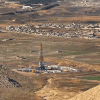
Shares in Heritage Oil Plc (LSE: HOIL), the independent upstream exploration and production company with operations in Iraqi Kurdistan (pictured), were unchanged on Wednesday following the release of its interim management statement.
Highlights
- Rig contract to drill the Miran West-3 well in the Miran Block, Kurdistan, was signed in April and the well is scheduled to spud in July 2011
- Exploration drilling to commence on Miran East in Q4 2011
- 3D seismic survey over the entire Miran structure is ongoing
- 2D seismic survey is planned to cover southern parts of the Miran Block
- Work programmes progressing in Tanzania, Mali and Malta
- Development scenarios are being reviewed for Kurdistan which include phased development of oil, condensate and gas to satisfy local markets/end users and address export options
- Drilling operations have commenced on the first horizontal well in the Zapadno Chumpasskoye Field, Russia, which is expected to provide a material increase in production
- Production in the first quarter of 2011 averaged 431 bopd
- Share buy back programme has begun with 2,070,631 Ordinary Shares acquired to date and held in treasury
- Arbitration proceedings have commenced in London against the Government of the Republic of Uganda (the "Ugandan Government")
- Annual General Meeting to be held on 20 June 2011
Posted in Iraq Oil & Gas News Comments Off on Heritage Oil Issues Interim Management Statement