



Share Price Prompts Heritage Oil Buy-Back
Posted on 26 April 2011 .
Heritage Oil Plc (LSE: HOIL), the independent upstream exploration and production company with operations in Iraqi Kurdistan, has announced that it is commencing with immediate effect, a buy back programme to spend up to $100 million to acquire its Ordinary Shares, as the Board of Directors (the "Board") considers that the current share price is trading at a significant discount to the intrinsic, underlying value of the Company.
Heritage shareholders passed a resolution at the last Annual General Meeting on 17 June 2010, allowing the Company to buy back up to 28,786,693 Ordinary Shares, representing approximately 10 per cent. of the Company's voting share capital. Heritage has been unable to commence a buy back programme until now as the Company has been in trading black-out for either operational or corporate reasons since the resolution was passed.
With the regulatory black-out having been lifted, the Board is now implementing with immediate effect, a share buy back programme of up to $100 million. Heritage announced recently that it had approximately US$600 million of cash at year end, excluding amounts reserved in connection with the tax dispute in Uganda. The Board, which collectively owns over 30% of the share capital, believes that the buy back of shares is a worthwhile investment and in the best interests of the Company and its shareholders.
The Company has a strong balance sheet with which to make the purchases whilst also progressing with current work programmes and continuing to seek further opportunities to add value. The Company is actively identifying prospects in 2011, through acquiring or processing seismic in Tanzania, Mali and Malta whilst also continuing with the appraisal of the Miran field in Kurdistan. Further wells will also be drilled on the Zapadno Chumpasskoye Field in Russia which could add a material increase to production levels.
Tony Buckingham, Chief Executive Officer, commented:
"The sale of the Ugandan Assets in 2010 has provided Heritage with a strong balance sheet and available cash. The recent share price performance following the discovery of the Miran gas field in Kurdistan neither reflects the underlying value of the assets nor our belief in the longer term prospects of the Company. The buy back of shares is in the best interests of the Company and its shareholders."
Posted in Iraq Oil & Gas News Comments Off on Share Price Prompts Heritage Oil Buy-Back
Badra Oil Field - First Phase Started
Posted on 25 April 2011 .
The Russian Gasprom Oil Company has began implementing the 1st phase of southeastern Iraq’s Badra oil field in Wassit [Wasit] Province, the Province’s Media director said on Sunday, according to Aswat al-Iraq.
“Gazprom’s team charged with executing the Badra oil field, 90 km to the east of Kut, has began the first phase of implementing the project,” Majid al-Itaby told the agency.
He said the first phase of the project has covered the ending of the engineering plans and the geological survey, to extract oil at the beginning of next year.
“Iraq’s South Oil Company had signed a contract with four international oil companies -- the Russian Gazprom, Turkish TPO, Korean Kogas and the Malaysian Petronas -- to develop the Badra oil field for U.S.$100 millions,” Itaby said, adding that the Company would extract oil from a 170 square km area in Badra township.
(Source: Aswat al-Iraq)
Posted in Iraq Oil & Gas News Comments Off on Badra Oil Field - First Phase Started
Czech Republic may sell combat jets to Iraq
Posted on 19 April 2011 .
The Czech Republic is planning to offer Iraq a number of light attack aircraft and help Baghdad to modernize its helicopter fleet, Czech Foreign Minister Karel Schwarzenberg said, according to a report from the Russian news agency RIA Novosti.
Czech Prime Minister Petr Necas will visit Iraq on May 23-24 to promote closer economic cooperation with Baghdad and sign an agreement on mutual protection of investments.
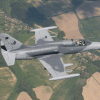
"The Czech Republic will offer Iraq L-159 combat aircraft (pictured), and we are also ready to take part in the upgrading of Iraqi helicopters," Schwarzenberg said on Monday after a meeting with Iraqi Foreign Minister Hoshyar Zebari in Prague.
The single-seat L-159 ALCA is a light multi-role combat aircraft designed for a variety of air-to-air, air-to-ground and reconnaissance missions.
The jet was developed in the late 1990s by Aero Vodochody on the basis of the proven airframe design and aerodynamic configuration of the L39 Albatros and L59 family of combat trainers.
The aircraft is equipped with an advanced multi-mode radar for all-weather, day-and-night missions and can carry a wide range of NATO-standard payloads including air-to-air and air-to-ground missiles and laser guided bombs.
The Czech Defense Ministry announced in January that it planned to sell 36 L-159 ALCAs that the Czech military does not need.
(Source: RIA Novosti)
Posted in Iraq Industry & Trade News, Security 1 Comment

Heritage Oil Down 4% Following Final Results
Posted on 19 April 2011 .
Shares in Heritage Oil Plc (LSE: HOIL) fell 4% this morning following the announcement of its results for the twelve months ended 31 December 2010.
All figures are in US dollars unless otherwise stated.
2010 Operational Highlights
· Discovered the largest gas field in Iraq in the last 30 years
· Highly productive Jurassic reservoir intervals tested in the Miran West-2 well at a restricted cumulative flow rate of over 75 million cubic feet per day ("MMscfd")
· Estimated gross P90-P50 in-place volumes of 6.8-9.1 Trillion Cubic Feet ("TCF"), with a P10 upside of 12.3 TCF for Miran West
· Management estimates Heritage has mean net risked contingent and prospective resources in Miran West and Miran East of 744 million barrels of oil equivalent ("MMboe"), based on a 75% working interest
· Miran development options being considered with first export production targeted for 2015 using planned regional infrastructure
· Achieved nearly a twelvefold increase in contingent resources from 53 MMbbls to 605 MMboe following the successful testing of hydrocarbons
· Completed 3D seismic acquisition offshore Tanzania; data currently being processed
· Further development work in Russia, production increased 65% in 2010
2010 Financial Highlights
· Completed the disposal of interests in Block 3A and Block 1, Uganda, (the "Ugandan Assets") for which Tullow Uganda Limited ("Tullow") paid a cash consideration of $1.45 billion, including $100 million for a contractual settlement, and Heritage received and retained $1.045 billion
· Cash at year end of $598 million
· Special dividend of 100 pence per share paid in August 2010
Outlook
Posted in Iraq Oil & Gas News Comments Off on Heritage Oil Down 4% Following Final Results

Iraqi Dinar Revaluation Enthusiasts are Unaware of Bernie Madoff’s Fame
Posted on 29 March 2011 .
By Tom Cleveland, market analyst for Forex Traders, exclusively for Iraq Business News. Forextraders.com is an online resource for the foreign exchange market.
“Buy on the rumor, sell on the news” is a time-honored investment phrase that is oftentimes more confusing than the wisdom it attempts to impart. The meaning relates primarily to company securities that appreciate in expectation of a big news announcement. Early speculation drives ups the price, such that when the real announcement is made, most investors sell on the news to take their profits, often driving the price down, rather than up. “Pump and Dump” stock frauds also follow a similar scenario, but in this case, criminals benefit and investors lose.
A similar situation has been building for years, some say as many as eight years, surrounding the potential “revaluation” of the Iraqi Dinar. As the rumor would have it, the Iraqi economy has stabilized, and the potential for enormous foreign currency reserves from increased oil exports will drive the value of the Dinar to unconscious levels versus the U.S Dollar. The government authorities will be forced to revalue the currency from 1,175 to 3 per Dollar, resulting in an outrageous windfall for anyone owning stockpiles of the currency. Does something here sound a little too good to be true?
In actuality, the Iraqi Dinar, or “IQD”, is a “controlled” currency. The central bank of Iraq determines the exchange rate and must support that rate by maintaining adequate foreign currency reserves to handle capital flows across its borders. The IMF permits countries with a transitional economy to implement currency controls in order to stabilize their economy during its redevelopment phase. Presently, international banks will not accept the Dinar, and it is not traded on any forex exchange. Actual purchases can be made through currency dealers that have been authorized to buy and sell banknotes that are already in circulation.
Posted in Iraq Banking & Finance News 702 Comments

French Grain Lobby Targets Iraq
Posted on 15 March 2011 .
Reuters reports that France's grain export lobby has invited an Iraqi delegation to visit the country as it tries to break into what has become one of the world's major wheat import markets.
The move followed the signing last year of a letter of intent between France Export Cereales and Iraq's grain board on establishing cooperation.
Jean-Pierre Langlois-Berthelot, president of the export lobby, told the Reuters Global Food and Agriculture Summit, "it's a very important market in this region. We have to be there [Iraq]".
France Export Cereales is confident French wheat will meet an official forecast for record shipments of 12.6 million tonnes outside the European Union this season, which would leave the country with adequate stocks of 2 million tonnes, he said.
French wheat has benefited this season from the absence of Russia and to some extent Ukraine in export markets after drought hit their harvests last year.
Langlois-Berthelot said rising food demand in Africa offered strong long-term export prospects but that the French grain sector would have to improve quality criteria such as moisture and protein levels in order to compete.
(Source: Reuters)
Posted in Agriculture, Iraq Industry & Trade News Comments Off on French Grain Lobby Targets Iraq

Former Austrian Chancellor: EU Should Source Energy in Kurdistan
Posted on 17 January 2011 .
In a recent interview on EU's energy security with World Security Network Foundation (WSN), former Austrian Chancellor Dr. Wolfgang Schüssel (pictured) said that Europe should also diversify sources of energy supply by looking, for instance, to the Kurdish Region of Iraq.
Europe is heavily dependent on Russia for its energy supply, especially natural gas, which was described by Schüssel as “a reliable and serious partner, but also sometimes a tough partner”.
Kurdistan has been described as a major supplier of natural energy, but instability in Iraq and disputes between the regional and federal government could make it difficult for supplies from the region to reach Europe.
Currently, Kurdistan has a capacity of 100,000 bpd and is expected to develop its fields to increase the output to 200,000, according to the Kurdistan Regional Government's (KRG) Minister of Natural Resource, Ashti Hawrami, according to AKnews.
Based on Hawrami's statement, the Iraqi government has included a provision in the 2011 budget of Iraq binding the KRG to exporting 150,000 bpd or the region's 17% share in the general budget will be cut accordingly. Kurds have rejected the bill.
Europe needs additional pipelines and alternative energy sources. The Kurdish part of Iraq may become alternative partner of Europe, explained Dr. Schüssel.
(Source: AKnews)
Posted in Iraq Oil & Gas News Comments Off on Former Austrian Chancellor: EU Should Source Energy in Kurdistan
Iraqi Drilling Company Plans 76 Wells in 2011
Posted on 15 January 2011 .
Iraq's state-run Iraqi Drilling Company plans to drill 76 wells in 2011 as part of a national effort to boost oil output to more than 200,000 barrels per day, the head of the firm said on Friday.
According to Reuters, the firm's director, Idrees al-Yassiri, said the plan included drilling more than 15 wells at the Nassiriya oilfield, which would help boost output from the field by 50,000-60,000 bpd.
"Our plan for 2011 is ambitious. We have enough energy to accomplish it ... The increase in production through the national effort will be more than 200,000 bpd through 2011," he said in a news conference.
The national effort includes drilling new wells in oilfields Iraq is developing on its own, including some of its giant fields like Nassiriya and East Baghdad.
Yassiri said the Iraqi Drilling Company would also drill wells for oilfields being developed by global oil companies.
"We will drill 23 wells for ENI at the Zubair oilfield and 20 wells for ExxonMobil in West Qurna (Phase One)," he said, adding the company will drill 15 wells as part of a consortium in Majnoon oilfield, which is being developed by Royal Dutch Shell.
"Drilling operations for foreign companies will add close to 150,000 barrels per day in 2011," Yassiri said.
The company has also submitted a bid for a tender to drill 23 wells in West Qurna (Phase Two), which is being developed by Russia's LUKOIL, Yassiri said, adding the development plan for the field included drilling 75 wells in the next two years.
(Source: Reuters)
Posted in Iraq Oil & Gas News Comments Off on Iraqi Drilling Company Plans 76 Wells in 2011
2 Sub-Contracts Awarded at Badra Oilfield
Posted on 06 January 2011 .
Two new sub-contracts have been granted for two local companies to participate in developing the Badra oil field in southern Iraq’s Wassit Province, Aswat al-Iraq reports on Thursday.
“The Russian Gasbromneft Company [Gazprom Neft], which won the contract to develop [the] Badra oil field, 90 km to the east of Kut ... has decided to grant two sub-contracts for two local companies to participate in the development works of the oil field,” a source told the news agency.
He said the Russian company had also granted “the local Arab Gulf Company, to carry out the works of eliminating mines and war remnants from the oil field’s site and its surrounding areas”. The work is expected to continue until May.
“Another Iraqi company, specialized in oil and gas excavation works, was granted a sub-contract to carry out seismic works at the Badra oil field, to continue till April next,” he said.
Badra is planned to produce 15,000 barrels of oil per day (bpd) by the year 2013, according to the contract concluded between the company and the Iraqi Ministry of Oil.
(Source: Aswat al-Iraq)
Posted in Iraq Oil & Gas News 1 Comment
Who's Who in the New Iraqi Cabinet
Posted on 20 December 2010 .
The following profiles of the top ministers ihttps://www.iraq-businessnews.com/wp-admin/post.php?post=14895&action=edit&message=10n the new Iraqi cabinet are based on information from Reuters and Associated Press:
-Prime Minister: Nouri al-Maliki, Shiite, the current premier.
Al-Maliki, 60, was first installed as prime minister as a compromise candidate in 2006 but barely hung onto the job this year when his political coalition fell short of winning the most seats in national elections. Born in 1950 in Hindiya, he holds a master's degree in Arabic and worked at the education ministry before fleeing Saddam Hussein's regime.
-President: Jalal Talabani, Kurd, also currently in office.
With his trademark grin and walrus mustache, Talabani, 77, has positioned himself as a father figure for Iraq. Despite holding a largely ceremonial post, he has flexed political muscle on some issues. He is viewed with suspicion by some Iraqis who believe the president should be an Arab.
Talabani was born near Arbil in northern Iraq in 1933 and became a lieutenant to Mullah Mustafa Barzani, patriarch of Iraqi Kurdish nationalism and founder of the Kurdistan Democratic Party. He split from the KDP in 1974 and formed his own party, the Patriotic Union of Kurdistan, in Damascus the following year. Talabani became Iraq's first elected president in more than 50 years in April 2005 and was selected again in April 2006 as a national unity government was put together.
-Parliament Speaker: Osama al-Nujaifi [Usama al-Najafi], Sunni.
Al-Nujaifi and his brother, Ninevah Gov. Atheel al-Nujaifi, are two of the most powerful Sunni Arabs in Iraq's north and have taken hardline positions against Kurdish power in Mosul. The 54-year-old speaker was born in Mosul and has a degree in electric engineering.
-Deputy prime minister: Saleh al-Mutlaq, Sunni.
The contentious anti-Iran Sunni lawmaker was banned from running in 2010 elections because of alleged ties with Saddam Hussein's disbanded Baath party, but allowed this week to resume his political life under a government power-sharing agreement. He was born in Fallujah in 1947.
-Deputy Prime Minister for Energy: Hussain al-Shahristani, Shiite.
The current oil minister will oversee Iraq's lucrative energy industry in his new post. Al-Shahristani was imprisoned for years during Saddam Hussein's regime. He opposed oil deals signed by Kurdistan government. Born in 1942 in Karbala, and a nuclear scientist by training, he studied in Britain, Russia and Canada.
-Foreign Minister: Hoshyar Zebari, Kurd, currently in the same post.
Articulate and accessible to reporters, Zebari, 64, has worked with American officials for years, going back to when he was the foreign spokesman for the Kurdistan Democratic Party. He speaks fluent English. He was born in the northern Kurdish town of Aqra, near Mosul.
-National Council for Strategic Policies Chairman: Ayad Allawi, Shiite.
The Shiite former prime minister's alliance won the most seats in the March election with strong Sunni support. Born in Baghdad in 1946, Allawi abandoned the Baath party in 1975 and escaped an assassination attempt by Saddam agents in 1978 while he was in London.
-Finance minister: Rafia al-Issawi [Rafie al-Essawi], Sunni.
He is currently serving as a deputy prime minister. He was a fierce critic of U.S. troop activity during the first major battle of Fallujah in 2004 when he was serving as director of the city's hospital, claiming more than 600 people - half of them women and children - were killed in the fighting.
- Oil Minister: Abdul Kareem Luaibi
Born in the Iraqi capital in 1959, Luaibi graduated from the University of Baghdad with a bachelor's degree in oil engineering. He was hired by the government as an oil engineer with the South Oil Company in 1982.
Luaibi worked with the Midland Refinery Company, another Oil Ministry affiliate, from 1993 to 1999 and moved to the technical department of the ministry in 2006. He moved up the ranks quickly, to inspector general, from 2007-09, and then as deputy minister in March 2009.
Luaibi is known to have good relations with international oil companies. He led most of the talks in the first and second bid rounds for Iraq's oilfields and signed many of the contracts with global majors.
(Sources: Reuters, Associated Press)