


Iraq Plans New Licensing Auction for 3 Gas Fields
Posted on 15 April 2010 .
15 April 2010 ( Dow Jones )
The Iraqi Oil Ministry is planning to hold this year a third licensing auction to develop three discovered gas fields Akkas, Mansouriya and Siba, a senior official at the ministry said Wednesday.
Abdul Mahdy al-Ameedi, director-general of the Ministry's Petroleum Contracts and Licensing Directorate, told Dow Jones Newswires that out of the 44 international companies pre-qualified for last year's first and second bidding rounds, only 15 will be invited to submit bids for the gas fields.
He didn't name them, but described them as "the large integrated firms which can develop both oil and gas fields and those specialized in developing gas fields."
Ameedi said he expected the licensing auction for these three fields to take place by the end of this year. The Oil Ministry is offering a 20-year long technical service contracts similar to those awarded during the first and second bidding rounds.
Iraq awarded 10 oil deals to international companies during the first and second bid rounds last year with the aim of boosting its crude oil production to 12 million barrels a day in six to seven years. Iraq is currently producing 2.4 million barrels a day.
Among the companies which won oil deals are Royal Dutch Shell PLC, BP PLC, Exxon Mobil Corp, Italy's giat Eni SpA, Russia's Lukoil OAO France's Total, Japan Petroleum Exploration Co., China National Petroleum Corp. and Malaysia's Petronas.
Both Akkas and Mansouriya fields were included in the first bid round last June.
A consortium led by Italy's Edison SpA, which was the sole bidder for the 4 trillion-cubic-feet untapped Akkas field in the western Anbar province, was rejected because it sought $38 for each extra barrel of oil equivalent produced while the ministry offered a maximum fee of $8.50 a barrel.
None of the 33 participating companies submitted a bid for the untapped 3.3 trillion-cubic-feet Mansouriya gas field located in the restive Diyala governorate in eastern Iraq.
Siba gas field, with estimated proven reserves of more than 3 billion cubic meters in Basra governorate near the border with Iran, was dropped from the list of oil and gas fields listed in the second bid round which took place last December.
Ameedi said it was decided to offer these gas fields for development because Iraq desperately needs gas to feed its power generators which are providing less than half of the country's need.
The announcement of the new bid round came only a few days after a senior Iraqi oil official said that a Shell gas development project was in trouble. Shell failed last month to sign a 25-year deal with Baghdad to produce gas from southern oil fields which is currently being flared. Both Iraq and Shell agreed to extend negotiations for another six months.
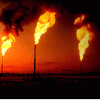
Iraq, which has proven natural-gas reserves of 3.15 trillion cubic meters, has a daily natural-gas production of 1.64 billion cubic feet, 70% of which is flared.
Posted in Iraq Oil & Gas News 1 Comment
Foreign Investment Continues, as Lukoil Announces Plans
Posted on 13 April 2010 .
 Foreign direct investment continues in Iraq as the pace picks up on the rehabilitation of the country’s infrastructure and economic base. Russian-based LuKoil is to drill its first exploration well at Iraq West Qurna 2.
Mr. Vagit Alekperov CEO of LUKoil said that Russia’s largest privately held oil company, LUKoil, "[will] start drilling the first exploration well at the end of the year."
Furthermore, recent reports show that there has been a recent turning point in the energy sector when it was announced that Iraq has stopped importing fuel for the first time since 2003. The Oil Ministry said in a statement. “We have reached the state of self-sufficiency in fuel products such as gasoline, kerosene and liquefied gas”.
Added to this is the news that Iraq's Kurdistan region is ready to start exporting oil at a rate of 100,000 barrels per day as soon as a new Iraq government is formed, its Natural Resources Minister Ashti Hawrami said recently. "We can begin exporting 100,000 barrels per day tomorrow - as soon as we have a government," Reuters quoted Hawrami as telling reporters at an industry conference. "And we can get to 200,000 to 250,000 by end year," he added.
Mr. William Wakeham, Managing Director of Anglo Arab Insurance Brokers observes “The tide is turning as oil imports decrease and exports increase. This marks a change in equilibrium for the Iraqi energy sector, in a very real sense”.
With this increase in activity comes all the support and complementary industries necessary to advance the stabilization of the oil and gas industry. Gazprom Neft is leading a consortium of investors in Iraq calling on the government to clear mines from the Badra oil field near the Iranian border. Iraqi authorities report there are more than 27 million pieces of unexploded ordnance in Iraq from the war with Iran in the 1980s. The largest number of mine fields is near Badra in Wasit province.
Mr. Wakeham goes on to say. “We have clients in many sectors including Oil & Gas as well as de-mining. It is clear that investment has been mobilized. AAIB are gearing up our efforts to help these customers to transfer and to manage their exposures.”
Posted in Iraq Oil & Gas News Comments Off on Foreign Investment Continues, as Lukoil Announces Plans
Did Big Oil Win the War in Iraq?
Posted on 12 April 2010 .
12 April 2010 - AlertNet
Posted on November 14, 2009
Last week, ExxonMobil became the first U.S. oil company in 35 years to sign an oil-production contract with the government of Iraq.
Do these contracts represent a "victory" for Big Oil in Iraq? Yes, but not one as big as the companies had hoped for (at least, not yet).
Before the United States and Britain invaded Iraq in March 2003, their oil companies were shut out of oil-production contracts being negotiated by the government of Saddam Hussein. Today, more than six years of war later, Saddam is gone, and the U.S. and British oil companies are not only in on the oil contracts, they have managed to sweeten the terms.
However, organized resistance by Iraqis and people around the world has thus far succeeded in denying Big Oil its Big Prize: passage of the Iraq Oil Law, alternatively called Iraq Hydrocarbons Law, which would grant far greater control over Iraqi oil to foreign companies on terms much less favorable to Iraq than the current contracts provide.
If the negotiations proceed on their current path, foreign companies will produce the vast majority of Iraq’s oil. How much control they will exert, and who will reap the greatest benefits (and endure the steepest costs) is yet to be determined.
Before the Invasion
In January 2000, 10 days into President George W. Bush’s first term, representatives of the largest oil and energy companies joined the new administration to form the Cheney Energy Task Force. As part of its deliberations, the task force reviewed a series of lists titled "Foreign Suitors for Iraqi Oilfield Contracts" naming more than 60 companies from some 30 countries with contracts in various stages of negotiation.
None of contracts were with American nor major British companies, and none could take effect while the U.N. Security Council sanctions against Iraq remained in place. Three countries held the largest contracts: China, Russia and France -- all members of the Security Council and all in a position to advocate for the end of sanctions.
Were Saddam to remain in power and the sanctions to be removed, these contracts would take effect, and the U.S. and its closest ally would be shut out of Iraq’s great oil bonanza.
After the Invasion
The invasion of Iraq dealt handily with the problem of U.S. and British exclusion. ExxonMobil, Chevron, BP, ConocoPhillips and other major oil companies met with the Iraqi government on countless occasions, and the Iraqis tried to make deals.
But the oil companies, backed aggressively by the Bush administration, steadfastly insisted that contracts would only be signed after the Iraq Oil Law was passed. They nearly prevailed on several occasions, but organized resistance in and outside of Iraq has continually stymied the law’s passage.
Several forces have conspired to bring the oil companies to the negotiating table today.
Most recently and significantly, Iraq’s Parliament has refused to even consider the law until after the January 2010 elections. It is quite likely that a new government hostile to the interests of foreign (particularly U.S. and British) oil companies could come to power in those elections, making passage of the law much less likely. The deals being offered today would be the best the companies would be likely to get.
President Barack Obama and his administration have been vocal and active proponents of the law’s passage. However, this administration’s allegiance to the oil industry is not as steadfast as that of its predecessor.
The Obama administration’s push for passage of the law comes at the same time that it pursues withdrawal of all but a residual U.S. troop presence. It is hard to underestimate the added negotiating weight brought by 150,000 members of the U.S. (and until very recently British) military. Bush announced his most public declaration for passage of the Iraq Oil Law at the same time that he announced the surge of an additional 20,000 U.S. troops into Iraq. The pending loss of its most potent negotiating stick has clearly made the oil companies’ more willing to deal.
Secretary of State Hillary Rodham Clinton may have best put forward the administration’s position at the U.S.-Iraq Business and Investment Conference on Oct. 20, explaining: "A comprehensive hydrocarbon law is vital for regulating the [Iraq] oil sector. Parliament has delayed this vote until after January, but steps can be taken in the interim; for example, by holding transparent, credible auctions on oil and gas fields as we are seeing ..."
In other words, 'we know you want the law, but Parliament isn’t biting, and we’re not keeping 150,000 U.S. soldiers in Iraq indefinitely for you to get it. So, sign the d*** contracts.'
And finally, under immense pressure, the Iraqi Oil Ministry also has steadily been sweetening the deals.
The New Oil Contracts
The Iraq Oil Ministry began a bidding round in June for eight currently producing oil fields, which are among the largest in the world. Only one consortium -- BP and the Chinese National Petroleum Corp. -- agreed to the terms. The rest of the companies balked, saying the terms just simply were not generous enough. The terms have since been sweetened (and applied retroactively to BP and CNPC's deal), and the companies are now jumping on board.
Because the U.S. and British companies have, to a large degree, squeezed into pre-existing negotiations, some strange bedfellows have emerged to sign these new contracts, and more odd pairings are expected soon.
- BP and CNPC finalized the first new oil contract issued by Baghdad for the largest oil field in the country, the 17 billion barrel Rumaila field.
- ExxonMobil, with junior partner Royal Dutch Shell, won a bidding war against Russia’s Lukoil and junior partner ConocoPhillips for the 8.7 billion barrel West Qurna Phase 1 project.
- Italy's Eni SpA, with California’s Occidental Petroleum and the Korea Gas Corp., was awarded Iraq's Zubair oil field with estimated reserves of 4.4 billion barrels.
- Japan's Nippon Corp., leading a consortium of Japanese companies including Inpex Corp. and JGC Corp., is at an advanced stage in talks to win the Nassiriyah oil field.
- Shell, with partners CNPC and the Turkish Petroleum Corp., is also in discussions for the giant Kirkuk oil field, although negotiations have been delayed until after Iraq’s January elections.
The Terms
These contracts are complex and unique, representing a hybrid of existing models. They are not the best that the oil companies hoped for, which would have been production sharing agreements (PSAs). Nor are they the worst the companies might have feared; Iraq is not maintaining its nationalized system, closed to foreign oil company production participation (U.S. and other foreign oil companies sell Iraqi oil now and have done so for decades).
They are also not technical service contracts (TSCs), although this is what the Iraqi Oil Ministry has named them (likely in an attempt to thwart opposition to the contracts for offering too much to foreign oil companies). Greg Muttitt, an Iraq oil expert with Platform, told me, "TSCs generally last just a few years, they're generally for a specific job (e.g. installing pumps) rather than managing a field, and they go to service companies like Baker Hughes and Halliburton."
On the positive side for the companies, where the development production contracts (DPC) that Iraq was signing prior to the 2003 invasion offered 12-year contracts, today’s run for 20 to 25 years. And while as recently as a year ago the Iraqis offered the foreign companies a 50 percent ownership stake, today’s contracts offer them a 75 percent stake (25 percent for the Iraqi government).
On the other hand, where the PSAs sought under the Iraq Oil Law would give the companies an equity stake and the ability to book the oil in the fields as their own, these contracts provide reimbursement fees for capital and operational expenses and a fixed fee per barrel of oil produced and deny the companies the ability to book reserves.
It remains unclear whether the foreign companies or the Iraqi government ultimately has production decision-making authority. And some of the benefits included in the contracts would be annulled if the Iraq Oil Law were passed, including requirements to hire and train Iraqi workers and the transfer of needed technology.
Finally, the Iraqis apparently sweetened the deals further in the last few weeks by reducing the amount the foreign companies pay in taxes and allowing them to use private security forces to protect their facilities.
The Next Bidding Round
On Dec. 11 and 12, the second, much larger, bidding round will be launched in Baghdad. Forty-four international companies have been prequalified to bid on run for 11 groups of oil and gas fields in already producing and undiscovered fields. Negotiations will include the super giant Majnoon field, which Chevron and France’s Total have teamed up to bid for.
The contracts for these fields are expected to mirror those described above, but no "model contract" has been made publicly available.
Sunlight
The Iraq Oil Law has remained an elusive goal of the world’s most powerful industry and governments because a massive organized global resistance movement has been shining a bright spotlight on its content, its backers, and on the consequences of its passage.
We must continue to shine this spotlight on the new contract negotiations to help ensure that 1) the military occupation of Iraq will be able to conclude, and 2) that the Iraqis are not freed from a foreign military occupation only to be brought under foreign economic control.
Posted in Iraq Oil & Gas News Comments Off on Did Big Oil Win the War in Iraq?

Iraq's Overly Optimistic Oil Plans
Posted on 12 April 2010 .
11 April 2010 - Forbes
Oil prices have been on a tear of late, rising almost 6% in a week to close at close to $87 per barrel on April 5. Despite a subsequent sell-off and oil's rather frothy prices, there do seem to be some short-term advantages, especially since oil market fundamentals kept prices within a narrow trading band from mid-2009 through the end of the first quarter of 2010. Strong growth in emerging market economies and accommodative monetary policy globally, as well as a more balanced oil market, should continue to provide modest support for oil prices. But if oil prices remain above $100 per barrel for long, higher prices could begin to choke off weak consumption, especially in the U.S. and in dollar-pegged commodity importers, in turn dragging oil back down.
Supply should continue to creep upward, likely at a faster pace than still sluggish demand. Oil production is rising slowly, OPEC continues to provide more supply, albeit at higher prices, and Russian output is at a recent peak. While prices can diverge significantly from oil market fundamentals, in the long term a number of new sources should be available, including offshore oil in Africa and Brazil, and the oil sands--though the economic viability of these sources depends on the price of crude.
We take a look at the energy sector prospects of Iraq, whose government aims to more than double oil production in the coming five years. While security and political constraints abound, production is inching up in Iraq, and recipients of 2009 oil-servicing contracts are beginning operations. Severe infrastructure shortfalls remain, however, and the pressure to maximize oil revenues could complicate the political and regulatory landscape.
As Iraqi officials vie to form the next government and violence continues to sporadically shake the country, the quest to develop Iraq's oil riches is picking up steam. In late March the successful bidders of the first oil servicing contract (BP and China National Petroleum Co.) began subcontracting out drilling operations in the Rumaila field. While this represents incremental progress, obstacles to full-scale oil sector development remain great. As the new government emerges and the U.S. troops continue their withdrawal, the energy sector's development will likely proceed at best in fits and starts.
Notably, foreign commercial interest has not been the problem. Despite the political uncertainties and deteriorating security situation, companies have flocked to invest in Iraq given the relatively low costs of production, favorable operating terms and lack of other investable oil fields in the region. International oil companies (IOCs) are eager to invest in Iraq, but the political, economic and regulatory hurdles are causing delays. The issuance of long-term servicing contracts, granted in 2009, is one way in. But the lack of clear guidelines about foreign ownership and property rights in the form of a petroleum sector may deter further development.
The protracted political talks aimed at forming a coalition out of the hodgepodge of parties who won parliamentary seats in last month's elections could lead to a deadlocked government, or simply a long power vacuum, as negotiations proceed slowly. This almost certainly will expose energy contracts to challenges at the federal and local levels. The power vacuum has also prompted more attacks. It remains to be seen if a stable coalition will be able to pass key stalled legislation, including bills relating to the energy sector. Key issues for the new government to address include the governance of the resource-rich and ethnically divided northern province of Kirkuk; the sharing of oil and gas revenues between federal and regional governments; the passage of a fiscal 2011 budget; and preparations for the final U.S. troop withdrawal in 2011. Companies and investors will hope for policy continuity and the ratification of signed contracts. In our view, many of these contracts will be upheld, as all political groups in Iraq benefit from these issues. But the legal obstacles could be significant, delaying output.
Iraq has the potential to be a major source of new oil in the next five to 10 years, but the process of scaling up production faces many obstacles. Modernizing and expanding the country's energy infrastructure will be costly, given Iraq's fiscal position, which may tempt Iraqi governments to extract as much revenue as possible to meet its fiscal vulnerabilities. Finally, as Iraq's oil production gradually climbs, it will face additional pressure from OPEC (Iraq is currently a nonvoting member of the bloc) to adhere to quotas. Given these uncertainties, Iraq's plans to more than double output within five years seem very optimistic.
Posted in Iraq Oil & Gas News 1 Comment

Russian Firm Discuss Investments
Posted on 08 April 2010 .
Iraqi Industry Ministry discussed investment opportunities with a delegation from the Russian firm Wontert Capital AG, according to a Ministry’s statement on Wednesday.
“Iraq seeks to employ advanced industrial technologies,” the Ministry said in the release received by Aswat al-Iraq news agency.
The Ministry told the delegation that Iraq has technical experiences, but it needs international support to exploit them, the statement added.
Posted in Iraq Industry & Trade News Comments Off on Russian Firm Discuss Investments
Future of Iraq's Oil Deals Uncertain
Posted on 06 April 2010 .
Now that the votes have been counted, the first big test facing Iraq’s fragile democracy is whether it can make the transition from one administration to the next without too much bloodshed or violence.
If this weekend's horrific sectarian slaughter and suicide bombings are any harbinger, things aren't looking good. But there will also come another test: whether the lucrative oil deals negotiated by the previous administration can survive the transition.
After a spectacularly successful auction of drilling rights last December, Prime Minister Nouri al-Maliki’s government spent the first few months of this year putting the finishing touches on 10 separate deals that, if implemented successfully, could see Iraq challenging Saudi Arabia as the world’s leading producer within the decade.
By any measure, these deals were the singular accomplishment of Maliki’s tenure. Oil Minister Hussain al-Shahristani earned the respect of the international oil community for driving a very hard bargain and delivering a deal that should quickly put his nation on the path to prosperity.
But in Iraq’s fevered political climate, no deal makes everyone happy, and the oil contracts could easily become a casualty as Iyad Allawi, the declared winner in last month’s election, begins the messy process of stitching together a governing coalition.
“The Maliki government did everything in their power to make sure those contracts would survive. They fast-forwarded the effective date of many of the contracts ... [and] they also had the contracts ratified by the Council of Ministers very quickly. Whether these actions are enough will be the main question,” said Thomas Donovan, an attorney with the Iraq Law Alliance, who has followed the process closely.
“My sense is that they will survive the challenge, and that they will last throughout the next transitional government and any government thereafter,” he said.
That is what some of the world’s largest oil companies — Exxon Mobil, BP, Royal Dutch Shell, Russia’s Lukoil and others — are banking on as they bet billions on Iraq’s ability to provide a politically stable and physically secure environment for them to go about their business.
And it is a gamble, says Giacomo Luciani, an oil industry scholar at the Gulf Research Center in Geneva.
“At the moment, we don’t know what’s going to happen. But we do know that the oil contracts are the main source of power, the main source of money, the main source of everything in Iraq,” Luciani said.
“We have to see what kind of coalition emerges and whether it finds it tactically convenient to raise objections to the oil deals,” he said.
Iraq nationalized oil production in 1961, and thereafter the notion of keeping Iraq’s oil under Iraqi control has played well for nationalist politicians from Saddam Hussein to today’s crop of Sunni and Shiite rivals. The reality, however, is that the dilapidation of Iraq’s oil fields that resulted from years of war and sanctions can only be repaired by a massive influx of capital and technology from international oil companies.
And Shahristani, the oil minister, can hardly be accused of giving away the store when he auctioned off the rights to develop some of Iraq’s prize oil patches. The successful bidders signed 20-year service contracts that will pay them a relatively modest per-barrel fee for each barrel they produce above an agreed minimum.
“He [Shahristani] obtained a very good deal for Iraq, but that doesn’t mean the deal will be confirmed. You are assuming that everyone is pursuing Iraq’s national interest, and that might not be the case,” said Luciani.
“In principle, I don’t think there’s a prejudice against foreign companies’ involvement. But one can see how it becomes part of someone’s political agenda,” he said.
Another major worry is security. With the U.S. planning to reduce the number of troops in Iraq to 50,000 by the end of August, and to effect a complete withdrawal by the end of 2011, providing security for the oil companies will fall to the Iraqis.
The worry was highlighted two weeks ago when authorities in oil-rich Basra province found a small weapons cache and a note threatening foreign oil companies. The incident appeared to be more theater than threat, but security experts admit it is hard to gauge the level of grassroots mistrust of foreign oil companies and how this might be exploited by those wishing to destabilize the government.
Much will depend on the new government and its choice of oil minister, said Ben Lando, editor of the influential Iraq Oil Report.
Although Allawi, a former interim prime minister, has been declared the winner in the March 7 election, it is not clear if he will be able to pull together enough allies to form a governing coalition. Even less certain is who will get the job as oil minister.
Shahristani, a former nuclear scientist who spent time in Saddam’s prisons, is widely respected in oil circles and could be asked to stay on, no matter who leads the next government.
“Shahristani is definitely not out of contention, though any coalition with the Kurds involved drastically reduces his chances to the point of elimination.” said Lando.
That’s because of the ongoing dispute over control of reserves in the semi-autonomous Kurdish region. Shahristani has antagonized the Kurds by refusing to recognize the contracts signed by nearly two dozen foreign oil companies with the Kurdistan Regional Government.
Others who might be considered for the oil post include Thamir Ghadhban and Ibrahim Bahr al-Uloom. Both held the job previously and are known in the oil community.
Even the wily Ahmad Chalabi’s name has been mentioned. Chalalbi, famous for providing the Bush administration with dubious intelligence about Saddam’s weapons of mass destruction, served as interim oil minister for a few weeks in 2005. He is also Allawi’s cousin, although in their case blood does not appear to be thicker than oil.
Posted in Iraq Oil & Gas News Comments Off on Future of Iraq's Oil Deals Uncertain
Iraq oil output goals unlikely to be met: Report
Posted on 05 April 2010 .
Commodities Now - Apr 1 2010
Toronto, Iraq's ambitious plans to boost crude oil production to as much as 12 million barrels per day in coming years is not likely to be met due to a myriad of challenges, IHS Cambridge Energy Research Associates said in a report on Wednesday. These "highly ambitious plans ... are unlikely to be fully realized given political, security, operational and infrastructure challenges," noted IHS CERA, an energy sector advisory firm based in Cambridge, Massachusetts.
The report points out that Iraq starts out with rich oil resources that have suffered from “underinvestment and underdevelopment for decades.”
“But Iraq’s new expansion timetable would dwarf the most rapid build-ups that we have recently seen in places such as Russia and Saudi Arabia,” said IHS CERA Senior Middle East Director, Bhushan Bahree. “The political, security, operational and infrastructure challenges in the country, along with a likely shortage of skilled personnel, are likely to hamper progress towards such an unprecedented achievement.”
Iraq’s recent elections and current efforts to form a new government could exacerbate existing sectarian and other tensions in the country and it is unclear what approach a new government could take regarding oil contracts. Security will also remain a concern as foreign workers and oil company operations expand in areas that have been prone to violence in the past, the report says.
The report identifies infrastructure and logistics as “major challenges.” Iraq is responsible for providing the infrastructure needed to receive the extra oil but its plans for providing a “complex network of capital-intensive infrastructure”—from ports and roads to power and water crucial for operations—in synchronization with the development oil fields are not known, representing a major potential bottleneck.
“Iraq’s expansion timetable appears extraordinarily ambitious in comparison to the recently completed capacity increase in Saudi Arabia,” says Bahree. “Saudi Arabia has significant security and infrastructure advantages yet it took Saudi Arabia between four and five years to expand its net output capacity by some 2 million barrels per day. Iraq will certainly be challenged to match this pace, much less exceed it.”
Though Iraq is unlikely to meet its “very stretch target” of elevating its capacity to 12mbd in six to seven years, the expansion of its production capacity still represents a significant increase with strong implications for OPEC and the regional balance, the report finds.
Iraq is not currently a party to OPEC’s production quota system. A significant ramp-up in Iraqi production would put the issue of bringing Iraq back into the quota system back on the agenda. Any issue within OPEC is likely years away; however, as it is widely assumed that the major producers will wait until Iraqi output begins to approach its OPEC share negotiated in 1988, which is at parity with Iran.
The discussion of quotas is also likely to be put off because OPEC cannot address quotas pertaining to Iraq without also discussing the allocations of other countries, such as Angola, Nigeria and Venezuela that dispute their current output targets.
“Expansion beyond parity with Iran is likely to generate a strong reaction from Tehran, which views parity as one of the concessions that it had to make for peace with Iraq in the late 1980s,” Bahree says. “Equally important will be the conflicting oil strategies that the two countries are pursuing. Iran, unable to raise its own output, is pursuing a strategy of maximizing oil revenues through higher prices. Iraq’s unfolding strategy is just the opposite—expanded volume to increase revenues.”
Posted in Iraq Oil & Gas News Comments Off on Iraq oil output goals unlikely to be met: Report
Demining Needed In Iraq, Oil Giants Say
Posted on 30 March 2010 .
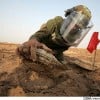
Gazprom Neft leads a consortium of investors in Iraq calling on the government to clear mines from the Badra oil field near the Iranian border.
Iraqi authorities report there are more than 27 million pieces of unexploded ordnance in Iraq from the war with Iran in the 1980s. The largest number of mine fields is near Badra in Wasit province.
Gazprom Neft said demining of the region was required to retrieve oil in the border region, Russia's state-run news agency RIA Novosti reports.
Reserves near Badra are estimated at around 2 billion barrels of oil and the project should cost around $2 billion, the report added.
Gazprom Neft, the oil division of energy monopoly Gazprom, leads a consortium along with KoGas from South Korea, Petronas from Malaysia and Turkey's TPAO at Badra.
Gazprom Neft under the terms of a 2009 agreement with the Iraqis will develop the Badra field in Wasit province for the next 20 years. Total capacity could reach 170,000 barrels per day.
Posted in Security 2 Comments
Turkey strengthens Iraqi energy ties
Posted on 28 March 2010 .
Turkey last week strengthened its energy ties with Iraq by renewing a contract to import Iraqi oil to the Turkish Mediterranean Sea port of Ceyhan, where Azerbaijani oil also arrives via the Baku-Tbilisi-Ceyhan (BTC) pipeline. Earlier this year, it was announced that Iraq will export between 5 billion and 10 billion cubic meters per year of natural gas to Turkey for inclusion in the Nabucco pipeline carrying the fuel to Europe.
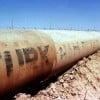
The oil will come from Kirkuk in Iraqi Kurdistan, along the route of the already existing 1,000 kilometer Kirkuk-Ceyhan oil pipeline. The pipeline, built in the late 1970s, consists of two trunks, with a combined design capacity of 1.6 million barrels per day, or more than half as much again as the BTC's design capacity.
The Kirkuk-Ceyhan pipeline was mainly empty from 2003, after the US overthrow of Saddam Hussein, until late 2007, and it has since been the target of disruptive attacks (most recently last November), besides suffering general disrepair as a result of the prewar UN sanctions and subsequent collateral damage. The German firm Siemens modernized the line in 2003 under the supervision of the Turkish firm BOTAS. Since re-entering service, it has operated at roughly one-sixth to, more recently, one-third of project capacity, when it has not been shut down for one or another reason.
Negotiations between Iraq and Turkey began last year, and agreement was reached after Turkish Energy Minister Taner Yildiz earlier this month expressed his wish to go ahead. Yildiz agreed with Iraq's deputy oil minister, Ahmad Al Shamma, concerning some changes to the existing contract, which expires at the end of this month. In particular, new transit taxes were agreed and provisions set for possible renovation, rebuilding or re-routing of the line.
The new Iraqi throughput from Kirkuk comes hard on the heels of the announcement three weeks ago that Turkish state firm TPAO is negotiating with the Iraq Southern Oil Company to drill 45 wells in the southern Rumaila oil field. That contract, which could be signed as early as this autumn, according to MEED, a business intelligence website, is worth US$318 million. The work would seek to almost treble field output to 2.8 million barrels per day, from 1 million.
Expansion of the Kirkuk-Ceyhan oil pipeline fits in with recently announced Turkish strategic plans to turn Ceyhan into a fully integrated oil hub over the next five years. Andalou News Agency reported on Tuesday that the country also intends to begin construction of a nuclear power plant by 2014, in addition to diversifying natural gas suppliers and raising the proportion of domestic-sourced power generation.
The government stated its intention to reduce its heavy dependence on Russian natural gas (due largely to the Blue Stream project, carrying gas from across the Black Sea to Turkey) while also constructing coal-fired and hydroelectric power plants to meet projected increases in domestic demand. That intention could be comprised, depending upon the conditions that Ankara allows to be set, upon construction and management of the gas storage facilities that Gazprom is building near Lake Tuz in central Anatolia. (See Iran claim clouds Turkey's energy goals, Asia Times Online, November 6, 2009).
Still, Turkey's announced plans would signify its intention not to be a consumer country for any of the gas transiting its territory from Russia through the projected "Blue Stream Two" project. They explain why, when Turkish Prime Minister Recep Tayyip Erdogan met Russian Prime Minister Vladimir Putin in Sochi 12 months ago, he argued strongly in favor of transforming Blue Stream Two into what is now called MedStream.
MedStream refers to a plan to conduct gas from Russia, after it crosses Anatolia from the Black Sea to Ceyhan, underneath the Mediterranean Sea to Ashkelon in Israel, with the cooperation of French companies.
It was once envisaged that gas from northern Iraq might be a candidate for re-export by Turkey along a MedStream route, before that gas became committed earlier this year to the European Nabucco project. The Russian gas might, after reaching Israel, go to South Asia by tanker, either through the Suez Canal or from the Gulf of Aqaba through the Red Sea and the Bab-el-Mandeb Strait between Eritrea/Djibouti and Yemen.
Posted in Iraq Oil & Gas News 4 Comments
Re-basing the Iraqi Dinar
Posted on 26 March 2010 .
The Central Bank of Iraq is planning to rebase the Iraqi dinar but hasn't decided yet on the timing of the move, the bank said in a statement last week. Affirms its commitment to its strategic projects, particularly knocking three zeroes from the Iraqi dinar," the statement said.
"Despite the technical and logistical preparations for the project we have yet to decide on suitable timing to implement the project," it said. Choosing a suitable time wouldn't be linked to economic aspects only, but rather to the security situation as well, it added.
“Most commercial Insurance Policies for Iraqi risks have monetary amounts in US dollars” comments Rob Edwards, Chief Operating Officer of AAIB Insurance Brokers. “And this goes for sums insured, indemnity limits, deductibles and premiums, so there will be little effect for the majority of policies.”
If the rebase decision is taken it means a current 25,000 Iraqi dinar banknote will become IQD25, and a dollar will equal only 1.17 dinars.
Mr. Edwards continued, “Some policies written outside Iraq and the Kurdish Region of Iraq are for more modest sums insured, in particular auto exposures and these typically use Iraqi Dinar (ID) limits. Underwriters and their reinsurers should keep a watching brief on this if they have policies with ID sums insured.”
Currency rebasing is usually monetarily neutral and is introduced to make commercial calculations easier and cheaper. Turkey, for example, knocked six zeroes off its lira currency in 2005. Russia did the same for its currency.
[Source: Zawya. Full article here http://www.zawya.com/Story.cfm/sidZW20100315000097/iq/?pass=1]
Posted in Iraq Banking & Finance News 11 Comments