


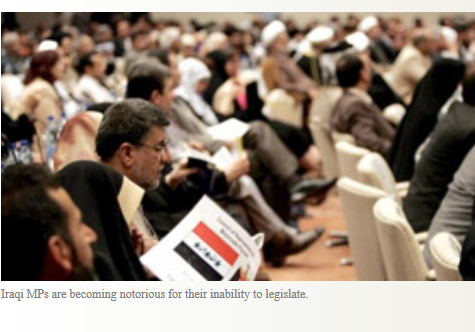
“Parliament has been busy discussing the 2014 electoral law for weeks,” says Bahaa al-Araji, a leading member of the Sadrist bloc. “And now time is running out [for these other laws]. We only have a few months before this session of parliament ends and that might not be enough to get through these laws, which have been suspended for months already.”
Judging by the Iraqi parliament’s previous performance, his prediction is most likely correct. It seems to take many months to pass any even vaguely important law and if the laws are still being discussed, or if no agreement can be reached, then they simply seem to be shelved until a later date.
Even one of the most recent, most widely discussed pieces of legislation has yet to be acted upon. A law dealing with MP pensions that had sparked widespread protests right around the country has been drafted, reflecting popular sentiment that MPs get paid far too much when they retire from the job. But even this legislation – which one imagines, might make a lot of ordinary Iraqi voters happy and which was supported by many MPs – has not been passed. And that is despite several efforts and many promises to table it.
Some of the most important pieces of legislation- that the country has been without for, in many cases, years – are as follows:
*The Political Parties Law
Even today a law enacted by US administrator, Paul Bremer, after the 2003 US-led invasion that toppled the government of Saddam Hussein, still governs how political parties are formed in Iraq and which rules they should abide by.
A document put together by Ana Nikonorow of the NGO Coordination Committee for Iraq, a body that coordinates NGO activities in the country, outlined the problems facing the passage of a draft law on the subject.
“A law governing the formation and running of political parties is a long awaited step to improving the transparency of this institution [the Iraqi Parliament]. A draft political parties law now nears passage. However articles deemed essential by civil society, regarding funding transparency and bans on parties associated with militias [are refuted by] key ruling parties,” Nikonorow writes. “Likewise the ruling parties draftingthe law have sought to locate the authority deciding the legality of parties under a political appointee.” Which means they would hardly be independent.
I am most curious as to why, in the article entitled, "Why Iraqi Mps Can Never Pass a Law …" that question was never answered?