


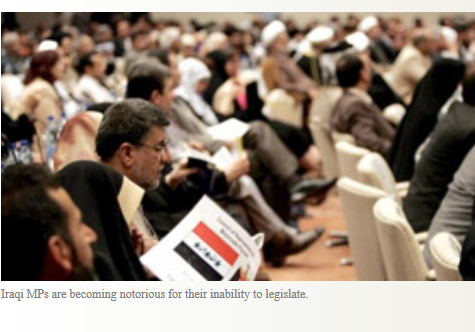
After Iraq’s last elections in 2010, the Federal Supreme Court came down on the side of the current prime Minister Nouri al-Maliki’s coalition and basically supported his coalition’s bid to rule Iraq.
“But,” al-Lawzi warned. “there isn’t enough time to pass this law on the Federal Supreme Court.”
Local political analysts have expressed deep concern over the Iraqi parliament’s obsession with one law at a time, to the detriment of all others. It’s not healthy, they say, especially in a country like Iraq that is still dealing with legislative baggage left behind by Saddam Hussein’s totalitarian state.
So why are Iraqi MPs like this? Observers say the reason that Iraq’s parliamentarians are so slow to do anything that ahs impact has to do with the political culture in Baghdad.
“The Iraqi Parliament has trouble dealing with legislation because the background of many MPs is not in business or trade,” suggests Abdul-Jabbar Ahmad, Dean of the College of Political Sciences at Baghdad University. “Rather they come from a partisan background, based upon a quota system.”
The unofficial quota system that is so often used in Iraqi politics is considered a source of many political ills in the country. After the 2003 US-led invasion of Iraq, the quota system was used to put together an interim government. The religious and ethnic background of would-be politicians in the interim leadership was based on demographics and the quota system was used to keep the peace and to maintain a balance between all the different, and often competing and conflicted, ethnic and religious factions. Although the quota system was never based in law, it has continued to be used in Iraqi politics today. However what often happens is that this quota principle leads to supposedly independent institutions being hamstrung, or dead locked.
Meanwhile Amer Fayyadh, Dean of the Political Sciences College at Baghdad’s Al Nahrain University, told NIQASH that he believes Iraqi politicians don’t place enough importance on passing laws and planning ahead.
“Political thinking in Iraq isn’t about future planning,” Fayyadh said. “It’s not about any kind of long-term or strategic planning.”
I am most curious as to why, in the article entitled, "Why Iraqi Mps Can Never Pass a Law …" that question was never answered?