


Iraq Can Double Oil Output in 10 Years
Posted on 16 February 2011 .
Iraqi oil output will double in the next decade, not quadruple as in initial government targets, but the country could still test Saudi Arabia's influence in OPEC, oil major Shell said on Monday.
In its energy scenarios to 2050, published for the first time since 2008, Shell said Iraq was a key uncertainty in the oil supply picture, with output likely to reach 5-6 million barrels per day over the next decade if reasonable stability and security are achieved, according to Reuters.
Iraq's previous government had said partnerships with oil and gas companies including Shell could push output to as much as 10-12 million bpd.
"This would mean annual growth rates of 10-15 percent would have to be sustained for at least 10 years -- a feat unseen in recent history," Shell said.
Shell said that in the medium term, a balance must be struck between ramping-up production quickly for Iraq to generate income and avoiding over-supply so that OPEC can manage its spare capacity buffer adequately.
"Key to price volatility will be OPEC's spare capacity levels, its adherence to agreed quotas to limit production during periods of weak demand and continued market perception of medium to longer-term supply-demand tightness".
Posted in Iraq Oil & Gas News Comments Off on Iraq Can Double Oil Output in 10 Years
Iraq Signs Fiber-Optic Telecom Agreement
Posted on 14 February 2011 .
The Iraqi Communications Ministry has signed a preliminary agreement with the Saudi company STC to link Iraq to Turkey and Saudi Arabia by an optical cable system.
Official ministry spokesman Samir Ali Hassoun told AKnews that this initial agreement determines the financial aspects of the deal.
The Ministry of Communications has been working for a long time on extending the existing optical cable network to provide advanced electronic communications in the country in the near future.
The internal structure of the Iraqi telecom network was badly damaged in April 2003 during the violence and looting that followed the US-led toppling of the former regime.
(Source: AKnews)
Posted in Iraqi Communications News Comments Off on Iraq Signs Fiber-Optic Telecom Agreement
ISX is region’s second best performer
Posted on 07 February 2011 .
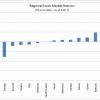
With a year-to-date return of 14.6% as of February 7, the Rabee Securities RSISX index is the region’s second best performer so far this year. Only Iran’s TEPIX index, up 16.4%, did better.
Regional stock markets have generally mirrored the lackluster performance of the Morgan Stanley global emerging markets index, which is down 1.8% year-to-date. The main headwinds, both in the region and around the world, are coming from the threat of rising inflation and higher interest rates. For all the talk of political uncertainty following the protests in Egypt, these have had little impact so far. Markets like Saudi Arabia and Jordan initially took big hits on the Egypt news, but most of those losses have since been made up.
While Iran and Iraq have had similar returns so far, the two countries face dissimilar macroeconomic situations. The Iranian economy is hampered by international sanctions and declining oil production, while year-on-year food price inflation reached 18.9% in December (the last reported month). This compares to the situation in Iraq, where foreign investment is growing rapidly, oil output is expected to double or triple over the next decade and December CPI was only 3.3%.
The two stock markets are quite different as well. The Tehran Stock Exchange has been operating since 1967, has a market capitalization of about US$ 90 bn and 420 listed companies. The history of the Iraq stock exchange only goes back to the mid-1990s. So far there are fewer than 100 listed companies with a combined market cap of around US$ 2 bn.
And the Iranian market has already been rising for quite a while. It was up 68% in 2010. The ISX ended last year basically flat. Its bull market has only just begun.
It shouldn't be hard for Iraq to take over the top spot.
Posted in Iraq Banking & Finance News, Mark DeWeaver on Investments and Finance 34 Comments
New Iraq Wheat Tenders Move the Market?
Posted on 07 February 2011 .
The Grain Board of Iraq (Ministry of Trade) has announced another tender on Monday for the supply of 100,000 tonnes of grain.
Some experts cite this tender as a factor in the 1.6% jump in grain prices on Monday. Reuters quotes Brett Cooper, senior manager for markets at FCStone Australia, as saying:
"Iraq has tendered for wheat and there is speculation in the market that Iraq will buy more wheat than what it has tendered. There is talk Turkey and Saudi Arabia will issue tenders soon."
The deadline for bids is 10:00 am Baghdad time on 12th February, and if the English version of the documents are correctly translated, interested parties must visit the Grain Board’s offices in Baghdad.
Posted in Agriculture, Tenders Comments Off on New Iraq Wheat Tenders Move the Market?

GM Sales in Iraq Up 52% Year-On-Year
Posted on 12 January 2011 .
General Motors's sales in the Middle East rose 26 per cent in the fourth quarter, compared with the year prior, helped by big gains in Iraq, the company announced on Wednesday.
The carmaker sold 123,258 vehicles in the Middle East in 2010, up 5.5 per cent from the previous year, according to a report in The National.
But sales picked up pace in the final quarter, with 38,450 Chevrolet, Cadillac and GMC vehicles sold across the region, up 26 per cent from the same period in 2009.
Its fastest growing market last year was Iraq, due to increased political stability in the country, said a GM spokesman.
Sales in Iraq in 2010 rose 52 per cent, year on year. But in the fourth-quarter, GM's sales in Iraq rose by 112 per cent compared to the same period one year earlier.
"It's mainly the stability... in 2007 we started seeing the country becoming more and more stable, and sales have been picking up," said the GM spokesman. "There is a correlation between the two."
Saudi Arabia continued to be GM's biggest regional market, by sales, due in part to its relatively large population. Sales in the Kingdom rose by 7 per cent year on year, and 28 per cent in the fourth quarter, compared to the same timeframe in 2009.
Sales in Kuwait and the UAE, the other two large markets for GM in the Middle East, remained flat compared to 2009, the spokesman said.
Cadillac was GM's fastest growing brand in the Middle East, with sales up 26 per cent year on year. Chevrolet sales were up 9.2 per cent year on year, due in part to new models including the Cruze and Malibu. GMC remained flat over the year.
(Source: The National)
Posted in Iraq Industry & Trade News Comments Off on GM Sales in Iraq Up 52% Year-On-Year
Japan to Assist Iraq's Nuclear Ambitions
Posted on 11 January 2011 .
Japan is ready to boost cooperation and projects in Iraq’s energy sector including rebuilding Iraqi nuclear reactor(s), Hussain Shahristani, Iraqi deputy prime minister for energy,has told reporters.
Shahristani reportedly said after his meeting with the Japanese Economy, Trade and Industry Minister, Akihiro Ohata, in Baghdad, "we discussed the issue of reconstruction of the nuclear reactor(s) in Iraq... and the Japanese expressed their interest in that. Iraq will study the possibilities of developing its peaceful nuclear industry."
A joint statement was issued after the meeting calling on the two countries to reinforce economic cooperation in areas including postwar reconstruction, oil development and electricity generation in Iraq. Feasibility studies have already started to build an electricity generation station in Iraq, according to the statement.
Additionally, Japan will send a trade delegation to Iraq next month to discuss cooperation in the energy and transportation sectors.
This is the first visit to Iraq by a Japanese Cabinet minister since the Democratic Party of Japan (DPJ) took power in September 2009. Arab diplomats in Tokyo told PanOrient News that the DPJ "has not given Arab countries the attention they used to get from Liberal Democratic Party."
Posted in Construction & Engineering In Iraq Comments Off on Japan to Assist Iraq's Nuclear Ambitions
Call to Exploit Border Oil Field Between Iraq and Jordan
Posted on 08 January 2011 .
The Chairman of Anbar Province’s Council has called on the Iraqi government on Saturday to invest in al-Risha oil field with, shared between Iraq and Jordan, and to lay down clear steps to exploit the field.
“We call on the Iraqi government and the Oil Ministry to expoit al-Risha Oil Field on the Iraqi side of the common border between Iraq and Jordan, being one of the most important oil fields ”, Muzhir Hassan told Aswat al-Iraq news agency.
He said that Iraq’s share in the joint al-Risha Oil Field is estimated at 80%, and Iraq has the right to expoit it through cooperation with the Jordanian government, to be achieved after the approval of the Central Government in Baghdad.
“Al-Risha and Ukaz oil fields in Anbar are a natural resource,” he added.
According to the report, the al-Risha oil field is situated close to the Iraq-Syria and Iraq-Jordan borders, stretching to the border of Saudi Arabia with Jordan.
(Source: Aswat al-Iraq)
Posted in Iraq Oil & Gas News Comments Off on Call to Exploit Border Oil Field Between Iraq and Jordan
France Wins $52m Power Distribution Contract in Basra
Posted on 04 January 2011 .
Iraq signed deals worth $52 million with France's Schneider Electric and Areva to build 15 power distribution stations in the southern oil hub of Basra, the province's deputy governor, Ahmed Hameed, said on Sunday.
Schneider Electric, has won a $29 million contract to build eight distribution stations, while Areva was awarded a $23 million deal to build seven plants.
The projects would be financed by the province's share in oil revenue and don't need the approval of the Ministry of Electricity in Baghdad.
The province is also in talks with a Saudi private company to supply it with power turbines that could provide an extra 150 megawatts, Hameed said.
Last summer, days of protests in the Shi'ite south, including Basra, over crippling power cuts forced the then electricity minister to step down.
The national grid usually allocates 950 MW of power to Basra, but in case of any technical failure, the supply could fall to less than half of that amount, which is not enough to cover its needs, said Hameed.
Iraq plans to boost power capacity to 27,000 MW in four years and would need to invest at least $3 billion to $4 billion per year to reach that target.
(Sources: Bloomberg, Reuters)
Posted in Iraq Public Works News Comments Off on France Wins $52m Power Distribution Contract in Basra
Saudi company wins KBR Ruling Over Work in Iraq
Posted on 04 January 2011 .
Tamimi Global Co. has won a $35 million arbitration award in London against Houston-based KBR for work it says it did in Iraq, according to court documents filed in Houston.
The Houston Chronicle reports that Tamimi, based in Saudi Arabia, worked as a subcontractor for KBR, providing dining and food services for U.S. troops. The company claims KBR withheld payments starting in 2008 because the U.S. government withheld payments to KBR after an audit of an earlier contract. Tamimi continued to operate through 2009, when its contracts with KBR ended.
The newspaper quotes a spokeswoman, Gabriela Segura, as saying that KBR is disappointed with the arbitration outcome and is evaluating its options.
(Source: Houston Chronicle)
Posted in Iraq Industry & Trade News Comments Off on Saudi company wins KBR Ruling Over Work in Iraq

Over $200m Allocated to Khaleeji 21 Soccer Tournament
Posted on 31 December 2010 .
The local administration in Basra decided to allocate the sum of 242.2 billion Iraqi dinars (ID) [$207m] to carry out service and urban projects in preparation for the hosting of the Khaleeji 21 soccer tournament [21st Gulf Cup of Nations], a spokesman said on Thursday.
“The higher committee for the rehabilitation of Basra, chaired by Governor Shaltagh Abboud al-Mayyah, earmarked ID242.2 billion for projects including the construction of three bridges in the city and two others in the province’s districts as well as the rejuvenation of five main intersections,” the source told Aswat al-Iraq news agency.
“The projects also include the rehabilitation of a road between the Khalid Bridge on the Shatt al-Arab waterway, the airport road and other roads leading to the Sports City,” he added.
The Arabian Gulf Cup of Nations, also known as Khaleeji, is a soccer tournament currently held every two years, rotating the host city each time.
While the competition is usually held on a biannual basis, the history of the competition has also seen it held every three, or even four years, due to political or organizational problems.
The Arabian Gulf Cup of Nations was founded at the 1968 Summer Olympics in Mexico by Bahrain, Kuwait, Saudi Arabia and Qatar.
The First Arabian Gulf Cup tournament took place in Bahrain in 1970, and was won by the Kuwaiti team.
(Source: Aswat al-Iraq)
Posted in Construction & Engineering In Iraq, Iraq Industry & Trade News, Iraq Public Works News Comments Off on Over $200m Allocated to Khaleeji 21 Soccer Tournament