


Shanghai Electric discusses Iraq Power Projects
Posted on 03 October 2025 .
By John Lee.
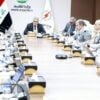
The Ministry of Electricity's Undersecretary for Production Affairs, Eng. Mohammed Nema Al-Tufaily, chaired a key meeting with Shanghai Electric to set firm timelines for the execution and completion of combined-cycle projects and rehabilitation of power stations.
The talks, attended by senior ministry officials and regional power company directors, focused on government-mandated programmes to expand generation capacity and strengthen infrastructure.
Projects include the installation of combined-cycle units at the Al-Mansuriya, Karbala, Hilla, Diwaniya, and Najaf gas power plants, adding 1,000 MW of capacity, as well as the rehabilitation of the Hartha thermal station to ensure readiness before summer 2026.
Al-Tufaily stressed strict adherence to contractual deadlines, site visits to monitor progress, and granting project managers sufficient authority to accelerate implementation. Shanghai Electric reaffirmed its full commitment to completing the projects within the agreed timelines.
(Source: Ministry of Electricity)
Posted in Iraq Industry & Trade News Comments Off on Shanghai Electric discusses Iraq Power Projects
Iraq buys Italian Truck-Mounted Lifts
Posted on 01 October 2025 .
By John Lee.
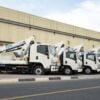
Iraq's Ministry of Electricity has reportedly purchased ten telescopic truck-mounted lifts made by Italian firm CTE.
The equipment was supplied by Precision Machinery, CTE's distributor in the UAE.
(Sources: Precision Machinery, Vertikal)
Posted in Iraq Industry & Trade News Comments Off on Iraq buys Italian Truck-Mounted Lifts
Iraq PM Pushes to Complete Canal Project to Supply Basra
Posted on 26 September 2025 .
By John Lee.
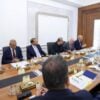
Prime Minister Mohammed Shia Al-Sudani chaired a meeting on Wednesday to accelerate the completion of the al-Bada'a Canal project, intended to secure water supplies for Basra. The session was attended by the Minister of Water Resources, the Head of the Advisory Board at the Prime Minister's Office, and senior officials from the Ministry of Water Resources.
The meeting reviewed progress on the canal, including a critical 65 km section that has been delayed for years due to sandy and gypsum terrain. Of this section, 45 km has already been completed. Discussions also covered a proposed water pipeline project and its viability under current shortages, with representatives of the implementing companies in attendance.
Al-Sudani directed the completion of customs exemptions for materials required for the project, the submission of proposals to amend the Cabinet decision on the canal to add new components, and the allocation of necessary funding. He also instructed the completion of a pumping station in the critical area and the provision of electricity to support it.
The meeting further addressed water conditions across central and southern regions, cross-border water releases, and ongoing diplomatic efforts to secure sustainable solutions to the water crisis.
(Source: Prime Minister's Office)
Posted in Construction & Engineering In Iraq, Iraq Public Works News Comments Off on Iraq PM Pushes to Complete Canal Project to Supply Basra

Iraq Opens First Solar Power Plant in Karbala
Posted on 22 September 2025 .
By John Lee.
Prime Minister Mohammed Shiaa al-Sudani on Sunday inaugurated, via videoconference, the first phase of the Karbala Solar Power Plant, Iraq's first project of its kind, in the presence of the Minister of Electricity.
Al-Sudani praised the efforts of the Ministry of Electricity and local authorities in Karbala for completing the project, highlighting the governor's role in coordinating with ministries and service sectors. He described Karbala as a gateway for service and development achievements.
The Prime Minister reaffirmed that solar energy is a strategic choice for Iraq, stressing the need to equip upcoming housing units - including those allocated to teachers - with solar systems. He noted that agreements are underway with TotalEnergies of France, alongside the completion of work by the company implementing the Karbala plant [Albilal Group], which is the first private firm to supply solar power to the national grid.
The Karbala plant has begun producing 22 MW of electricity and is expected to reach 75 MW within two months. Al-Sudani confirmed that additional renewable, clean, and sustainable energy projects are planned, aligning with Iraq's strategy to cut carbon emissions and mitigate environmental impacts caused by outdated production methods.
(Source: PMO)
Posted in Iraq Industry & Trade News Comments Off on Iraq Opens First Solar Power Plant in Karbala
Why is Energy-Rich Iraq still having to Import Electricity?
Posted on 19 September 2025 .
By Hayder Al Shakeri for The National. Any opinions expressed here are those of the author(s) and do not necessarily reflect the views of Iraq Business News.
Why is energy-rich Iraq still having to import electricity?
For more than a decade, Iraq's power system has relied heavily on Iranian gas and electricity imports, which at times provide up to a third of national supply.
This has made Baghdad vulnerable to political pressure and US sanctions, both of which disrupt payments and deliveries as well as driving recurring blackouts.
Posted in Iraq Industry & Trade News, Iraq Oil & Gas News Comments Off on Why is Energy-Rich Iraq still having to Import Electricity?

ROX Motor's Silk Road Tour Reaches Iraq
Posted on 18 September 2025 .
ROX Motor's Silk Road Tour Reaches Iraq, Strengthening Regional Connectivity and Sustainable Mobility
BAGHDAD, IRAQ, Sep 4, 2025 - ROX Motor, an international luxury new energy vehicle brand committed to becoming the leading new energy vehicle brand for outdoor lifestyle enthusiasts worldwide by 2030, has completed the Iraq leg of its 25,000 km Silk Road Tour, following a 9,500-kilometre journey across China, Central Asia, and the Caucasus.
As a pivotal stage in its global journey, the convoy traced Iraq's historic routes through Mosul, Erbil, and Baghdad, combining extensive test drives with cultural exchanges that underscore ROX Motor's mission to connect history with modern innovation and foster cross-regional dialogue.

During the journey, the ROX 01 luxury all-terrain SUV demonstrated exceptional performance across plains, mountain passes, and urban roads. Powered by REEV dual-energy technology, the model integrates fuel and electricity with an intelligent AWD system and five driving modes, delivering versatile, efficient, and reliable mobility tailored to the needs of Iraqi users.

To support this chapter, ROX Motor's partner Laith Al Obaidi Group provided technical expertise through three showrooms and two service centres in Baghdad, Mosul, and Erbil. These facilities form strategic anchors in ROX Motor's expanding global service network and strengthen the bridge between Chinese innovation and the Iraqi market.

Aligned with Iraq's "Vision 2030," a national strategy centred on sustainability and environmental stewardship, ROX Motor is deepening cooperation with local partners to advance green mobility and sustainable growth. With its all-terrain innovation, strategic partnerships, and deep commitment to users, the brand continues to accelerate its global journey, empowering outdoor lifestyles and redefining mobility across continents.
About ROX Motor
ROX Motor is an international new-energy vehicle company, focused on Smart, All-terrain, REEV innovation. We are dedicated to empowering those who yearn to explore faraway places through advanced technologies. Our vision is to become the world's leading outdoor lifestyle brand.
For more information, please visit: https://www.roxmotor.com/en
Posted in Iraq Industry & Trade News Comments Off on ROX Motor's Silk Road Tour Reaches Iraq
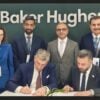
Baker Hughes signs Deal to Reduce Gas Flaring in Iraq
Posted on 18 September 2025 .
By John Lee.
US energy technology company Baker Hughes has announced an agreement with Iraq-based Halfaya Gas Company (HGC) to strengthen their collaboration for an innovative flare gas recovery system at the Bin Umar [Nahr Bin Umar, Nahr Ben Umar] gas processing plant in southeastern Iraq. The project will significantly reduce upstream flaring and transform waste gas into valuable products.
The agreement builds on a previously announced memorandum of understanding to establish a collaboration for the Bin Umar development project and completion of a pre-Front End Engineering and Design (FEED) study. It marks an important step in Iraq's drive to eliminate routine flaring and support the country's energy transition and environmental priorities.
The project is expected to recover up to 300 million standard cubic feet per day (MMSCFD) of flared gas. This equates to approximately 32 billion kilowatt-hours of energy annually - comparable to the yearly electricity consumption of roughly 2 million average households in Iraq. The waste gas that would have otherwise been flared will be converted into treated dry gas, liquefied petroleum gas (LPG), and condensate for domestic use and export.
The companies have also agreed to collaborate on development of upstream oilfields in Iraq, also leveraging Baker Hughes' Oilfield Services & Equipment segment expertise. This includes exploring strategic opportunities to develop local maintenance and repair services, along with an industrial manufacturing collaboration.
Hussein Saihood, CEO of Raban Al Safina for Energy Projects (RASEP, part of RAS Group), said:
"Our collaboration with Baker Hughes reaffirms our unwavering commitment to Iraq's future by reducing emissions, enhancing energy security and accelerating the development of a modern and sustainable energy infrastructure. Through strategic alliances with world-class partners, we are laying the foundations for long-term prosperity and resilience for our people ... Baker Hughes' demonstrated technical capabilities, tailored solutions and in-country service presence make them an ideal partner for this critical project."
Alessandro Bresciani, senior vice president Energy Equipment, Industrial & Energy Technology at Baker Hughes, said:
"Making traditional sources of energy more efficient with lower emissions is critical for sustainable energy development. The industry has a responsibility and opportunity to enable this today ... This agreement is a testament to our shared commitment to driving progress at scale and represents another significant milestone in Baker Hughes' journey to help customers achieve more sustainable and efficient operations."
The Bin Umar project is being developed by Halfaya Gas Company Ltd. (HGC), a special purpose project company owned by RASEP - Part of RAS Group, pursuant to a 15 years' BOOT contract with South Gas Company (SGC, a subsidiary of the Iraqi Ministry of Oil).
The flare gas recovery system is part of Baker Hughes' broad portfolio of emissions abatement solutions capable of improving productivity, efficiency and delivering increased value at scale across customer operations.
(Source: Baker Hughes)
Posted in Iraq Oil & Gas News Comments Off on Baker Hughes signs Deal to Reduce Gas Flaring in Iraq
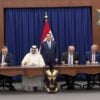
Partners Sign Key Contracts for Iraq's Gas Growth Integrated Project
Posted on 16 September 2025 .
By John Lee.
TotalEnergies, in partnership with Basra Oil Company (30%) and QatarEnergy (25%), has signed the final contracts of the Gas Growth Integrated Project (GGIP) at the Ratawi [Artawi] field in Basra, under the patronage of Prime Minister Mohammed Shia al-Sudani.
The agreements include:
- a joint operating contract between the Ministry of Oil, Basra Oil Company (BOC), TotalEnergies (45%, operator), and QatarEnergy;
- a seawater treatment facility with Hyundai (capacity 7.5 million barrels per day);
- a central oil and gas processing facility with Turkiye's Enka (210,000 bpd and 163 MMscfd of gas); and,
- a gas processing plant with China Petroleum Engineering & Construction Corp (CPECC) (600 MMscfd in two phases).
The Common Seawater Supply Project (CSSP), to be built near Umm Qasr, will substitute treated seawater for freshwater currently drawn from the Tigris, Euphrates, and aquifers, helping to reduce regional water stress and free up around 250,000 cubic metres of water daily for agriculture.
The Ratawi redevelopment, launched in 2023, will raise output to 120,000 bpd in 2026 (phase 1) and to 210,000 bpd in 2028 (phase 2), with no routine flaring. Associated gas will be processed through the 300 MMscfd Gas Midstream Project to supply the national grid, providing electricity to around 1.5 million households. The project also includes a 1,000 MW solar power component.
Prime Minister al-Sudani welcomed the agreements, describing them as evidence of Iraq's improving investment climate. Oil Minister Hayan Abdul Ghani and Qatari Energy Minister Saad Sherida Al-Kaabi attended the signing, alongside executives from TotalEnergies, Enka, Hyundai, and CPECC.
TotalEnergies CEO Patrick Pouyanné said that with all four GGIP components - oil, gas, water, and solar - now launched, the first phase of production is expected in early 2026, employing around 7,000 Iraqis during construction.
Full text of statement from TotalEnergies:
Patrick Pouyanné, Chairman and Chief Executive Officer of TotalEnergies, and His Excellency Saad Sherida Al-Kaabi, Qatari Minister of State for Energy Affairs, Deputy Chairman and Chief Executive Officer of QatarEnergy, met on Sunday, 14th of September in Baghdad with His Excellency Mohammed Shia al-Sudani, Prime Minister of the Republic of Iraq, and His Excellency Hayan Abulghani, Minister of Oil and Deputy Prime Minister, to announce the start of construction of the Common Seawater Supply Project (CSSP) and the full field development of the Ratawi oil field.
These are the two last major contracts of the Gas Growth Integrated Project (GGIP), led by TotalEnergies (45%, operator) alongside its partners Basra Oil Company (30%), and QatarEnergy (25%).
With these signatures, all four parts (natural gas, solar, oil, water) of the GGIP are now in execution phase. The GGIP, a showcase project for TotalEnergies' multi-energy strategy, aims to sustainably develop Iraq's natural resources to improve the country's electricity supply while contributing to its energy independence and reducing its greenhouse gas emissions.
The seawater treatment plant, a key infrastructure to preserving the country's water resources
The CSSP will be built on the coast near the town of Um Qasr. It will process and transport 5 million barrels of seawater per day to the main oil fields in southern Iraq.
Treated seawater will be substituted for the freshwater currently taken from the Tigris, Euphrates, and aquifers to maintain pressure in the oil wells. The project will therefore help alleviate water stress in the region and is expected to free up to 250,000 cubic meters of freshwater per day for irrigation and local agriculture needs.
Ongoing redevelopment of the Ratawi field, one of Iraq's lowest-emission oil sites
The Ratawi redevelopment was launched in September 2023. Phase 1 aims to increase production to 120,000 bpd and is expected to come on stream by early 2026.
The launch of phase 2 (full field development) will enable to increase production to 210,000 bpd starting in 2028 with no routine flaring.
All 160 Mcf/d of associated gas produced every day will be fully processed thanks to the 300 Mcf/d Gas Midstream Project (GMP), whose construction began early 2025. The GMP, which will also treat previously flared gas from two other fields in southern Iraq, will deliver processed gas into the national grid where it will fuel power plants with a production capacity of approximately 1.5 GW, providing electricity to 1.5 million Iraqi households. An Early Production facility to process 50 Mcf/d of associated gas will start early 2026 together with the Ratawi phase 1 oil production.
"We are delighted today to award the two final contracts of the Gas Growth Integrated Project, in particular the seawater treatment plant which has been long awaited by the oil industry in Iraq. In less than 2 years since the GGIP effective date in August 2023, TotalEnergies and its partners have fully executed their commitment towards the people of Iraq and launched all projects included in the multienergy GGIP projet, the best showcase of TotalEnergies transition strategy. All these projects will bring a significant contribution to the Iraq economy and employ during the construction phase 7,000 Iraqi nationals.," declared Patrick Pouyanné, Chairman and Chief Executive Officer of TotalEnergies. "Furthermore, I am proud to confirm that the first phase of the associated gas, oil and solar projects will start-up as soon as early 2026."
About the Gas Growth Integrated Project in Iraq
In 2023, TotalEnergies launched the multi-energy Gas Growth Integrated Project (GGIP) in Iraq. The GGIP is designed to enhance the development of Iraq's natural resources to improve the country's electricity supply. This 4-in-1 project comprises the recovery of gas that is currently flared at three oil fields in southern Iraq to supply electric power plants, the redevelopment of the Ratawi oil field, the construction of a 1 GWac (1.25GWp) solar farm and of a seawater treatment plant.
(Sources: TotalEnergies, Ministry of Oil, PMO)
Posted in Construction & Engineering In Iraq, Iraq Industry & Trade News, Iraq Oil & Gas News Comments Off on Partners Sign Key Contracts for Iraq's Gas Growth Integrated Project
Iraq's Verdict on America, Britain, and Iran After 2003
Posted on 13 September 2025 .
By Dr. Layth Mahdi. The opinions expressed are those of the author, and do not necessarily reflect the views of Iraq Business News.
Iraq's Verdict on America, Britain, and Iran After 2003
Two decades after the U.S.-led invasion, Iraqis remain sceptical of the promises made in 2003. Operation Iraqi Freedom toppled Saddam Hussein but left behind a fractured system that has enriched elites while failing ordinary citizens.
Pre-2003 vs. Post-2003 Iraq: A Comparison
Before 2003, Iraq had a relatively stable but perhaps corrupt system that served ordinary citizens in ways the post-invasion promises of "freedom" never materialized. At that time, Iraq's agricultural sector contributed 12% to the GDP, while industry contributed 14%. Illiteracy was virtually non-existent. However, by 2025, these figures had dramatically declined: agriculture's contribution to GDP fell to 1.3%, industry to just 2%, while illiteracy increased, affecting 25% of the population.
Democracy or Dysfunction?
The post-2003 parliamentary system splintered into nearly 300 political parties. Instead of building a functioning democracy, these groups divided ministries and state institutions like spoils of war. Paralysis, corruption and embezzlement became the hallmarks of governance.
The shortcomings of Iraq's ruling class are often glaring. Some leaders cannot distinguish between a million, a billion, and a trillion. Others struggle to read policy documents. For many Iraqis, this captures the decay of a system that promised democracy but delivered dysfunction.
Iran's Expanding Influence
The U.S. and Britain's invasion of Iraq created a power vacuum that Iran quickly moved to fill. Tehran extended its influence into Iraq's politics, security, and economy, often with tacit approval from Washington.
Today, Iran-backed militias operate outside Baghdad's control, undermining the authority of the state. Iran's reach extends into Iraq's parliament, judiciary, and key ministries. Many Iraqis believe that Tehran has deliberately weakened the country's agricultural and industrial sectors to ensure that Iraq remains dependent on Iran for economic survival.
The People Left Behind
While politicians and militias have prospered, ordinary Iraqis continue to endure worsening conditions and poverty. Successive governments have failed to provide basic services such as electricity, clean water, healthcare, education, and jobs.
Southern Iraq suffers most. Poverty exceeds 50 percent, with Muthanna Governorate approaching 60 percent. Unemployment is widespread, corruption entrenched, and illiteracy affects an estimated 10 million Iraqis, about one in four citizens.
The scale of corruption is staggering. According to a report from Iraq's Central Bank in collaboration with the World Bank, $1.46 trillion in public funds has been stolen since 2003. Only 2% of that amount recovered. More than $600 billion has been smuggled abroad, much of it funnelled to Iran through proxies.
A Fragile State
Iraq today is trapped in a cycle of instability. The government is widely seen as illegitimate and incapable of governing effectively. The Prime Minister relies on over 100 advisors, many of whom are relatives, friends, or loyalists with little expertise.
The bloated public sector, with 10 million employees, relies almost entirely on oil revenues. A sharp drop in oil prices could trigger a national crisis, fuel mass protests, and even collapse the government.
Meanwhile, Iraq's population grows by about a million every year, further straining the weak infrastructure, collapsing services, and a stagnant economy.
Searching for a Future
Some Iraqis argue that fundamental change is needed. Proposals include moving from a parliamentary to a presidential system, creating an independent legislature, and reforming the public sector with investment in vocational training and economic development.
But such reforms require stability, something Iraq has struggled to achieve since 2003.
When U.S. Ambassador Paul Bremer promised Iraqis a future of democracy, stability, and prosperity, it captured the hopes of a nation. Yet, twenty years later, many Iraqis feel that these promises have not been delivered.
Posted in Blog Comments Off on Iraq's Verdict on America, Britain, and Iran After 2003

Tabaqchali: A tour of Ur, the Marshes, and Al-Qurna
Posted on 09 September 2025 .
By Ahmed Tabaqchali, Chief Strategist of AFC Iraq Fund.
Any opinions expressed are those of the author, and do not necessarily reflect the views of Iraq Business News.
"Southern Mesopotamia: A tour of Ur, the Marshes, and Al-Qurna"
"The world's surprise boomtown: Baghdad" is the title of The Economist's September 4th article highlighting Baghdad's construction boom, driven by the country's stability, which in turn is drawing foreign investments. These, and the points made in the article on population growth, pent-up demand, and liquidity, were the themes that were made here in July 2023 in "Construction Activity and Stability" which further highlighted that "This private sector led construction activity was supported by funding from the Central Bank of Iraq's IQD 14 trillion (USD 10.7 billion) and IQD 4 trillion (USD 3.1 billion) subsidised lending initiatives ..." and noting "... during 2021-22, about IQD 6.7 trillion (USD 5.2 billion) and IQD 0.5 trillion (USD 0.4 billion) were disbursed from the two initiatives for real estate financing ...".
The market, as measured by the Rabee Securities U.S. Dollar Equity Index (RSISX USD Index), was up 4.0% for the month and 4.3% for the year, following increases in 44.8% and 97.2% in 2024 and 2023 respectively. Unlike in the prior two years, the summer holidays and the 40-day Arbaeen pilgrimage did not exert their usual subduing effects on the market's turnover, or on its trend. This came as a surprise as August is the hottest month of the year, and mid-month witnessed the climatic ending of the pilgrimage that marked the martyrdom of Prophet Muhammad's grandson Imam Hussein. As such, this supports the thesis that the market's technical picture continues to be positive, and that the RSISX USD Index is continuing with the process of consolidating its gains that started in December 2024, following a blistering 35.9% three-month rally. While this consolidation could continue over the next few weeks, the likely consolidation or pullback should be within its multi-month uptrend (chart below)
Rabee Securities U.S. Dollar Equity Index and Daily Turnover
 (Source: Iraq Stock Exchange, Rabee Securities, AFC Research, daily data as of August 31st. Note: daily turnover adjusted for block trades)
Even more of Iraq, as seen through a visitor's eyes
As mentioned, three months ago, my friend and colleague Thomas Hugger, CEO of Asia Frontier Capital (AFC), visited Iraq at the end of May, and with me, embarked on a tour of the country that included business visits, cultural, and historic tours. Two months ago, we reviewed our visit to the Iraq Stock Exchange (ISX), the Bank of Baghdad, and Baghdad Soft Drinks. Last month, we reviewed our visit to some of Baghdad's old districts (Al-Madrasa Al-Mustansiriya, Al-Mutanabbi Street, and Al-Shawaka), the ancient cities of Babylon, and Ctesiphon. This month, we review our visit to the ancient city of Ur, the Marshes, and the meeting point of the Tigris and Euphrates rivers forming Shatt Al-Arab at Al-Qurnah. Next month will cover our visit to Iraq's third largest city, Basra, and other aspects of Thomas's Iraq visit, that space did not allow for inclusion.
Our guide for this leg of the visit, as for the prior visit to Babylon and Ctesiphon, was Ali Ghanem Sarhan, one of my students at Baghdad Business School (BBS), who is now an independent freelance tour guide specialising in cultural and historical tours. His rich Instagram account (@alighanim.1) chronicles his criss-crossing the country with tourists from all over the world.
Our first destination, the ancient city of Ur, about 350 km south of Baghdad, was founded circa 3800 BC, while ancient, is still about 1,600 years younger than the first Sumerian city of Eridu. Ur, along with Uruk and Eridu, was among the most significant city-states of southern Mesopotamia, which were founded circa 5400-3800 BC on the edges of the Mesopotamian Marshes. These cradles of civilisation developed complex systems for writing, mathematics, astronomy, agriculture and its related industries, and many others -some of which we use without being aware of such as the division of the year into 12 months, and of the hours into 60 minutes. Agriculture and trade with the outside world played a major part in Ur's evolution as Southern Mesopotamia, apart from the two rivers, the reeds that grew along their embankments, and its rich soil, had no other natural resources such as metals, stones, rocks or wood. The products of its extremely sophisticated agricultural system were traded for the materials it needed, and the city became a major regional trading hub that traded with all the known world then, as far as the peoples of the Indus Valley.
Ur, during its third dynasty, circa 2200-2000 BC, was the capital of an empire, which at its heyday was an incredibly rich cosmopolitan city, with a population of around 65,000. The dynasty's founder king Ur-Nammu built its great Ziggurat, other major constructions, and enacted the first known legal code -about 300 years before the code of the great Babylonian king Hammurabi. The city's well-developed bureaucracy needed to run a highly centralised system of governance for the empire, built upon that of the Akkadian empire founded by Sargon the Great, circa 2400-2200 BC, following the conquering of all the Sumerian city states, Ur included -the evidence of which can be seen in the sophisticated administrative tablets, or the "spreadsheets of empire", unearthed from the state archives of Girsu (i).
Ur's connection with our world does not stop with bureaucracy, but extends to faith and myth as the city is believed to be the home of Abrham who is thought to have lived there circa 2000-1500 BC, as well as its connection much earlier to the story of the deluge of Noah. During the city's excavation in 1929, sandwiched between two distinct layers marked by human habitation, an 8-12 foot thick layer of soil was discovered that showed no sign of human occupation, and was the result of soil deposits of a massive flood dating circa 3500-3200 BC. While too old to have been the result of Noah's deluge, it nevertheless was probably an inspiration for the story of the flood. The Tigris and Euphrates, brought life, prosperity and wealth to Mesopotamia, but also devastation with their irregular floods, the largest of which featured in Sumerian and Babylonian myths as punishments for human sins -in particular the great flood story in the "Epic of Gilgamesh", in which the god Enlil, warns Utnapishtim about a deluge that would be brought by the angry gods, and instructs him to build a great boat to preserve human and animal life. It's thus fitting that the late Pope Francis, while speaking next to Ur's Ziggurat said "This blessed place brings us back to our origins" and "We seem to have returned home" during his historic visit to Iraq in March 2021.
UR
 (Source: AFC Research)
Ur's Ziggurat, much like all the great structures of southern Mesopotamia, was constructed from mudbricks utilising the rich muddy sediments deposited over the centuries by the flooding of the two rivers. However, many have not survived the thousands of years unscathed from the combination of the effects of the natural elements, neglect, conflict, and looting. Fortunately, layers of sedimentation protected the Ziggurat's base until it was excavated in the 1920s, like many of Ur's other remains. Despite the suffocating heat, the Ziggurat's towering base was a magnificent sight to behold, both from a distance and while standing at the foot of the great middle staircase leading to the base's top. Based on the many sketches of how it originally looked, I tried to visualise how majestic it originally was with its next two successively smaller levels, and the shrine at the summit dedicated to the moon god Nana. We first walked to the base of the Ziggurat's central staircase on the specially constructed wooden footpath, and from there to the remains of temples, palaces, the residential area, with our guide describing each including pointing out the general area that is believed to have been the home of Abrham.
UR
 (Source: AFC Research)
Despite the rich history and the majesty of the site, we were the only visitors -it had a few signs with brief descriptions of the structures, but it did not have any tourist facilities, nor an information centre, nor even basic shops. In an effort to address these shortcomings, the authorities, a few kilometres away, developed a sort of a tourist village, which we visited, and once more were the only visitors -plus it felt like a ghost town. However, it was not obvious, at least to me, how that would work with the lack of facilities at the site itself -nevertheless it's welcomed as a start of the mind shift needed to embrace tourism and unlock its value in contributing to job creation, and economic growth.
Thomes notes: "It is impressive that this place we visited was already inhabited about 4,000 years ago and that Pope Francis visited Ur on March 6th, 2021. But it seems he had better timing than us since the temperature was around 25 degrees Celsius when he visited. That's much lower compared with the 46 degrees Celsius we had to endure. On the other side, it was sad to see that we were the only visitors to this majestic site and the tourist village. I sincerely hope that will change and more tourists interested in heritage will visit these important sites in the future and that the Government of Iraq will continue to preserve them for our descendants."
Tourist village near Ur
 (Source: AFC Research)
As we left Ur, the extreme heat, and the expanse of the desert around the Ziggurat complex, it was difficult to imagine that this was a sprawling city, teeming with life, in the middle of a lush green land, surrounded by an extensive network of canals, with the Euphrates, the Marshes, and the sea at its doorstep The Euphrates has changed course since then, the sea has receded by about 200 km, and our next destination, the Marshes, were now about 100 km away.
The Marshes, formed, about 11,000 to 13,000 years ago, by the convergence of the Tigris and Euphrates as they branched into deltas and shallow lakes, played a major part in the development of Mesopotamia. At some point in time, they were the largest wetland ecosystem of western Eurasia. The Marshes, as we know them today and that we were headed to, are what is left of these ancient Marshes, which took their shape gradually as most of the ancient Marshes dried up and the sea regressed to the south. They are home to the Marsh Arabs, known as the Ma'dan, who despite the intrusion of technology such as electricity initially, and the internet recently, have largely maintained many aspects of a unique aquatic way of life that goes back to the founding of the Sumerian cities circa 5400 BC. In addition to being the home of the Ma'dan, they are the historic home of the Mandaeans, followers of probably the most ancient religion in the world, and who have preserved customs and traditions that might date back to Babylon -interestingly, remnants of the Babylonians were still living in the Marshes in the tenth century AD. Ecologically, the Marshes are home to numerous species of fish and birds, are a stop-over for migratory birds, and are considered a key bio diversity area as literally they are a water world in the middle of an arid desert.
Over the years, the Marshes gradually eroded, initially by changing weather patterns, with the erosion accelerating in the middle of the last century with the building of dams upstream on the two rivers, in and outside Iraq, that substantially reduced water flows. More serious, were the drainage by successive governments to reclaim land for agriculture, and for oil exploration and development. However, it was their relative isolation and seclusion, that historically provided a sanctuary for those who opposed the state over the centuries, that almost led to their extinction following the First Gulf War in 1991. Then the regime, in seeking to quash the rebellion that rose in the south of the country following the war, embarked on a spectacular feat of engineering to drain them. The flows of the Tigris and Euphrates rivers were diverted by hundreds of kilometres of embankments, dykes, and canals, which over five years drained up to 90% of the Marshes, or an area of about 8,000 square kilometres -the result was a dwindling of the population to about 20,000 from a peak of 500,000 in the 1950s. Over a decade later, following the invasion of Iraq in 2003, they were reflooded, and life, though much changed from the past, returned gradually. Happily, the Marshes were declared a UNESCO World Heritage Site in 2016 (ii).
Our entry to the Marshes was through the town of Chibayish, in which we had a short walkabout, before heading to our host's dwelling at the edge of the waters -like many of those who returned, he and his family live on dry land at the edge of the Marshes and not on the tiny islands that dotted them as in the past. We were welcomed at the Al-Mudhif, the traditional hospitality house made from the reeds that grow on riverbanks and in the Marshes, whose shape and construction have not changed for thousands of years. After a few rounds of Chai (Iraqi tea), each one of us was served a Masgouf -the Ma'dan insist that their Masgouf is the original method of this uniquely Iraqi way of grilling fish. We accepted their story and enjoyed the fish; after all, history is on their side as the Masgouf dates back over four and a half thousand years to the Sumerians, and its cooking doesn't seem to have changed much since then according to some Sumerian texts. I have to admit though, that I prefer the Baghdadi custom of accompanying Masgouf with red rice, as opposed to Ma'dan's custom of accompanying it with white rice, and for Thomas, expecting to eat mostly Kebab in Iraq and not a specific fish lover, it was his second fish meal, and he notes: "I once again enjoyed eating the delicious and nicely prepared Masgouf, but it was a little bit unique to eat the freshly cooked fish with bare fingers. I also enjoyed the flavour-rich rice and the sweet chai. However, I have to honestly admit that sitting in a chair and eating food from a table is much more comfortable than eating on the floor. I was glad that Ahmed and his brother were also struggling and experiencing, like me, some form of back pain."
At the Mudhif
 (Source: AFC Research)
After our meal, and another round of chai, our host gifted us "Shemaghs" -the traditional Iraqi headgear that is also the headgear of Jordanians and Palestinians known as the "Keffiyeh", which has Sumerian origins. Legend has it that Sumerian fishermen wore fishnets over their heads to protect them from the scorching sun, which in time evolved into today's headgear that incorporates two lines representing the two rivers and the fishing net design through; and the Keffiyeh is etymologically derived from the Iraqi city of Kufa, and means "from Kufa" (iii). Afterwards, we embarked on a long tour of the Marshes in the traditional long narrow canoe used by the Ma'dan for thousands of years, named the Mashoof, with the only nod to modernity being the gasoline-powered motor. No amount of reading or watching videos prepared me for the beauty or serenity of the Marshes once we were deep within them -we must have spent up to two hours lost in this magical place. I plan to come back again, and hope to spend a few days to truly appreciate the place, see more of its people and try to experience a dying way of life. Thomas notes: "It was an amazing experience. After travelling hundreds of kilometres through desert, dust and sand, suddenly these water channels opened behind the house where we enjoyed the delicious lunch earlier. It was very relaxing peaceful, and the sunset was incredible. Also, the nature with all its different inhabitants, from simple fireflies to water buffalos was fascinating. As you can see, we took some stunning pictures but witnessing it in real is a very different story and much more impressive. I hope this remarkable place can be preserved for the future and will not be destroyed for a few pennies profit."
A Mashof ride in the Marshes
 (Source: AFC Research)
The final leg of our tour of Southern Mesopotamia was a drive to the meeting point of the Tigris and Euphrates rivers forming the Shatt Al Arab river at Al-Qurnah, however, that was late in the evening and we couldn't take a full sense of the place -but then, it's almost impossible to appreciate anything after being in the Marshes, even though Al-Qurnah is believed to be the Garden of Eden. Once again, there were no tourist facilities apart from a garden that housed a dead tree that the locals refer to as "Adam's Tree"- suggesting it's the "Tree of the Knowledge of Good and Evil". However, the site's sign leaves this to the imagination, instead noting that Abraham prayed there a few thousand years ago and saying that there will be a tree like Adam's tree in Paradise. Thomas notes: "The place was a little busier maybe because it was after sunset and local people and local tourists enjoyed the funfair, ice cream, and other local attractions nearby the "Garden of Eden". However, it was sad to see that the tree was 'dead'. Sign of life?"
The sense of the antiquity of Southern Mesopotamia, both from being close up to the remains of its structures and from experiencing the remnants of its culture, this phrase comes to life: "In the landscape of recorded history, Iraq is Everest: just as Everest makes other mountains seem small, Iraq makes ancient history seem recent by comparison" (iv).
Al-Qurnah
 (Source: AFC Research)
Further information
The history of the Southern Mesopotamia, Sumerians, and the Marshes was simplified a great deal in the telling, keeping only the saliant points, and leaving so much more interesting material out. Dates are approximate, based on many sources, and the cities would have been settled much earlier than founded.
- On the evolution of Southern Mesopotamia, and of the Sumerians, this video is worth watching
- " The Sumerians - Fall of the First Cities" Paul Cooper (@PaulMMCooper) 16 August 2020
- The story of the Marshes' revival is captured in a CBS article and video; as well as reflections twenty years following the Iraq invasion by the Iraqi-American engineer who played a crucial part in their reflooding.
- "Iraq's marshlands: Resurrecting Eden", CBS 60 minute article, 22 June 2011
- "Iraq's marshlands: Resurrecting Eden", CBS 60 minutes video, 25 July 2011
- "Eden reborn: Revitalizing Iraq's marshes", Azzam Alwash, in Chatham House's series "Iraq 20 years on: Insider reflections on the war and its aftermath", 3 April 2023
- "The Story of the Keffiyeh", Rajrupa Das, Al Markaz Review, 3 March 2024
- "Heirs to Forgotten Kingdoms", Gerard Russell, Simon & Schuster UK, 10 September 2015
Please click here to download Ahmed Tabaqchali's full report in pdf format.
Mr Tabaqchali (@AMTabaqchali) is the Chief Strategist of the AFC Iraq Fund, and is an experienced capital markets professional with over 25 years' experience in US and MENA markets. He is a board member of Arab Bank Iraq, a Visiting Fellow at the LSE Middle East Centre, Senior Fellow at the Institute of Regional and International Studies (IRIS), and a Senior Non-resident Fellow at the Atlantic Council.
His comments, opinions and analyses are personal views and are intended to be for informational purposes and general interest only and should not be construed as individual investment advice or a recommendation or solicitation to buy, sell or hold any fund or security or to adopt any investment strategy. It does not constitute legal or tax or investment advice. The information provided in this material is compiled from sources that are believed to be reliable, but no guarantee is made of its correctness, is rendered as at publication date and may change without notice and it is not intended as a complete analysis of every material fact regarding Iraq, the region, market or investment.
Posted in Ahmed Tabaqchali, Investment Comments Off on Tabaqchali: A tour of Ur, the Marshes, and Al-Qurna