


PetroChina to Join Exxon on West Qurna Oilfield
Posted on 11 August 2013 .
China's largest energy firm, PetroChina, will join ExxonMobil in developing Iraq's giant West Qurna oilfield and is in talks with Lukoil to buy into a second project at the field, according to the South China Morning Post.
China is already the top foreign player in Iraq's southern oilfields, and a deal at West Qurna would boost its dominance, making PetroChina the biggest single foreign investor.
"PetroChina will participate in developing the field," said an industry source with direct knowledge of the deal with Exxon.
The Morning Post's source said that the agreement will be announced in the coming weeks, but declined to give further details on how the world's two most valuable listed energy firms would work together in Iraq. Both PetroChina and Exxon declined to comment.
Exxon holds a 60 percent stake in West Qurna 1, a US$50 billion investment project pumping around 480,000 barrels per day (bpd).
In March, PetroChina's ex-chairman Jiang Jiemin told Reuters that the Chinese energy major was willing to team up with Exxon at West Qurna.
PetroChina is also in talks with Lukoil for a stake in another development project at the field, West Qurna-2, a Lukoil source said. That source also declined to give details on the size of the stake under discussion.
"Lukoil bosses have already said they would prefer an Asian partner, a Chinese partner, in the project to secure a guaranteed market for oil sales," the source said.
Lukoil's chief executive Vagit Alekperov has said that the company wanted a Chinese firm to replace Norway's Statoil at the project, after Statoil agreed last year to sell its 18.75 per cent stake.
West Qurna-2 is expected to produce 500,000 bpd in 2014, and need total investment of US$30 billion. Lukoil plans to invest US$5 billion in the project in 2013 alone.
Last year, Exxon offered to sell its stake in the southern Iraq West Qurna-1 oilfield after a dispute with Baghdad over contracts it signed with autonomous Kurdistan in the north, deals the central government rejects as illegal.
A Morning Post source familiar with PetroChina operations in Iraq said in March the two companies were discussing a deal that would enable Exxon to retain operator status at the oilfield, where Royal Dutch Shell is minority partner with 15 percent.
However, some industry sources have said it is unlikely that PetroChina would buy stakes in both projects, due to their sheer size and scale.
(Source: The South China Morning Post)
Posted in Iraq Industry & Trade News, Iraq Oil & Gas News 3 Comments
Kurdistan Opens Oil Trade Route Via Iran
Posted on 11 August 2013 .
According to The Express Tribune, Iraq’s Kurdistan region is exporting crude oil by truck to an Iranian port for shipping to Asia, using a trade route that is likely to anger both Baghdad and Washington.
In a dispute largely over revenue sharing, Kurdistan’s crude exports through a pipeline controlled by the Iraqi central government, dried up last year. However, it is transporting about 50,000 barrels of crude and condensates per day by road from the landlocked region through Turkey.
Now, sources are reporting, that the Kurdistan Regional Government (KRG) has approved a second route for crude through Iran used previously only for petroleum products.
For the past two months, crude has been trucked from Kurdish fields over the border to Iran’s Bandar Imam Khomeini (BIK) terminal, 900 km to the south on the Gulf. Amounts are unclear but have been reported to be as much as 30,000 bpd.
One industry source in Kurdistan said the regional government in Arbil was anxious not to put out either of the region’s powerful neighbours, Turkey and Iran, in transporting the crude. “It’s a political compromise,” said the source, who declined to be identified. “They cannot ignore the Iranians and go all the way with the Turks. They have to balance.”
However, it is not clear what Iran, which faces huge problems in selling its own oil products because of international sanctions, gets out of the arrangement.
Oil lies at the heart of the dispute between the Arab led Iraqi central government and the ethnic Kurdish run northern enclave. At issue are control of oilfields, territory and crude revenues shared between the two administrations.
“We have made it very clear that the only acceptable option for oil exports is through the federal pipeline network,” a senior Iraqi oil official said. “We consider any other trade, whether it be through Iran or Turkey, as smuggling. It’s illegal.”
Baghdad claims sole authority over oil exploration and exportation, and in the past has accused the Kurds of smuggling crude via Iran and keeping the revenue for itself.
The KRG says its right to exploit and export the reserves under its soil is enshrined in Iraqs federal constitution, which was drawn up following the US-led invasion of 2003.
Arbil has already antagonized Baghdad by signing exploration and production deals on its own terms with firms including Exxon Mobil, Chevron and Total, and is currently laying the final stretch of an independent export pipeline to Turkey.
Fuel oil and naphtha have moved by truck from Kurdistan through Iran for years, because Kurdish domestic sales contracts allow the sale of these products outside Iraq.
Washington, a long standing ally of the KRG, has previously pressured Arbil to stop this trade as it tightens the sanctions imposed over Iran’s disputed nuclear programme.
“We have advised Arbil in the past not to engage in business with Iran and will continue to do so,” a US diplomat said when asked how Washington would view the KRG’s official approval for crude exports through Iran.
Amounts of Kurdistan crude being trucked through Iran are likely to be modest when compared with its production capacity. Industry sources report that the oil is mainly from the region’s three biggest producing fields – Taq Taq, Tawke and Khurmala.
At Iran’s BIK terminal, the truckloads of crude are pooled in storage tanks and then pumped onto ships for export.
The tankers sail directly to Asia or to storage facilities at Fujairah in the United Arab Emirates and elsewhere in the Gulf, where the crude is kept in tank farms part-owned by European companies.
(Source: The Express Tribune)
Posted in Iraq Oil & Gas News, Iraq Transportation News, Politics 2 Comments

Oil Companies in Kurdistan - Complete List of Top Oil Companies
Posted on 25 June 2013 .
Erbil Governorate has compiled and published a list of the top oil companies in Kurdistan [Note: This list was originally compiled and published by Marcopolis - Ed.].
[NEW: An updated list can now be found by clicking here - Ed.]
Listing them by country:
USA
- Exxon Mobil
- Chevron
- Aspect Energy
- Marathon Oil Corporation
- Hillwood International Energy
- Hunt Oil
- Prime Oil
- Murphy Oil
- Hess Corporation
- HKN Energy
- Viking International
Canada
- Forbes and Manhattan
- Western Zagros Resources
- Talisman Energy Inc
- NIKO Resources
- Ground Star
- Shamaran
Posted in Iraq Oil & Gas News 14 Comments
Who's Winning the Battle for Iraq's Oil?
Posted on 06 June 2013 .
Who is the biggest winner from the recovery in Iraqi oil production? Denise Natali, a Middle East expert at the National Defense University in Washington, told the New York Times:
“The Chinese are the biggest beneficiary of this post-Saddam oil boom in Iraq ... They need energy, and they want to get into the market.”
China already buys about 1.5 million barrels a day from Iraq -- nearly half the oil that Iraq produces -- and it looks like the front runner to take over Exxon Mobil's stake in the giant West Qurna-1 oilfield.
All of which sits very well with Abdul Mahdy al-Ameedi, head of Iraq's Petroleum Contracts and Licensing Directorate (PCLD). “We don’t have any problems with [the Chinese],” he said. “They are very cooperative. There’s a big difference, the Chinese companies are state companies, while Exxon or BP or Shell are different.”
Poking fun at the idea that the US really invaded Iraqi to get its oil, Daily Show presenter Jon Stewart quipped:
"Don't you have to be in a war to win it?"
But regardless of who actually wins the contracts, the increasing supply of oil from Iraq is helping to take the pressure off world oil supply, and the impact of that is felt around the globe.
Posted in Blog, Iraq Oil & Gas News 1 Comment

Economy Starts to Hum, but Projects Need to Ramp Up
Posted on 30 May 2013 .
By Sherif Salem.
As has often been the case in Iraq, developments in recent weeks have inspired both pessimism and optimism.
On the one hand, an increase in bomb attacks – with 300 fatalities in April – raised fears of a return to the peak in levels of violence seen of 2005-2006. And events in neighbouring Syria have served to heighten nerves.
However, on the economic front, there has been a steady flow of positive news. Fortunately, investors seem to be focusing on this, and taking a long-term view, with the stock market holding firm. This is important as Iraqi companies will increasingly turn to capital markets in coming years to build scale and seek to fulfill their potential.
Firstly, global oil majors continue to pour money into the development of key oil fields, which is vital for long-term economic stability. BP allocated $2.85 billion to further develop the Rumaila oilfield this year, up from $2.2 billion last year. Exxon Mobil is spending $1.65 billion on the West Qurna 1, slightly up on the $1.6 billion spent last year.
Iraq aims to raise oil production to 6 million barrels per day (bpd) by 2017 from the current 3.1 million, which should fund a huge programme of spending on social and physical infrastructure.
On the micro level there are also signs that the grassroots Iraqi economy is starting to hum. For example, Al Mansour Bank, in which Qatar National Bank (QNB) has a majority stake, has just reported loan growth of 12 percent in the first quarter, compared to a year earlier. However, with deposits expanding more than four-fold from a year earlier, the scope for lending should be much higher.
Posted in Sherif Salem Comments Off on Economy Starts to Hum, but Projects Need to Ramp Up
Turkey Puzzled by US Stance on Exxon-KRG Oil Deal
Posted on 30 May 2013 .
Turkish officials are dismayed hearing about US concerns that Turkey’s decision to sign an agreement with ExxonMobil in northern Iraq is perceived as a threat to Iraq’s unity.
Noting that it is ExxonMobil, a US company, that is going to do the exploration work in the Iraqi Kurdistan Regional Government's (KRG) area, the Turkish side is curious why the Obama administration would want Turkey — a country that is more than 80% dependent for its energy needs on outside sources — to turn its back on newly rising opportunities in its neighborhood that will help it to diversify its energy portfolio, while giant US oil and gas companies are exempt from such criticism.
According to the Turkish side, it is primarily these giant oil companies that decide how and when these hydrocarbon reserves will come on the market, and that when they make their move it is best to be on board from the beginning. As ExxonMobil took a step in that direction by exploiting the northern Iraqi resources, Turks are saying that it is not even serious to paint Turkey as a country attacking Iraq’s territorial integrity.
“We have a fast developing economy and industry. We have a large population and we don’t have our own homegrown energy resources to match our needs to keep up with the growth,” a Turkish official told Al-Monitor. “ So what it is exactly that the United States wants us to do — that we don’t work with Russia, Iran and Iraq! So, who should we buy our energy from?”
The Wall Street Journal, however, reported on May 14, “US officials fear setting a precedent to let regional governments strike independent resource deals could destabilize [Iraqi Prime Minister Nouri al-] Maliki’s government during a time when sectarian violence in Iraq is mounting.”
The Wall Street Journal also went on to write:
"'Our position on energy trade from Iraq has been consistent and remains unchanged: The United States doesn’t support oil exports from any part of Iraq without the appropriate approval of the federal Iraqi government,' said Caitlin Hayden, a spokeswoman for the National Security Council."
Turkish officials, however, argue that if the Obama administration is worried about rising sectarian conflict in Iraq, they should point fingers at themselves and take responsibility as the former occupier of the country — but not blame Turkey for anything that goes wrong in Iraq. “The problem is in Baghdad, not in Ankara,” one Turkish official told Al-Monitor.
The signing of the agreements does not mean that these resources will be available for consumption on the market tomorrow. It is going to take time, and much can change in Baghdad’s relations with the Iraqi Kurds before then. “We are just watching out for our best interest.”
Tulin Daloglu is a contributor to Al-Monitor's Turkey Pulse. She has also written extensively for various Turkish and American publications, including The New York Times, International Herald Tribune, The Middle East Times, Foreign Policy, The Daily Star (Lebanon) and the SAIS Turkey Analyst Report. On Twitter: @TurkeyPulse
Posted in Iraq Oil & Gas News 1 Comment

Discussions Continue on Reducing Oil Targets
Posted on 19 May 2013 .
Shell is reported to be in “exploratory discussions” with the Iraqi government to lower the target for oil output at the Majnoon field.
The Iraqi government agreed in January with Lukoil to cut targeted production at the West Qurna-2 field.
It is also in talks with Exxon Mobil to reduce targeted output at West Qurna-1, and with Eni for reductions at Zubair.
Shell's regional vice president, Mounir Bouaziz, told Bloomberg that, whether the discussions result in a reduced plateau, “it is important that the government keeps up with its efforts to provide an enabling environment for the oil and gas investments”.
(Source: Bloomberg)
Posted in Iraq Oil & Gas News Comments Off on Discussions Continue on Reducing Oil Targets
Turkey Joins Exxon in Kurdistan Oil Deal
Posted on 15 May 2013 .
By John Lee.
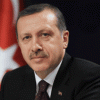
Turkish prime minister has said that state-owned Turkiye Petrolleri AO (TPAO) is has reached an agreement with the Kurdistan Regional Government (KRG) and ExxonMobil to carry out oil exploration in northern Iraq.
Tayyip Erdoğan (pictured) told reporters:
"Countries from various parts of the world are taking steps to explore and produce oil in different parts of Iraq, and then deliver it to world oil markets.
"There's nothing more normal, more natural than Turkey, which provides all kinds of support and aid to its next-door neighbor, to take a step that is based on mutual benefit."
An Ankara-based source told Hurriyet Daily News that TPAO will take equity stakes in a partnership with Exxon and KRG, and would become part of the production-sharing agreement.
Prime Minister Tayyip Erdoğan said that details would be clearer after his visit to the US - he is due to meet U.S. President Barack Obama on Thursday.
(Sources: Hurriyet Daily News, Reuters, Dow Jones)
Posted in Iraq Oil & Gas News 1 Comment

GKP set for Growth
Posted on 03 May 2013 .
Gulf Keystone has provided an update on its four blocks in the Kurdistan Region of Iraq, including the world class discoveries at Shaikan and Sheikh Adi, as well as Akri-Bijeel and Ber Bahr:
Background
With the Shaikan commercial discovery alone, Gulf Keystone has one of the world's largest onshore conventional oil & gas developments with a Pmean 13.7 billion barrels of gross oil-in-place as set out by Dynamic Global Advisors, independent Houston-based exploration consultants. A recent report by Goldman Sachs highlights the scale of the Shaikan development and the fact that in 2015 the global production increase will in part come from the Shaikan field*. The Company continues to be highly active with the drill bit, in order to further prove the value of its blocks.
Today Gulf Keystone is on the verge of moving into a phase of significant production, with the capacity to produce up to 40,000 barrels of oil per day ("bopd") from Shaikan in the coming months and up to 400,000 bopd in the coming years. The Company will be a key contributor in meeting the Kurdistan Regional Government's oil production targets of 1 million bopd in 2015 and 2 million bopd by 2019.
Considerable progress is being made on the regional pipeline infrastructure development and the Company's increasing production will be matched by the available export capacity. The size and quality of the Company's fields is now increasingly recognised and a number of the world's largest oil companies, including ExxonMobil, Chevron and Total, are now following Gulf Keystone's lead and commencing active work programmes in the Kurdistan Region of Iraq.
*Goldman Sachs: April 12, 2013 - "380 projects to change the world. From resource constraint to infrastructure constraint"
Commenting on today's announcement, Todd Kozel (pictured), Executive Chairman and CEO, said:
"As one of the first companies to see the potential of the region, over the last five years Gulf Keystone has drilled or participated in nearly 20 wells and remains one of the most active operators in the Kurdistan Region of Iraq. Shaikan is the largest onshore development worldwide today not in the hands of a major operator. However, we believe that we have only scratched the surface of the true value of our blocks and our ongoing exploration and appraisal activity is expected to result in further upside.
"The Company is encouraged by recent reports from a variety of sources, including political spokespersons, regarding the close and burgeoning ties between the Kurdistan Region of Iraq and Turkey, which the Company believes presents further transformational progress for the region. In this context, Gulf Keystone will play a major role as a co-host of the 2nd International Energy Arena Conference in Erbil on 30 May, a meeting place for key political and industry decision makers on the energy cooperation between the Kurdistan Region of Iraq and Turkey.
"I therefore strongly believe that there is considerable momentum in the development of Kurdistan's vast natural resources and Gulf Keystone is in a prime position to benefit as the region moves to this next stage.
"Our remarkable journey continues and I remain indebted to our hosts in the Kurdistan Regional Government and to the outstanding team within our Company. We have never been more excited about the future."
Posted in Iraq Oil & Gas News Comments Off on GKP set for Growth

Rosneft Sets Sights on Iraq
Posted on 25 April 2013 .
By John Lee.
Russian news agency RT reports that Rosneft is considering a joint venture with ExxonMobil in Iraq.
Company President Igor Sechin (pictured) told reporters:
"We will work with anyone who offers good terms, we'll work with ExxonMobil too."
An Iraqi oil ministry delegation will visit Moscow on 10th May to discuss the deal.
(Sources: RT, Reuters)
Posted in Iraq Oil & Gas News Comments Off on Rosneft Sets Sights on Iraq