


Report on USAID Tijara Growth Program
Posted on 05 February 2013 .
Since its launch in April 2008, the USAID-Tijara Provincial Economic Growth Program has used an integrated approach to economic development that combines financial incentives with educational opportunities to spur private sector development in Iraq.
Tijara, which means trade in Arabic, is a multi-faceted USAID program that works in the areas of sustainable microfinance, bank lending for small and medium enterprises, business development services, youth entrepreneurship, investment promotion and trade reform. It also promotes Iraq’s accession to the World Trade Organization and provides loans to displaced victims of civil unrest who are attempting to revive their private businesses.
The successful five-year program, now drawing to a close, has added momentum to Iraq’s transition from a centralized economy dominated by inefficient state enterprises to a free market financial system where energetic, innovative and previously underserved entrepreneurs are given the chance to flourish.
Click here to download an illustrated report about the program and its impact.
(Source: USAID)
Posted in 'Your Country' - United States Comments Off on Report on USAID Tijara Growth Program
US-Sponsored Training Strengthens Financial Sector in Iraq
Posted on 05 February 2013 .
The U.S. Mission in Iraq, through the United States Agency for International Development’s (USAID) Financial Development Project, is working with the Iraqi banking industry to help banks improve best practices. The U.S. Mission invited seven banks from across Iraq for the January 21-28 launch of the first in a series of 20 training seminars in support of the Iraqi banking and financial services sector.
Representatives of Ashur Bank, who participated in the training this week, said, "Credit and finance instruments are new in Iraq. This training provided us with both technical information and practical skills to understand how we can expand our business in this area." USAID Iraq Mission Director Thomas Staal stated, “We are excited about this training for the banking sector. It is part of our effort to help Iraq’s banking system modernize and become accessible to more Iraqi citizens.”
In addition to conducting this series of banking and financial services training seminars, the Financial Development Project, together with international donors, is seeking to establish a “Banking and Finance Academy” in Iraq. Such an academy would provide long-term, sustainable support to enhance the capability of the local banking system and establish a modern, well-functioning banking sector to serve as a foundation for Iraq’s growing economy.
USAID’s Financial Development Project is an important element of the U.S.-Iraq engagement under the Strategic Framework Agreement. The project supports a more vibrant Iraqi banking sector that will increase economic opportunity and prosperity for all the people of Iraq.
(Source: US Embassy)
Posted in Iraq Banking & Finance News Comments Off on US-Sponsored Training Strengthens Financial Sector in Iraq
US to Assist Iraq with Elections
Posted on 23 January 2013 .
On January 21, the U.S. Embassy in Baghdad, through the United States Agency for International Development (USAID), signed a memorandum of understanding (MOU) with Iraq’s Independent High Electoral Commission (IHEC) formalizing its cooperation to develop IHEC’s institutional capacity in the areas of strategic planning, electoral management, and external relations through the Elections Support Project. Under the MOU, USAID will continue to assist IHEC to develop its capacity to hold free and transparent elections.
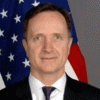
U.S. Ambassador to Iraq Stephen Beecroft (pictured) and USAID Mission Deputy Director David Harden signed the MOU for the U.S. Embassy, and IHEC Board Chairman Sarbast Rasheed signed for the IHEC. In his remarks, Ambassador Beecroft said that:
"The United States remains committed to its partnership with Iraq and with the IHEC to facilitate the success of free and fair elections that will help solidify democratic processes in Iraq."
USAID Mission Deputy Director Harden highlighted the positive cooperation between the United States and Iraqi governments, noting:
"Signing this MOU renews our commitment to work with our Iraqi counterparts for the common goal that unifies us: seeing Iraq’s nascent democratic traditions and institutions grow and flourish."
Mr. Rasheed expressed his appreciation for the support that USAID has given to the IHEC and thanked USAID for its continued commitment by saying that:
"USAID has played an important role in helping the IHEC meet international standards for transparent, credible elections. The MOU that we have signed today reaffirms our commitment to continue these efforts."
This MOU supports the U.S.-Iraqi Strategic Framework Agreement by helping ensure that the Iraqi people’s voices are heard in free and fair elections.
(Source: US Embassy)
Posted in Politics Comments Off on US to Assist Iraq with Elections
US, Iraq to Improve Iraqi Agriculture
Posted on 21 January 2013 .
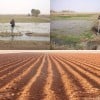
The U.S. Embassy, through the United States Agency for International Development (USAID), and the Iraqi Ministry of Agriculture (MOA), met from January 15 to January 17 to help Iraq improve its agricultural sector through the U.S.-funded Harmonized Support for Agricultural Development (HSAD) project.
This project will improve agricultural investment opportunities and efficiency and introduce modern farming technologies and practices to help Iraqi agribusinesses become more productive and competitive.
The event was attended by Senior Deputy Minister of Agriculture, Dr. Subhi al-Jumaily, other GOI officials, representatives from Iraq’s agricultural colleges, and USAID Mission Director to Iraq Thomas Staal. Mr. al-Jumaily expressed his enthusiasm for the new project, stating, “We are very optimistic that these recommendations will produce results that will strengthen the agriculture sector and eventually lead to increased opportunities for Iraqi farmers.”
In his remarks, Mr. Staal emphasized U.S. government support to Iraqi agriculture, saying, “We are happy to see that our partnership with Iraq’s agriculture sector, which began in 2003, is continuing through HSAD. The recommended technologies and reforms, if implemented, will open up the market for increased investment which in turn will help a broad cross section of Iraqi farmers.”
The HSAD project will help the Ministry of Agriculture reform Iraqi laws, regulations, and institutions in the agricultural sector to encourage increased private sector investment. HSAD builds on USAID’s recently concluded 5.5-year, $179-million Inma agricultural project that helped expand the agribusiness private sector in Iraq and is another U.S. government program in support of Iraqi agriculture as outlined in the Strategic Framework Agreement.
(Source: US Embassy)
Posted in Agriculture Comments Off on US, Iraq to Improve Iraqi Agriculture
Iraq-US Cmte for Cultural and Educational Cooperation
Posted on 28 December 2012 .
The third meeting of the U.S.-Iraq Joint Coordination Committee for Cultural and Educational Cooperation took place in Baghdad on December 17, 2012, underscoring the deep and broad collaboration between the Government of the United States and the Government of Iraq in support of a strong Iraqi education system, the preservation of Iraq’s rich cultural heritage, and robust exchange programs between the two nations.
Higher Education
The United States and Iraq are working together to build a strong Iraqi higher education system, including linkages with U.S. academic institutions and enhanced collaboration on scientific research.
- U.S. and Iraqi efforts helped increase the number of Iraqis studying in the United States by 31 percent in the 2011-2012 academic year. The EducationUSA network provides information about study in the United States to thousands of interested Iraqi students annually through direct advising as well as U.S. university fairs in Iraq.
- More than three hundred Iraqi students and scholars have studied or conducted research in the United States through the Fulbright Program, with 30 students (half of whom are women) and 35 faculty participating in the 2012-2013 academic year.
- The Iraq University Linkages Program supports seven partnerships between U.S. and Iraqi universities to strengthen curricula, enhance and update teaching methods and technology, and improve career services for students.
- The Baghdad-based English Language Institute, established in partnership with the Iraqi government, is expected to open in 2013 and will provide English language instruction to hundreds of Iraqi government scholarship students each year. The U.S. provided $1 million in funding to the institute.
Posted in Iraq Education and Training News Comments Off on Iraq-US Cmte for Cultural and Educational Cooperation
Private Bank SME Lending Tops $224m
Posted on 25 December 2012 .
More than $224 million has been injected into Iraq’s private sector economy in the form of Small & Medium Enterprise bank loans thanks to a cooperative effort between the USAID-Tijara Provincial Economic Growth Program and 12 private commercial banks. Of this amount, around $113 million presently is in circulation helping business owners expand their companies and create new jobs.
Prior to 2008, there was little SME bank lending in Iraq. As recently as December 2008, USAID-Tijara partner banks reported only $5 million worth of disbursements with $3 million of that sum outstanding.
Today, USAID-Tijara private partner banks have $113 million worth of SME loans circulating throughout Iraq. Nationwide, that total climbs to $650 million when total bank SME loans unreported to USAID-Tijara are added. This increase in SME lending shows that Iraqi banks regard small and medium-sized businesses as good customers and vital community assets.
SME loans are a recognized driver of job growth. According to bank records, borrowers receiving SME loans hired 21,000 new employees when they expanded their businesses.
Four years ago, many SME loans were guaranteed or subsidized by non-banking financial institutions such as the Iraqi Company for Bank Guarantees and the Iraqi Company for Financing SMEs. Today, over 56% of the SME loans made by USAID-Tijara’s partner bank were made with the banks' own money.
One indication that SME loans are becoming a permanent part of Iraq’s commercial financing is the fact that 63% of the disbursed SME loans reported to USAID-Tijara have been made over the past 20 months. Indeed, of the 12,535 SME bank loans reported over the past four and a half years, two out of three, or 67%, are currently outstanding.
The accelerating rate of SME lending by Iraq’s private commercial banking sector is a major contributor to the economic revitalization in Iraq, says Adnan Chalabi, Director General of the Bank of Baghdad and chairman of the Iraqi Private Banks League. “Growth outside of the oil sector depends squarely on growing business at all levels,” he notes. “Small and medium enterprise financing is a dynamic force that directly improves Iraq’s economic well being.”
For additional information on banks that have SME lending programs please visit www.ipbl-iraq.org.
(Source: USAID-Tijara)
Posted in Iraq Banking & Finance News Comments Off on Private Bank SME Lending Tops $224m
US Launches New Support for Civil Society Program in Iraq
Posted on 04 December 2012 .
The U.S. Embassy, through the United States Agency for International Development (USAID), celebrated the completion of the USAID nine-year, $740 million Community Action Program, during a transition ceremony in Baghdad on November 27, 2012.
From Dohuk to Al Anbar to Basrah, the Community Action Program helped local communities complete 10,000 projects, from schools and water networks to health clinics and roads. The ceremony was hosted by U.S. Embassy Deputy Chief of Mission, Douglas Silliman, and Acting USAID Mission Director, David Harden.
During his remarks, Mr. Silliman noted that:
“The Community Action Program worked at the grassroots level, fostering citizen involvement and giving communities the opportunity to learn and demonstrate their skills in mobilizing resources and engaging their local governments to identify community priorities and meet local development needs.”
USAID’s Harden added:
“The Iraqi capacity to work in a democratic process is now well known and demonstrated. USAID support for this dialogue, beginning under the Community Action Program, will continue through future programming.”
The ceremony also commemorated the launch of USAID’s new initiative, Broadening Participation through Civil Society, to provide funding for local NGOs that advocate for vulnerable communities. The new initiative seeks to empower Iraqis by providing an initial $75 million in funding for up to 175 local NGOs to build their capacity and advocate on behalf of Iraqi citizens, including the poor and marginalized. The new project will provide technical advice in key fields such as education, legal institutions, agriculture, and economic diversification.
(Source: US Embassy)
Posted in 'Your Country' - United States, Iraq Industry & Trade News, Iraq Public Works News Comments Off on US Launches New Support for Civil Society Program in Iraq
US, Iraq Strategic Framework Fact Sheet
Posted on 30 November 2012 .
U.S.A. and Republic of Iraq Strategic Framework Fact Sheet: Services, Technology, Environment, and Transportation
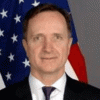
Ambassador Stephen Beecroft (pictured) and Deputy Prime Minister Salih al-Mutlaq launched the first meeting of the Services, Technology, Environment and Transportation (STET) Joint Coordinating Committee (JCC) under the U.S.-Iraq Strategic Framework Agreement on November 28, 2012 at the Council of Minister's Secretariat.
The two governments agreed to expand U.S.-Iraq cooperation in the areas of health, agriculture, water, and private-sector development. Future high-level meetings will focus on cooperation in the other areas covered under this JCC.
Health: Recognizing the importance of availability to health care in promoting social well-being and fostering economic advancement, the two governments pledged to collaborate to improve the delivery of health services to the Iraqi people.
The U.S. Agency for International Development (USAID) and the Government of Iraq (GOI) Ministry of Health established a national Technical Advisory Committee for policy discussion and technical collaboration in cooperation with other ministries.
- 36 Model Health Clinics: USAID will establish 36 model clinics in 18 provinces. Clinics will include all necessary equipment and modern systems with trained staff. The Ministry of Health will replicate these clinics nationwide using co-financing funds.
- Basrah Children’s Hospital and Maysan Hospital: The U.S. government will facilitate outfitting the Basrah Children’s Hospital with advanced medical equipment, including a magnetic resonance imaging machine and computed tomography scanner. The GOI will ensure the continued training and maintenance required for these facilities, in operation since 2010. The U.S. government will also complete construction of a surgical hospital in Al Amarah, Maysan Province; and the GOI will assume responsibility for providing medical equipment and furniture, staffing, as well as maintenance and operation of the completed facility upon transfer.
- Field Epidemiology Training Program for Iraqi Doctors: The Ministries of Health and Higher Education, in partnership with the U.S. Department of State and Centers for Disease Control, developed the Field Epidemiology Training Program to train Iraqi medical doctors in disease surveillance, outbreak response, and applied epidemiology. The first cohort of 11 doctors will graduate in Baghdad on December 3.
- Bilateral Discussion to Expand Foreign Trade and Investment: The U.S. government will advise companies of the growing health care market in Iraq, and the two governments will periodically review laws, regulations and other practices in the sector to remove impediments to bringing advanced health care solutions to the Iraqi market.
Posted in 'Your Country' - United States, Agriculture, Healthcare, Iraq Public Works News, Iraq Transportation News 1 Comment

Infinite possibility, Immediate need – Education in Iraq
Posted on 21 November 2012 .
By Madeleine White, former teacher and educational writer and Head of Marketing, Whizz Education.
Several years ago, I was working as an English Literature Teacher in at a typical state secondary school in the UK. I remember sitting in a classroom of 16 year old boys, who really didn’t want to be there. They wanted to earn money and didn’t see how a class on Dylan Thomas could help prepare them for this immediate working future. Essentially they couldn’t see the point.
Creating this ‘point of engagement’ has been something that has followed me through my career into educational marketing and interestingly is very much on the global agenda also.
I was recently on a trade mission organised by the KRG to Erbil and was lucky enough to meet Kurdistan’s President Barzani. He reiterated his desire to ensure that extraction of the region’s natural resources was matched by a commitment to supporting the human resource. It made me realise that finding this point of engagement was very much on his agenda also.
This is why:
- Kurdistan wants to build upon the natural resources to leverage their human resources.
- In order to do this they need the right structures in place that will encourage the growth and development they are looking for, within the economy as a whole
- They also need to address region specific needs, such as rebuilding agriculture, serving water needs and indeed supporting the infrastructure needed to facilitate the development of the region’s natural resources.
Posted in Iraq Education and Training News, Madeleine White 1 Comment
Microfinance Conference Focuses on Economic & Social Advancement
Posted on 23 October 2012 .
From October 23 - 24, 2012, the U.S. Mission in Iraq, through the U.S. Agency for International Development (USAID), and in cooperation with the Iraqi Microfinance Network, will host the Inclusive Financial Services Stakeholders’ Conference at the Rotana Hotel in Erbil. The conference theme is “Iraqi Microfinance – The Path to Economic and Social Advancement”.
The conference will bring together international, regional, and national industry leaders, including representatives from Iraq’s 12 microfinance institutions (MFIs), which provide financial services across all of the country’s 18 provinces. Keynote speakers include Erbil Governor Nawzad Hadi and Ali Maki, Director General of Iraq’s NGO Directorate.
Since 2003, Iraq’s microfinance industry has disbursed almost 420,000 loans valued at more than $1 billion. Iraq’s microfinance industry provides loans to disadvantaged Iraqi citizens, women, internally displaced persons, and micro and small enterprises in need of business financing.
WHAT: Inclusive Financial Services Stakeholders’ Conference Opening Ceremony
WHERE: Rotana Hotel, Erbil
WHEN: October 23, 2012, 9 a.m. – 12 p.m.
CONTACT: Salam Muhammad Hadi 07808-588-985; Ahang Tal’at Hamid 07504-462-041
(Source: US Embassy)
Posted in Iraq Banking & Finance News Comments Off on Microfinance Conference Focuses on Economic & Social Advancement