


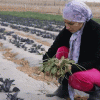
Video: Widows Use New Skills for New Life
Posted on 22 July 2012 .
By John Lee.
Many Iraqi widows face incredible hardships, lacking the education and job skills needed to make a new life.
To provide new skills and sustainable incomes to the widowed members of Zanapiq Al-Hakal Association in Ninawa, the USAID-Inma Agribusiness Program provided breeding sheep along with training in how to breed and raise them.
The sheep provide a sustainable source of income to the widows and their families and hope for a brighter future.
(Source: USAID-Inma)
Posted in Agriculture Comments Off on Video: Widows Use New Skills for New Life
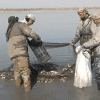
Video: Cross Breeding Helps Revive Iraq's Fish Industry
Posted on 19 July 2012 .
By John Lee.
After years of decline, the Euphrates and Middle East Fish Farms, Iraq's largest and best designed hatcheries, were operating at less than 40% capacity due to conflict, sanctions, and production problems.
In 2008, USAID's Inma Agribusiness Program began a partnership with Euphrates Fish Farm to help improve the carp fingerling production in Iraq.
With support from USAID-Inma and the Iraqi Ministry of Agriculture, the farm has produced over 32 million fingerlings over the past several years.
(Source: USAID-Inma)
Posted in Agriculture Comments Off on Video: Cross Breeding Helps Revive Iraq's Fish Industry

Video: Olive Oil Industry in Iraq Begins to Ripen
Posted on 17 July 2012 .
By John Lee.
A new video produced by USAID showcases the Al-Zatoon Olive Association's new processing plant in Ninawa province, home of the first mechanized olive oil presser in Iraq and a model for similar demonstration projects in Kurdistan, Salah al Din and the Tallafar district of Ninawa province.
A new olive oil industry in Iraq is growing, thanks to training, equipment and technical assistance received from the USAID-Inma Agribusiness program:
(Source: USAID)
Posted in Agriculture Comments Off on Video: Olive Oil Industry in Iraq Begins to Ripen
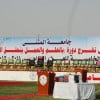
Samawa BDC Goes to University
Posted on 17 July 2012 .
By John Lee.
The Samawa Business Development Center (SBDC) continues to expand the range of services it provides in Muthanna Province to meet the needs of government and businesses alike. Initially benefitting from grants and support provided by the Dhi Qar and Muthana Provincial Reconstruction Team and the USAID-Tijara program, the SBDC has grown from simply providing training programs in business skills to residents in Samawa to establishing their own Printing and Advertising Center and an Employment Placement Service to work with the local government and business community.
Banners have been an effective tool to announce upcoming events and to advertise businesses and even political party candidates. Recently, the SBDC was contacted by one of their early advertising clients, Muthanna University, to produce banners and other material for this year’s graduation ceremonies.
“We produced some signs for the University in January for their new buildings and are very glad they returned to ask us to help highlight their graduation ceremonies” said SBDC Director Emad Mansour Rabat. “Our Printing and Advertising Center allows local government and businesses to design and have these large format banners produced locally without having to travel to Baghdad. It is a great benefit for clients here in Muthanna and nearby provinces.”
(Source: SBDC)
Posted in Iraq Industry & Trade News Comments Off on Samawa BDC Goes to University
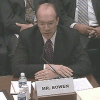
Iraq Auditor Questions $636m in Costs
Posted on 15 July 2012 .
By John Lee.
The Special Inspector General for Iraq Reconstruction (SIGIR), Stuart Bowen (pictured), has found serious weaknesses in the government’s controls over Iraq reconstruction funds that put billions of American taxpayer dollars at risk of waste and misappropriation.
The precise amount lost to fraud and waste can never be known, but SIGIR believes it is significant. As of June 30, 2012, SIGIR audit reports had questioned $635.8 million in costs, and SIGIR Investigations, working with other agencies, had resulted in $176.84 million in fines, forfeitures, and other monetary results.
SIGIR audit reports identified internal control weaknesses such as inadequate reviews of contractors’ invoices, insufficient numbers of, or inadequately trained oversight staff, poor inventory controls, high staff turnover, poor recordkeeping, insufficient price competition by subcontractors, and weak oversight of cash disbursements.
For example, SIGIR’s audit of a DoS contract for Iraqi police training program support found that more than $2.5 billion in U.S. funds was vulnerable to fraud and waste as a result of poor DoS oversight. Another SIGIR audit of a DoD contract for warehousing and distribution services found that the contractor’s business systems had not been adequately reviewed. Business system reviews are the government’s primary control to ensure that prices paid are reasonable and allowable.
Weaknesses in internal controls open the door to opportunities for fraud and other illegal activities. As of June 30, 2012, SIGIR investigators, working with other agencies’ investigators, have developed information used to indict 87 individuals and convict 71 individuals for fraudulent activities including bribery, kick-backs, theft of government funds and property, inflated invoices, delivery of insufficient or inferior goods, and bid rigging.
Posted in Construction & Engineering In Iraq, Iraq Public Works News, Security Comments Off on Iraq Auditor Questions $636m in Costs
On-Farm Trials: Tools to Reduce Poverty
Posted on 11 June 2012 .
By Layth Mahdi, Agricultural Advisor. The opinions expressed are those of the author, and do not necessarily reflect the views of Iraq Business News.
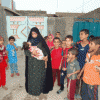
On-farm demonstration trials are used to teach farmers to improve their agricultural practices and increase yield. It serves as one of the most valuable extension education program to help farmers to sustain the environment, increase agricultural production and reduce poverty.
In Iraq, over 80 percent of farmers practice traditional farming techniques that resulted in low production and productivity. It is useful to demonstrate good crop production practices on small plots by comparing them with traditional farming methods so farmers can see results and adopt the new practices.
Some technologies had shown good results such as introducing a greenhouse tomato production, combined application technique of fertilizers and pesticides or changing the practice from flood irrigation to furrow irrigation (https://www.iraq-businessnews.com/2011/09/12/furrow-irrigation-strategy-to-save-water-in-iraq/).
Last year I have visited many agricultural extension centers in Iraq and found that the extension personnel lack the infrastructures (research equipment) and monetary support for their activities. In addition the personnel have limited academic education and knowledge, and lack practical field experience and skills. Above all they lack adequate incentives.
Most agricultural extension staff told me that they receive a very low salary, less than $200/month. The Ministry of Agriculture (MoA), instead of constructing modern villages ($500 million) and providing agricultural loan ($500 million) without any study (failed programs), MUST allocate financial resources to provide training and education program to revitalize the agricultural extension services and workers in order to better serve the needs of farmers. This approach is as an investment option for MoA to improve agricultural production and to fight rural poverty.
In 2008, a demonstration trial was conducted in farmer’s field in Anbar province, Iraq. It was published in March 2009 in Information Management Unit – PRT/USAID, Baghdad, Iraq, and can be found in this pdf.
Posted in Agriculture 1 Comment
USAID Initiative Boosts Youth Employment
Posted on 01 June 2012 .
USAID-supported job training, apprenticeships and microfinance loans help unemployed Iraqi youth secure meaningful work.
CHALLENGE. At the start of 2010 Iraq had the highest rates of unemployment in the Middle East. Thirty percent of its adults lacked jobs. More than half of the country's young urban males were unemployed. At 19 percent, female participation in the workforce was even lower, according to World Bank estimates at the time. Restless youths desperate for something to do often joined terrorist militias, perpetuating the cycle of violence.
INITIATIVE. With funding from the U.S. Ambassador’s Targeted Development Program, the USAID-Tijara Provincial Economic Growth Program designed the Iraqi Youth Initiative. The goal was to create 2,500 full-time jobs for Iraqis between the ages of 18 to 35. Selected youths received training at one of 11 Small Business Development Centers around the country. Those wanting to start their own business were referred to the Youth Entrepreneurship Access to Finance Program (YEAF). There aspiring entrepreneurs received help writing a business plan and were introduced to microfinance institutions working with USAID-Tijara that could provide startup financing.
Young people with no interest in running a business were sent to the Youth Employment Promotion (YEP) program where training consisted of language and computer skills plus information on resume writing and office etiquette. USAID-Tijara located Iraqi companies willing to provide apprenticeships to worthy young Iraqis and then matched prospective employees with appropriate employers.
RESULTS. Since the start of the Iraqi Youth Initiative (IYI) two years ago, 3,256 youth have been trained to be independent entrepreneurs under the YEAF program. Some 1,165, 13% of them women, have started businesses with microfinancing worth $4,049,000.
Of the 1,455 people trained by YEP, 800 received apprenticeships with Iraqi companies. Thirty-four percent were women. More than 845 Iraqi companies have pledged an additional 2,861 apprenticeships that could evolve into permanent jobs.
Thanks in part to IYI and other USAID development efforts, Iraq’s unemployment now hovers slightly above 15% and the United Nations estimates youth unemployment has fallen to 23%.
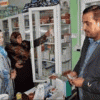
About the Photo: Rana Mohammed Ali, 29, is one of 15 young Iraqis who found jobs at five Tikrit pharmacies thanks to Wedad Abdul-Halim, 55, a licensed pharmacist active in Salah ad Din’s medical services community. A corporate supporter of USAID’s Iraqi Youth Initiative, Wedad also placed 13 IYI graduates in local medical diagnostic clinics as laboratory assistants. Fifteen of the 28 now have permanent jobs paying higher salaries.
Active in the volunteer community, Wedad approached a local orphanage she supports and convinced it to employ two young people as care givers. They, too, now have lasting employment.
(Source: USAID)
Posted in Employment Comments Off on USAID Initiative Boosts Youth Employment
Karbala Printing & Marketing Service Center
Posted on 25 May 2012 .
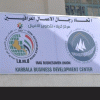
The Karbala Printing and Marketing Service Center has gone from a dream, to a concept, to a proposal and will soon be a reality for the Karbala Business Development Center (KBDC). The KBDC recently signed a Performance Grant Agreement with the USAID-Tijara program for funding to establish the Marketing Service Center in Karbala.
The KBDC is contributing funding for a large format printer capable of printing vinyl banners, staff and facility while USAID-Tijara is contributing funding for furniture, printers and inventory, and an initial period of operations.
The Center is designed to provide marketing support to businesses in Karbala for improved design of clients’ marketing and advertising material, forms, business cards and banners. Mr. Ahmed Abdulabbas Al-Waili, Executive Director of the KBDC said “we have tried previously to step forward to become a printing and copy services center, and now with USAID-Tijara’s support program we can provide jobs and have sustainable income for the Center and pay salaries for our staff and create more business services in future.”
Karbala BDC joins the Al-Zaqora Printing and Marketing Services Center in Nassriya and the Muthanna Printing and Marketing Services Center in Samawa as newly established facilities initiated by Small Business Development Centers in Iraq to support growing demand by businesses, universities, government and the general public for locally designed and printed material.
(Source: SBDC)
Posted in Iraq Industry & Trade News Comments Off on Karbala Printing & Marketing Service Center

Iraqi Co. for Financing SMEs Tops $26m in Loans
Posted on 07 May 2012 .
This week the United States Government, through the U.S. Agency for International Development (USAID), will reach a significant milestone in its efforts to support Iraqi businesses. Loans extended by Iraqi Company for Financing Small and Medium Enterprises (ICF-SME) to develop or expand small businesses will reach a total of $26 million or ID 30.18 billion. These loans to small and medium-sized businesses have created over 1,200 new jobs for Iraqis.
Founded in May 2009 with an initial $6 million grant from the USAID-Tijara Provincial Economic Growth Program, the ICF-SME program is designed to help expand Iraq’s private sector, as called for in the U.S.-Iraq Strategic Framework agreement. Funds that borrowers repay to the banks are, in turn, used to grant new loans. This cycle of repayment and new lending, plus additional money contributed by the banks has allowed $7 million of USAID grants to produce 1,374 loans averaging $19,000 in size for a total sum of loans exceeding $26 million.
“Iraqi businesses need enormous amounts of money to allow them to buy new equipment and expand, and will someday begin to compete on an international level,” said Managing Director Wisam Noori. “ICF-SME helps finance these purchases through bank loans made increasingly from loans that have been paid back.” Banks appreciate the lending program because it is stable, long-term, and can be obtained by eligible Iraqis at a low fixed rate of 10 percent, a rate substantially below prevailing market interest of 12-14 percent.
The nine private Iraqi commercial banks participating in the ICF-SME program are Gulf Commercial Bank, Sumer Commercial Bank, Ashur International Bank, North Bank, Iraqi Middle East Bank for Investment, Baghdad Bank, National Bank of Iraq, Mosul Bank for Investment and Development, and Basra International Bank for Investment.
Posted in 'Your Country' - United States, Iraq Banking & Finance News, Iraq Industry & Trade News Comments Off on Iraqi Co. for Financing SMEs Tops $26m in Loans

Iraq Micro-Finance Forum in Erbil
Posted on 24 April 2012 .
The Government of Iraq in cooperation with UNDP Iraq, USAID-Tijara and the Consultative Group to Assist the Poor organised the Iraq Micro-Finance Forum in Erbil.
The Forum’s key objectives were promoting synergy between the Government’s poverty alleviation and job creation efforts and the existing microfinance industry, enhancing service delivery by microfinance institutions to micro-small and medium enterprises, enhancing access to financial services to the Iraqi people who currently have limited or no access to microfinance, with a focus on youth and women.
“Limited access to institutional finance is found to be one of the key constraints to private sector growth in Iraq” said Peter Batchelor, UNDP’s Country Director. “A stronger private sector, able to provide jobs for the Iraqi people will ultimately contribute to Iraq’s welfare and poverty alleviation” he added.
The combination of poverty and lack of formal job opportunities is increasing the already high demand for microfinance in Iraq. The Government has placed job creation high on its development agenda and aims to transform from direct lending it has previously engaged in to becoming a partner in sustaining and supporting the microfinance industry as a vehicle for private sector growth and job creation.
The Forum featured experts and speakers from Iraq, Yemen, Jordan, Lebanon, the UAE, Italy, Poland and Pakistan. A shared vision for the microfinance sector in Iraq was formulated where opportunities for growth and challenges were identified, support activities explored and stakeholders’ roles operating in the sector were agreed upon.
Participants in the Forum included representatives of the government from the Prime Minister’s Advisory Board, Ministry of Labour and Social Affairs, Ministry of Industry and Minerals, Kurdistan Regional Government, The Central Bank of Iraq, NGOs, microfinance institutions, academia and the private sector.
The participants agreed on basic principles for supporting the development of the microfinance sector in Iraq to be formulated in policy recommendations and will be shared among participants for comments prior to finalisation and submission to the Task Force for Economic Reforms for endorsement.
Posted in Iraq Banking & Finance News Comments Off on Iraq Micro-Finance Forum in Erbil