



GE Wins Erbil Power Plant Contract
Posted on 07 December 2010 .
GE (NYSE: GE) today announced that it will provide gas turbine technology to Mass Global Investment Company, an independent power producer, to help meet northern Iraq’s growing demand for electricity. Under the agreement, GE will supply three Frame 9E gas turbines and generators for the 375-megawatt expansion of the Arbil Power Plant, located in Iraq’s Kurdistan region.
“Our mission is to support Iraq’s overall efforts to continue developing and expanding its energy infrastructure,” said Ahmad Ismail, chairman of Mass Global. “We are confident that working with a global technology leader such as GE, with its proven and reliable advanced energy technology, will contribute significantly to helping us fulfill our mission, which is in line with the Kurdistan regional government’s initiative calling for the private sector to help meet the energy requirements in this region.”
This new contract follows an announcement earlier this year that GE is providing equipment for two other projects in the same region that are part of Mass Global’s ongoing efforts to support Kurdistan and Iraq’s current and future power needs. When all of the current projects are completed, the total electricity capacity of Mass Global-developed power plants in the Kurdistan region will be increased to 2,200 megawatts.
“This latest agreement builds upon our growing relationship with Mass Global to provide innovative technology and services to help ensure that the people of northern Iraq have a reliable and secure supply of electricity,” said Joseph Anis, GE Energy’s president for the Middle East. “This agreement also reflects GE’s ongoing commitment to support Iraq in boosting its power generation and infrastructure growth.
Posted in Construction & Engineering In Iraq, Iraq Oil & Gas News Comments Off on GE Wins Erbil Power Plant Contract
Korea's Hyundai May Build Power Stations in Anbar
Posted on 07 December 2010 .
An investment delegation from the Korean company Hyundai, specialized in establishing and equipping oil-fired power plants, visited Anbar province on Tuesday to discuss proposals for investment in the province, according to a report from AKnews.
Wissam al-Rawi, the head of the Energy Committee of Anbar Council, said that the council discussed investment with the Hyundai delegation and ways of operating oil-fuelled plants and satisfying the needs of citizens through setting up several power stations.
Khalil Ibrahim al-Awwad, the director of the electricity distribution department, said that the Korean company’s proposals to set up three large stations and link them to a central plant were discussed in detail.
"The Korean company Hyundai has a long history in building plants and generators,” he said.
Hyundai's representative, Medhat al-Hamdani, said that "the company is ready to begin working in Anbar and eliminate the electricity problem. Its mission is to quickly establish power stations that work using oil, as a result of deteriorating conditions and the lack of gas or diesel.”
Hamdani said that the new plants would satisfy the power supply needs of the province, particularly during the scorching summer months when extra electricity is needed to power air-conditioner units and water coolers.
Consumer payments were also discussed: Interest free credit installments and governmental subsidies were the two possibilities currently being examined.
(Source: AKnews)
Posted in Construction & Engineering In Iraq, Iraq Oil & Gas News, Iraq Public Works News Comments Off on Korea's Hyundai May Build Power Stations in Anbar

Shahristani to Lose Oil Ministry ... Well, Sort Of
Posted on 01 December 2010 .
A confidante of Prime Minister Nouri al-Maliki claims there will be a shake-up in the oil and energy portfolio when the new cabinet positions are announced.
According to Iraq Oil Report, Hussain al-Shahristani will move from his current position as Minister for Oil and Acting Minister for Electricity, into a newly-created Deputy Prime Minister role with responsibility for oil and electricity issues.
This effectively creates an additional plum vacancy to be gifted as part of the negotiations between the rival blocs, while allowing Maliki's right-hand man to retain at least some control of this key function.
The report says Maliki targets to have cabinet positions decided by 15th December.
(Source: Iraq Oil Report)
Posted in Construction & Engineering In Iraq 1 Comment
New Power Stations in Basra
Posted on 01 December 2010 .
Local government in Basra province announced that a new gas-powered electricity station with a capacity of 500 MW will soon be built in Najibia region in the north of the province.
Technical deputy Munthir Niema told NMC that the cost of the station will depend on petro-dollar balance, and its output will be used for Basra only. He added that the station will consisted of four units.
Niema mentioned that another three stations will be established in the province in the near future according to the agreement with international companies Siemens and General Electric.
Meanwhile, the Ministry of Oil has announced that Shell will create a major new gas recovery plant in Basra.
(Source: National Media Center, AKnews)
Posted in Iraq Public Works News 2 Comments
Shell Gas Extraction Plant Announced in Basra
Posted on 01 December 2010 .
The Iraqi Oil Ministry announced on Tuesday plans to establish a natural gas extraction company in Basra in collaboration with Shell, according to reports from AKnews.
Ministry spokesman Assem Jihad told the agency that the joint venture would extract the gas from the fields in Basra to power electrical generators.
"The company will seek to reach a daily production of 700m cubic feet of gas for use in electricity generation, and thus electricity will improve markedly,” he said.
Surplus gas will be exported, contributing to the venture’s profitability.
"There have been offers from many investment companies to invest in gas extraction,” he explained, “especially since Iraq is seeking to ensure its production of gas and oil meets international standards."
Meanwhile, Basra's local government has announced the creation of a new 500MB gas-fired power station.
(Source: AKnews, National Media Center)
Posted in Iraq Oil & Gas News 1 Comment
Core inflation jump not what it seems
Posted on 01 December 2010 .
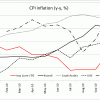
Last week a Central Bank of Iraq (CBI) official revealed that October year-on-year core CPI inflation jumped to 3.2% from just 1.87% in September, breaking a nine-month downtrend. At first glance, you might conclude that Iraq is now at the start of the same CPI uptrend that its neighbors, and indeed much of the developing world, have been experiencing all year as a result of money printing by the Federal Reserve. (See chart. Note that Iraqi core inflation excludes fruits and vegetables, nonalcoholic drinks, and gas and gasoline.)
Such a development would have important implications for the dinar. While in other countries central banks raise interest rates to control inflation, this remedy would be of little use in Iraq. As the leading role of state-sector banks and enterprises makes the economy relatively insensitive to rate hikes, the only way for the CBI to keep a lid on rising prices is to lower the local currency cost of imported goods through exchange rate appreciation. Dinar bulls might therefore take the core inflation jump as good news.
But it turns out the jump was due mainly to higher prices for housing, water, and electricity, which suggests that it may be more the result of October’s ten-fold increase in electricity tariffs than anything else. While it would still not be surprising if Iraqi inflation began to trend higher given what's going on in the rest of the region, the October number thus cannot be taken as evidence that this is already happening.
Posted in Iraq Banking & Finance News, Mark DeWeaver on Investments and Finance 1 Comment
22 Power Plant Tenders to be Issued Next Week
Posted on 24 November 2010 .
Iraq will soon ask for bids on projects to install and run 22 gas turbines that could boost its power generating capacity by 30 percent in the next few years, an official from the Ministry of Electricity said on Tuesday.
Reuters reports that the ministry plans to ask companies to build plants in four provinces, install and operate turbines it has already purchased from General Electric, and sell the power back to the government.
Power-starved Iraq, trying to rebuild after years of war and economic sanctions, hopes to triple its electricity capacity to 27,000 megawatts from the current 9,000 MW in four years.
Laith al-Mamury, the head of investments and contracts at the Electricity Ministry, said the deal will allow the companies to buy the turbines on a delayed payment plan.
“I believe on November 30 [the tender details] will be offered to the companies,” Mamury told Reuters in an interview.
“We have the units. The investor will come to finish the rest of the equipment and operate the plant for 20 to 25 years,” he said.
The 22 gas turbines, valued at $40 million [47 billion Iraqi dinars] each, would be installed in Diwaniya, Muthanna, Maysan and Basra provinces, Mamury said.
The turbines would produce 125 MW each, or 2,750 MW in total, more than 10 percent of Iraq’s ultimate goal of 27,000 MW. They were among 72 turbines Iraq purchased in 2008 from GE and Siemens in deals worth more than $5 billion.
Posted in Iraq Oil & Gas News, Iraq Public Works News, Tenders Comments Off on 22 Power Plant Tenders to be Issued Next Week

GE Fuel Oil Treatment Selected for Iraqi Power Plant
Posted on 23 November 2010 .
GE (NYSE: GE) has signed a contract with Iraq’s Ministry of Electricity to supply an advanced fuel oil treatment technology, FuelSolv, to help enhance the reliability and productivity of the Al-Quds power plant on the outskirts of Baghdad.
“The Al-Quds power station provides much-needed electricity for Iraq and GE’s innovative gas turbine technology and fuel oil performance solution can help keep the Al-Quds power plant running at peak performance and efficiency throughout the year,” said Joseph Anis, GE Energy’s president for the Middle East.
“This agreement is further testament to GE’s ongoing commitment to support Iraq in boosting its power generation capacity and infrastructure growth so as to supply reliable electricity for Iraq’s people.”
GE is supplying 2,000 tons of FuelSolv, a proprietary fuel oil treatment product that can be added to a variety of power plant fuels, including heavy oil, to protect and improve the performance of power generation equipment.
This contract is the largest fuel oil treatment contract GE has signed in the Middle East and marks GE’s second fuel treatment order in Iraq, following a contract signed last year for the supply of 500 tons of FuelSolv to the Baghdad South power plant. FuelSolv was developed by the water and process technologies business unit of GE Power & Water.
The fuel additive is designed to facilitate safe, continuous operation of the GE heavy-duty gas turbines at the Al-Quds plant. When running at full operation with its six GE Frame 9E heavy-duty gas turbines, the Al-Quds plant generates 800 megawatts for the Iraq electricity grid.
GE has a long history of supporting Iraqi infrastructure needs in power generation, oil and gas, water processing, aviation and healthcare and more than 120 GE power turbines are installed in the country today.
GE has been active in the Middle East since the 1930s and has management and project management offices as well as local repair and service facilities to serve customers throughout the region.
Posted in Iraq Industry & Trade News, Iraq Oil & Gas News Comments Off on GE Fuel Oil Treatment Selected for Iraqi Power Plant

Inflation Rises to 3.2% in October
Posted on 23 November 2010 .
An official from the Central Bank of Iraq said on Monday that the core annual inflation rate in Iraq jumped to 3.2 percent in October, from 1.9 percent in September, due to rising costs of housing, water and electricity. Spending on fuel is excluded from the calculations.
"The inflation rate is still under control", senior central bank adviser Mudher Kasim said. According to World Bank figures, the rate of inflation in Iraq had stabilized at 1.9 percent in August and September.
The central bank aims to ease monetary policy and the promotion of bank credit in order to encourage investment and economic growth in the non-oil sector. And excludes the central bank when calculating the rate of core inflation.
(Sources: Reuters, XE)
Posted in Iraq Banking & Finance News Comments Off on Inflation Rises to 3.2% in October

Danish Company to Boost Karbala's Electricity
Posted on 13 November 2010 .
Karbala's local government has signed a contract with a Danish company to install five new electrical generators in the province.
The head of the Strategic Planning and Constructing committee, Abbas Nasser Hassani told AKnews that a delegation from Karbala local government signed the contract with Danish company Simko, which has offices in Turkish capital, Ankara.
Three of the units will have a capacity of 30 mw, with the other two being 20mw.
He said that the company will complete the project within 22 months of the signing of the contract.
Hassani added, "the output of these stations, added to the contract signed with the American company Caterpillar to build a power station with a capacity of 100 mw, which will cover half of the city's electric power total needs (450 mw)."
“We called for the federal government to give the freedom for the Iraqi provincial councils to contract with international companies for the purpose enhancing the electricity production.”
Hassani said that the electricity production of these stations will be separated from the national grid, which needs many years to be repaired.
Regarding the decision by the Ministry of Electricity to increase prices, Hassani said that it is not fair to raise electricity prices, because the people are still suffering from the lack of the electricity.
Karbala's residents get electricity for only one hour in every six.
(Source: AKnews)
Posted in Construction & Engineering In Iraq 1 Comment