


Saudi Firm to Invest in Oil and Electricity
Posted on 31 August 2010 .
A delegation from the Saudi al-Jumaih Holding Company briefed Iraqi Vice President Abdel Abdulmahdi [Adel Abdul Mahdi] on the projects the firm is planning in the oil and electricity sectors, according to a report from Aswat al-Iraq.
Abdulmahdi welcomed the Saudi firm and all other Arab and foreign companies planning to invest in the Iraqi market’s various sectors.
Posted in Iraq Oil & Gas News Comments Off on Saudi Firm to Invest in Oil and Electricity

Iraq's Economy Mounts Shaky Advance, Led by Oil
Posted on 29 August 2010 .
"Seven years after the U.S.-led invasion, Iraq's petroleum industry shows signs of living up to the potential that American planners hoped for at the start of the military operation, a potential boost to the war-ravaged country's economic recovery.
"After fits and starts, Iraq's oil production has rebounded to pre-war levels."
So reports the Wall Street Journal on Friday, in a feature article on Iraq's economic recovery.
While the country suffers from a shortage of electricity, the increasing demand for power is a sign of overall economic growth.
"The International Monetary Fund estimates Iraq's gross domestic product will grow at above 7% this year, compared to a contraction of almost three quarters of a percent in 2005, the first year the IMF started posting reliable data.
"Inflation slipped to 2.7% in June, the lowest level in three decades, according to Mr. Kassim at the central bank. The IMF pegs inflation at just over 5% this year, down from about 37% in 2005.
"But unemployment remains stubborn, with official figures showing 20% of eligible workers without jobs. While that figure is down from previous years ... U.S. commanders and diplomats are pushing job creation as a way of keeping young Iraqi men out of the insurgency."
(Source: Wall Street Journal)
Posted in Iraq Industry & Trade News, Iraq Oil & Gas News Comments Off on Iraq's Economy Mounts Shaky Advance, Led by Oil

American Company Proposes Power Plant in Babil
Posted on 29 August 2010 .
The head of the Babil Investment Commission said on Saturday that they had received an offer from a U.S. company to build a 250 MW power plant in the province.
According to a report from AKnews, Alaa Herba explained that American company 'California Source', which specializes in the energy sector, had submitted a comprehensive proposal for the establishment the plant which, and that this was being studied by the investment committee.
"The committee is currently studying the project to consider the possibility of granting the investment license to this company...If the project was implemented, it would resolve shortages of electricity production in all areas of the province."
Despite having one of the largest power plants in Iraq, the Musaib thermal plant, and the Hilla gas plant, Babil province suffers from acute shortages of electrical power. Citizens of the province can currently expect no more than 20 hours of electricity a day.
(Source: AKnews)
Posted in Iraq Public Works News Comments Off on American Company Proposes Power Plant in Babil
Weekly Security Update for 26th Aug 2010
Posted on 26 August 2010 .
National Overview
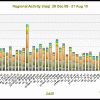
The total number of hostile incidents reported nationally increased for the third week in a row, seeing a significant rise in the number of recorded incidents in Baghdad and slight rises in the north and north central regions. The west and south east regions remained the same, in terms of numbers of incidents, with the south central region decreasing slightly.
The holy month of Ramadan, now in to its second week and could be responsible for the increase in activity across parts of the country as it is generally agreed that Ramadan is thought to offer an excellent opportunity for insurgents to exploit due to the potentially lax security across the country.
 The last US combat brigade pulled out of Iraq at dawn on 19 Aug, a key milestone in the withdrawal of American forces more than seven years in Iraq. At this point the US mission in Iraq was re-christened "Operation New Dawn", from "Operation Iraqi Freedom". This pullout coincided with the arrival of James Jeffrey, the new US ambassador to Iraq; his arrival comes during a political deadlock in Iraq.
Iraqi politics is still in turmoil with no real end in sight. American and Iraqi officials have publicly said that the reason an Iraqi government has not been formed is due to Iranian interference. There are a number of Shiite politicians who are close to Tehran and, for a range of reasons, may take their orders from there. There are not enough of these politicians to create a government, but there are enough to block a government from being established. This is of great importance to the security of Iraq; no new government being formed after elections in March and at a time, in the middle of the month of Ramadan, when insurgent attacks have been known to peak in the past is causing much instability.
On 15, 16 and 22 Aug the Basra Contingency Operating Base was targeted by Indirect Fire; of interest is the improving accuracy of the rounds landing in the area, suggesting that the insurgent teams carrying out the attack are becoming more effective. The Indirect Fire attack that took place in the early morning of the 22 Aug, when three 107mm rounds landed with in the Basra Contingency Operating Base, resulted in the death of one U.S. soldier. No further details are known at this time, but this is the first U.S. death since the 4th Stryker Brigade, 2nd Infantry Division crossed the border in to Kuwait ahead of the planned declaration of an end to US combat operations in Iraq by the August 31 deadline.
The reliability of an 18 Aug 10 report by Asharq al-Awsat stating that a prominent Iraqi Shiite militant leader has returned to Iraq from his refuge in Iran has been confirmed. Ismail al-Lami, commonly known as Abu Deraa, has been high up on the U.S. military’s targeting list since 2004, when he and his aides in Muqtada al Sadr’s Shiite Mehdi Army spent the most violent years of the war carrying out a series of attacks against Iraqi Sunnis under Iranian guidance.
US Forces remain the primary target of insurgents with Private Security Companies an acceptable alternative even though Iraqi Security Forces generally present a much easier target than US Forces. Insurgents will continue to attack US Forces and Private Security Companies with Improvised Explosive Devices and Explosively Formed Projectiles on the main routes around the. The operational tempo stepped up in July and looks as though this will continue through August.
Baghdad
 Officially reported incidents in Baghdad have increased again for the third week in succession to 51 incidents compared to 41 last week. This is now the highest level of incidents in the capital since 06 – 12 Jun 10 and a worry to the Iraqi Security Forces.
The International Zone was targeted on only one occasion this month and this was classed as an ineffective Indirect Fire attack. The majority of attacks this week took the form of an Improvised Explosive Devices with 29 out of the 51 incidents being of this nature. It was also reported that on 21 Aug the Director General of the Ministry of Interior was killed in Small Arms Fire attack in the Mansour area of the city.
Under Vehicle Improvised Explosive Devices have also been used on a regular basis with 11 being reported resulting in a number of civilians being successfully targeted – a number of deaths have been reported in open sources, but it is unclear whether this is as a result of the Under Vehicle Improvised Explosive Device attacks.
With the U.S. drawing down its forces and the Iraqi government talks in limbo, Iran appears to be telegraphing to the U.S. that it has retained some critical levers over the years to turn the heat up in Iraq at a time when the U.S. lacks the force strength of the 2007 surge. By insisting on a strong Sunni presence in the Iraqi government and proceeding with its withdrawal plans, the U.S. is taking a gamble that Iran, whose primary interest is to consolidate Shiite influence in Iraq, will impose limits on itself to contain ethno-sectarian fissures and prevent an outbreak of violence so large that it would risk unraveling the political gains Iran has made thus far.
The timing for the return of the Shiite militant leader, Abu Deraa, to Iraq was likely carefully deliberated by Iran with the withdrawal of U.S. combatant forces from the country during the last week when the remnants of the 2nd Infantry Division left Iraq two weeks before their scheduled departure. However, the Iraqi government remains in complete flux, with Iranian-backed political forces blocking an attempt by the U.S. ensuring a prominent place for Iraq’s Sunnis in the ruling coalition and this issue is unlikely to be resolved in the near term. The U.S. will have 50,000 troops in country to maintain a blocking force against Iran through at least 2011 to influence its negotiations with Iran over Iraq.
Basra
 In comparison to the other regions in Iraq, it has been a relatively quiet week this week in terms of the number of incidents in the south east region.
This could potentially reflect the start of the second week of Ramadan in this area. The reports of another Explosively Formed Projectile attack in the north of Basra city and a further Indirect Fire attack against the Basra Contingency Operating Base resulting in the death of a U.S. soldier, have been the main incidents this week.
The general atmospherics in Basra are most likely at the lowest for about 18 months. The lack of constant electricity (even regular electricity), the lack of clean water, inflation and the rise in food prices during Ramadan are causing substantial problems. The importance of the religious ceremonies of Ramadan may provoke a heightened level of attacks from insurgent groupings in Iraq who are keen to exploit the strict observance of rituals such as fasting, when Iraqis’ defenses are low. However, there is no substantial data to support or deny this; although ‘spectacular’ attacks such as large scale bombings targeting religious gatherings can be common during this time, particularly in religious cities such as Karbala. These points along with the latest attack carried out on 07 Aug 10 has affected the local populations belief about their security in the City and the role the Iraqi Security Forces are playing in this – especially in light of the U.S. draw down. Public anger is likely to be directed against provincial and national level politicians and their failure to form a government.
There have been further heightened threats issued during this reporting period including heightened threat on Main Supply Routes from Improvised Explosive Devices.

Posted in Weekly Security Update Comments Off on Weekly Security Update for 26th Aug 2010

Rosneft Invests $630m in Crescent JV
Posted on 23 August 2010 .
Reuters, quoting a top Russian official, says Russia's largest oil producer Rosneft will invest $630 million in a joint project with UAE firm Crescent Petroleum to drill for gas in the Middle East.
In May, Rosneft's Chairman Igor Sechin, who is also Russia's Deputy Prime Minister, said Russia was keen for projects to drill for gas in Iraq.
Last year, Crescent Petroleum formed a consortium with Dana Gas of the UEA, Austria's OMV, and Hungary's MOL, that aims to pump enough gas from Iraq's Kurdistan region to kick-start the Nabucco pipeline to Europe via Turkey. Nabucco is seen by many as the main competitor of the Gazprom-led South Stream pipeline and is aimed at lessening European dependence on Russia, which supplies a quarter of the EU's gas needs.
Meanwhile, according to both Itar-Tass and RIA Novosti, Russian Prime Minister Vladimir Putin met with Crescent's Chairman, Hamid Jafar, on Saturday to discuss energy cooperation in the Middle East.
"During the talks, future cooperation in the energy sector of Iraq and other Middle Eastern countries was discussed," the Russian government press service said.
RIA Novosti also mentions that former (and possibly future) Iraqi Prime Minister Ayad Allawi is a board member of Crescent Petroleum, and that he was present at the meeting with Putin, but he is not listed as a director on Crescent's website.
Crescent in Iraq
Crescent Petroleum has been present in Iraq for almost 20 years, with offices in Baghdad, Erbil and Basra, all staffed 100% by qualified and experienced Iraqis. The Company has been actively engaged with the Ministry of Oil since the late eighties, carried out studies and training for the Iraqi Ministry of Oil and completed a full field development plan for the Ratawi oil field in Basra province, and would be able to achieve 250,000 barrels of new oil per day in just 18 months. The agreement was fully negotiated in the mid-nineties but not signed due to respect for international sanctions.
Crescent Petroleum is in partnership with its affiliate Dana Gas, and currently implementing a major integrated natural gas project in the Kurdistan Region of Iraq, under a service agreement signed with the regional authorities, to produce, process and deliver 300 million cubic feet per day of gas supplies urgently needed for power generation. The combined project investment of $650m is the largest private-sector investment currently being undertaken in Iraq, and involves the construction of about 180km of pipelines and two LPG plants. The project will sustain two power plants to generate 1250 MW providing cost effective electricity for 4 million Iraqis, freeing the extra 300 MW of electricity to other provinces, saving Iraq $2.5bn a year in imported fuels, and creating over 2000 new jobs. The first phase of the project was accomplished within record time, highlighted by the servicing and completion of the wells, laying the pipeline across challenging mountainous and hazardous terrain, and the installation of brand new processing facilities. 50,000 tonnes of equipment were imported. The first gas production commenced on 05 October 2008, delivering the much needed fuel to the region’s electrical power generation facilities.
In addition, Crescent Petroleum and Dana Gas are developing a joint gas strategy with the Kurdistan Regional Government, including gas export plans to Europe, and are jointly leading the "Kurdistan Gas City" project to use gas supplies to fuel local industry and job creation.
Crescent has already engaged with the Basra Development Commission, as well as the federal Ministries of Industry and Investment Commission, with a view to meeting local infrastructure needs including utilising currently flared gas and launching a Basra Gas City project on an even larger scale than the one in Kurdistan.
(Sources: Reuters, Itar-Tass, RIA Novosti, Crescent Petroleum)
Posted in Iraq Oil & Gas News Comments Off on Rosneft Invests $630m in Crescent JV
150 Power Transformers Arrive in Maysan
Posted on 23 August 2010 .
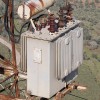
Around 150 electricity transformers have arrived on Saturday in Maysan [Missan] as part of an Iraqi government’s grant to the province.
“The grant totals at $100 million [120 billion Iraqi dinars],” a local media source told Aswat al-Iraq news agency.
He explained that the new transformers will be installed within the coming days.
“The new transformers will contribute to a better power supply to the residents of Missan,” the source added.
(Source: Aswat al-Iraq)
Posted in Iraq Public Works News Comments Off on 150 Power Transformers Arrive in Maysan
Sabotage at Mosul Power Station
Posted on 16 August 2010 .
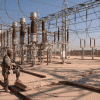
Mosul's gas-fueled power station has been shut down due to an act of sabotage in western Mosul city, which cut the gas pipeline that feeds the facility, according to a report from Aswat al-Iraq.
“A bomb hit the pipeline in the al-Mansoor area, western Mosul city,” said a release issued by the Iraqi Electricity Ministry on Saturday.
Fires erupted in the pipeline and the station was totally shutdown.
“A number of areas in Ninawa province are now without electricity due to this attack,” the statement explained.
Work is underway to repair the pipeline to re-supply the station with gas.
The Mosul Power Station has a generation capacity of 180 Megawatts.
(Source: Aswat al-Iraq)
Related articles:
Posted in Iraq Public Works News, Security Comments Off on Sabotage at Mosul Power Station
Production Resumes at Baiji Refinery
Posted on 15 August 2010 .
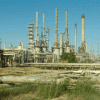
Iraq's state-owned North Refineries Company yesterday said it had re-started production at its Baiji oil refinery, and was looking to boost production levels to 80 per cent to make up losses after a shutdown, according to a report from Gulf Daily News. The refinery normally operates at 70pc of its capacity.
An official at the refinery, north of Baghdad, said all production units were operational after it shut down on Thursday due to an electrical fault caused by overloading of the grid.
"We will work with our full efforts to reach an 80pc capacity to compensate what we lost during the shutdown," the official said.
The official said of the three units at the refinery, two were working at 70-75pc of production capacity, while one was at 65pc.
The North Refineries Company, which operates the refinery, has a capacity of 300,000 barrels per day. A senior official at teh company said electricity flow at the refinery was now stable.
(Source: Gulf Daily News)
Related articles:
Posted in Iraq Oil & Gas News Comments Off on Production Resumes at Baiji Refinery
Dana Gas Iraq Output Nearly Doubles
Posted on 11 August 2010 .
Dana Gas PJSC, the Middle East’s largest regional, private sector, natural gas company, has announced its financial results for the quarter ended 30th June 2010.
Revenue from the sale of hydrocarbons increased to AED 428 million, with gross profit reaching AED 179 million. These figures represent increases of 41% and 84% respectively, compared to the same period last year. This is due to strong production growth, amounting in aggregate to 29%, from the Company’s operations in Egypt (where ten fields are now producing) and in the Kurdistan Region of Iraq, where production from the Khor Mor field continues to increase. It is also due to higher market prices for, condensate, LPG and oil during the quarter, as compared to 2Q 2009.
In the Kurdistan Region of Iraq Dana Gas, through its 40% share, produced 1.06 million boe of gas and condensate during the quarter, an increase of approximately 88% over the same period in 2009. The first train of the LPG Plant at Khor Mor is in partial operation, producing gas and condensate. Production of LPG will start later in 2010, which will further increase production.
With regard to the Iraqi operations, Chief Executive Officer, Mr. Ahmed Al-Arbeed, said: "In the Kurdistan Region of Iraq, production continues to grow as we supply gas to meet the demands of the Erbil and Bazian power stations and it remains a source of pride to Dana Gas that this region of Iraq is one of the few with a reliable electricity supply. We are producing gas and condensate through our new permanent facilities and the first train of the LPG plant at Khor Mor will commence LPG production shortly. Consequently, Dana Gas’ growth is set to continue."
Dana Gas should not be confused with the London-listed Dana Petroleum (LSE: DNX).
Related articles:
Posted in Iraq Oil & Gas News Comments Off on Dana Gas Iraq Output Nearly Doubles
$8.7 Billion Missing - NGOs Blame Lack of Accountability
Posted on 11 August 2010 .
The NGO Coordination Committee in Iraq (NCCI) has issued the following statement regarding the $8.7 billion of Iraqi funds that cannot be accounted for:
Last week, the US Special Inspector General for Iraq Reconstruction (SIGIR) issued an audit stating that the Pentagon cannot account for 96 percent of $9.1 billion that was set aside for reconstruction and humanitarian relief in Iraq after the 2003 US-led invasion. While the audit accused the US Department of Defense (DoD), the administrator of these funds, of “lax oversight” and “weak control”—rather than outright fraud—the Iraqi government may attempt to take legal action in the coming months and recover these funds. The missing $8.7 billion is critically needed to improve basic services like water, electricity and food security amongst the most vulnerable Iraqi populations.
The Development Fund for Iraq (DFI) was created in May 2003 by the Coalition Provisional Authority (CPA), the American occupation administration that handled all governmental affairs—including reconstruction and humanitarian relief—in Iraq post-invasion. On 22nd May 2003, the UN Security Council Resolution 1483 recognized the DFI under the following terms:
“The DFI shall be used in a transparent manner [by the CPA] to meet the humanitarian needs of the Iraqi people, for the economic reconstruction and repair of Iraq’s infrastructure, for the continued disarmament of Iraq, and for the costs of Iraqi civilian administration, and for other purposes benefiting the people of Iraq.”
Using the CPA as a conduit, the DoD primarily administered the DFI between 2003-2004. When the CPA was disbanded in June 2004, the Iraqi transitional government authorized the DoD to continue overseeing the DFI until December 2007.
In administering the DFI, the CPA and DoD allocated most of the funds to private American companies and contractors to implement reconstruction programmes. In this process, the DoD failed to follow the US Department of Treasury’s guidelines established for all US agencies operating in Iraq. Namely, the DoD did not create required bank accounts for the funds or designate any organization as the executive agent to manage their usage. This “breakdown in controls” made funds vulnerable to “undetected loss” and “inappropriate uses” according to the audit.
Some of the DFI funds were certainly spent in Iraq, yet the extent to which the unaccounted money was lost to waste and corruption is entirely speculative. After the 2003 invasion, “Iraq was awash in cash—in dollars and bills. [There were] piles and piles of money,” said Frank Willis, a former CPA official. More than $12 billion in cash was transferred to Iraq in the first fourteen months. According to Alan Grayson, a whistleblower working with other lawyers to further expose the CPA’s corruption, “American law was suspended, Iraqi law was suspended, and Iraq basically became a free fraud zone.” Another audit of the DFI in 2009 exposed cases of bribery, fraud and money laundering involving several DoD and CPA officials.
The SIGIR’s audit brings another alarming issue to light: The DoD is likely holding and spending DFI funds today— at least $34.3 million according the auditors’ rough estimates—although the US is no longer vested with any legal authority to do so. Since 2007, the Iraqi Ministry of Finance supposedly assumed full control over managing the DFI funds. However, the DoD cannot locate most of the DFI funds that seem to have vanished in the Iraqi government’s and Pentagon’s bureaucracies.
The DFI includes Iraqi oil and natural gas revenues, surplus funds from the UN Oil-for-Food Program (1995-2003), and frozen Iraqi assets that were seized from the previous Ba’ath government. The untraceable $8.7 billion derives from the Iraqi people and their government’s resources, rather than foreign donors or the US government. Since the audit’s findings were released, Sabah Al-Saedi, chairman of the Integrity Committee in Iraq’s parliament, has publically suggested that “Iraq should take legal action to get back huge amounts of money [that disappeared from the DFI].” He elaborated that the Iraqi government urgently needs this money “for rebuilding the country and providing services for this poor nation.”
Since the invasion, US funds have provided more than $50 billion for major reconstruction projects in Iraq. Paradoxically, many of the same humanitarian concerns from 2003 persist. Regional experts, such as Patrick Cockburn, still concur that “no country in the world needs more investment [for economic growth and humanitarian operations] than Iraq.” This begs the question: Why was the occupying force charged with overseeing the delivery of major funds earmarked for recovery in the first place?
Iraq now ranks seventh in the 2010 Failed States Index, faces an ongoing power vacuum, and has multiple vulnerable areas in dire need of humanitarian assistance. The Iraqi people continue to await the restoration of their nation’s overburdened national electricity grid, reconstruction of adequate water treatment facilities, and attention to a number of other lingering, unmet basic needs. Tensions in Iraq are still mounting as money fails to translate into tangible results or improve basic standards of living. As usual, it is the Iraqi people who must pay the price for corruption in relief programs, similar to what was experienced during the Oil-for-Food Programme established by another UN Security Council resolution (1995-2003).
This audit’s findings come at a time of waning donor support from nations which were formerly key funders of Iraq’s humanitarian sector, including the US and the United Kingdom (UK). As Mercy Corps and NCCI discussed in a recent joint policy brief, funding shortages are threatening many UN agencies’ and NGOs’ ability to continue or expand long-term humanitarian relief operations in Iraq. The audit further highlights that Iraqis did not receive adequate support for humanitarian relief and reconstruction. Donor support for Iraqi civilians, especially from the US and UK, is not only necessary; it is also an ethical obligation.
Moreover, Iraq needs more than an increase in funding. Future funding should also be characterized by a high level of accountability and transparency. Humanitarian actors must ensure that effective Monitoring and Evaluation (M&E) programmes track financial transactions and assess progress of humanitarian relief operations in Iraq to prevent future mismanagement of Iraqi humanitarian relief funds on such a large scale.
Posted in Iraq Oil & Gas News Comments Off on $8.7 Billion Missing - NGOs Blame Lack of Accountability