


USAID Awards Grants to Local NGOs
Posted on 20 September 2011 .
The United States Agency for International Development (USAID), together with program partners convened Wednesday, September 14, 2011, in Baghdad to award the first round of grants funded by the US Government through USAID’s Iraq Access to Justice Program.
Representatives of Government of Iraq ministries, the U.S. Embassy and other partner organizations attended the meeting, at which NGOs, law schools, and other civil society organizations received grants with the purpose of providing legal aid and enhancing legal assistance to underserved and disadvantaged populations across Iraq.
These groups include women, widows, divorcees, orphans, internally displaced persons, persons with disabilities, minorities, and those who lack state protection and services, such as individuals without formal identity documents or legal status in Iraq.
USAID’s Access to Justice Program is working with Iraqi NGOs and civil society partners to provide information and advocacy to these vulnerable populations so that they can access the benefits and services that are rightfully theirs and more fully realize their legal rights.
The Access to Justice Program will award over $6 million in grants. The first round of grants highlighted at this event are valued at over $1.2 million, distributed through 15 separate grant awards to Iraqi civil society organizations. Each grant is valued at approximately $81,000 and they have been designated to support projects between six to twelve months in duration.
The meeting was attended by representatives of the new grantee partners and other organizations, all of whom shared their vision and experience serving vulnerable populations. All participants spoke about plans for making service and assistance to these groups sustainable through continued internal support and lasting legislative and curricular reforms.
(Source: US State Dept)
Posted in Iraq Public Works News Comments Off on USAID Awards Grants to Local NGOs
Iraqi Banks Struggle with Limited Services and Capital
Posted on 22 July 2011 .
Reuters reports that it's a tough road ahead for Iraqi private banks required to raise their capital to boost business as they battle against decades of state dominance to win a slice of the asset base from government-run enterprises.
It blames a poor credit culture, the lack of a modern banking system, and the dominance of state banks, for slowing development in the financial sector.
Many Iraqis remain do not have bank accounts, and there are concerns that most business in the country is done through direct cash dealings, which have security implications.
Economist Salam Smeism commented:
"We still have the remains of a central management which is still forcing government offices and ministries to deal with government banks exclusively, and consequently all the deposits are going into state banks.
"Where is the benefit in having the money go from the government to the government? We need to develop the private sector."
Executive director of the Iraqi Private Banks League, Abdul-Aziz Hassoun, said Iraq nationalised its private banks in 1964, paving the way for dominance of the financial industry by the country's state banks.
After the U.N. imposed economic sanctions in 1991, private banking once again opened up in Iraq. The OPEC country has seven state-owned banks, 23 private banks and eight Islamic private banks, according to the central bank website.
Posted in Iraq Banking & Finance News 1 Comment
Agricultural Working Group: Strategies to Reduce Poverty and Unemployment in Iraq
Posted on 18 July 2011 .
By Layth Mahdi, Agricultural Advisor. Any opinions expressed are those of the author, and do not necessarily reflect the views of Iraq Business News.
The Iraqi agriculture production and productivity has been on a linear decline since 2003. Despite this, it remains the second-largest contributor to Iraqi GDP after oil revenues. It has the potential role in decreasing unemployment, poverty and violence if essential programs are implemented in its restoration.
Iraqi people believe that the occupation severely damaged the agricultural sector. The reconstruction efforts that were led by USAID contractors failed to achieve any significant progress. This is because inadequate planning, management and an inefficient political situation in this country.
The country’s urban population makes up roughly 21.1 million (66% of total) compared to a rural population of 10.9 million (34%). Demographically 50% of the population is under the age of 18. Illiteracy rates are on the rise. Recent data indicates that over seven million Iraqis are illiterate, meaning 24% of the population are unable to read and write. Iraq's literacy gender gap is significant, only 46% of adult females and 66% of adult male are literate. Education in Iraq is continuing to decline due to mismanagement of government funds. Over 15% of school aged children are not enrolled in any education program due to their obligation to help support their families.
One of the main challenges that the Government of Iraq (GoI) faces in rebuilding Iraq is high unemployment and poverty. The GoI cannot make a serious attempt at implementing programs to tackle these issues because the decision makers are not knowledgeable and they lack vision. They have attempted to provide aid and social welfare without addressing the root causes of the nation’s problem. For example, the GoI employed more than one and half million people from 2004 to 2010 in the government sector, primarily police and military.
In the next five years, oil production will triple and annual oil revenue is projected to increase to $200 billion by 2015. Currently, Iraq is still under Chapter 7 and huge amounts of money have been spent to cover military and security costs every year. High unemployment and poverty are among the main sources of social turmoil. Iraq is still politically, socially and economically unstable. If these issues are left unresolved, poverty, unemployment, and military operations will hinder growth in oil sales.
Unemployment and poverty are rising. The GoI must create jobs for more than three million citizens over the next three years (2014) in order to decrease the unemployment rate. Agriculture has traditionally been the largest employment sector in Iraq. It contributed more than 7.5% of GDP before 2003 and employed more than 25% of the total work force. Therefore, the agriculture sector needs to be restored in order to absorb the large number of unemployed people.
Current GoI employees lack working experience, management and are corrupt. These situations result in a lack of economic growth. Seven million people who live under poverty line ($2 per day). The private sector is not functional, and the government’s economic growth programs are either slow, ineffective or haven’t started. Therefore, I expect that about 10 million people will live under the poverty line by 2015. Iraqi leaders need to help people to overcome these social problems. PM Al Maliki MUST initiate a fund from Pertro-dollar (see my articles in Iraq Business News) and create International Working Groups in order to restore the agricultural sector in the coming years.

Posted in Agriculture Comments Off on Agricultural Working Group: Strategies to Reduce Poverty and Unemployment in Iraq
Iraqi Farmers to Focus on Marketing
Posted on 21 June 2011 .
As agriculture in Iraq grows and evolves, many farmers, packing house operators, wholesalers and food suppliers have questions about its future. They wonder whether produce will be sold in stalls or in supermarkets. They question the impact imported goods will have on Iraqi-raised products.
To facilitate discussions about the future of agriculture in Iraq, the USAID-Inma Agribusiness Program has hosted “Future of Marketing” forums around the country. Meetings in Erbil and Hilla, typical of many, drew nearly 150 participants in early 2011.
Looking into the future, business owners and farmers discussed their goals, potential constraints, and shared best practices.
In Erbil, hypermarket retailer Bruno Brassart told participants that suppliers need to understand consumers’ needs.
“We are here for business,” said Brassart, the keynote speaker. “So you have to get it right!” Brassart manages the Carrefour outlet in Erbil, the largest store in the governorate.
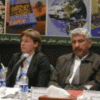
In Hilla, a panel of local businessmen and farmers called for better market research and government support of marketing efforts. Keynote speaker Khudair Al Emarah of the Euphrates Fish Farm emphasized the need for more communication. Through events like these, he said, both staple and niche markets will continue develop.
USAID-Inma helps link producers, distributors and retailers through industry meetings. These conferences teach farmers about consumer demand for diverse, high-quality goods. They create opportunities for stakeholders to form organizations and foster dialogue with government officials.
The success of these forums can be judged by the increasingly sophisticated level of discussions among suppliers and potential clients, and the growing number of deals that are made at these meetings, for the future supply of meat, fruit and vegetables.
(Source: USAID)
Posted in Agriculture Comments Off on Iraqi Farmers to Focus on Marketing
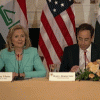
Clinton urges U.S. companies to invest in Iraq
Posted on 11 June 2011 .
Iraq is open for business, and American companies should make an effort to invest there, Secretary of State Hillary Clinton (pictured) has said, according to a report from CNN.
The Secretary was addressing the Business Forum Promoting Commercial Opportunities in Iraq, which included executives from companies as far-ranging as Occidental Petroleum, JP Morgan Chase, General Electric, Microsoft and Lockheed Martin in a round-table discussion aimed at getting companies focused on commercial opportunities in Iraq despite its current "tough environment."
Secretary Clinton said, "President Obama and I and our government believe strongly that expanding economic opportunity is as essential as building democratic institutions. We think they go hand in hand. And in particular, it's very important for people going through the changes that are sweeping the region and that Iraq has, in many ways, been a leader in demonstrating, to believe and to see that democracy delivers: Is your life better or not? Do your children have a better opportunity or not?
"And this is clearly not a job for government alone. It is a very important partnership that has to be forged. Businesses like those represented here at this table create jobs, provide livelihoods, increase standards of living, give hope to individuals and their families. And what government should do, whether it's in the United States or in Iraq, is to be a good partner, to help create the conditions for investment and growth that will be broadly spread and create a ladder of economic opportunity for those willing to work hard, to acquire the education and skills required in the modern world.
Posted in Construction & Engineering In Iraq, Iraq Banking & Finance News, Iraq Industry & Trade News, Iraq Oil & Gas News, Security 3 Comments
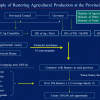
Agricultural Production: Iraq’s Best Chance for Restoring Food Security
Posted on 08 June 2011 .
By Layth Mahdi, Agricultural Advisor. The opinions expressed are those of the author, and do not necessarily reflect the views of Iraq Business News.
Agricultural development plays a key role in achieving human well-being, maintains food security, reduces poverty and mitigates violence. In addition, it contributes to the protection of natural resources, environmental stability and the balance between rural and urban populations as well as the protection of cultural heritage. The agricultural sector is essential to the provision of employment opportunities and the reduction of violence.
Prior to 2003, Iraq had imported about 30% of its food needs annually. The decline in agricultural production after this period, created the need for importing 90% of the food at a cost estimated at more than $12 billion annually. Due to the sudden shift in the agricultural policy from subsidized assistance to an immediate shift to a free market policy, the outcomes lead to a decline in production. The observed outcome resulted in many farmers abandoning the land and agriculture. The impact on natural resources results in an exploited and degraded environment leaving the land destitute and the people impoverished, unemployed experiencing a sense of losing their human dignity.
Despite the huge Iraqi budget (more than $ 90 billion/year), the trend of unemployment, poverty, malnutrition, among Iraq’s most vulnerable population-children; hunger and homelessness has accelerated in the past eight years. For example, unemployment reached more than 40%, and poverty up to 23% (7 million people) of the population. There are five million illiterate, eight million representing widows and spinsters. Additional, an estimated 2.7 million disabled Iraqis and more than two million displaced inside and outside the country. The average family size is large with 5 members per household in the urban sector and 8 members in the rural areas. Another issue that Iraqis face is their incomes per capita is low (300-400 dollars / month) contributing to deepening poverty.
Iraqi population birth rate has increased to more than 750 thousand per year. These worsening living conditions and the deterioration in the agricultural sector, education and health, poor services and increased violence coupled with the lack of or absence of economic development has increased the suffering of average Iraqis fomenting increased suffering from turmoil and political instability, social, and creates violence and terrorism.
Current Iraqi decision makers have exhibited a lack of vision for economic development due to their deficient skills, knowledge and the absence of leadership. Therefore, the performance of the GOI remains below par. Iraq is rich in natural resources and the government has all the administration, regulatory laws and funding, but lacks the political guidance and ability to reform and create economic development ultimately leading to unsustainable growth.
The Iraqi reconstruction efforts led by United State and the coalition have spent more than $60 billion to date. The goal has been to improve basic services, rebuild the economy, strengthen democracy, and improve the infrastructure, building capacity and legitimacy of the Iraqi government. USAID contractors have struggled and are perceived to have failed, unable to reach the full potential of their goals to improve economic growth. The projects were really quite simple and had little to no value in improving the local economy.
The U.S. government has a long-term strategic plan in the Middle East. At the same time the US government has many enemies. Tensions are rising (note recent ME riots) and more protests may be upcoming that will have a negative impact on GOI. The US military should consider initiating agricultural programs to assist GOI in creating jobs and reduce poverty which ultimately will enhance US-Iraqi relations. It is not in the best interest of America to keep the country impoverished and suffering from rising unemployment and poverty.
... also available in pdf format.
And please click here to download a spreadsheet calculating the profit projection for a typical farmer in Muthanna.
Posted in Agriculture Comments Off on Agricultural Production: Iraq’s Best Chance for Restoring Food Security
Strengthening Iraq
Posted on 23 May 2011 .
The U.S. Department of State has made a statement about the "substantial investment and great sacrifices" that the United States has made to "bring about progress":
Since 2003, the United States has been an active partner to help Iraqis strengthen their democracy, build civil society, improve security, and re-integrate fully into the regional and global community and economy. Since 2009, we have worked through the U.S. Iraq Strategic Framework Agreement to reinvigorate this partnership in a range of sectors, including democracy-building, security, education, energy, trade, health, culture, information technology, law enforcement, and judicial cooperation.
We have made a substantial investment and great sacrifices to bring about progress. We have strengthened Iraq’s democracy, rule of law, and civil society. We have helped rebuild its security infrastructure and helped Iraq rejoin the international community after decades of isolation. Our support – with significant assistance from international partners since 2003 – has helped Iraq successfully conduct five major elections or referenda since 2004, including two parliamentary elections. Over 12 million Iraqis voted in the 2010 parliamentary election – a 62 percent turnout. The U.S. has also substantially assisted Iraq’s new parliament, the Council of Representatives, in building core capacity and competence. State and USAID programs have helped Iraqi civil society – including women’s groups, human rights organizations, budget transparency entities, and the media -- play an active role in Iraq’s democracy. We are also supporting Iraqi parliamentary efforts that produced the region’s most progressive non-governmental organization law. In December 2010, the United States also helped Iraq secure UN Security Council termination of most Chapter VII sanctions against Iraq, bringing Iraq into a more normal relationship with the community of nations.
Since November 2008, our security relationship with Iraq has undergone a significant transition. Building on the success and sacrifice of our troops who partnered with Iraqi Security Forces to bring an end to sectarian fighting and combat insurgency, we have ended the combat mission, reduced our troop level to below 50,000, and handed the lead for the security of their nation to Iraqi Security Forces. The Iraqis have developed the capacity to successfully provide internal security, as our forces have shifted from a combat role to a role focused on advising and training.
The U.S. has provided training, technical expertise, and equipment to bolster critical rule of law capacity in Iraq, focusing in particular on the police, corrections service, and judiciary. This investment has improved the Iraqi government’s ability to provide for the humane treatment and legal rights of its citizens, while also properly incarcerating criminals and insurgents.
On the economic front, we have worked to promote growth and reform in multiple sectors of Iraq’s economy. We have helped the Iraqis realize better management in key ministries with procedural and institutional reforms and training on international procedures and standards. U.S. programs have produced or supported key benchmarks:
- Three transparent and efficient oil and gas bid rounds since 2009.
- An Electricity Master Plan which lays out a strategy to improve and reform Iraq’s electricity sector.
- Iraq setting up the first commercial court to settle arbitration disputes for international investors in 2011.
- Iraqi ministry and provincial officials reforming agricultural policies and boosting productivity in a sector that is key to Iraq’s employment.
- Iraq’s accession to the World Trade Organization to expand Iraq’s trade and global economic integration.
- Iraq’s successful engagements with the IMF and World Bank to undertake key public financial management, social safety net, and banking sector reforms.
- Intense interaction between U.S. and Iraqi businesses to promote investment in Iraq.
Our assistance has helped Iraq combat corruption with programs for integrity institutions: the Board of Supreme Audit, the Commission on Integrity, and the Inspectors General. Our assistance also helped Iraq produce and begin to implement a 2010 comprehensive national anti-corruption strategy.
We have promoted long-term economic growth, political development, and strong cultural links to the U.S. by assisting the educational sector in Iraq. Iraq has the largest Fulbright Foreign Visiting Student Program in Middle East, and the International Visitor Leadership Program in Iraq is the largest in the world. Iraq is the eighth-largest foreign government contributor to the Fulbright program. Additionally, USDA has cemented links between Iraqi universities and U.S. land grant universities to build an agricultural extension program.
Transforming NGO Microfinance Institutions to Non Bank Financial Institutions
Posted on 22 May 2011 .
By T. Keyzom Ngodup, co-founder and Executive Director at Ideas sYnergy, an Iraq based private sector development consulting company.
For a long time now, the discussion continues within different circles and corridors in Iraq, on whether microfinance institutions (MFIs) can operate as NGOs and continue providing micro-loans to low-income entrepreneurs who lack access to finance for their ideas and enterprises. The NGO Directorate and the Central Bank of Iraq, both of whom recognize the importance of financial intermediation for micro, small and medium enterprises (MSMEs) applaud the work of MFIs with a few reservations on ownership of the fast growing assets of the lending NGOs, on interest rates (which is the lowest among MENA microfinance industries and globally), and on the transformation of NGO-MFIs to Non Bank Financial Institutions.
There are 12 microfinance institutions, operating as NGOs, providing access to finance for those living in poverty and those without access to banks, namely the un-banked. As of December 2010, these MFIs, operating in all 18 governorates of Iraq, boosted an outstanding loan portfolio of $106.4 million and 75,182 active clients, growing by 28.4% and 27.7% respectively since 2009. The support of USAID has been instrumental in the sustainability of these NGO-MFIs, and USAID-Tijara continues to provide technical assistance and lead the sector’s development. However, in order for NGO-MFIs to scale-up, institutional transformation to NBFIs is recognized as one of the most effective strategies for achieving a significant scale by offering a wider range of services, accessing commercial sources of capital and improving operational efficiency through enhanced systems, controls and transparency in reporting that would result from links to the Central Bank and other banking expertise.
The banking system, comprising of state, private and foreign banks, is highly liquid with total deposits amounting to $33 billion in 2009. Bank liquid reserves to bank asset ratio increased from 98% in 2004 to 156.6% in 2009, compared to 14% for Saudi Arabia and 12.32% for UAE in 2009. According to CBI, total bank loans amounted to $5.8 billion as of June 2010. This compares to around $22.4 billion for Syria and approximately $250 billion for Saudi Arabia. While there is a steady rise in credit to private sector as a percentage of GDP, at 6% in 2009, Saudi Arabia and UAE record above 50%, and even low success economies such as Libya and Syria record 16% and 21% respectively. Although the banking sector is the main component of the Iraqi financial system, the banks offers few credit facilities, and the credit culture is poor. USAID, through the recently incepted Iraq Financial Development Project (IFDP), in partnership with CBI, is working to address the infrastructure of the financial sector through targeted reforms, credit information systems such as credit bureau, and enhancement to the national payment systems to enable cost-effective financial intermediation.
Success achieved by the NGO-MFIs need to be accordingly considered within the Central Bank’s reform priorities, and clear guidelines need to be issued for NGO-MFIs that are considering transformation in order to access mainstream commercial capital for their target clients: the poor and the un-banked. NGO-MFIs CHF and Amalkom have demonstrated not just commitment, but also the capability to ‘mainstream’ towards a regulation institution and access the $90 million line of credit from OPIC, however unclear guidance from CBI and correspondence with the NGO Directorate has stalled the process, or in other words, delayed the deployment of enterprise financing that the young entrepreneurs in Iraq need.
Read www.microfinancegateway.org, www.sanabelnetwork.org for more information on microfinance and MSME financing.
T. Keyzom Ngodup is co-founder and Executive Director at Ideas sYnergy, an Iraq based development consulting company committed to economic and social development through market-based solutions that help build and scale innovative businesses for sustainable and inclusive private sector development.
Posted in Iraq Banking & Finance News, Keyzom Ngodup Comments Off on Transforming NGO Microfinance Institutions to Non Bank Financial Institutions
Unlikely MSME Financiers Provide Islamic Microfinance for the Poor
Posted on 20 April 2011 .
By T. Keyzom Ngodup, co-founder and Executive Director at Ideas sYnergy, an Iraq based private sector development consulting company.
Six NGO-microfinance institutions (MFIs) provide Islamic micro-financing Al-Murabaha to over 7,000 micro-enterprises, 14% of them women-owned small businesses across Anbar, Kirkuk, Ninewa, and Tikrit. Al-Takadum in Al-Anbar pioneered micro-financing based on Islamic principles in 2007 and has branches in all major cities of the governorate. Islamic microfinance represents a confluence of two rapidly growing domains in Iraq: microfinance and Islamic finance. There are seven banks providing Islamic finance in Iraq, however both banks and non-banks such as the NGO-MFIs face difficulties in expanding their services in the absence of distinct regulatory frameworks for Islamic finance and a national Shari’a Board.
In Iraq, Islamic finance is still in its infancy, and business models are just emerging. The range of Islamic finance products available and their outreach is influenced by a variety of factors, with regulatory environment surrounding Islamic finance as critical point of constraint. Shari’a-compliant microfinance has the potential to not only respond to unmet demand but also to combine the Islamic social principle of caring for the less fortunate with microfinance’s power to provide financial access to the poor. Unlocking this potential in Iraq is the key to providing financial access to the Muslim poor who currently reject microfinance products that do not comply with Islamic law or those who use conventional products but prefer Islamic ones.
The introduction of Murabaha lending in the Iraqi microfinance sector (Iraqi microfinance industry includes 14 MFIs and 70,000 clients from the low-income population segment) has enabled MFIs to reach out to a larger number of clients traditionally excluded from the financial sector. Given the young history of the industry against the backdrop of insecurity, microfinance is increasingly recognized as the only channel through which people without tangible collateral can access financing. It is imperative for the Iraqi microfinance sector to continue providing religiously acceptable loan products to achieve the overall objective of poverty reduction and entrepreneurship. The need to conform to certain religious principles affects the structure and development of Islamic MFIs. It is essential, therefore, to seek approval from qualified Islamic scholars particularly before developing new financial instruments.
While each Islamic bank has its own Shari’a boards, there is tremendous information asymmetry on Shari’a compliance across banks as well as the missing regulatory frameworks for deepening Shari’a products and investments in the country. In the absence of Central Bank laws pertaining to Islamic finance and Islamic microfinance, Islamic MFIs rely on Fatwas issued by religious leaders of a province. Consequently, Islamic MFIs and others offering Islamic microfinance Murabaha products often face challenges in understanding what constitutes Shari’a compliance. Since Shari'a law is not a single codified body of law and is open to interpretation, the opinions of Shari'a scholars may differ on the same question of Shari'a law depending on the school of thought to which particular scholars belong.
Experience in Al Takadum MFI demonstrates the time consuming process the MFI had to undergo in order meet with different local sheikhs in different cities of the same province in order to discuss what constitutes Murabaha transaction. They face the unique challenge of Shari’a compliance in their operations and accounting/MIS practices, with the added complexity from the breadth of a Murabaha transaction. In the absence of a national Shari’a board, Islamic finance is defined by a broad spectrum of religious leaders and can create significant challenges leading to misinterpretation and malpractice.
Despite regulatory gaps, MFIs offering Islamic microfinance Al-Murabaha have prospered due to increased demand for Shari’a compliant products in Iraq. Islamic microfinance Murabaha portfolio grew at a rate of 68% compared to the average microfinance industry growth rate of 36%. Despite high growth rate, at only 10% of total industry portfolio, scale is vital to driving down cost-income ratios for Islamic MFIs so that they may in turn serve a greater number of small businesses at affordable market-based price.
Note: The Iraqi microfinance industry is supported by a range of donors with USAID playing a pivotal role in sector development. USAID-Tijara continues to provide technical assistance to the microfinance industry (read more at www.tijara-iraq.com).
T. Keyzom Ngodup is co-founder and Executive Director at Ideas sYnergy (www.ideas-sYnergy.net), an Iraq based development consulting company committed to economic and social development through market-based solutions that help build and scale innovative businesses for sustainable and inclusive private sector development.
Posted in Iraq Banking & Finance News, Keyzom Ngodup 1 Comment

University Research Co. (URC) Wins $75m Iraq Contract
Posted on 06 April 2011 .
University Research Co., LLC (URC) has been awarded a $74,855,589, four-year contract from the U.S. Agency for International Development (USAID) to provide support to the Iraqi Ministry of Health (MoH) to support the Ministry’s strategic plan to achieve better quality primary health care.
URC will manage this project together with Management Systems Internationaland Sallyport, in partnership with the Iraqi MoH.
Intended to have national scope, the project will target a minimum of 360 main primary care centers (health clinics) and implement activities at the central, provincial, and clinical levels. The project will strengthen health systems and build capacity of MoH human resources with an emphasis on delivering primary health services at clinics.
Dr. Bushra Abbasi, USAID Iraq Primary Health Care Project Chief of Party, said: “Thanks to USAID for supporting this project, which will partner with the Iraqi Ministry of Health to improve the overburdened, under-staffed primary health care system in Iraq. This project aims to assist Iraq to strengthen health services essential to the Iraqi people.”
Dr. Abbasi is a medical doctor with over 25 years of experience, the last five devoted to the Iraq MOH through USAID-funded projects. A native Arabic speaker, she has worked in the Arab world, especially on issues related to improving healthcare systems.
The USAID Iraq Primary Health Care Project will use evidence-based health quality improvementapproaches adapted to the Iraqi context. Focusing on achieving rapid, tangible, measurable improvements in the quality of primary health care services in partnership with communities, the project will:
• increase the limited number of female nurses and doctors available for women’s health care services,
• improve professional training for other health care providers (especially nurses), and
• foster a team approach to management and clinical care.
The project will focus on the following results:
(1) Strengthening systems and processes that support clinical care,
(2) Improving delivery of quality primary care according to evidence-based standards, and
(3) Expanding effective community partnerships for primary health care.
Barbara Turner: “With our worldwide experience in assisting governments adapt quality improvement approaches to strengthen health systems, URC is well positioned to support the Ministry of Health in their strategic plans for improving primary health care services for the Iraqi people.”
The World Health Organization defines primary health care as “essential health care made accessible at a cost a country and community can afford, with methods that are practical, scientifically sound and socially acceptable.” In Iraq, most health care is delivered through government hospitals and community level health care clinics.
About URC
URC, which celebrated its 45th anniversary last year, is a global company dedicated to improving the quality of health care, social services, and health education worldwide. With our non-profit affiliate, the Center for Human Services (CHS), URC manages projects in over 30 countries including the United States. Based in Bethesda, Maryland, URC has about 700 employees around the world.
Posted in Iraq Education and Training News, Iraq Public Works News Comments Off on University Research Co. (URC) Wins $75m Iraq Contract