


OPEC+ Agrees Production Adjustment for June
Posted on 05 May 2026 .
By John Lee.
Seven OPEC+ member countries have agreed to implement a production adjustment of 188,000 barrels per day (bpd) in June 2026, following a virtual meeting held on 3 May 2026.
The seven countries involved are Saudi Arabia, Russia, Iraq, Kuwait, Kazakhstan, Algeria, and Oman, all of which had previously announced additional voluntary adjustments in April and November 2023. [United Arab Emirates (UAE) announced that it will exit the OPEC and OPEC+ from 1st May.]
The group stated that the additional voluntary adjustments announced in April 2023 may be returned in part or in full, subject to market conditions, on a gradual basis. Key points from the meeting include:
- A production adjustment of 188,000 bpd to be implemented in June 2026
- Full flexibility retained to increase, pause, or reverse the phase-out of voluntary adjustments, including those announced in November 2023
- Commitment to full conformity with the Declaration of Cooperation, including monitoring by the Joint Ministerial Monitoring Committee (JMMC)
- Intention to fully compensate for any overproduced volume since January 2024
- Monthly meetings to review market conditions, conformity, and compensation
The seven countries will hold their next meeting on 7 June 2026.
Full statement from OPEC:
Saudi Arabia, Russia, Iraq, Kuwait, Kazakhstan, Algeria, and Oman adjust production and reaffirm commitment to market stability
The seven OPEC+ countries, which previously announced additional voluntary adjustments in April and November 2023, namely Saudi Arabia, Russia, Iraq, Kuwait, Kazakhstan, Algeria, and Oman met virtually on 3 May 2026, to review global market conditions and outlook.
In their collective commitment to support oil market stability, the seven participating countries decided to implement a production adjustment of 188 thousand barrels per day from the additional voluntary adjustments announced in April 2023. This adjustment will be implemented in June 2026 as detailed in the table below. The additional voluntary adjustments announced in April 2023 may be returned in part or in full subject to evolving market conditions and in a gradual manner. The countries will continue to closely monitor and assess market conditions, and in their continuous efforts to support market stability, they reaffirmed the importance of adopting a cautious approach and retaining full flexibility to increase, pause or reverse the phase out of the voluntary production adjustments, including reversing the previously implemented voluntary adjustments announced in November 2023.
The seven OPEC+ countries also noted that this measure will provide an opportunity for the participating countries to accelerate their compensation. The seven countries reiterated their collective commitment to achieve full conformity with the Declaration of Cooperation, including the additional voluntary production adjustments that will be monitored by the Joint Ministerial Monitoring Committee (JMMC). They also confirmed their intention to fully compensate for any overproduced volume since January 2024.
The seven OPEC+ countries will hold monthly meetings to review market conditions, conformity, and compensation. The seven countries will meet on 7 June 2026.

(Source: OPEC)
Posted in Iraq Oil & Gas News Comments Off on OPEC+ Agrees Production Adjustment for June

Jiyad: US-Israeli War Against Iran - Detrimental Impacts on Iraq
Posted on 20 April 2026 .
By Ahmed Mousa Jiyad. Any opinions expressed are those of the author, and do not necessarily reflect the views of Iraq Business News.
The American - Israeli War Against Iran, the Unprecedented Severe International Energy Crisis and Detrimental Impacts on Iraq
On Friday evening, April 10th, the esteemed "Al-Mushtarak" platform graciously organized a debating event in which I discussed the implications, complexities, and consequences of the above topic. Here is a brief report on the event.
I began the PowerPoint presentation by asserting my conviction that the US-Israeli aggression against Iran has created and continues to create an unprecedented severe international energy crisis. The longer the aggression persists, the deeper the "energy crisis" becomes, and its cumulative consequences could potentially lead to an "energy catastrophe" on a global scale. I argued further that the world may witness and suffer from a form of "Imperialism of capture and control over resources through military means" in tenuous international law and relations.
The first part of my presentation analyses the components, indicators, and developments of the energy crisis. It begins by presenting the reasons that lead to the belief that what we are witnessing is an unprecedented, severe, and impactful international energy crisis. This is followed by identifying key terms for understanding the sequence, hierarchy, and cumulative nature of an international energy crisis: Availability, Reliability, Durability, Accessibility, Deliverability, Affordability, Ramifications, and Actions. Through the dynamics of the energy multiplier, accelerator, and deepener, the energy crisis of today could be worsened into an energy catastrophe on the global level.
Because oil price exhibits the most significant direct consequences of the war, the mechanisms impacting oil price movements -- market fundamentals, market sentiments, and the new America-specific TACO (Trump Always Chicken Out) Trading -- were analysed, along with their potential to cause stagflation in economic activity. This constitutes the heavy "political cost" of launching and continuing the aggression, especially for Trump.
While the focus, in the prevailing narratives, is on West Texas Intermediate (WTI) and Brent crude prices, I observe that the price levels of other crudes -- Dubai, Oman, and Urals/Russian -- have been and remain significantly higher than those of WTI and Brent. Since the prices of Dubai and Oman crudes are the benchmarks for pricing, with premium, the Arabian Gulf crude oil destined for East Asian markets, and because East Asian refineries are important sources of exported petroleum products to Europe and America, the impact of increased prices of petroleum and petrochemical products on the final consumer reflects the prices of crude oil imported from the Arabian Gulf countries and Russia more, and far greater, than the increase in WTI and Brent crude prices. Hence, there is a need for a mindset shift when considering oil price consequences. This section was premised on information, data, and statistics compiled from reliable international sources.
The second part addressed the repercussions on Iraq's oil sector and the measures taken by the authorities to mitigate them.
It began by discussing the importance and necessity of activating the contractual clauses related to force majeure by all Iraqi companies affiliated with the Ministry of Oil. This is vital to avoid potentially very high costs Iraq could incur if force majeure were not invoked, particularly in the upstream petroleum projects under the concluded bid rounds and other modalities. The Ministry's companies have not yet invoked the article in a contractual, standardized, and comprehensive manner.
This part presented and discussed possible and available alternatives proposed by the authorities for exporting crude oil and fuel oil via pipelines and trucks, highlighting the non-availability, limitations, and lack of economic viability of such alternatives.
Data on Iraqi oil exports indicates very low generated revenues during March due to a thin export volume through the southern outlets. The price levels of Basra Medium and Basra Heavy crude oil in the US markets were higher than those of WTI and Brent crude, since SOMO uses another benchmark -- ASCI -- for pricing its exports to the American market.
The section also discussed the chronic problem of Iraqi refineries, which is characterised by high fuel oil production and limited production of gasoline and diesel/gas oil. The extent to which official directives disregard this chronic reality by calling for increasing refinery production at maximum capacity, without considering the lack of sufficient storage capacity for the fuel oil surplus production, was also discussed.
The problem of associated gas shortages due to halting oil production was also addressed, along with its repercussions on cooking/heating gas -- LPG production -- and electricity generation activities. This is a chronic dilemma that Iraq has suffered from for decades, and it will only worsen further with the approaching summer, characterised by soaring temperatures.
The Ministry has taken a number of belated and limited measures that cannot compensate for its failure in previous years to take sufficient precautionary measures to confront the consequences of a well-known and highly probable crisis.
The third part includes a number of other important and relevant considerations of geopolitical, geomilitary, geostrategic, and international relations dimensions, as well as concluding remarks.
The event included discussion, comments, and questions after my presentation. The full recording of the event, in Arabic, can be viewed and downloaded through the following link:
https://www.youtube.com/watch?v=_dBrKmWxiFQ [Arabic]
Mr Jiyad is an independent development consultant, scholar and Associate with the former Centre for Global Energy Studies (CGES), London. He was formerly a senior economist with the Iraq National Oil Company and Iraq's Ministry of Oil, Chief Expert for the Council of Ministers, Director at the Ministry of Trade, and International Specialist with UN organizations in Uganda, Sudan and Jordan. He is now based in Norway (Email: mou-jiya(at)online.no, Skype ID: Ahmed Mousa Jiyad). Read more of Mr Jiyad's biography here.
Posted in Ahmed Mousa Jiyad, Iraq Oil & Gas News Comments Off on Jiyad: US-Israeli War Against Iran - Detrimental Impacts on Iraq

Lukoil Tax Settlement Confirmed for West Qurna 2 Oil Field
Posted on 09 April 2026 .
By John Lee.
The Iraqi government has confirmed tax settlement arrangements related to operations at the West Qurna 2 oil field, as part of broader contractual and financial adjustments.
Under the decision, North Oil Company (NOC), as the government partner in the contract, will settle the tax obligations in accordance with Decision No. 41 of 2026.
The Council of Ministers also confirmed that outstanding liabilities attributed to Russia's Lukoil have been incorporated into the total value of the final settlement approved under Decision No. 129 of 2026.
The settlement framework includes tax dues for the years 2025 and 2026.
(Source: PMO)
Posted in Iraq Oil & Gas News Comments Off on Lukoil Tax Settlement Confirmed for West Qurna 2 Oil Field
OPEC+ Agrees Production Adjustment for May
Posted on 07 April 2026 .
By John Lee.
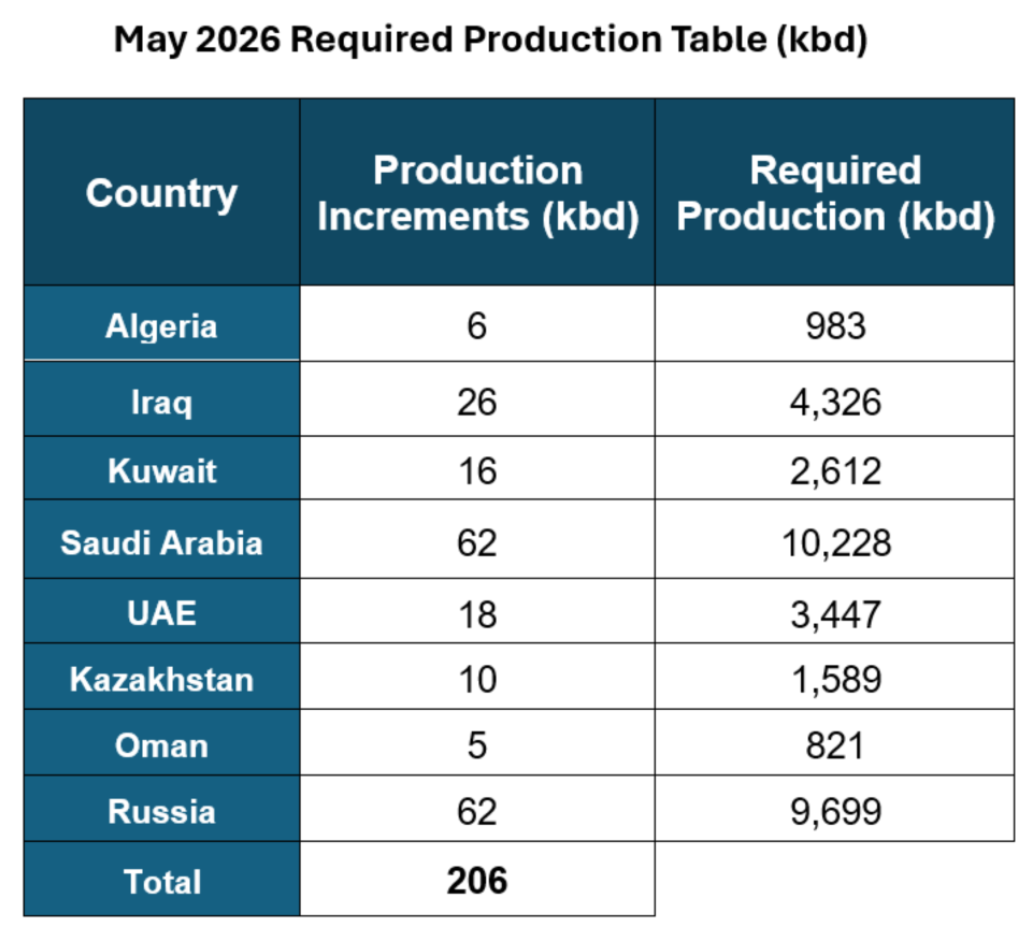
OPEC has announced that eight OPEC+ countries will implement a production adjustment of 206,000 barrels per day in May 2026, as part of ongoing efforts to stabilise global oil markets.
The decision was taken during a virtual meeting on 5 April involving Saudi Arabia, Russia, Iraq, UAE, Kuwait, Kazakhstan, Algeria, and Oman.
The eight countries will continue to meet monthly to review market conditions, compliance, and compensation, with the next meeting scheduled for 3 May 2026.
Full statement from OPEC:
Saudi Arabia, Russia, Iraq, UAE, Kuwait, Kazakhstan, Algeria, and Oman adjust production and reaffirm commitment to market stability
The eight OPEC+ countries, which previously announced additional voluntary adjustments in April and November 2023, namely Saudi Arabia, Russia, Iraq, UAE, Kuwait, Kazakhstan, Algeria, and Oman met virtually on 5 April 2026, to review global market conditions and outlook.
In their collective commitment to support oil market stability, the eight participating countries decided to implement a production adjustment of 206 thousand barrels per day from the 1.65 million barrels per day additional voluntary adjustments announced in April 2023. This adjustment will be implemented in May 2026 as detailed in the table below. The 1.65 million barrels per day may be returned in part or in full subject to evolving market conditions and in a gradual manner. The countries will continue to closely monitor and assess market conditions, and in their continuous efforts to support market stability, they reaffirmed the importance of adopting a cautious approach and retaining full flexibility to increase, pause or reverse the phase out of the voluntary production adjustments, including reversing the previously implemented voluntary adjustments of the 2.2 million barrels per day announced in November 2023.
The eight OPEC+ countries also noted that this measure will provide an opportunity for the participating countries to accelerate their compensation. The eight countries reiterated their collective commitment to achieve full conformity with the Declaration of Cooperation, including the additional voluntary production adjustments that will be monitored by the Joint Ministerial Monitoring Committee (JMMC). They also confirmed their intention to fully compensate for any overproduced volume since January 2024.
In addition, the eight OPEC+ countries reiterated the JMMC's statement for its 65th meeting, highlighting the critical importance of safeguarding international maritime routes to ensure the uninterrupted flow of energy.
The eight countries also expressed concern regarding attacks on energy infrastructure, noting that restoring damaged energy assets to full capacity is both costly and takes a long time, thereby affecting overall supply availability. Accordingly, they stressed that any actions undermining energy supply security, whether through attacks on infrastructure or disruption of international maritime routes, increase market volatility and weaken the collective efforts under the DoC to support market stability for the benefit of producers, consumers, and the global economy. In this regard, the eight countries commended the DoC countries that took the initiative to ensure the continued availability of supplies, particularly through the use of alternative export routes, which have contributed to reducing market volatility.
The eight OPEC+ countries will hold monthly meetings to review market conditions, conformity, and compensation. The eight countries will meet on 3 May 2026.
(Source: OPEC)
Posted in Iraq Oil & Gas News Comments Off on OPEC+ Agrees Production Adjustment for May

Iraqi Cabinet to Consider Settlement with Lukoil
Posted on 04 April 2026 .
By John Lee.
The Iraqi government has reviewed a proposed settlement with Lukoil following its withdrawal from the West Qurna 2 field.
The discussions took place during a meeting chaired by Prime Minister Mohammed Shia Al-Sudani, with the participation of Deputy Prime Minister for Energy Affairs and Minister of Oil Hayan Abdul Ghani Al-Sawad, Finance Minister Taif Sami, and senior oil ministry officials.
The meeting addressed the legal framework for a final settlement with Lukoil, examining the causes of delays and agreeing on key points to establish a legal basis for the agreement. A final recommendation has been submitted to the Council of Ministers for decision.
In February, the Prime Minister's Office reported that the cabinet had approved a settlement with Lukoil to transfer operations to Basra Oil Company (BOC).
(Source: Ministry of Oil)
Posted in Iraq Oil & Gas News Comments Off on Iraqi Cabinet to Consider Settlement with Lukoil

How Chevron's New Deals Could Transform Iraqi Oil
Posted on 04 March 2026 .
By Simon Watkins for OilPrice.com. Any opinions expressed are those of the author(s), and do not necessarily reflect the views of Iraq Business News.
How Chevron's New Deals Could Transform Iraq's Production Outlook
The very recent signing of two sets of major oil deals by U.S. oil giant Chevron following the forced withdrawal of Russian firms from key energy projects in Iraq is a key turning point in the West's resurgence in the Middle East, a senior U.S. Treasury source told OilPrice.com last week.
Click here to read the full report.
See also:
Posted in Iraq Oil & Gas News Comments Off on How Chevron's New Deals Could Transform Iraqi Oil

OPEC+ Agrees to Increase Oil Production
Posted on 03 March 2026 .
By John Lee.
Iraq participated via video link in a meeting of OPEC+ countries to review global oil market conditions and the production outlook.
The group agreed to modestly increase oil production starting April 2026, adding 206,000 barrels per day, as part of a gradual unwinding of earlier voluntary output cuts, citing stable economic conditions and low oil inventories.
However, they emphasized flexibility to pause, slow, or reverse this increase depending on how market conditions evolve.
Full statement from OPEC:
Saudi Arabia, Russia, Iraq, UAE, Kuwait, Kazakhstan, Algeria, and Oman adjust production and reaffirm commitment to market stability
The eight OPEC+ countries, which previously announced additional voluntary adjustments in April and November 2023, namely Saudi Arabia, Russia, Iraq, UAE, Kuwait, Kazakhstan, Algeria, and Oman met virtually on 1 March 2026, to review global market conditions and outlook.
In view of a steady global economic outlook and current healthy market fundamentals, as reflected in the low oil inventories, the eight participating countries decided to resume the unwinding of the 1.65 million barrels per day of additional voluntary adjustments announced in April 2023 and agreed on a production adjustment of 206 thousand barrels per day. This adjustment will be implemented in April 2026 as detailed in the table below. The 1.65 million barrels per day may be returned in part or in full subject to evolving market conditions and in a gradual manner. The countries will continue to closely monitor and assess market conditions, and in their continuous efforts to support market stability, they reaffirmed the importance of adopting a cautious approach and retaining full flexibility to increase, pause or reverse the phase out of the voluntary production adjustments, including reversing the previously implemented voluntary adjustments of the 2.2 million barrels per day announced in November 2023.
The eight OPEC+ countries also noted that this measure will provide an opportunity for the participating countries to accelerate their compensation. The eight countries reiterated their collective commitment to achieve full conformity with the Declaration of Cooperation, including the additional voluntary production adjustments that will be monitored by the Joint Ministerial Monitoring Committee (JMMC).
They also confirmed their intention to fully compensate for any overproduced volume since January 2024. The eight OPEC+ countries will hold monthly meetings to review market conditions, conformity, and compensation. The eight countries will meet on 5 April 2026.

(Sources: OPEC / Ministry of Oil)
Posted in Iraq Oil & Gas News Comments Off on OPEC+ Agrees to Increase Oil Production
Jiyad: Preliminary Assessment of Chevron Agreements
Posted on 02 March 2026 .
By Ahmed Mousa Jiyad. Any opinions expressed are those of the author, and do not necessarily reflect the views of Iraq Business News.
Preliminary Assessment of MoO-Chevron Agreements
On February 23, 2026, the Ministry of Oil (MoO) website published a very brief statement indicating the signing of bilateral and trilateral settlement and framework agreements with the Russian company Lukoil and the American company Chevron, concerning a group of oil fields and exploration blocks.
Due to the limited information provided by the MoO statement, and the complete lack of transparency adopted by the Ministry under the current government regarding this matter, this initial assessment was prepared based on available information and continuous monitoring of developments in the oil sector and the fields covered by these agreements. The assessment revealed significant ambiguity and a lack of clarity, raising "what if" questions and complex implementation dilemmas, as well as a high probability of changes to existing contracts and the adoption of new contracts favouring the American company.
The economic rationale behind the agreements is questionable, and the continued marginalization of national efforts in developing upstream petroleum causes deep concern. It should be emphasized that the findings of this assessment are highly subject to change should sufficient and accurate information regarding these agreements become available. For legal reasons, questions are being raised here, not accusations.
The first part of this contribution identifies the subject matter and content of the signed agreements, while the second part provides essential background information and raises important questions. The third part discusses and analyses each of the four agreements, and the fourth part offers additional and concluding remarks.
Click here to read the full article.
Mr Jiyad is an independent development consultant, scholar and Associate with the former Centre for Global Energy Studies (CGES), London. He was formerly a senior economist with the Iraq National Oil Company and Iraq's Ministry of Oil, Chief Expert for the Council of Ministers, Director at the Ministry of Trade, and International Specialist with UN organizations in Uganda, Sudan and Jordan. He is now based in Norway (Email: mou-jiya(at)online.no, Skype ID: Ahmed Mousa Jiyad). Read more of Mr Jiyad's biography here.
Posted in Ahmed Mousa Jiyad, Iraq Oil & Gas News Comments Off on Jiyad: Preliminary Assessment of Chevron Agreements
Chevron Signs Agreements for West Qurna 2, and Additional Fields
Posted on 24 February 2026 .
By John Lee.
Preliminary principles agreements have been signed covering the transfer and development of several oil fields in southern and central Iraq.
- The first agreement was signed between Basra Oil Company (BOC) and US oil major Chevron for the transfer of management of the West Qurna 2 field.
- A second agreement was signed between Dhi Qar Oil Company (DQOC), North Oil Company (NOC), and Chevron to:
-
- Develop the Nasiriyah oil field;
- Develop four exploration blocks in Dhi Qar province;
- Develop the Balad oil field in Salahaddin province.
In parallel, Basra Oil Company and Russia's Lukoil signed a settlement agreement under which the West Qurna 2 contract will be transferred temporarily to Basra Oil Company, with all outstanding financial dues between the parties settled. The settlement will take effect following approval by the Council of Ministers.
An additional framework agreement was signed between Basra Oil Company, Lukoil and Chevron allowing for the temporary transfer of the contract to Basra Oil Company, which will subsequently assign it to Chevron following completion of negotiations and agreement on the terms of a new contract. The framework provides Chevron with exclusive negotiating rights for one year under agreed criteria.
The signing ceremony was held under the patronage of Prime Minister Mohammed Shia Al-Sudani and attended by Deputy Prime Minister for Energy Affairs and Minister of Oil Hayan Abdul Ghani, US Special Envoy to Iraq Tom Barrack, and Chargé d'Affaires Joshua Harris.
(Source: Ministry of Oil)
Posted in Iraq Oil & Gas News Comments Off on Chevron Signs Agreements for West Qurna 2, and Additional Fields

Iraq wants Increased Business with Russia
Posted on 23 February 2026 .
By John Lee.
Iraq's Ambassador to the Russian Federation, Abdul Karim Hashem Mustafa, met with Russian Deputy Foreign Minister for Economic Cooperation and Eurasian Integration, Alexander Anatolyevich Pankin (pictured), to discuss mechanisms for facilitating trade and enhancing investment cooperation between the two countries.
According to the state-run Iraqi News Agency (INA), the meeting took place at the Russian Ministry of Foreign Affairs in Moscow and focused on strengthening bilateral relations, particularly in the economic and commercial spheres.
The two sides reviewed preparations for the 11th session of the Iraqi-Russian Joint Committee, scheduled to be held in Moscow later this year. The ambassador noted that current trade volumes remain below potential and stressed the need to increase exchange through new agreements and memoranda of understanding, as well as activation of previously signed accords.
He also emphasised the importance of finalising a bilateral road transport agreement and establishing practical mechanisms to facilitate visa issuance for Iraqi businesspeople travelling to Russia, in order to stimulate trade and investment flows.
Mustafa further called for follow-up on the outcomes of the 10th Joint Committee session, held in Baghdad in February 2025, to ensure implementation of agreed measures ahead of the upcoming round of talks.
The ambassador highlighted the positive role of Russian companies operating in Iraq, particularly in the energy sector, and renewed Iraq's invitation for Russian firms to participate in strategic projects, including the Development Road project.
For his part, Deputy Minister Pankin affirmed Russia's readiness to strengthen economic and trade cooperation with Iraq and to address obstacles that may impede progress, underscoring the importance of accelerating draft agreements for signature during the forthcoming Joint Committee meeting.
(Source: Iraqi News Agency)
Posted in Iraq Industry & Trade News Comments Off on Iraq wants Increased Business with Russia