


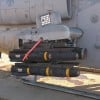
$69m Contract for Hellfire Missiles
Posted on 16 September 2014 .
By John Lee.
Hellfire Systems LLC, of Orlando, Florida, has been awarded a $68,721,521 [80 billion Iraqi dinar] modification (P00104) to firm-fixed-price, foreign military sales contract W31P4Q-11-C-0242 to acquire 1,361 Hellfire II tactical missiles in containers and air-to ground missiles: model AGM-114R, AGM-114R-3, AGM-114P-4A, TGM M36E7, and ATM-114Q-6.
The countries involved in this foreign military sales contract are Iraq, Jordan, Indonesia, Saudi Arabia and Qatar.
Fiscal 2012, fiscal 2013 and fiscal 2014 other procurement funds in the amount of $68,721,521 [] were obligated at the time of the award.
Estimated completion date is Nov. 30, 2016. Work will be performed in Orlando, Florida. Army Contracting Command, Redstone Arsenal, Alabama, is the contracting activity.
(Source: US Dept of Defense)
Posted in Security Comments Off on $69m Contract for Hellfire Missiles

International Community Supports Baghdad Against IS
Posted on 15 September 2014 .
At an international conference in Paris, the five permanent members of the U.N. Security Council, representatives of European and Arab states, and representatives of the EU, Arab League and United Nations, have all pledged to help the government in Baghdad fight against Islamic State militants.
The full statement from the French Ministry of Foreign Affairs is shown below:
Communiqué from the Ministry of Foreign Affairs and International Development
Paris, September 15, 2014
1. At the invitation of the President of the French Republic and the President of the Republic of Iraq, an international conference on peace and security in Iraq was held today in Paris.
2. The conference participants (Bahrain, Belgium, Canada, China, the Czech Republic, Denmark, Egypt, France, Germany, Iraq, Italy, Japan, Jordan, Kuwait, Lebanon, the Netherlands, Norway, Oman, Qatar, Russia, Saudi Arabia, Spain, Turkey, United Arab Emirates, United Kingdom, United States of America, Arab League, European Union, United Nations) expressed their commitment to the unity, territorial integrity and sovereignty of Iraq. They welcomed the formation of a new government under the authority of the Prime Minister, Mr Haïdar al-Abadi, and offered him their full support to strengthen the rule of law, implement a policy of inclusiveness, and ensure that all components are fairly represented within the federal institutions and all citizens are treated equally. All of these measures are necessary in order to successfully combat Daech (ISIL) and terrorist groups, which represent a threat to all Iraqis.
3. The conference participants asserted that Daech (ISIL) is a threat not only to Iraq but also to the entire international community. They condemned the crimes and acts of mass violence that Daech (ISIL) commits against civilians, including the most vulnerable minorities, which may amount to crimes against humanity. They agreed to cooperate and do everything to ensure that the culprits are brought to justice. They confirmed support for the inquiry led by the Office of the High Commissioner for Human Rights to that end.
Posted in Security Comments Off on International Community Supports Baghdad Against IS

UNESCO targets 10,000 Out-of-School Children
Posted on 11 September 2014 .
UNESCO officials concluded a series of meetings held with director generals in Ministries of Education in the central government in Baghdad and the Kurdistan regional government, as well as representatives from local NGOs, to discuss ways to enhance cooperation and accelerate the implementation of UNESCO programmes targeting 10,000 out-of-school children and youth in Iraq.
“UNESCO is committed to extend its technical and financial support to related Ministries to allow 10,000 IDPs children and youth re-enroll in academic institutions”, stated Zulfiqar Ali, Education Project manager in UNESCO Office for Iraq. “Providing a learning opportunity for all children and youth, and making sure that their education is not interrupted by displacement is a main priority for UNESCO in this stage, and a pillar for its projects in Iraq”, he added. UNESCO’ expert’s statement came following his three days’ meetings with the Iraqi officials from 5 to 7 September 2014 in the city of Erbil, in the Kurdistan region of Iraq.
UNESCO’s response is based on two main projects focusing on schools renovation, reconstruction, examination, organizing catch-up classes and providing psychosocial support. With the aim to guarantee IDPs’ children and youth right to quality education, UNESCO Office for Iraq is implementing the “Educate A Child Initiative (EACI) in Iraq” and “Providing access to quality education to adolescents and young adults in conflict affected areas in Iraq”, two pioneering initiatives funded respectively by the governments of Qatar and the Kingdom of Saudi Arabia. These interventions will provide access to education for internally displaced out-of-school children and youth at primary and secondary level in camps, as well as in host communities in Iraq.
Dr. Yousif Othman, Director General of Educational Planning, at the Ministry of Education in the Kurdistan regional government praised UNESCO efforts, and stressed that “schools used as shelter by IDPs need to be evacuated, and UNESCO already committed to renovate and reconstruct secondary schools for IDPs children and youth allowing them to start schooling from new academic year”.
Posted in Iraq Education and Training News, Security Comments Off on UNESCO targets 10,000 Out-of-School Children

US Sanctions 3 Terrorist Financiers
Posted on 08 August 2014 .
By Patrick M Schmidt.
The United States Treasury has announced that its Terrorism and Financial Intelligence Unit has imposed sanctions on Kuwaiti citizens who are believed to be routing funding to militant groups in Syria and Iraq. The two groups have been identified as the Nursa Front and the Islamic State of Iraq and the Levant (ISIL).
“We and our international partners, including the Kuwaiti government, need to act more urgently and effectively to disrupt these terrorist financing efforts,” said David Cohen, Treasury's Undersecretary for Terrorism and Financial Intelligence.
Mr. Cohen has previously called out Kuwait and Qatar for their roles in funding extremist activity in the region.
The full statement from the U.S. Department of the Treasury is shown below, along with details of the three men:
The U.S. Department of the Treasury today imposed sanctions on three key terrorist financiers under Executive Order (E.O.) 13224. Two of the individuals designated today, Shafi Sultan Mohammed al-Ajmi and Hajjaj Fahd Hajjaj Muhammad Sahib al-‘Ajmi, are Kuwait-based and support the Syria-based, al-Qaida-linked terrorist organization Al Nusrah Front (ANF); one individual, ‘Abd al-Rahman Khalaf ‘Ubayd Juday’ al-‘Anizi, is a financier and facilitator of the Islamic State of Iraq and the Levant (ISIL), previously known as al-Qaida in Iraq (AQI).
Each has been designated as a Specially Designated Global Terrorist (SDGT). ANF and ISIL continue to receive donations from private citizens located predominantly in the Arabian Peninsula to fund their operations. Today’s actions target individuals who play key roles in the external financing and facilitation of terrorists in Syria and Iraq, including particularly dangerous foreign fighters.
“Through fundraising appeals on social media and the use of financial networks, Shafi al-Ajmi, Hajjaj al-‘Ajmi, and al-‘Anizi have been funding the terrorists fighting in Syria and Iraq,” said Under Secretary for Terrorism and Financial Intelligence David S. Cohen. “We and our international partners, including the Kuwaiti government, need to act more urgently and effectively to disrupt these terrorist financing efforts.”
Shafi Sultan Mohammed al-Ajmi
Al-Ajmi operates regular social media campaigns seeking donations for Syrian fighters and is one of the most active Kuwaiti fundraisers for ANF. In July 2014, he publicly admitted that he collected money under the auspices of charity and delivered the funds in person to ANF. Al-Ajmi also acknowledged purchasing and smuggling arms on behalf of ANF.
Hajjaj Fahd Hajjaj Muhammad Shabib al-‘Ajmi
Hajjaj Al-‘Ajmi serves as a funnel for financial donations to ANF facilitators in Syria, traveling regularly from Kuwait to Syria to engage in financial activity on behalf of ANF and deliver money to the group. He agreed to provide financial support to ANF in exchange for installing Kuwaitis in ANF leadership positions. In early January 2014, he offered ANF money to lead a battlefield campaign in Homs, Syria.
‘Abd al-Rahman Khalaf ‘Ubayd Juday’ al-‘Anizi
Since at least 2008, al-‘Anizi worked with a senior ISIL facilitator and ISIL financial official to transfer funds from Kuwait to Syria. He also worked with an ISIL facilitator to pay for the travel of foreign fighters moving from Syria to Iraq. Al-‘Anizi worked to smuggle several foreign fighters from Kuwait to Afghanistan, likely to join al-Qa’ida and was involved in extremist facilitation activities with Iran-based al-Qa’ida facilitators, including the movement of extremists to Afghanistan via Iran.
As a result of today’s designation, any assets these individuals may have under U.S. jurisdiction are frozen, and U.S. persons are generally prohibited from doing business with them.
Identifying Information
Name: Shafi Sultan Mohammed al-Ajmi
AKA: Dr. Shafi al-Ajmi
AKA: Sheikh Shafi al-Ajmi
AKA: Shaykh Abu-Sultan
DOB: 01 January 1973
POB: Warah. Kuwait
Nationality: Kuwaiti
Passport: 0216155930
Address: Al-Uqaylah, Kuwait, Area 3, Street 327, Building 41
Name: Hajjaj Fahd Hajjaj Muhammad Shabib Al-‘Ajmi
AKA: Hijaj Fahid Hijaj Muhammad Sahib al-Ajmi
AKA: Hicac Fehid Hicac Muhammed Sebib al-Acmi
AKA: Hajjaj bin-Fahad al-Ajmi
AKA: Sheikh Hajaj al-Ajami
AKA: Hajaj al-Ajami
AKA: Ajaj Ajami
DOB: 10 August 1987
POB: Kuwait
Nationality: Kuwaiti
Name: ‘Abd al-Rahman Khalaf ‘Ubayd Juday’ al-‘Anizi
AKA: Abu Usamah al-Rahman
AKA: ‘Abd al-Rahman Khalaf al-Anizi
AKA: Abu Shaima’ Kuwaiti
AKA: Abu Usamah al-Kuwaiti
AKA: Abu Usama
AKA: Yusuf
AKA: ‘Abd al-Rahman Khalaf al-‘Anzi
DOB: Circa 1973
(Sources: US Treasury Dept, VOA)
(Terrorism image via Shutterstock)
Posted in Security Comments Off on US Sanctions 3 Terrorist Financiers

Asiacell Sales Decline
Posted on 24 July 2014 .
By John Lee.
Mobile operator Asiacell has posted an 8 percent drop in sales in the first half of 2014, due to the security situation and increased competition.
In its first half results its parent company, the Qatar-based Ooredoo, made the following statement:
"Asiacell faced a growing wave of political and social instability during the period, allied to the effects of an increasingly competitive market.
"Consequently, revenue for the first half of 2014 was QAR 3,220 million (1H 2013: QAR 3,502 million), a decrease of 8%; EBITDA was down by 17% to QAR 1,544 million and EBITDA margin was also down to 48% from 53%.
"Asiacell focused on a number of cost efficiencies during the period in the face of growing competition whilst continuing its roll-out programme of network modernisation to ensure Asiacell customers continue to benefit from Iraq's best and most reliable network.
"Consequently, Asiacell'scustomer base grew by 10.6% to 11.6 million compared to the first half of 2013. In response to the political and social situation in the country, Asiacell is monitoring the situation carefully and has a range of contingency plans in place to ensure the continued operation of the business."
(Source: Ooredoo)
Posted in Iraqi Communications News Comments Off on Asiacell Sales Decline

Resumption of Cargo Flights to Kurdistan
Posted on 22 July 2014 .
By Patrick M Schmidt.
International cargo flights to Kurdistan were set to resume today (Tuesday) following an announcement by the central government this month in reaction to the KRGs move for independence.
The resumption of flights will impact a number of Turkish, Qatari, and Emirati airlines that operate out of the KRGs two main airports in Erbil and Sulaimaini.
Talar Faiq (pictured), director of Erbil International Airport, told Rudaw:
“We have not received any decision about the resumption of (cargo) flights and we are waiting for notification from Iraqi aviation authorities so that we can restart our flights.”
The federal government also did not notify the two airports in Erbil and Sulaimani when it ordered a halt to the cargo flights.
(Source: Rudaw)
Posted in Iraq Industry & Trade News, Iraq Transportation News Comments Off on Resumption of Cargo Flights to Kurdistan
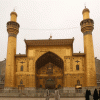
Najaf, Qom take Different Approaches in Iraq
Posted on 22 July 2014 .
By Ali Mamouri for Al-Monitor. Any opinions expressed are those of the author, and do not necessarily reflect the views of Iraq Business News.
Najaf and Qom have taken two different approaches in dealing with general political affairs in Shiite communities since the introduction of the idea of velayat-e faqih. Although this idea was put forward for the first time in Najaf by the founder of the Islamic Republic of Iran, Ayatollah Ruhollah Khomeini, it has not been welcomed by the Shiite hawza (seminary).
Finally, Khomeini managed to attain his wish to implement velayat-e faqih on the ground after the victory of the Islamic Revolution in Iran, which made this idea widely popular within the Iranian seminary of Qom.
The period after 2003 was a great challenge for both Najaf and Qom, during which competition emerged between them on how to deal with the political affairs of Iraq. Qom tended to implement its religio-political vision in Iran on the situation in Iraq, while Najaf had a different perspective over the situation in Iraq — which has a wider religious and ethnic diversity than that of Iran — therefore considering it impossible to have a narrow Shiite perspective over Iraq.
Najaf thus opted for dealing positively with the change by building an inclusive civil state in Iraq that does not only take into consideration the Shiite majority. On the other hand, Qom only saw in Iraq an American threat to Iran’s interests on the one hand and the Shiite majority on the other. According to it, the American threat must be eliminated and the Shiite authority must be in control.
The difference also appeared during the recent Iraqi crisis. Grand Ayatollah Ali al-Sistani contented himself with issuing a fatwa urging the support of the army in all of its religious and ethnic components against terrorists, while at the same time repeatedly emphasizing the need to completely ban militias and unofficial armed groups. He never mentioned the word Shiites, or anything else related to Shiism, in his statements and in the declarations made by his office and spokesman.
He was very careful when confirming the need to protect the holy places since he did not mention any specific description portraying these sanctuaries as Shiite shrines. His statements were broad and mentioned Christian and Yazidi temples and others in the areas falling under the control of the Islamic State (IS) — formerly known as the Islamic State of Iraq and al-Sham (ISIS). Meanwhile, Qom authorities focused their attention on the subject of Shiites and the expansion of Shiism in Iraq. Their statements and denouncements made toward the various parties in this crisis were based on this sectarian ideological perspective.
Posted in Security Comments Off on Najaf, Qom take Different Approaches in Iraq

A Thawing of Relations with Saudi Arabia?
Posted on 03 July 2014 .
By Padraig O'Hannelly.
Earlier this week, King Abdullah bin Abdulaziz Al Saud pledged $500 million of humanitarian aid from Saudi Arabia to the Iraqi people, to be administered by the United Nations.
This could be a very significant move, given that relations between Iraq and its powerful and wealthy neighbour have been strained for many years.
As recently as March, the Iraqi prime minister accused Saudi Arabia and Qatar of effectively declaring war on his country by funding Sunni fighters in Anbar province.
And while Saudi Arabia denies any such funding, it is generally believed that wealthy individuals in the country are a key source of funding for insurgents, including ISIS.
This development can only serve to improve relations between Iraq and Saudi Arabia and is to be welcomed.
(Flag image via Shutterstock)
Posted in Blog Comments Off on A Thawing of Relations with Saudi Arabia?
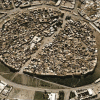
Erbil Citadel joins UNESCO World Heritage List
Posted on 25 June 2014 .
UNESCO representative and Iraq Office Director Axel Plathe congratulated Iraq, and in particular the Kurdistan Region for the inscription of the Erbil Citadel on UNESCO’s World Heritage List, hoping that this step opens new opportunities for the local community, and brings the well-deserved international attention to this historical site.
“On behalf of UNESCO I would like to congratulate Iraq and specifically the Kurdistan Region for the inclusion of Erbil Citadel on the World Heritage List” stated Plathe.
“The inscription represents an international recognition of the Citadel’s outstanding universal value, and highlights its significance as a testimony to the evolution of the human civilization”, added UNESCO Director.
“UNESCO hopes that this step, with its major cultural and touristic potential, would open new opportunities for the community, and pave the way for additional exemplary conservation measures that would help in safeguarding it for future generations”.
Erbil Citadel is the fourth site from Iraq to be included in the World Heritage List, after Ashour, Hatra, and Samarra Archeological city. Located on top of a 32 meters high artificial mound, Erbil Citadelis believed to comprise archaeological remains representing previous historical periods.
The Citadel is of an elliptical shape, covering slightly more than 10 hectares of urban fabric composed of traditional courtyard houses, built of fired bricks. It also includes several public buildings such as mosques, a traditional public bath, and several historic graves.
Since 2007, several projects aiming at the conservation and revitalization of the Citadel have been initiated by the Kurdistan Regional Government and implemented through the High Commission for the Erbil Citadel Revitalization (HCECR) and UNESCO.
Under the Chair of Her Excellency Sheikha Al Mayassa Bint Hamad Bin Khalifa Al Thani, the World Heritage Committee is meeting in Doha, Qatar from 15 to 25 June to consider the inscription of 36 sites on UNESCO’s World Heritage List nominated by States Parties.
During this meeting, members of the Committee have also examined the state of conservation of more than 100 of the 981 existing World Heritage properties.
(Source: KRG)
Posted in Leisure and Tourism in Iraq Comments Off on Erbil Citadel joins UNESCO World Heritage List

John Kerry: Mission Impossible?
Posted on 23 June 2014 .
By John Cookson. Any opinions expressed are those of the author, and do not necessarily reflect the views of Iraq Business News.
US Secretary of State John Kerry's whistle-stop swing through the Middle East and Europe will likely include a meeting this week with Iraq's embattled caretaker prime-minister Nouri al-Maliki.
At the Baghdad summit we can expect Secretary Kerry to again hammer home Washington's demand that the Iraqi premier form an inclusive government of national unity with Sunni politicians given prominent roles. The top US official will also seek assurance that the 300 American military advisers being sent to shore up Iraq's military are immune from prosecution on Iraqi soil.
In my opinion Secretary Kerry's visit to Baghdad is almost certainly mission impossible, as Al-Maliki is not likely to relax his hard-line stance on either issue.
On Sunni inclusiveness Washington has made the same impassioned plea for years and Al-Maliki has ignored it, even as unrest raged in Al-Anbar and UN Secretary General Ban Ki-moon warned Iraq was facing disaster. It was a high-risk political gamble by Al-Maliki, but the recent general election result shows millions of Iraqis supported him and endorsed his policies.
On the question of whether 300 advisers will not be tried in Iraq if they commit crimes; again Al-Maliki is unlikely to U-turn on his consistent policy of non-immunity, especially as few in Baghdad can forget how 4 American Blackwater security guards, working for the State Department, escaped prosecution in Iraq for shooting dead 14 Iraqi civilians in 2007 - their US trial is ongoing.
Al-Maliki's tough position was boosted Sunday when Iran's Supreme Leader Ayatollah Ali Khamenei came out and expressed strong opposition to intervention in Iraq by the United States - or anyone else - and he insisted that the Iraqis themselves can bring an end to chaos sweeping the country.
Khamenei also suspects Washington wants to keep Iraq under its control and place its own stooges in power.
Posted in John Cookson, Politics, Security Comments Off on John Kerry: Mission Impossible?