


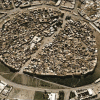
Erbil’s Big Challenge: Tourists vs. Locals
Posted on 18 January 2014 .
This article was originally published by Niqash. Any opinions expressed are those of the author, and do not necessarily reflect the views of Iraq Business News.
Erbil’s Big Challenge: Tourists vs. Locals in Fight for Facilities
This year the northern Iraqi Kurdish city of Erbil must live up to its hard won title, Capital of Arab Tourism 2014. But power cuts, an ailing sewage system and a lack of public restrooms has locals complaining that before authorities look after the visitors they hope to attract, they should take care of local business.
Two weeks ago, on January 1, the northern city of Erbil took up its mantle as the Capital of Arab Tourism for 2014.
The authorities in the city were already being criticised for what appeared to be an inability to capitalize on the award – and now that 2014 has started, many locals are joining in the chorus of disapproval.
In the evenings the central square and market in Erbil, the capital of the semi-autonomous region of Iraqi Kurdistan, are often crowded with visitors. Hirsh Hamza, 18, is one of these. He says he is proud of the fact that Erbil has won this award but he says that even he has concerns that his hometown won’t live up to the tourism title.
“Power cuts, garbage and dirt. And look,” he says gesturing at the crowded square filled with families, “there isn’t even a public bathroom here. That doesn’t seem appropriate for a city that has such a title,” he argues.
Even if there was a public restroom here, it’s possible that the city’s ailing sewage system couldn’t cope with it anyway – especially in heavy rains when the sewage system is prone to flooding. So like other locals, Hamza says that Erbil authorities should first make sure that their own people are living a good life and have their needs catered to, before paying attention to potential visitors.
Posted in Leisure and Tourism in Iraq 3 Comments

Banks In Iraqi Kurdistan "Out Of Cash"
Posted on 05 January 2014 .
This article was originally published by Niqash. Any opinions expressed are those of the author, and do not necessarily reflect the views of Iraq Business News.
"Sorry, We’re Out of Money": Banks in Iraqi Kurdistan Out of Cash
Locals in Iraqi Kurdistan have found themselves unable to withdraw cash from their banks, despite the fact that they have enough in their accounts. It’s a liquidity problem that recurs every year around this time. Some financial analysts suspect a plot and locals have started keeping their cash under the bed.
Nawzat Qader is standing helplessly in front of a bank in the city of Sulaymaniyah, in the semi-autonomous region of Iraqi Kurdistan. He had wanted to withdraw a small amount of money, so that he could cover his family’s needs over the New Year period. He had deposited IQD800,000 a few weeks ago (around US$500) but when he went to the bank to withdraw it, he was told that the bank had no cash and that he would have to wait.
“How is this possible?” Qader complained loudly. “How is it that I go to my bank to withdraw money that I know I have but I must return home empty handed? How can we trust our banks when things like this happen?”
This has become a common problem for banks in the region around this time of year. Iraqi Kurdistan, in Iraq’s north, operates mostly independently of Baghdad and has its own legislature, military and parliament. However what it does not seem to have enough of is cash. Every year toward the end of the fiscal year the problems become more obvious; it’s also led to delays in salary pay outs for government employees.
“Banks here don’t function the way modern banks do,” says Ali Hama Salih, formerly host of a TV show that uncovered corruption who’s now a politician for the anti-corruption Change movement. “The banking system here has failed.”
“People have lost confidence in the banking system because of these crises in liquidity,” agrees Hawar Sheikh Raouf, of Iraq’s Mansour Bank, which is half owned by the Qatar National Bank; the latter is regarded as one of the Middle East’s safest. “The poor services offered by some of these banks don’t help either.”
Posted in Iraq Banking & Finance News 1 Comment
Occidental Offers Stake in Mideast Unit
Posted on 17 September 2013 .
Occidental Petroleum has reportedly begun trying to sell a minority stake in its Middle East unit for as much as $8 billion.
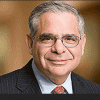
According to a report from Bloomberg, Chief Executive Officer Stephen Chazen (pictured) has held talks with sovereign wealth funds and possible strategic partners for a 40 percent stake in the Mideast business, whose value he pegs at $20 billion.
It cites two informed sources, who asked not to be named as the discussions are private, as saying that Chazen is handling the talks himself and isn’t working with bankers now.
No buyer has emerged and any deal may take several months.
Occidental has operations in countries including Oman, Qatar, Iraq and Libya. Fadel Gheit, an analyst with Oppenheimer & Co. in New York, told Bloomberg:
“It’s difficult to sell assets in six countries .. The whole area is almost radioactive.”
(Source: Bloomberg)
Posted in Investment, Iraq Oil & Gas News 4 Comments
Iraq Stock Market Report
Posted on 16 September 2013 .
Advertising Feature
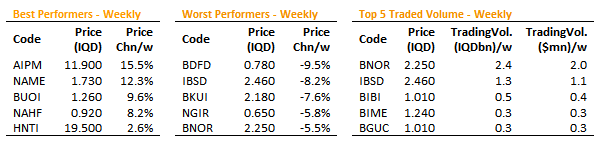
Rabee Securities Iraq Stock Exchange (ISX) market report (week ending: 12th September 2013).
Please click here to download a table of listed companies and their associated ticker codes.
The RSISX index ended the week at ID1,697 (-2.6%) / $1,829 (-2.3%) (weekly change). The number of week traded shares was 4.1bn and the weekly trading volume was ID7.0bn ($5.8mn).
ISX Company Announcements
- Iraqi Islamic Bank (BIIB) will hold its AGM* on Sept. 23, 2013 to discuss 2012 financial statements and increasing its capital from IQD152bn to IQD202bn through bonus and rights issues. ISX will suspend trading of BIIB starting on Sept. 16, 2013.
- Credit Bank of Iraq (BROI) will hold its AGM* on Oct. 1 to discuss 2012 financial statements and increasing its capital from IQD150bn to IQD250bn through bonus and rights issues.
- Elaf Islamic Bank (BELF) will hold its AGM* on Sept. 21, 2013 to discuss 2012 financial statements and increasing its capital from IQD152bn to IQD200bn through bonus and rights issues. ISX will suspend trading of BELF starting on Sept. 15, 2013.
- Iraqi Agricultural Products (AIRP) will hold its AGM* on Sept. 18, 2013 to discuss 2012 financial statements and pay 40% cash dividend (IQD0.40 per share). ISX suspended trading of AIRP starting on Sept. 11, 2013.
- Original shares of Dijlah&Furat Bank (BDFD) resumed trading on Sept. 11, after the decision to increase its capital from IQD100bn to IQD156bn through 6% bonus and 50% rights issues and pay 8% cash dividend (IQD0.08 per share). BDFD has not been trading since May 19,2011.
- Shares of Al-Mosul for Funfairs (SMOF) resumed trading on Sept. 11, 2013. The company has decided to distribute 100% cash dividend (IQD1.00 per share) in its AGM* (August 24, 2013).
- Shares of Iraqi Date Processing&Mark. (IIDP) and AL-Badia for General Trans (SBAG) resumed trading on Sept. 11, 2013 after they have met the disclosure requirements.
- Original shares of Modern Chemical Industries (IMCI) resumed trading on Sept. 10, 2013 after the decision to increase its capital from IQD90mn to IQD135mn through 50% bonus issue and pay a cash dividend of 25% (IQD0.25 per share).
- Modern Construction Mat. (IMCM) will hold its AGM* on Sept. 17, 2013 to discuss 2012 financial statements and approve decreasing the capital by the un-subscribed amount of IQD249,844,409, so that the capital will be IQD5.37bn. ISX suspended trading of IMCM starting from on Sept. 10, 2013.
- Iraq's number two telecommunications operator Asiacell (TASC) has named Amer al-Sunna as chief executive, the company's parent firm Ooredoo said in a statement on Monday. Sunna previously worked for Ooredoo's units in Jordan and the Philippines before joining Asiacell as managing director in February. Al Sunna brings with him 20 years of telecom experience, while outgoing CEO Ahmed, who served in his position for almost six years, will remain with Asiacell as chief advisor to the chairman. Asiacell listed on the Iraqi bourse in February following a $1.27bn share sale. Ooredoo, which owns a 64% stake in Asiacell, changed its name from Qatar Telecom earlier this year. (Reuters, Comm)New shares of Dar Al-Salam for Insurance (NDSA) from the capital increase to IQD2.9bn through 19.83% bonus issue resumed trading on Sept. 8, 2013.
Posted in Investment 4 Comments

Gulf Precast Builds 65 Schools in Iraq
Posted on 10 September 2013 .
UAE-based Gulf Precast has signed a contract to build 65 precast schools in various locations in Central Iraq.
The design of the schools and their boundary walls has already been finalised. While the initial part of the production is under way in the UAE, Gulf Precast is already in the process of setting up a production plant in Iraq. This is the first phase of the international expansion strategy of the UAE Precast Leader.
The Precast schools awarded to Gulf Precast are a part of an Iraqi national program to build 1,485 schools across Iraq this year. The schools have been specified using precast construction, and consist of 6, 9, 12, 18, and 24 class rooms. While several potential Precast Manufacturers had been considered, Gulf Precast, which has been operating in the Emirates for the last 28 years, has been selected both for its wealth of expertise and for its readiness to set up a Precast Plant in Iraq.
The Iraq factory will cater for the second production phase of the schools project as well as for the fast-track infrastructure and housing program launched by the Iraq government, delivering quality construction by the UAE expert which handled many iconic projects, such as the Dubai Mall, the Paris Sorbonne University Abu Dhabi, high rise towers in the Jumeirah Beach Residence complex, more than 2,000 villas in the Al Falah Community Development, to name a few.
The new Iraq factory will complement the current 6 UAE plants managed by Gulf Precast as well as its 2 recent additions: its new Al Ain mobile Plant and Abu Dhabi Airport extension on-site Plant. Located in Baghdad, the Iraq factory is designed to produce 200 M3 of Precast per day in addition to 900 M2 of Hollowcore slabs daily.
Omar Araim, the representative of Gulf Precast in Iraq stated:
"The Iraqi government has launched an ambitious program of construction development which can only be achieved if modern performing technologies such as Precast are employed. By being present in the country during the initial stages of this program, companies such as Gulf Precast are positioning themselves as a key actor of the expected national expansion."
Gulf Precast's expansion strategy is not limited to Iraq only, but also includes numerous countries such as Saudi Arabia, Qatar, Libya, Oman, India and or Nigeria, countries in which Joint Ventures are in progress with governmental and private organisations.
Elias Seraphim (pictured), CEO of Gulf Precast declared that:
"The expertise gained by Gulf Precast in the very mature and demanding construction sector of the United Arab Emirates is perceived as a critical success factor by many of our Joint Venture partners or intended partners.
"They, in turn, bring to the partnership their extensive knowledge of the local construction market. In a few years' time, Gulf Precast intends to become an internationally renowned key player of the construction economy."
(Source: Gulf Precast)
Posted in Construction & Engineering In Iraq, Iraq Education and Training News 6 Comments
Should US go into Syria: What do Ordinary Iraqis Think?
Posted on 09 September 2013 .
By Mustafa Habib.
This article was originally published by Niqash. Any opinions expressed are those of the author, and do not necessarily reflect the views of Iraq Business News.
Iraqis know better than most that military intervention comes at a price. Ten years after foreigners invaded their country and toppled their dictatorship, the country still isn’t stable. So do they think the West should intervene in Syria?
It has been just over ten years since the US-led invasion of Iraq. But that event and its aftermath have been hanging heavily over the current debate in the West over whether it should intervene in Syria or not.
But how do Iraqis feel about a potential invasion or intervention in Syria? Most of them are well aware that the US military helped to oust a dictator, Saddam Hussein, a man who governed their country with iron and fire for over 24 years. However the destruction and virtual civil war that followed Hussein’s ousting is more than enough to make many of them unenthusiastic about the prospect of external intervention in Syria. And it seems that, no matter what sect or ethnicity they claim, most Iraqis are only too well aware of what comes after intervention.
“When foreign forces overthrew Saddam Hussein, I couldn’t hide my joy,” recalls Saeed Jabbar, a Baghdad university professor. “But we didn’t expect all the devastation and destruction that came afterwards,” he told NIQASH.
“Bashar al-Assad is clearly a dictator – but he should be removed by the Syrian people and not by external forces.”
In the west of Anbar province, where the population is mostly Sunni Muslim like former Iraqi leader Hussein was, a tribal leader there told NIQASH: “The people of Anbar have a clear position on Syria. They all believe that al-Assad and his regime should be toppled, just like Saddam Hussein’s was,” argues Ahmad al-Jumaili.
Iran Divides Iraqi Politicians
Posted on 01 September 2013 .
By Harith Hasan for Al-Monitor. Any opinions expressed are those of the author, and do not necessarily reflect the views of Iraq Business News.
Iraq is currently the scene of a sharp regional conflict between Iran and its opponents. This is nothing new, however. Regional events have come to show that any country witnessing political or social instability, amid weak state control, can be exposed to a similar power struggle on the part of rich and stable regional powers that have a geopolitical agenda.
This is the case in Lebanon, Syria, Egypt, Yemen and Bahrain. One can say that the current regional rivalry is hampering the process of rebuilding the state and national identity. It is due to this rivalry that internal conflicts have become complicated, as they turn into an extension of a wider regional conflict waged by powerful countries on the soft lands of unstable countries.
Moreover, the political, ideological and financial alliances that are forged between the regional powers and their local collaborators fuel internal division. In a country like Iraq, where this division takes on a sectarian character, the regional conflict leaves a major destructive effect.
Therefore, the most violent aspects of this conflict take place in countries where a power struggle is more intense, either because of their strategic importance or due to the lack of an ultimate hegemonic power.
This is particularly the case in Iraq, Syria and Lebanon, which together form the main part of the Fertile Crescent. Step by step, the regional rivalries plaguing these three countries fell within the framework of a wider foreign conflict whose two major poles are Iran and Saudi Arabia.
Thus, it currently seems impossible to deem that the instability plaguing these countries is the result of a mere lack of compatibility between the subnational communities. These communities have increasingly become transnational communities.
By rampant “sectarianization,” we mean that there is in the region a continuous process that aims to establish sectarian, rather than national, identities.
It is noteworthy that this process affects the internal conflict, for the political community is divided over the identification of friends and enemies. Ernst Renan once defined the nation as a group of people united by a common hatred of their neighbors. If this is true, then the current problem in a country like Iraq is the absence of this “common hatred” for a given enemy.
Posted in Politics, Security Comments Off on Iran Divides Iraqi Politicians
Qatar Airways Launches 5th Iraqi Destination
Posted on 22 August 2013 .
Qatar Airways launched flights on Wednesday to its fifth destination in the Republic of Iraq, Sulaymaniyah, increasing the airline’s frequency across Iraq from 16 to 20 flights each week.
The new services, which will operate four-times-a-week non-stop from the airline’s Doha hub, brings the carrier’s global network to 129 destinations worldwide.
The Doha – Sulaymaniyah route is being operated by a state-of-the-art Airbus A320 featuring 144 seats in a two-class configuration of 12 seats in Business Class and 132 seats in Economy.
Selected aircraft feature seatback TV screens, providing passengers with the next generation interactive on board entertainment system, featuring a choice of more than 800 audio and video on-demand options, together with an SMS text messaging service from each seat.
The launch marks the rapid expansion by Qatar Airways in Iraq since the middle of 2012 when it began flights to Erbil, followed by the capital Baghdad, Najaf and Basra. Sulaymaniyah also marks the carrier’s fifth new Middle Eastern destination launched this year after Basra, Najaf, Gassim in the Kingdom of Saudi Arabia and Salalah in Oman.
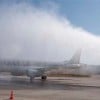
The arrival of Qatar Airways’ flight QR438 was welcomed with a water salute at Sulaymaniyah International Airport and a warm reception presided by local officials. Fathi Al Shehab, Qatar Airways Senior Vice President GCC, Levant, Iran and Indian Subcontinent, led an official delegation on the flight from Doha and was welcomed at the airport by Director General Sulaymaniyah International Airport Eng.Tahir Qadir.
Posted in Iraq Transportation News 2 Comments

Britain in Danger of Missing Out on Basra Boom
Posted on 25 July 2013 .
By Robin Simcox, Research Fellow for Strategic Analysis, part of the Henry Jackson Society.
On Sunday 14 July, over fifty people were killed in a series of terrorist attacks in Iraq. The most deadly attacks took place in Basra, where three roadside bombs killed twenty eight.
A series of attacks – particularly via car bombs – have rocked Basra in recent months. However, the levels of violence are unlikely to deter future investment not only in Basra, but Iraq more broadly.
Oil sales account for over 90% of Iraq’s budget. It exports most of its oil from the south, and Basra – as a major hub for the Iraqi oil industry – is vital to the economy. The Southern Oil Company, the state-owned enterprise responsible for the southern oil fields, is based in Basra; 80 % of the country’s crude oil is exported from there; and 70% of Iraq’s oil is produced in the south.
As a result, and despite security concerns, investment has arrived. Foreign investment in Iraq reached $60 billion in 2012, and construction projects in Basra have seen malls, social clubs and hotels open. Standard Chartered is planning to open a branch there next year. As of last month, Qatar Airways now flies directly into Basra.
Basra is also a key port town, with the cargo unloading statistics at Basra contributing to revenues from Iraqi ports reaching $30 million a month in December 2012. This is the highest amount achieved in the country’s history, and the growing demand for shipping means that the Ministry of Transport plans to open a new port in Basra in the coming months.
All this helps explain why Nouri al-Maliki, Iraq’s prime minister, once described Basra as ‘the lung’ of the country. It is a potential economic powerhouse within Iraq, and clearly of significant strategic importance. Unless there is an enormous spike in violence, the potential gains on offer will ensure that terrorism does not lead to foreign disengagement.
Posted in Iraq Industry & Trade News 6 Comments
Qatari Firm Wins $65m Housing Contract
Posted on 04 July 2013 .
By John Lee.
The Muthanna Investment Commission has announced that a Qatari company has been contracted to build a housing project in central Samawa.
Doha Investment Company won the contract for the $65 million housing complex, which will include 480 housing units, a school, a health centre and various other services, reports al-Shorfa. Some will be low-cost housing units.
The project is expected to begin in August and be completed within two years.
(Source: Al-Shorfa)
Posted in Construction & Engineering In Iraq Comments Off on Qatari Firm Wins $65m Housing Contract