


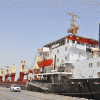
Iraqis Fear Impact of New Kuwait Port
Posted on 10 November 2011 .
This article was written by Ahmad Wahid, and was originally published by the Institute for War and Peace Reporting, iwpr.net. It is reproduced by Iraq Business News with permission. Any opinions expressed are those of the author, and do not necessarily reflect the views of Iraq Business News.
Thousands of Iraqis working across five ports in Basra fear they will lose their livelihoods if Kuwait presses ahead with plans to build one of the Gulf’s biggest harbours.
There are worries that once the 1.1 billion US dollar Mubarak port is completed, Iraq stands to lose up to 60 per cent of maritime traffic – mostly the larger cargo ships that already struggle to dock in Basra’s Umm Qasr, the country’s only deep-water port.
Work has started on a new port at Al-Faw close to Umm Qasr, but in May this year, the Kuwaitis began construction of the Mubarak port just over the border from the site.
The close proximity of the two developments has angered Iraqi politicians, workers and tribal leaders, who have pledged action against the Kuwaiti government.
Iraq’s transport ministry announced the 1.6 billion dollar port project for Al-Faw in 2005, with an Italian construction firm winning the contract to build the facility. Construction only got under way in 2010, with the first stage of the development planned to be complete by 2014.
The finished project, with total costs estimated to reach six billion dollars by the completion date of 2028, includes not only the port itself but infrastructure such as train lines linking Europe to the Gulf.
Iraqis say that once the new port opens, they will be as hard-hit economically as when the country was subject to sanctions in the 1990s because of the invasion of Kuwait.
Posted in Iraq Industry & Trade News, Iraq Transportation News, Politics Comments Off on Iraqis Fear Impact of New Kuwait Port
Foreign Companies to be 'Encouraged' to Hire Locals
Posted on 07 November 2011 .
The Iraqi government is to provide financial incentives for foreign companies to hire Iraqi workers, according to AKnews.
The parliamentary committee for labor and services decided to reduce taxes and other 'not specified obligations' towards the Iraqi government, as well as to provide facilities to these companies.
"The foreign companies can rely on their skilled workers in the technical and engineering affairs, but it is unacceptable for foreign [conpanies] to bring in foreign workers that do not require skill and can be accomplished by Iraqi workers," Yunadim Kanna, chairman of the committee, said.
It remained unclear if that decision is backed by the majority of the parliament or by the Iraqi government, and therefore it is not clear if it will ever become law.
The unemployment rate in Iraq is 16 percent, meaning four million Iraqis are out out of work, according to the Ministry of Labour.
These figures do not reveal the extent of the problem as they do not record underemployment - where people cannot find enough work to support themselves.
According to this report, Iraq decided in May to deport foreign workers, especially Asians, but the decision has not yet been put into effect.
(Source: AKnews)
Posted in Employment Comments Off on Foreign Companies to be 'Encouraged' to Hire Locals

No More Charity: Making Iraq's Economy Work
Posted on 20 September 2011 .
Most of Iraq’s revenue comes from oil. But natural riches may also mean fewer political freedoms and a state that behaves like a charity toward its own people. This must change, an Iraqi economist Nagih al-Obeidi argues in this article from Niqash.
The economic and political theory on “rentier states” says that a nation that derives most of its income from one natural resource, such as oil, doesn’t need much other domestic economic activity. Taxes are not as important and the government is not held as accountable by electors.
The same theory indicates that one of the biggest challenges for a rentier state is to develop a democratic, civil society and to ensure that the central government is not autocratic or bloated. And it is often used to explain why oil-rich nations in the Middle East and Africa might not perform as well, in terms of general standards of living and political freedoms. Dr Najeh al-Ubaidi, an Iraqi economic researcher based in Berlin, discusses whether post-Saddam Hussein Iraq is becoming more or less of a rentier state, the dangers of this and the possible solutions.
Because of its dependence on one resource – oil - the Iraqi economy is usually described as a “rentier economy”. The Iraqi government has been controlling oil income for several decades and this has allowed it to redistribute that income in a way that serves only the interests of the ruling elites. A rentier state may not need to tax its citizens as heavily because it relies on the sale of oil supplies. It is estimated that internal tax revenues amount to only a few percentage points of the annual Iraqi state budget. And when it comes to expenditure, the state often behaves like a charity, distributing public money as though it were alms to citizens. But even the description - rentier economy – does not adequately describe the behaviour of the Iraqi state and the nature of its relationship with its citizens. While there is no doubt that Iraq’s oil wealth can be a key factor in achieving a better standard of living and welfare in Iraq, it is also the reason why the Iraqi government should be assessing its policies and its position.
Rentier Symptom #1: The State as Charity
Under the first system of government established in Islam, also known as a caliphate, the leader of the state – the caliph – could distribute state moneys more or less as he pleased. And it seems that Saddam Hussein’s regime contributed to this tradition. Today, the rise of a more Islamic political bloc to power seems to be continuing with this attitude.
Posted in Construction & Engineering In Iraq, Iraq Banking & Finance News, Iraq Commodities & Mining News, Iraq Industry & Trade News, Iraq Oil & Gas News 1 Comment

Dr Sami al-Araji Speaks with Iraq Business News
Posted on 12 September 2011 .
Following his address to the Iraq Mining 2011 conference in London, the Chairman of Iraq's National Investment Commission, Dr Sami al-Araji, was interviewed by Padraig O'Hannelly for Iraq Business News:
Iraq Business News: Dr al-Araji, in your speech you mentioned the visa problems that Iraqis sometimes have entering the UK; what some businesses are also saying is that they have difficulty getting expat workers into Iraq … what is your opinion on this matter?
Dr Sami al-Araji: We have unemployment – officially about 15%, unofficially I don't know – they need to work, and it is unacceptable while we have unemployed people sitting around that we import people from the outside.
But it is fully understood, and fully understandable, that we can't source all the talent we need from engineers in Iraq. Nobody would ask you, for example, why did you bring in this or that. In the beginning [of an investment], you put forward your action program, you say I need engineers and so on, and these I will bring with me because they aren't available. We have a system with the Ministry of Social Affairs, where you say we need 10,000 workers, and 5,000 you will have to bring in for the following reasons, the other 5,000 we will get locally, [and say to the Ministry] “please get us the 5,000”.
And that's exactly what we are working on. Nobody is saying “oh, no, there can be no foreign workers, or if there are foreign workers we have to sit down and [verify] this or that”, the only authority is to the Ministry of Social Affairs, and they are very positive and cooperative and they try very much to help.
But what is happening is that some of the people have mismanaged this, and that's why there has been a problem.
IBN: Regarding foreign companies' perception of problems like corruption, and the Transparency International index on corruption, do you have any specific targets or plans to address that problem?
SA: We know there is some corruption, but I think very honestly it is magnified by the press and by the different committees around the world. We have made a lot of progress in fighting corruption and improving transparency, that is number one.
Posted in Employment, Investment, Iraq Banking & Finance News, Iraq Commodities & Mining News, Iraq Industry & Trade News, Iraq Oil & Gas News Comments Off on Dr Sami al-Araji Speaks with Iraq Business News
Four Million More Jobs By 2015
Posted on 12 August 2011 .
The Iraqi Planning and Development Ministry is to create four million new jobs by 2015, minister Ali Shukri said today.
Speaking to AKnews, he said the jobs would be both public and private sector and will bring down the poverty rate from 23% to 16%.
Private-sector employment is hampered by limited rights, such as a lack of unions and pension rights. That's why most Iraqis, Aknews writes, are interested in public-sector jobs.
The Ministry will first create new public-sector posts to improve administration.
Unemployment has fallen from 52% in 2006 to 15% today. The unemployment rate for young males is still 30%, and young women 16%, but poverty is down from 45% and inflation has fallen from 65% to 6%.
(Source: Aknews)
Posted in Employment, Politics Comments Off on Four Million More Jobs By 2015
Trailing Iraq's Cigarette Smugglers
Posted on 27 July 2011 .
Bandits, border guards and big profits
NIQASH’s correspondent follows the illegal nicotine trail, as he joins local smugglers taking cigarettes into Syria. Dodging border guards and bandits, he meets the locals risking their lives to deliver millions of profitable packs to smokers every day.
Several days ago, two soldiers and a member of the public were wounded and around 50 others arrested, following a clash between the Iraqi armed forces and militants. But these casualties and arrests were not the result of any “war against terror”. Instead it was to do with a war against one particular drug: nicotine. The violence had been between cigarette smugglers and military operating along the Iraqi-Syrian border.
Gunmen apparently fired on the vehicle that the commander of the border guards’ regiment near Bi'r Qasim in western Ninawa province was travelling in. A member of the same patrol, Khaled Ahmad, reported that the group was on a mission to intercept smugglers ferrying goods into Syria.
“We have fought many battles with smugglers who outnumbered us and were better armed,” Ahmad said. “They carry machine guns and binoculars and their trucks are escorted by 4WD vehicles until they get to the border of Syria and Iraq.”
“Smuggling cigarettes is a profitable business,” Mosul stock market trader Hamed al-Jibouri told NIQASH; deals between cigarette traders are often done in Mosul’s local stock market with brokers playing a major role in the transactions and negotiations. “Cigarettes are imported legally from Turkey and Jordan, then brought in through Erbil and Anbar by influential Mosul merchants.”
Turkey and Jordan, from where many of the cigarettes originally come, also border on Syria, but these are far harder to cross illicitly. Dozens of warehouses receive millions of cigarettes every day. A master case costs between US$200 and US$300 – each master case contains 50 cartons of cigarettes, which in turn contains 10 packs of cigarettes each. Each master case contains 10,000 cigarettes.
Posted in Iraq Industry & Trade News, Security Comments Off on Trailing Iraq's Cigarette Smugglers
Iraqi Crackdown on Foreign Workers Criticised
Posted on 25 July 2011 .
This article was written by Hazim al-Sharaa, and was originally published by the Institute for War and Peace Reporting, iwpr.net. It is reproduced by Iraq Business News with permission. Any opinions expressed are those of the author, and do not necessarily reflect the views of Iraq Business News.
The ministry of labour has drawn criticism for launching a fierce campaign against Iraq’s legions of illegal foreign workers and those who employ them.
After the fall of Saddam regime, thousands of overseas workers were legally recruited by foreign companies who’d secured contracts worth hundreds of million of US dollars to rebuild the country’s shattered infrastructure. When the work ended, many remained in the country and sought illegal work.
But economists and business owners say the drive to deny them employment is a politically-motivated attempt to reduce the joblessness following a wave of street protests demanding more public sector work. They warn it is an empty gesture which will fail to have a positive economic impact.
However, the ministry of labour says it is simply implementing Saddam-era employment legislation.
According to a 1987 labour law, businessmen caught hiring illegal labourers face up to six months in prison or a fine five times the gross total income of every foreign employee they engage. A new, more progressive labour law is being drafted, but the old one, as is the case with much legislation from the Saddam period, remains on the statute books.
Some commentators are doubtful whether the labour ministry will be able to fill the void left by foreign workers if they are forced to leave.
Meanwhile, the ministry has been carrying out inspection campaigns in busy districts across Baghdad and other major cities in an attempt to convince Iraqi businessmen to dismiss foreign workers.
Majid al-Soowari, an Iraqi economist and government critic, described the crackdown as “politically motivated [and] aimed at appeasing millions of unemployed Iraqis”.
Hilal al-Tahan, a senior professor at the Faculty of Economics at the University of Mustansiriya, also criticised the ministry’s plan, calling it counterproductive and politicised.
There are no official statistics on how many foreign workers are in Iraq, however, Al-Soowari and the ministry of labour estimate that there are around 15,000 to 25,000, mainly Muslims from the Indian sub-continent.
"We are not responsible for the entry of those foreign workers as most of them entered through contractors and they should have been responsible for them,” Hosni Ahmad, a ministry of labour official, said. He added that in 2004 the Coalition Provisional Authority, CPA, also brought in overseas labour from the sub-continent to work on building the Green Zone, Baghdad International Airport and military installations among other infrastructure projects.
The CPA was the transitional government, now dissolved, which was set up by America following the fall of Saddam’s regime.
The government says it has no money to repatriate illegal foreign workers. The 1987 labour law makes no mention of repatriation, but the new bill compels employers to take responsibility for ensuring that overseas employees they hire return home after completing their contracts.
In the interim, an interior ministry source said the department was working on the possibility of granting illegal labourers a six-month temporary residency visa, and allowing their employers to deduct enough money from their salaries to repatriate them.
He conceded that for this to work, the ministry would need to carry out a statistical study on the exact number and identity of the workers - but acknowledged that it would be a challenge.
"It takes much effort and a long time to introduce new [labour] laws,” Al-Soowari said. “[But] solutions must… not just be for propaganda purposes.”
He was referring to the crackdown on foreign workers coming in the wake of protests over unemployment – currently over one million, according to government figures.
“The question here is: will [sacking] overseas workers who are hired as housemaids provide new jobs for Iraqis? It’s not going to achieve a thing,” he said.
Al-Tahan warned that the government move would have an immediate negative impact on the economy and could trigger an inflation hike.
“Business owners will have to employ Iraqis instead with higher wages, less working hours and even less productivity, taking away money from the economy,” he said, adding that the labour ministry should look at training and skill programmes for unemployed Iraqis and introducing start up loans for small-to-medium sized business start-ups as a priority.
Yunadim Kana, a member of the labour and social affairs parliamentary committee, said it was examining the government’s decision to implement the 1987 law, with members currently undecided about the merits of the move.
Iraqi businesses say enforcing the Saddam-era legislation would damage their operations.
Like most businessmen, Zaid Hadi, the manager of a popular ice-cream shop in the high-end Al-Mansoor district in Baghdad, does not want to lose his workers.
"The decisions by the ministry are always hasty, and changes are always radical," said the 23-year-old, who employs two Bangladeshi waiters, both Arabic speakers. "I got my Bengali workers into training courses on etiquette and service, and they are serious at work, unlike Iraqis."
Six major employers in Baghdad who were interviewed by IWPR said the work ethic of foreign labourers was superior to that of Iraqis.
Jamal Bilal, one of Hadi’s Bangladeshi workers, said in a mixture of Arabic and English that he is comfortable where he is and has good ties with his boss and local people.
He sends his entire 350 US dollar monthly salary to his family back home and is provided with food and accommodation by his employer, like most low-income foreign workers in Baghdad.
Mohammd Muhsin, a 41-year-old Baghdad-based businessman, who runs a recruitment agency, said he was inundated with requests to bring in maids from abroad. He receives on average 20 to 30 enquiries a day – however, has no option but to turn away customers.
In eight years, the ministry of labour has granted 44 work visas - the official total number of all low-skilled foreign workers in Iraq - to mostly Bangladeshi housemaids.
Muhsin, along with other Iraqis, believes that hiring foreign rather than Iraqi housemaids is a safer option as the country continues to grapple with sectarian violence.
Violence in Iraq has dropped sharply since the peak of sectarian bloodshed in 2006 to 2007, which pitted Sunni and Shia neighbourhoods against each other. Although things are now much quieter in Baghdad, militant groups on both sides continue to carry out attacks, though many now target Iraqi security forces.
Ahmad Khalid, a 26-year old newlywed Baghdadi, is looking for a foreign maid for the same reason as Muhsin. "She won't be ethnically committed to anyone here, therefore she will be less of a security risk for my family,” he said.
Al-Soowari believes that rather than kicking foreign workers out of jobs, the government should be opening its doors to them to help rebuild Iraq.
"We need to hire foreign workers… to get things back on track, after the Iraqis failed to step up and move the economy forward,” he said, adding that even the government of Iraq could do with the expertise of foreign workers.
(Source: IWPR)
Posted in Construction & Engineering In Iraq, Employment, Iraq Industry & Trade News, Iraq Oil & Gas News, Leisure and Tourism in Iraq, Politics Comments Off on Iraqi Crackdown on Foreign Workers Criticised
Agricultural Working Group: Strategies to Reduce Poverty and Unemployment in Iraq
Posted on 18 July 2011 .
By Layth Mahdi, Agricultural Advisor. Any opinions expressed are those of the author, and do not necessarily reflect the views of Iraq Business News.
The Iraqi agriculture production and productivity has been on a linear decline since 2003. Despite this, it remains the second-largest contributor to Iraqi GDP after oil revenues. It has the potential role in decreasing unemployment, poverty and violence if essential programs are implemented in its restoration.
Iraqi people believe that the occupation severely damaged the agricultural sector. The reconstruction efforts that were led by USAID contractors failed to achieve any significant progress. This is because inadequate planning, management and an inefficient political situation in this country.
The country’s urban population makes up roughly 21.1 million (66% of total) compared to a rural population of 10.9 million (34%). Demographically 50% of the population is under the age of 18. Illiteracy rates are on the rise. Recent data indicates that over seven million Iraqis are illiterate, meaning 24% of the population are unable to read and write. Iraq's literacy gender gap is significant, only 46% of adult females and 66% of adult male are literate. Education in Iraq is continuing to decline due to mismanagement of government funds. Over 15% of school aged children are not enrolled in any education program due to their obligation to help support their families.
One of the main challenges that the Government of Iraq (GoI) faces in rebuilding Iraq is high unemployment and poverty. The GoI cannot make a serious attempt at implementing programs to tackle these issues because the decision makers are not knowledgeable and they lack vision. They have attempted to provide aid and social welfare without addressing the root causes of the nation’s problem. For example, the GoI employed more than one and half million people from 2004 to 2010 in the government sector, primarily police and military.
In the next five years, oil production will triple and annual oil revenue is projected to increase to $200 billion by 2015. Currently, Iraq is still under Chapter 7 and huge amounts of money have been spent to cover military and security costs every year. High unemployment and poverty are among the main sources of social turmoil. Iraq is still politically, socially and economically unstable. If these issues are left unresolved, poverty, unemployment, and military operations will hinder growth in oil sales.
Unemployment and poverty are rising. The GoI must create jobs for more than three million citizens over the next three years (2014) in order to decrease the unemployment rate. Agriculture has traditionally been the largest employment sector in Iraq. It contributed more than 7.5% of GDP before 2003 and employed more than 25% of the total work force. Therefore, the agriculture sector needs to be restored in order to absorb the large number of unemployed people.
Current GoI employees lack working experience, management and are corrupt. These situations result in a lack of economic growth. Seven million people who live under poverty line ($2 per day). The private sector is not functional, and the government’s economic growth programs are either slow, ineffective or haven’t started. Therefore, I expect that about 10 million people will live under the poverty line by 2015. Iraqi leaders need to help people to overcome these social problems. PM Al Maliki MUST initiate a fund from Pertro-dollar (see my articles in Iraq Business News) and create International Working Groups in order to restore the agricultural sector in the coming years.

Posted in Agriculture Comments Off on Agricultural Working Group: Strategies to Reduce Poverty and Unemployment in Iraq

Iraq Needs Strategies to Improve Prospects for Youth – UN Envoy
Posted on 18 July 2011 .
The top United Nations envoy for Iraq has called on the country's authorities to develop a vision as well as strategies to improve the economic and social prospects for its young people, noting that a number of youth development indicators in a new report are of concern.
The Youth Status Analytical Report found high illiteracy and unemployment rates among the country's youth. Enrolment in secondary education is 21 per cent, while unemployment among youth between the ages of 15 and 29 is over 57 per cent.
In addition to education and employment, the report analyzes the needs of youth in the areas of health and disabilities, access to media and technology, sports, security, political and civil society participation, and poverty.
“Youth have legitimate concerns about employment opportunities, delivery of basic services and accountability,” Ad Melkert, the Secretary-General's Special Representative for Iraq, said as the report was launched at a conference held yesterday in Baghdad.
Mr. Melkert, who is head of the UN Assistance Mission for Iraq (UNAMI), called on Iraqi decision-makers “to listen to the needs of young people and respond to their legitimate demands and expectations.”
Stating that the report provides the Government with a “key planning tool,” he recommended three measures to help decision-makers move forward. The first is agreement on an “Agenda for the Future” with policy targets and timelines that will improve the economic and social prospects for young people.
The second is the establishment of a widely representative “Youth Dialogue Platform” with participants between 18 and 25 years of age for regular consultation with the Government and the Council of Representatives, or parliament.
In addition, he recommended that a “Jobs for Youth” programme be initiated that will on a month-by-month basis increase the number of young people provided with jobs, training or self-employment opportunities.
“Now it the time to bring civil society and the United Nations together within a coordinated platform to reach consensus on how the future of Iraq should look like through its youth,” said Mr. Melkert.
The report was compiled by the Baghdad and Al- Rafidain Universities in conjunction with the Ministry of Planning, with the assistance of the UN Population Fund (UNFPA).
(Source: UN)
Posted in Employment, Iraq Education and Training News Comments Off on Iraq Needs Strategies to Improve Prospects for Youth – UN Envoy
Creating jobs in the private sector
Posted on 11 July 2011 .
By T. Keyzom Ngodup, co-founder and Executive Director at Ideas sYnergy, an Iraq based private sector development consulting company.
IRAQ INSIGHTS, published by Ideas sYnergy, aims to consolidate and build intellectual capital on private sector development, empowering stakeholders to address issues of access and structural reforms on a diverse range of topics impacting inclusive economic development in Iraq.
IRAQ INSIGHTS July 2011, Private Sector in Iraq: Creating Jobs and Enhancing Sustainable Development?
- Status of Iraq’s Unemployment & Underemployment: An Overview of the Public and Private Sector in Iraq
- Are Iraqis’ Fears of Private Sector Jobs Justified?
- Reading Beyond the Rank: Examining the Measurements of World Bank Doing Business in Iraq 2011 Report
- Micro, Small and Medium Enterprises: Hurdles to their potential to lead private sector development and employment generation
Iraq Insights by Ideas sYnergy_July 2011 Issue 2
T. Keyzom Ngodup is co-founder and Executive Director at Ideas sYnergy, an Iraq based development consulting company committed to economic and social development through market-based solutions that help build and scale innovative businesses for sustainable and inclusive private sector development.
Posted in Employment, Investment, Iraq Banking & Finance News, Iraq Education and Training News, Iraq Industry & Trade News, Keyzom Ngodup 1 Comment