


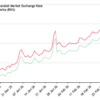
Dinar-Dollar Exchange Rate: Iran War has Little Impact
Posted on 05 March 2026 .
By John Lee.
In his latest monthly investment report for Iraq Business News, Ahmed Tabaqchali shows that the gap between the parallel and official exchange rates for the Iraqi dinar (IQD) had already been rising before the U.S.-Israel war on Iran started, due to domestic customs policy changes making it harder for informal importers to transfer money across borders.
When the war began, the gap barely reacted (only a 2.5% spike), and has since settled back in line with that pre-existing trend, suggesting the war had little lasting impact on this particular exchange rate dynamic.
Click here to read Ahmed Tabaqchali's full report.
See also:
IQD in the Crossfire: What a Trump-Iran Conflict Could Mean for Iraq's Dinar
Top 10 Dinar Articles from February
Central Bank Advances Iraqi Banking Reform, Eases Foreign Transactions
Posted in Iraq Banking & Finance News, Iraq Industry & Trade News Comments Off on Dinar-Dollar Exchange Rate: Iran War has Little Impact
Top 10 Dinar Articles from February
Posted on 03 March 2026 .
The following were the ten most read dinar-related articles on Iraq Business News for the month of February:
- Iraqi Dinar Speculation "Misplaced" -- CBI Boss
- Iraqi Dinar Falls Against Dollar
- 2026: The Year Iraqi Dinar Speculators Finally Strike Gold?
- Central Bank Advances Iraqi Banking Reform, Eases Foreign Transactions
- The Iraqi Dinar Revaluation Deception: 10 Persistent False Claims Exposed
- Donald Trump and the "Great Iraqi Dinar Revaluation"
- Iraqi Banks Restricted from US Dollar Transactions: FULL LIST [Amended]
- One Year of Trump: Iraqi Dinar Speculators Still Waiting
- Dinars to Dollars - Tabaqchali Explains Market Gap
- IQD in the Crossfire: What a Trump-Iran Conflict Could Mean for Iraq's Dinar
The previous month's listing can be viewed here.
For more information on the Iraqi dinar, check out IBN's Dinar Page here: https://www.iraq-businessnews.com/the-dinar-page/?swcfpc=1
Posted in Iraq Banking & Finance News Comments Off on Top 10 Dinar Articles from February

Power-Bid In Iraq: Will Maliki Return?
Posted on 28 February 2026 .
By Neville Teller for Eurasia Review. Any opinions expressed are those of the author(s), and do not necessarily reflect the views of Iraq Business News.
Power-Bid In Iraq: Will Maliki Return?
On January 27 US President Donald Trump declared on his Truth Social media platform that Iraq would be making a "disastrous mistake" if Nouri al-Maliki was re-installed as prime minister.
He argued that "last time Maliki was in power, the country descended into poverty and total chaos" and that this "should not be allowed to happen again."
Posted in Politics Comments Off on Power-Bid In Iraq: Will Maliki Return?

IQD in the Crossfire: What a Trump-Iran Conflict Could Mean for Iraq's Dinar
Posted on 27 February 2026 .
By Guest Blogger. Any opinions expressed are those of the author(s), and do not necessarily reflect the views of Iraq Business News.
The Iraqi Dinar Caught in the Crossfire: What a Trump-Iran Military Conflict Would Mean for Iraq's Currency
The Middle East is once again on the edge. The United States has assembled its largest concentration of naval and air power in the region since the 2003 invasion of Iraq, two carrier strike groups, dozens of warships, and hundreds of warplanes now positioned within striking distance of Iran.
Negotiations between Trump's envoy Steve Witkoff and Iranian officials in Geneva have reportedly yielded "significant progress", but the ultimate outcome may hinge on whether Iran is prepared to offer concessions significant enough for Trump to call a victory. With diplomacy fragile and military options on the table, one often-overlooked casualty of any escalation would be Iraq's currency, the dinar.
Iraq: The Battlefield Between Two Worlds
To understand what a US-Iran military conflict would do to the Iraqi dinar, you have to first understand Iraq's precarious geopolitical position. The country is simultaneously a close security partner of the United States and an economy deeply enmeshed with Iran. Iraq spends roughly $900 million monthly on Iranian goods, a major portion of this historically going to electricity and gas. Iranian-backed militias are embedded within Iraq's state institutions. US troops remain on Iraqi soil. Iraq's government walks a tightrope between US alliance and Iranian influence, and its currency walks the same tightrope with it.
The Iraqi dinar's journey has been one of the most dramatic in monetary history. The currency dropped substantially from 3 IQD per USD before 1991 to about 1,310 IQD per USD today. Decades of war, sanctions, and corruption have slowly eroded its value. In recent years, Iraq has made modest progress: the International Monetary Fund (IMF) has provided structural guidance, oil revenues have been strong, and the Central Bank of Iraq (CBI) has maintained a managed peg to the dollar. Iraq's position as OPEC's second-largest oil producer and strong international support drive steady economic improvements. But all of that relative stability would face severe pressure the moment US bombs begin falling on Iranian soil.
Scenario One: A Limited Strike
The most likely immediate military scenario, and the one that has been most openly discussed in Washington, involves a targeted, time-limited campaign against Iranian military and nuclear infrastructure. Trump may order a targeted attack on select military sites inside Iran to pressure the country's leaders into agreeing to an acceptable deal, demonstrating US threats of action are real. The targets could include ballistic missile sites, facilities connected to Iran's nuclear program, or buildings used by the Islamic Revolutionary Guard Corps.
In this scenario, the Iraqi dinar's fate would be shaped by several competing forces. On one hand, oil prices would almost certainly spike, and for Iraq, higher oil prices are a lifeline. Iraq's state budget is overwhelmingly dependent on petroleum revenues, and a sudden surge in global crude prices triggered by conflict fears would, in theory, fill state coffers. A better-funded government can defend its exchange rate more effectively.
On the other hand, a limited strike would almost certainly trigger Iranian retaliation, and Iraq would be squarely in the blast radius. Iran's kinetic retaliation plan relies on a reconstituted arsenal of over 3,000 ballistic missiles capable of striking US bases and allied territory across the region, and many of those bases are in Iraq. US embassies in Iraq and other Arab states began to evacuate personnel in response to Iranian threats on American bases as far back as the lead-up to last year's Operation Midnight Hammer. Iranian-backed Iraqi militias like Kataib Hezbollah have already issued explicit warnings: leader Ahmad al-Hamidawi warned that any strike on Iranian soil would trigger a "total war" involving militias across the Levant.
For the dinar, this translates to a severe confidence crisis. When violence erupts on Iraqi soil, even if Iraq is not the primary combatant, foreign capital flees, domestic savers rush to convert dinars to dollars, and the black market premium widens dramatically. The Central Bank of Iraq, which sells dollars at auction to defend its peg, would come under enormous pressure. Its foreign exchange reserves, while substantial, are not unlimited, and a sustained capital flight could force a de facto devaluation.
Scenario Two: Sustained Military Campaign or Regime Change
Current contingency planning in the Pentagon is configured for sustained, weeks-long operations against Iran if so ordered by Trump. A broader campaign aimed at degrading Iran's military capacity, or worse, one that tips into regime change, would represent a qualitatively different shock to the Iraqi economy.
Iraq's energy dependence on Iran is the most acute vulnerability. If war disrupts those supply lines, through Iranian cut-offs, infrastructure damage, or US sanctions enforcement, Iraqi power grids would come under renewed pressure. Blackouts would damage industry, commerce, and ordinary life. Economic output would contract sharply, and the government's ability to pay civil servant salaries and maintain social order would erode. In such conditions, the dinar would face significant downward pressure regardless of what the oil price is doing.
There is also the migration and refugee dimension. A major war with Iran, a country of over 90 million people, could produce refugee flows that would dwarf anything the region has seen since 2003. Iraq, which shares a long border with Iran and already hosts displaced populations from earlier conflicts, would be on the front lines of that humanitarian wave. The fiscal and social cost could be immense.
For currency markets, the historical parallel is instructive. During the 2003 US invasion of Iraq itself, Iraqi currency markets experienced extreme dislocations. Capital flight, hoarding of hard currency, and the collapse of normal economic activity all preceded any formal devaluation. A war next door, one that also engulfs Iraqi militias and potentially Iraqi territory, could produce similar dynamics even without Iraq being the primary target.
The Oil Price Paradox
One of the most important, and often misunderstood, dynamics in this scenario is the double-edged nature of oil prices. A major US-Iran conflict would almost certainly send crude prices sharply higher, at least initially. Iran is a significant oil producer, and any conflict that threatens the Strait of Hormuz, through which roughly 20% of the world's oil supply passes, would trigger immediate panic buying in global energy markets.
For Iraq, this creates a cruel paradox. Higher oil revenues would, in theory, improve the government's fiscal position and its ability to defend the dinar. But the same conflict that pushes oil prices up would simultaneously disrupt Iraq's own oil export infrastructure, close off Iranian energy imports that keep the lights on, trigger militia violence, scare away foreign investment, and force emergency spending on security. The net effect on the dinar would almost certainly be negative, as the costs outweigh the revenue windfall.
The Sanctions and Banking Dimension
Any escalation would also intensify the already complex sanctions environment that shapes how the Iraqi economy interfaces with the global financial system. The Trump administration focuses on selective sanctions against Iraqi banks while conditioning waivers for Iranian energy purchases. This policy could soon affect Iraq's economic partnerships and currency stability. Banks found to be facilitating Iranian transactions face being cut off from dollar-clearing networks, a potentially devastating punishment in an economy that relies so heavily on the greenback.
This creates a further squeeze on the dinar. If Iraqi banks are penalised for maintaining ties with Iran, ties that are partly economically necessary and partly politically unavoidable, the result is a fragmentation of Iraq's banking sector, reduced access to dollar liquidity, and a wider spread between the official and parallel exchange rates. Ordinary Iraqis, who already prefer to hold savings in US dollars rather than dinars, would accelerate that dollarisation, further undermining confidence in the local currency.
Historical Lessons: What 2003 Tells Us
The 2003 US invasion of Iraq offers a partial precedent, though the situations differ significantly. In the immediate aftermath of the invasion, the Iraqi currency market experienced extreme volatility. The old Saddam-era dinar was eventually replaced with a new currency, and a managed peg to the dollar was established. Over time, with massive oil revenues and international support, the new dinar stabilised.
But the early years of post-invasion Iraq were characterised by exactly the kind of dynamics a new conflict would recreate: capital flight, dollarisation, black market currency trading, and a gap between official and street exchange rates. The key difference now is that Iraq is not the direct target of military action, but it is the unavoidable collateral victim, geographically, economically, and politically sandwiched between the two combatants.
What Investors and Observers Should Watch
For those tracking the dinar, whether as currency speculators, businesses operating in Iraq, or observers of the wider regional economy, the key indicators to monitor are:
The Central Bank of Iraq's foreign exchange auction volumes and reserves. A sharp drop in reserves or a sudden suspension of dollar auctions would signal that the peg is under existential pressure. The spread between the official exchange rate and the parallel market rate. Historically, this spread widens during periods of political and security stress, and a significant widening would be an early warning of impending devaluation. The status of Iranian energy supplies to Iraq. If gas flows are disrupted and the lights go out, the economic fallout would be rapid and severe. And crucially, the behaviour of Iraq's Iranian-backed militias. If they activate in response to US strikes on Iran, Iraq would transition from bystander to active warzone, and the dinar would face its most serious crisis since 2003.
Conclusion: A Currency with No Good Options
The Iraqi dinar is, at its core, a hostage to forces far beyond Baghdad's control. Iraq's government has limited ability to insulate its currency from a major military confrontation between the United States and Iran, a conflict whose epicentre would be on its doorstep and whose shockwaves would run directly through its energy sector, banking system, and political fabric.
Administration officials have been unclear about what their objectives are as they confront Iran, and that uncertainty itself is a risk factor for the dinar. Markets hate ambiguity, and a conflict with no clear endgame is the worst of all possible scenarios for a currency already carrying the weight of decades of instability.
In the best case, a short, sharp military strike followed by a rapid return to negotiations, the dinar would likely suffer a temporary shock: a flight to dollars, a widening of the parallel market premium, and a drawdown of central bank reserves, but ultimately a manageable correction. In the worst case, a sustained campaign, militia activation across Iraq, energy supply disruption, and a regional war, the dinar would face its most severe test since the 2003 invasion. The outcome would depend not just on what the US military does to Iran, but on whether Iraq can remain a bystander in a war that, by its very geography, it cannot escape.
This article reflects the geopolitical and economic situation as of late February 2026. It does not constitute financial or investment advice.
For more information on the Iraqi dinar, check out IBN's Dinar Page here: https://www.iraq-businessnews.com/the-dinar-page/?swcfpc=1
See also:
If Trump Strikes Iran: Mapping the Oil Disruption Scenarios
Dinar Weakness: CBI "Not Responsible"
Iraqi Banks Restricted from US Dollar Transactions: FULL LIST [Amended]
2026: The Year Iraqi Dinar Speculators Finally Strike Gold?
Dinar Explainer 1: Why Iraq has Two Exchange Rates
Donald Trump and the "Great Iraqi Dinar Revaluation"
(Picture: The U.S. Navy aircraft carrier USS Gerald R. Ford (CVN-78), currently on route to the region).
Posted in Iraq Banking & Finance News, Iraq Industry & Trade News, Security Comments Off on IQD in the Crossfire: What a Trump-Iran Conflict Could Mean for Iraq's Dinar

If Trump Strikes Iran: Mapping the Oil Disruption Scenarios
Posted on 27 February 2026 .
By Clayton Seigle, for the Center for Strategic and International Studies (CSIS). Any opinions expressed are those of the author(s), and do not necessarily reflect the views of Iraq Business News.
If Trump Strikes Iran: Mapping the Oil Disruption Scenarios
President Donald Trump has hinted at potential military strikes unless Iran agrees to fully abandon nuclear enrichment, accept strict limits on missile capabilities, and halt support for regional proxy groups.
This analysis assesses the risk of oil supply disruptions that could result from a new conflagration in the Middle East Gulf region.
Please click here to read the full report.
See also:
IQD in the Crossfire: What a Trump-Iran Conflict Could Mean for Iraq's Dinar
Posted in Iraq Industry & Trade News, Iraq Oil & Gas News, Security Comments Off on If Trump Strikes Iran: Mapping the Oil Disruption Scenarios

Central Bank Advances Iraqi Banking Reform, Eases Foreign Transactions
Posted on 26 February 2026 .
By John Lee.
The Central Bank of Iraq (CBI) has announced completion of the principal phase of its comprehensive reform programme for commercial, Islamic and foreign bank branches operating in Iraq.
According to the Bank, all Iraqi banks have submitted the required documentation under the "minimum requirements" framework, selecting one of three pathways:
- Continuing in the market as independent banking institutions;
- Merging with other banking institutions;
- Exiting the market.
The submissions enable the Central Bank to assess each institution's compliance with minimum reform standards. Over the coming months, banks are expected to address any identified gaps and work towards full compliance.
The Central Bank also announced a new initiative aimed at expanding the capacity of private banks to support international trade. Banks meeting specified criteria under Central Bank evaluation will be permitted to resume cross-border transactions and issue letters of credit in multiple international currencies, including:
- Euro;
- UAE dirham;
- Chinese yuan;
- Jordanian dinar.
The Bank said the move forms part of its broader strategy to strengthen confidence in Iraq's financial sector, enhance global integration, and support sustainable economic growth.
See also:
IQD in the Crossfire: What a Trump-Iran Conflict Could Mean for Iraq's Dinar
Iraqi Banks Restricted from US Dollar Transactions: FULL LIST [Amended]
CBI on Banking Reform, "Digital Dinar", Dollar Transactions ...
IMF Pushes Reform of Iraq's Banking System
Iraq announces Major Banking Sector Overhaul
(Source: Central Bank of Iraq)
Posted in Iraq Banking & Finance News, Iraq Industry & Trade News 1 Comment
Top 10 Dinar Articles from January
Posted on 01 February 2026 .
The following were the ten most read dinar-related articles on Iraq Business News for the month of January:
- 2026: The Year Iraqi Dinar Speculators Finally Strike Gold?
- Iraqi Dinar "Plummets Against Dollar"
- One Year of Trump: Iraqi Dinar Speculators Still Waiting
- Donald Trump and the "Great Iraqi Dinar Revaluation"
- The Iraqi Dinar Revaluation Deception: 10 Persistent False Claims Exposed
- 10 Things the CBI Said About the Iraqi Dinar in 2025
- Iraqi Dinar Prospects: Reality Check After Six Months of Trump
- 8 Things the IMF Said About Iraq and the Dinar in 2025
- Iraq Reviews Measures to Improve Sovereign Credit Rating
- CBI Instructions for Exchanging Dinars
The previous month's listing can be viewed here.
For more information on the Iraqi dinar, check out IBN's Dinar Page here: https://www.iraq-businessnews.com/the-dinar-page/?swcfpc=1
Posted in Iraq Banking & Finance News Comments Off on Top 10 Dinar Articles from January
Trump Warns Against Return of Maliki as Prime Minister
Posted on 27 January 2026 .
By John Lee.
US President Donald Trump has warned that Iraq would face serious consequences if Nouri al-Maliki were to return as Prime Minister.
In a statement posted on Truth Social, Trump said that Iraq had experienced instability and economic decline during Maliki's previous term in office. He added that, if Maliki were reinstated, the United States would withdraw its support for Iraq, which he said would undermine the country's prospects for stability, prosperity, and development.
The comments were framed as a warning against political choices that, in Trump's view, could negatively affect Iraq's future and its relationship with the United States.
Full statement from President Trump:
I'm hearing that the Great Country of Iraq might make a very bad choice by reinstalling Nouri al-Maliki as Prime Minister. Last time Maliki was in power, the Country descended into poverty and total chaos. That should not be allowed to happen again. Because of his insane policies and ideologies, if elected, the United States of America will no longer help Iraq and, if we are not there to help, Iraq has ZERO chance of Success, Prosperity, or Freedom. MAKE IRAQ GREAT AGAIN!
(Source: Truth Social)

US Envoy calls to Dismantle Corruption Networks in Iraq
Posted on 22 January 2026 .
By John Lee.
Mark Savaya, US President Donald Trump's special envoy to Iraq, has said that corruption must be tackled decisively if Iraq is to achieve stability, arguing that militias are a symptom rather than the root cause of the country's challenges.
He identified fake payrolls, fake loans, and fictitious assets as major sources of corrupt funds that must be eliminated.
Full statement from @Mark_Savaya:
If Iraq is to be fixed, corruption must be confronted first and decisively. Militias are a symptom. Corruption is the disease.
I know in detail how illicit money is channeled. It does not flow only through senior principals. More importantly, it moves through layers of lower level actors such as family members, friends, guards, drivers, and intermediaries. This structure creates insulation and deniability while keeping the system fully operational.
This is a highly complex and deliberately constructed network that has been active for more than two decades. It has successfully bypassed regulations, compliance frameworks, and international auditing mechanisms. Through this system, Iranian backed militia groups have been financially empowered, protected, and sustained.
Any serious effort to stabilize Iraq, restore sovereignty, and dismantle militias must begin with dismantling the corruption networks that finance and protect them. The sources of massive corrupt money such as fake payrolls, fake loans, and fictitious assets must stop.
Without that, every other effort will fail.
(Source: @Mark_Savaya)
Posted in Iraq Industry & Trade News, Politics, Security Comments Off on US Envoy calls to Dismantle Corruption Networks in Iraq
One Year of Trump: Iraqi Dinar Speculators Still Waiting
Posted on 15 January 2026 .
By Guest Blogger. Any opinions expressed are those of the author(s), and do not necessarily reflect the views of Iraq Business News.
One Year of Trump: Iraqi Dinar Speculators Still Waiting for a Miracle That Will Never Come
As Donald Trump marks his first anniversary back in the White House on 20th January, one group of investors remains stubbornly committed to a fantasy: Iraqi dinar speculators still convinced that their fortunes will suddenly multiply a thousandfold. Many of these speculators think Trump's presence in the White House will be the catalyst for that revaluation (or 'RV', as they call it).
Twelve months of economic reality have done nothing to shake their faith, even as every metric confirms what experts have been saying all along -- there will be no massive revaluation.
The question is not whether the dinar will skyrocket in value. The question is: how much longer can speculators ignore the overwhelming evidence that their investment strategy is fundamentally flawed?
The Current Reality
As the anniversary of Trump's inauguration approaches, the official USD/IQD exchange rate remains unchanged from a year ago, while anecdotally the unofficial "street" value of the dinar has weakened a little.
While the weakening, if real, may be small, some would argue that any apparent softening of the currency indicates the general direction of travel, and that has been against the speculators.
Oil Prices Slump
Far from creating conditions for currency appreciation, Trump's first year has coincided with a marked deterioration in Iraq's fiscal position. With oil prices around $62 per barrel, Iraq's petroleum revenues, which account for more than 90 percent of total government income as of 2025, are no longer sufficient to cover planned public expenditures.
Despite a rise in recent days, Brent crude is down more than 20% since Trump regained power, and IMF estimates assume no major price increases this year.
Trump's Policies Have Made Things Worse
Rather than helping Iraq as some speculators imagined, Trump's policies have created additional headwinds. His aggressive stance towards Iran has disrupted Iraq's energy security, whilst his broader trade policies have contributed to oil price volatility.
For Iraq, caught between its dependence on Iranian energy imports and pressure from Washington, Trump's approach has created economic uncertainty rather than opportunity.
The Devaluation Risk
Perhaps most tellingly, experts are warning not of revaluation but of potential devaluation. A leading Iraqi economist has warned that Trump's pressure to reduce oil prices could harm the Iraqi economy and potentially lead to devaluation of the Iraqi dinar, according to reporting from earlier in 2025.
Iraq has precedent for currency devaluation when faced with fiscal pressure. In December 2020, amidst a collapse in oil prices, the Central Bank of Iraq devalued the dinar by 22.7 percent, changing the official rate from 1,190 to 1,460 dinars to the U.S. dollar. The current economic pressures are severe enough that another devaluation cannot be ruled out -- the exact opposite of what speculators expect.
The Psychology of Denial
What's remarkable about dinar speculation is not just the gap between expectation and reality, but the psychological mechanisms that keep believers invested despite overwhelming contrary evidence.
The psychology of dinar speculation shares characteristics with other speculative bubbles and get-rich-quick schemes, with confirmation bias leading believers to interpret any news as supporting their thesis whilst dismissing contrary evidence.
This pattern has been evident throughout Trump's first year. When the president makes any comment about the Middle East, speculators interpret it as a sign that revaluation is imminent. When oil prices rise temporarily, it's seen as vindication. When predictions fail to materialise, the goalposts simply move to the next date.
There's no economic mechanism by which a sudden, massive revaluation could occur without devastating consequences, as such a move would instantly make Iraqi goods and services prohibitively expensive, destroy the country's export competitiveness, and potentially trigger economic chaos.
The Human Cost
Beyond the economic analysis lies a more troubling reality. Some individuals have diverted substantial portions of their savings into dinars, sometimes purchasing at markups far above the official exchange rate from dinar dealers. Others have held onto their investments for years, forgoing more conventional investment strategies that might have actually generated returns.
After one year of Trump's presidency -- a period some speculators insisted would bring the long-awaited revaluation -- these investors are no closer to their dreams. The dinar has not appreciated; the promised miracle has not materialised.
What the Next Year Holds
Looking ahead, the outlook for Iraq, and therefore for the dinar, remains challenging. The World Bank projects that the current account is forecast to remain in deficit in 2025-27 and lead to a decline in the reserve to import ratio to 6.6 months in 2027.
The IMF emphasises the need for urgent measures, noting that Iraq's vulnerabilities have increased in recent years due to a large fiscal expansion, with the oil price remaining well below what is needed to balance the budget.
These projections suggest continued fiscal strain, potential further reserve depletion, and mounting pressure on the dinar to weaken, not strengthen.
The Verdict After One Year
One year into Trump's presidency, the verdict is clear: Iraqi dinar speculation remains what it has always been: a fundamentally flawed investment strategy based on economic misunderstanding and wishful thinking.
The dinar has not revalued by 1,000x. It has not revalued by 100x. It has not revalued by 10x. It has, in fact, slightly depreciated on the street. Iraq's economy faces mounting fiscal pressures, declining reserves, and an uncertain future tied to volatile oil markets.
Trump has shown no interest in Iraqi currency policy, nor would he have the power to simply decree a revaluation even if he wanted to. The mechanisms of currency valuation respond to economic fundamentals, not presidential wishes.
For speculators still holding dinars and waiting for their fortunes to change, the question must be asked: what evidence would it take to change your mind? If twelve months of deteriorating fundamentals, weakening reserves, mounting fiscal deficits, and continued absence of any revaluation haven't shaken your faith, what will?
The Iraqi dinar speculation phenomenon remains a cautionary tale about the intersection of hope, economic illiteracy, and the human tendency to cling to beliefs even when confronted with overwhelming contrary evidence. As Trump begins his second year in office, the speculators continue to wait for a miracle that economics tells us will never come.
The true revaluation needed is not of the dinar, but of the investment strategy itself. Until speculators recognise that currencies reflect economic realities rather than political fantasies, they will continue their futile wait for riches that exist only in their imaginations.
For more information on the Iraqi dinar, check out IBN's Dinar Page here: https://www.iraq-businessnews.com/the-dinar-page/?swcfpc=1
See also:
8 Things the IMF Said About Iraq and the Dinar in 2025
10 Things the CBI Said About the Iraqi Dinar in 2025
2026: The Year Iraqi Dinar Speculators Finally Strike Gold?
Posted in Iraq Banking & Finance News 3 Comments