


Weekly Security Update, 30 December 2014 - 05 January 2015
Posted on 06 January 2015 .
 National Overview
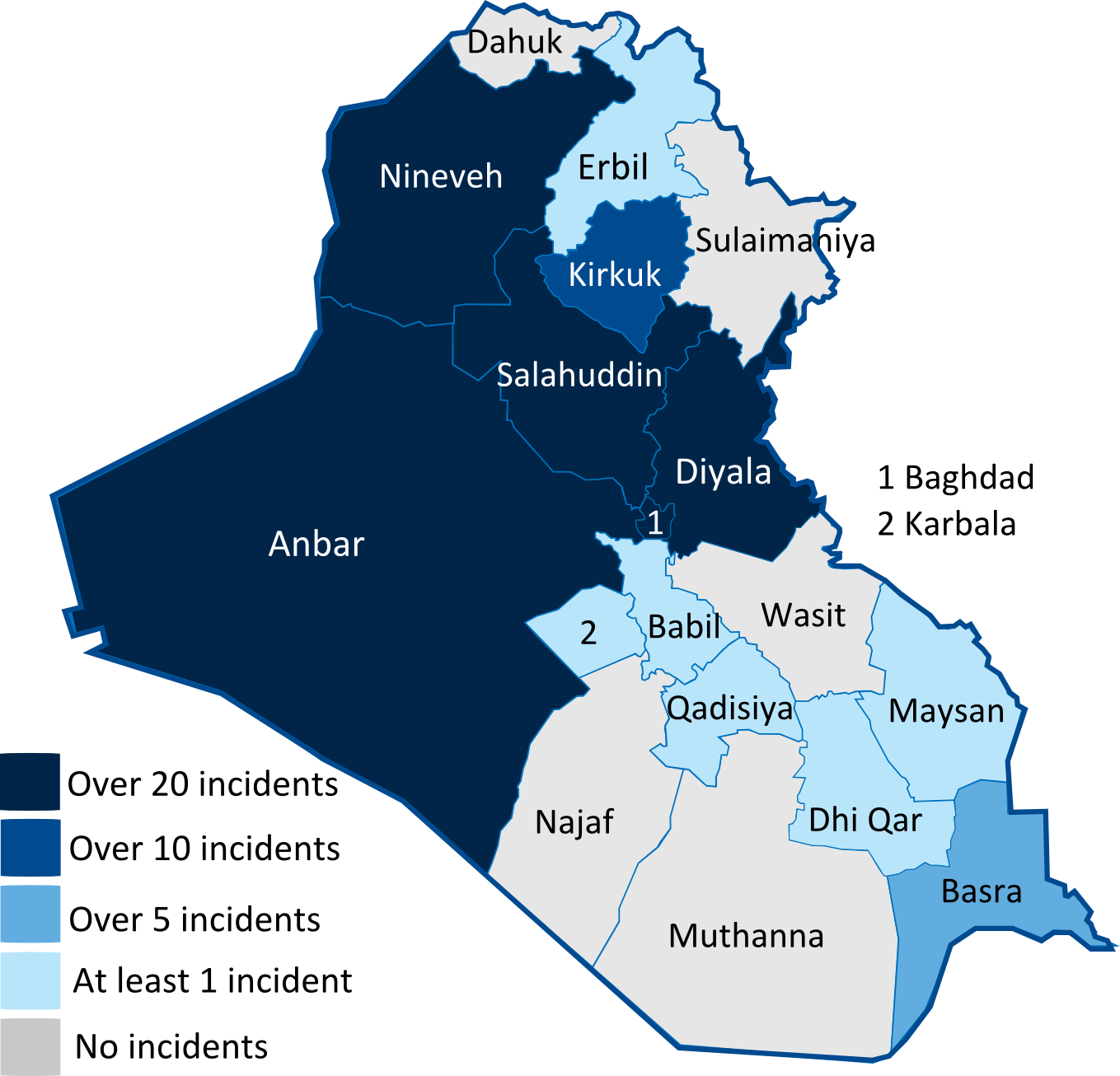
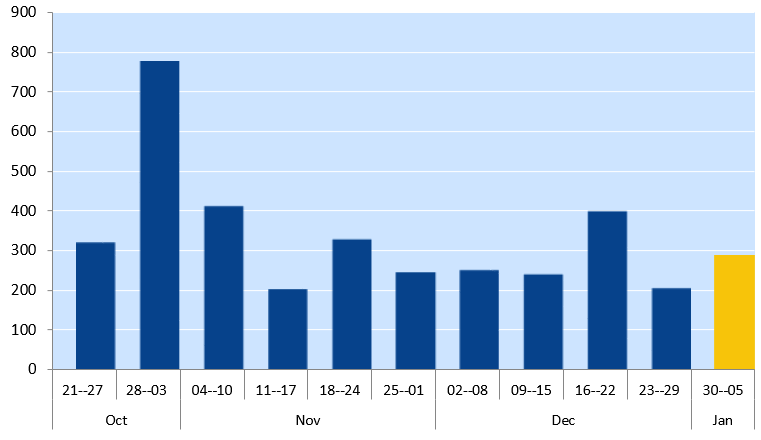
One year on from the start of the militant uprising in Anbar province, Iraq’s fractured regions remain on sharply different political trajectories. In the Sunni heartlands of Ramadi and Fallujah where an initial protest by local tribesmen forced the withdrawal of the Iraqi security forces in December 2014, ISIS units launched a major offensive against urban centres and ISF border posts this week, driving up nationwide fatalities even as the pace of attacks on northern battlefields slowed to a halt on many key fronts. Figures released by the Iraqi government estimating the death of at least 15,000 people in 2014 (an increase of 130% from the previous year), along with hundreds of thousands of refugees also occurred amid the confirmation of yet further growth of the Iraqi oil economy, with production now reaching levels unseen since the 1980s. Embodying these distinct trends has been the province of Kirkuk, which despite witnessing considerable security challenges and refugee influxes over recent months continues to operate a functioning oil economy, resuming international exports this week through the Turkish port of Ceyhan.
North
Peshmerga-led forces report limited gains in the Makhmour and Qayara areas south-east of Mosul, as the allied advance slows in the central plains. While ISIS units continue to fiercely resist all movement west from Peshmerga-held villages in the disputed territories, no major assaults were organized this week in the northern governorates, most likely in order to support the ongoing Anbar offensive. Instead, the majority of violence took the form of skirmishes and mortar fire on ISF-held frontline cities, including Samarra, Tikrit and Muqdadiya, where sporadic VBIEDs continue to be used regularly as means of undermining and delaying the allied push. While challenging to independently corroborate, a growing number of local reports have also suggested a depletion of manpower and support in ISIS-held areas of Hawijah, Sharqat and Mosul with hundreds of civilians reported to have been abducted over the past seven days as a targeted policy to cow the local population.
Central
ISIS forces press in on Ramadi and coalition training centres in line with a sustained assault on remaining ISF positions in south-central Anbar. At the time of writing, fierce battles are underway to gain control of the Andalus, Hoz and Mostaudah districts of downtown Ramadi, following an offensive launched over the past 24 hours. The energy of the current ISIS advances is likely to have been facilitated by the redirection supplies and heavy armour further south on 04 January, which has enabled the group’s ground forces to surround and besiege key ISF installations in the vicinity of Ramadi, including the Ain Al Assad air base where US military personnel are currently stationed. Control of the Iraqi-Jordanian, and Iraq-Saudi Arabian borders was also tested this week in a series of deadly VBIED complex attacks upon ISF and Saudi military posts. Such attacks have come at the expense of momentum in the northern battlefields of Hit and Haditha, a fact ISF units are expected to exploit over the coming days in renewed clearance operations against the Kubaisa sub-district.
South
Localised demonstrations in the Qurna area over the reporting period increase the prospect of an escalation in economic unrest against oil and gas facilities, amid unchanged security dynamics in neighbouring governorates. The largest of these disruptions occurred on 04 January when as many as 600 protestors erected tents and closed roads close to the Jabani bridge of north-eastern Basra, demanding jobs and work opportunities from IOCs in the area. News sources have indicated that Royal Dutch Shell, one of the main developers of the Majnoon field were specifically targeted by the demonstrators, due to alleged failure to uphold employment commitments, with protests only ending after local political representatives invited the group’s leaders to discuss job allocations the following day. While no further incidents have occurred, community relations are expected to remain tense in the Qurna area as details of the deal with local government are made public. Less than a year ago, hundreds of protestors blocked a main entrance to the West Qurna-2 oilfield in the area following an employment dispute with Russian IOC Lukoil.
Posted in Weekly Security Update 7 Comments

Iran, Iraq to Link Railroads
Posted on 05 January 2015 .
By Patrick Schmidt.
After a meeting between Iraqi and Iranian officials, an agreement has been reached to connect the two countries’ rail systems.
The project calls for Iraq to lay 32 kilometers of track to the city of Basra from the Iranian border.
Iranian officials claim that the link would allow Iraqis access to Central Asia and Russia via Iran.
The project would also make travel easier for Iranians who wish to visit holy shrines in Iraq.
(Sources: Zawya, NINA)
Posted in Construction & Engineering In Iraq, Iraq Transportation News 2 Comments

Iraq and Russia Maintain Oil Glut
Posted on 03 January 2015 .
By John Lee.
Iraq and Russia are leading the global surge in oil exports despite a highly competitive market. This has maintained low prices not seen since 2009, with a February settlement for Brent Crude at $56.42 a barrel.
Bloomberg reported record export data of 10.6 million barrels a day from Russia and 2.9 million bpd from Iraq, a rate not seen since 1980, the height of the post nationalisation oil industry under Saddam Hussein.
Slowing Chinese economic growth and a slowdown in European manufacturing, as well as Saudi geopolitical motivations have created an unprecedented oil market.
A strong dollar has also contributed to what analyst Walt Zimmerman described as a "double whammy" for prices.
This has forced oil dependent nations such as Iraq to urgently review their budgets for 2015.
(Source: Bloomberg)
Posted in Iraq Oil & Gas News 5 Comments

Abdul-Mahdi: Now the Real Work Begins
Posted on 10 December 2014 .
By Cengiz Çandar for Al-Monitor. Any opinions expressed are those of the author, and do not necessarily reflect the views of Iraq Business News.
Adel Abdul-Mahdi, Iraq’s former vice president and current oil minister in Haider al-Abadi's government, spotted me aboard a flight from Beirut to Istanbul. He was in a rush, on his way back to Baghdad after the Nov. 27 OPEC meeting in Vienna.
I met up with him Dec. 1 around midnight at his hotel in Istanbul, before his early flight to Baghdad. During our tour d’horizon, he hinted about the upcoming, fateful meeting he would be having with Iraqi Kurds waiting to see him in Baghdad to strike an oil deal.
I have known Abdul-Mahdi for a long time and can attest that there is no other Arab politician in Iraq closer to the Kurds than he is. The warm and close friendship he developed with Jalal Talabani, the former Kurdish president of Iraq, during his exile in Damascus when Saddam Hussein held power, makes him an indispensable Iraqi oil minister in Erbil's eyes.
“Massoud Barzani told me,” Abdul-Mahdi said, “if they cannot come to terms even with me, they probably never can with anybody else in Baghdad.”
Abdul-Mahdi has always had a strategic mind, accumulating tremendous knowledge and experience of the region since the 1960s. A Francophone and a fluent English speaker, he has been an intellectual heavyweight since the days I knew him in 1970s Beirut.
From what he told me, an oil deal between Baghdad and Erbil seemed close, but he remained cautious. A few hours later, he would be sitting down for tough negotiations with Kurdistan Regional Government (KRG) Prime Minister Nechirvan Barzani; Barzani deputy Qubad Talabani, son of the former Iraqi president; and the KRG’s very competent oil minister, Ashti Hawrami.
Posted in Iraq Oil & Gas News 3 Comments
'Ghost' Soldiers Haunt Iraqi Army
Posted on 19 November 2014 .
By Adnan Abu Zeed for Al-Monitor. Any opinions expressed are those of the author, and do not necessarily reflect the views of Iraq Business News.
The Iraqi army includes “ghost” soldiers, a purely Iraqi term used to describe members whose names are registered in the wages and salaries lists, but who are not actually present in the military ranks. Their wages go to leaders who cover for their absence.
There are ghost employees in state departments as well; they are absent in reality, but present in terms of official staff who enjoy salaries and privileges.
Al-Monitor was unable to interview officers who benefit from these ghost employees. Instead, it met with former lawmaker and leader in the Mutahidoun bloc, Mohammed Othman al-Khalidi, in Baghdad. He confirmed this phenomenon saying, “The ghost employees were one of the reasons behind the shocking collapse of the Iraqi army before the Islamic State (IS) in Mosul.
Mosul, the second biggest city in Iraq, fell into the hands of IS on July 10, after a sudden withdrawal of Iraqi troops.
Khalidi described these unreal soldiers as “ghosts in the army’s ranks, who get paid for staying home. This pushed the competent authorities to resort to armed militias to fill the gap within an army that failed to defend its country.”
The Iraqi army was established in 1921, and in 2003 the leader of the US occupational authority in Iraq, Paul Bremer, reformed it. Back then, the army included around 400,000 soldiers, but today, there are only 170,000.
According to statistics, whose source he did not mention, Khalidi estimated that 30% of the army members were “ghosts.”
Asked about measures taken to limit this phenomenon, he said, “We asked to restructure the armed forces, as part of the National Guard project,” adding, “The partisan designations by political parties and forces allowed the presence of numerous ghosts in all state facilities, and not only in the military institution.”
Posted in Security Comments Off on 'Ghost' Soldiers Haunt Iraqi Army

Rape, Slavery, Hunger Strikes -- Kidnapped Yazidi Women
Posted on 16 November 2014 .
This article was originally published by Niqash. Any opinions expressed are those of the author, and do not necessarily reflect the views of Iraq Business News.
Rape, Slavery, Hunger Strikes, Escape Attempts – Iraqi Doctors Tell Of Kidnapped Yazidi Women They Treat
[Picture: Yazidi (Yezidi) Temple in northern Iraq.]
Three months ago, the extremist group known as the Islamic State kidnapped hundreds of women from the Yazidi sect. Since then there have been many stories about what has happened to the women, including physical and sexual abuse, slavery and forced marriage.
NIQASH spoke to doctors who have treated some of those women and confirmed that the horror stories are true - and worse.
When the young girl first came to their village, the people living there knew nothing about her. In this village, mostly populated by Arabs, the locals just saw a young girl that kept crying. Every day she cried.
And for a long time nobody could figure out why. This was because the man who owned the house in which the 16-year-old girl was living was a member of the extremist group, the Islamic State, or IS, and he didn't want his neighbours to know what was going on.
However in small villages like this one it is hard to keep secrets. The women of the village began to whisper about the girl whose name is Layla. “Poor thing, she is a Yazidi,” they said.
A few weeks have passed since Layla was brought to the village to live in the house of the IS fighter and one of the IS group leaders comes to visit her regularly – she was forced to marry him and was also forced to convert to Islam.
Layla's story is not uncommon. The Yazidi women and girls who have been kidnapped by the IS group have been forced to either become the wives of the IS fighters and convert, or they are given as “sex slaves” to members to reward them for their service.
Posted in Healthcare, Security Comments Off on Rape, Slavery, Hunger Strikes -- Kidnapped Yazidi Women

Foreign Minister Receives Russian Ambassador
Posted on 10 November 2014 .
By John Lee.
Iraq’s foreign minister, Ibrahim al-Jaafari, received the Russian Ambassador to Iraq, Elia Morganov, on Sunday.
The two sides discussed issues of politics and security, including international efforts to support Iraq in its war against the Islamic State in Iraq and the Levant (ISIL).
(Source: MoFA)
Posted in Iraq Industry & Trade News, Security Comments Off on Foreign Minister Receives Russian Ambassador

Iraqi Weapons Trade Thrives
Posted on 03 November 2014 .
By Wassim Bassem for Al-Monitor. Any opinions expressed are those of the author, and do not necessarily reflect the views of Iraq Business News.
An Iraqi blogger wrote on the Facebook page "Buying and Selling Weapons in Iraq,” an account he also manages: “Needed anti-armor rocket propellers. Anti-personnel missiles available."
This Facebook page consists of countless posts that promote the sale and purchase of various types of arms in Iraq.
The weapons trade in Iraq is thriving and has become a public affair due to widespread "social militarization” and the escalating war against the Islamic State (IS), which is now occupying extensive territories in northern and western Iraq.
A trader in Babil, a city located 100 kilometers (62 miles) south of Baghdad, and its surrounding regions told Al-Monitor on condition of anonymity that the price of weapons has risen. “The price of a Kalashnikov rifle, which is the most sought-after in Iraq, varies between $350 and $900, depending on its buttstock. The price of a two-handed Czech- or Romanian-made rifle ranges between $600 and $1,000," he said.
Abdel Amir Hasan who owns a shop in Hillah, the capital of Babil governorate, told Al-Monitor, “Most traders, if not all, have at least one gun [for personal use], which has become indispensable at work, in the car and at home. Some people including doctors and workers find a gun insufficient and possess a machine gun as well.”
Iraqi society has seen an increase in fighting against IS in particular and arms possession among civilians is common, as they no longer fear buying weapons, even the mid-range ones. Sheikh Mazen al-Kallabi, who is one of the prominent tribal sheikhs in Babil governorate, said in an interview with Al-Monitor, “Inhabitants of rural areas and tribal members are usually better armed than citydwellers. [Tribal members] mostly carry single-handed or two-handed guns.”
Kallabi, who bought a gun for $900, added, “Most [tribal members] own dozens of PKC machine guns and the security authorities are well aware of that.”
Posted in Iraq Industry & Trade News, Security Comments Off on Iraqi Weapons Trade Thrives

Lukoil to Increase Output at West Qurna-2
Posted on 24 October 2014 .
By Patrick M Schmidt.
The Dubai-based division of the Russian oil company, Lukoil announced revise production figures for the West Qurna-2 fields.
The company began production in March 2014 with an output of approximately 120,000 barrels of oil per day. Current production levels are now at 300,000 barrels of oil per day.
It is expected output will reach 400,000 barrels of oil per day by next year.
West Qurna-2 has an estimated 13 billion barrels of oil in reserve and is located approximately forty miles from the city of Basra.
(Source: Gulf News)
Posted in Iraq Oil & Gas News Comments Off on Lukoil to Increase Output at West Qurna-2

Islamic State Fighter Jet Concerns
Posted on 20 October 2014 .
By Patrick M Schmidt.
Concerns are now mounting with Western defense agencies that the Islamic State (IS) has gained control of Syrian fighter jets. It is believed the captured at least three jets during their assault of the Syrian air force base, al-Jarrah.
The fighters may be receiving training from Iraqi pilots who have defected to the Islamic State. The jets would be an addition to the vast array of weaponry the Islamic State has seized following assaults on Iraqi and Syrian military installations.
Initial reports suggest the aircraft have been flown at low altitudes for only a few minutes at a time. It is also believed that the aircraft are Russian-made.
The United States military says it will continue to conduct strikes against the Islamic State and will investigate these claims as they currently have no information on the issue.
(Source: Reuters)
(Terrorism image via Shutterstock)
Posted in Security Comments Off on Islamic State Fighter Jet Concerns