


Why Two Exchange Rates?
Posted on 02 April 2014 .
By Mark DeWeaver.
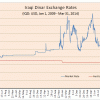
Since the Central Bank of Iraq (CBI) began changing the rules for its USD auctions in 2012, Iraq has been operating a de facto dual exchange rate system. (There’s a summary of some of the CBI’s recent rule changes on pages 12-14 of this report from Sansar Capital.) For those with access to the CBI auction—mainly banks and (as of March, 2013) importers using letters of credit—the rate has been fixed at IQD 1,166: USD 1.00. For the rest of us, the dinar has ranged from 1,194 to 1,292, with two major episodes of depreciation in mid-2012 and mid-2013 (see chart).
The ostensible purpose for this arrangement is to limit illicit outflows of foreign exchange to Iran and Syria. In practice, it serves mainly as a subsidy to banks, large importers, and anyone in a position to generate phony trade documents. The losers include everyone from foreign investors in Iraqi stocks to the government itself, which gets the CBI rate on its oil-export revenues.
Iraq is unusual in this regard. Dual (or even multiple) exchange rates are usually only found in countries suffering from chronic trade deficits and foreign exchange shortages. Typically the objective is to make foreign exchange available for “essential” imports or to control inflation by lowering import prices. Examples include Hitler’s Germany, China in the 1980’s and early ‘90’s, Burma prior to 2012, and Venezuela today. (See this note from the Asian Development Bank for an excellent introduction to this topic.)
It’s hard to see why Iraq belongs on this list. The country has a trade surplus, inflation is low, and the central bank has ample foreign exchange reserves. Even USD outflows to Iran are presumably no longer a major issue.
One exchange rate should be enough.
Posted in Investment, Mark DeWeaver on Investments and Finance 11 Comments
Turkish Energy Minister: We're Waiting to Export KRG Oil
Posted on 26 March 2014 .
By John Lee.
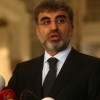
Turkish Energy Minister Taner Yildiz (pictured) has remarked at a press conference that the country is ready to export oil from storage tanks at Ceyhan, once they have reached their capacity of 2.5 million barrels.
Baghdad is currently opposed to such a move, and minister Yildiz has expressed a desire for the dispute to be ended, saying that the continuation of the quarrel is hurting the KRG, Turkey and Iraq. He said in a statement for NTV Television,
"We would like this to be offered to world markets on behalf of Iraq. Regardless of the volumes, Iraqis will auction and sell this oil at world market prices.This could be done via Tupras or brokers in other countries."
Last week KRG prime minister Nechirvan Barzani offered to export 100,000 bpd through the Iraqi State Oil Marketing Company (SOMO) as a gesture of goodwill to Baghdad, a move welcomed by Iraq's deputy prime minister for energy Hussein al-Shahristani. Difficult negotiations continue.
(Source: The Peninsula)
Posted in Iraq Oil & Gas News, Politics Comments Off on Turkish Energy Minister: We're Waiting to Export KRG Oil
Ooredoo hits out at Iraq Delays
Posted on 06 March 2014 .
By John Lee.
Qatari telecommunications operator Ooredoo, which owns the Iraqi mobile phone company Asiacell, has hit out at prices quoted by the Iraqi government for a long-delayed auction for 3G spectrum licences.
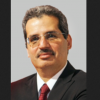
Company CEO Dr Nasser Marafih (pictured) told Arabian Business:
“The country needs it, the people need it. We are ready to deploy [it], but it has to be done at the right price. What they’ve put(the price) is not reasonable at all in our view ... That’s something that we’re discussing with the government.”
The awarding of licences for 3G has been delayed for several years, with recent reports suggesting that the process may be again postponed until 2015; it has also been reported that bidding for the licences will start at a minimum of more than $300 million.
In February last year, Asiacell raised $1.27 billion in a public float, while it holds more than a third of market share in the country.
(Source: Arabian Business)
Posted in Iraqi Communications News Comments Off on Ooredoo hits out at Iraq Delays
Iraq Stock Market Report
Posted on 25 February 2014 .
Advertising Feature
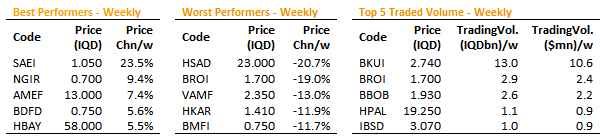
Rabee Securities Iraq Stock Exchange (ISX) market report (week ending: 20th February 2014).
Please click here to download a table of listed companies and their associated ticker codes.
The RSISX index ended the week at ID1,888 (-2.5%)/ $2,005 (-2.5%) (weekly change). The number of week traded shares was 11.2bn and the weekly trading volume was ID26.6bn ($21.8mn).
Company Announcements
- Kurdistan Bank (BKUI): B/S - FY13 (Assets: IQD1,077bn, -7% q/q (+4% y/y), Monetary Credit: IQD162bn, +35% q/q (+88% y/y), Deposits: IQD564bn, -16% q/q (-2% y/y), P&L (annual) - FY13 (Estimated NBI: IQD55.3bn, +7% y/y, Operating Profit: IQD41.3bn, +4% y/y, Profit Before Tax: IQD42.8bn, +7% y/y). P&L (Quarterly) - 4Q13 (Estimated NBI: IQD7.1bn, -74% q/q (+599% y/y), Operating Profit: IQD2.2bn, -91% q/q (vs IQD4.6bn Operating Loss in 4Q12), Profit Bef. Tax: IQD3.0bn, -88% q/q (vs. IQD5.2bn Loss Before Tax in 4Q12).
- Elaf Islamic Bank (BEFI): B/S - FY13 (Assets: IQD268bn, +1% q/q (-30 y/y), Monetary Credit: IQD62.4bn, +82% q/q (+33% y/y), Deposits: IQD67.2bn, +12 q/q (-45% y/y), P&L (annual) - FY13 (Estimated NBI: IQD17.1bn, -8% y/y, Operating Profit: IQD11.1bn, -14% y/y, Profit Before Tax: IQD9.3bn, -26% y/y). P&L (Quarterly) - 4Q13 (Estimated NBI: IQD6.0bn, +96% q/q (+12% y/y), Op. Profit: IQD3.1bn, +66% q/q (-1% y/y), Profit Bef. Tax: IQD3.0bn, +71% q/q (-6% y/y).
- According to the CBI letter published on Feb. 17, 2014, CBI will not ban any bank from FX auctions even if they didn’t reach IQD250bn paid-in capital, because all banks have showed a serious effort to increase their capital. This decision is excluding the banks that have been banned for other reasons. (Please note, CBI didn’t give a list of these banks in the letter. In addition, the target capital set by the CBI for private banks with a deadline of June-end 2013 was IQD250bn.)
- Iraqi for Seed Production (AISP) will hold its AGM* on Mar. 16, 2014 to discuss 2013 annual financial results, electing new board members, increasing its capital through 15% bonus issue, distributing 50% cash dividend (IQD0.50 price per share) and allocating 15% of the profit to cover the last year's deficit. ISX will suspend trading of AISP starting on Mar. 9, 2014.
- Original shares of Babylon Bank (BBAY) will resume trading on Feb. 23, 2014 after the decision to increase its capital from IQD150bn to IQD250bn through 3.18% bonus and 63.48% rights issues. The opening price will be IQD0.77 per share with +/- 50% limit for the first session.
- Original shares of Mosul Bank (BMFI) resumed trading on Feb. 20, 2014 after the decision to increase its capital from IQD202bn to IQD252.5bn through 25% bonus issue.
- AL- Batek For Financial Investments (VBAT) will hold its AGM* on Feb. 27, 2014 to discuss 2012 annual financial results, distributing cash dividend and electing new board members. ISX suspended trading of VBAT starting on Feb. 20. Please note, VBAT is trading in non-regular market.
- New shares of Credit Bank of Iraq (BROI) from the capital increase to IQD250bn through 13.3% bonus and 53.3% rights issues resumed trading on Feb. 19, 2014.
- Al-Mansour Bank (BMNS) will hold its AGM* on Feb. 25, 2014 to discuss 2013 annual financial results and distributing cash dividend. ISX suspended trading of BMNS starting on Feb. 18, 2014.
- Original shares of Economy Bank (BEFI) resumed trading on Feb. 18, 2013 after the decision to increase its capital from IQD150bn to IQD250bn through 53.3% rights and 13.3% bonus issues.
- A cross transaction occurred on IQD4.7bn Kurdistan International Bank (BKUI) shares on Feb. 17, 2014. This represents 1.6% of BKUI capital.
- Subscription on 100bn Iraqi Middle East Bank (BIME) shares started on Feb. 16, 2014 to increase the capital through rights issue.
Posted in Investment 5 Comments
Maliki Heralds Construction of Karbala Refinery
Posted on 24 February 2014 .
By John Lee.
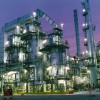
Prime Minister Nouri al-Maliki has spoken at a ceremony to mark the start of construction on Karbala's forthcoming 140,000 bpd refinery, Iraq Directory reports.
As part of Iraq's energy strategy to increase refining capacity to 750,000 bpd, the new $6 billion refinery will be constructed by a consortium led by Hyundai Engineering and involving the Refinery of Karbala Corporation over a period of four years. When complete it will produce a range oil and gas based products, including asphalt.
Iraq is planning 3 other major refineries, including the Nasiriyah Integrated Project, a 300,000 bpd refinery, the auction for which takes place on June 19th.
(Source: Iraq Directory)
Posted in Iraq Oil & Gas News 5 Comments
3G Licences "at Least $307m Each"
Posted on 09 February 2014 .
By John Lee.
Ahmed Alomary, a former commissioner at the Communications and Media Commission (CMC), told Reuters that Iraq plans to auction third-generation (3G) telecommunications licences for a minimum of $307 million each.
Current 2G services are supplied by Zain Iraq (a unit of Kuwait's Zain), Asiacell (a subsidiary of Ooredoo) and Orange affiliate Korek, who each paid $1.25 billion for their licences in 2007. Revenue growth in the sector has stagnated in recent years, largely because the government delayed permission for the three national operators to launch 3G services.
An open auction could potentially allow new entrants into Iraq's telecommunications sector, although the prospect of building out a network from scratch in crisis-torn Iraq may limit interest, and the process could slow the introduction of 3G services.
The government source said no time frame had been set for the auction, adding "I doubt it will happen this year."
Iraq's fixed-line network is limited; the country had 300,000 fixed-line broadband subscribers and 1.9 million landlines in 2013, according to Sydney-based telecommunications consultancy BuddeComm.
(Source: Reuters)
Posted in Iraqi Communications News 5 Comments
Nassiriya Oil Project Auction Postponed
Posted on 14 January 2014 .
By John Lee.
Iraq's oil ministry has again delayed an international tender for the development of its Nasiriya oil field and the construction of a new refinery, according to a report from Reuters.
The auction for the Nassiriya Integrated Project will now take place on 19th June, have been originally scheduled for December, and then 23rd January.
Oil ministry spokesman Asim Jihad said:
"We have decided to push back the bidding process in order to make some necessary changes to the model contract and also to give companies more time to consider the new amended contract."
The project involves the development of the 4-billion-barrel Nassiriya oilfield, and the building of a 300,000 bpd refinery.
(Source: Reuters)
Posted in Iraq Oil & Gas News 5 Comments
Iraq Stock Market Report
Posted on 23 November 2013 .
Advertising Feature
Rabee Securities Iraq Stock Exchange (ISX) market report (week ending: 21st November 2013).
Please click here to download a table of listed companies and their associated ticker codes.
The RSISX index ended the week at ID1,751 (-0.7%)/ $1,866 (-0.9%) (weekly change). The number of week traded shares was 4.8bn and the weekly trading volume was ID9.8bn ($7.4mn).

ISX Company Announcements
- Central Bank of Iraq (CBI) published a letter on its website on the weekend (dated November 1, 2013) directed to the Iraqi Islamic Bank (BIIB) stating that CBI has decided to give Iraqi Islamic Bank a new deadline to reach the IQD250bn paid-in capital, which is the target capital set by the CBI for all private banks with a deadline of June-end, 2013. The new deadline has been set on January 31, 2014 for BIIB. As of today, just five out of 21 listed banks (Kurdistan Bank, United Bank, North Bank, Gulf Commercial Bank and Mansour Bank) have completed increasing capital to IQD250bn or more, so, based on CBI’s decision for BIIB, we believe that CBI may extend the deadline for all private banks that haven’t reached the target capital yet. Please note, on Oct 23rd, 2013, CBI announced that CBI’s Board decided in its meeting, held on Oct 5th, 2013, to prohibit all private banks, which have not reached the IQD250bn paid-in capital, from entering the Dollar Auctions (includes selling cash, opening LCs, and Money Transfer), however, one day after that announcement, on Oct. 24th, CBI cancelled its decision to prohibit private banks from the Dollar Auctions for an unspecified period of time.
- CBI has published a letter, dated on Nov 17, 2013, directed to Commercial Bank of Iraq (BCOI) and Iraqi Middle East Inv. Bank (BIME) noting that these banks have been banned from CBI’s dollar auction due to failure in taking serious steps to increase their capital.
- Central Bank has announced the following new dollar prices effective from Dec 1, 2013: LCs: IQD1172 for every $1, Selling in cash: IQD1177 for every $1, Selling for money wiring purposes: IQD1179 for every $1.
- AL- Kindi of Veterinary Vac. (IKLV) will hold its AGM* on Dec. 10, 2013 to discuss 2012 financial annual report and increase its capital from IQD4.5bn to IQD5.4bn through bonus and rights issues.
- Mansour Hotel (HMAN) will hold its AGM* on Dec. 7, 2013 to discuss 2012 financial annual report.
- Iraqi Engineering Works (IIEW) will hold its AGM* on Dec. 1, 2013 to discuss 2012 annual financial results. ISX will suspend trading of IIEW starting on Nov. 24, 2013.
- A cross transaction occurred on IQD32mn Babylon Hotel (HBAY) shares on Nov. 18, 2013. This represents 2.4% of HBAY capital.
- National Bank of Iraq (BNOI) will hold its AGM* on Nov. 23, 2013 to discuss increasing its capital from IQD152bn to IQD250bn through 64.5% rights issue. ISX suspended trading of BNOI starting on Nov. 17, 2013.
- Iraqi Date Processing&Mark. (IIDP) will hold its AGM* on Nov. 24, to discuss year end (Aug 31, 2012) results and cash dividend. ISX suspended trading of IIDP starting on Nov. 17.
Posted in Construction & Engineering In Iraq 4 Comments
Dinar Exchange Rate Linked to Oil Exports, Federal Reserves
Posted on 28 August 2013 .
By Omar al-Shaher for Al-Monitor. Any opinions expressed are those of the author, and do not necessarily reflect the views of Iraq Business News.
According to an Iraqi financial expert, the value of Iraq’s federal reserves currently amounts to about $80 billion, following the recent increase in the country’s oil exports. Nevertheless, no information was made available by the Central Bank of Iraq (CBI) to this effect.
Speaking to Al-Monitor, Iraqi financial expert Hussein al-Asadi said, “According to my information, the value of Iraq’s federal reserves currently amounts to about $80 billion. This includes funds, precious metals and other items.”
Nevertheless, the spokesman for the CBI, which is charged with managing the federal reserves of Iraq, has yet to issue a statement in this regard. Meanwhile, Al-Monitor’s correspondent in Baghdad failed to obtain comment from the bank’s governor, Abdul Basit Turki, to this effect, or determine the identity of those authorized to speak to the media. The bank has only issued statements to comment on the developments of its work.
The last comment made by the CBI regarding the country’s federal reserves dates back to Jan. 31, 2012, when the bank denied the “decline of gold reserves.” The CBI stated, “They have been stable throughout the past months and amount to 29,730 tons.”
Asadi added, “The US dollar is the main currency in the Iraqi reserves. There are also some reserves in other currencies, in addition to gold. ... Due to the troubled military and political conditions of the country, Iraq’s reserves cannot be invested to a large extent, as is the case in China or the United Arab Emirates, for instance.”
“Iraq is distributing its reserves to a number of banks just to protect [these funds], although it does generate some interest on the deposits,” Asadi added.
Posted in Iraq Banking & Finance News 22 Comments
More Firms Pre-Approved for Nassiriya Bid
Posted on 19 August 2013 .
By John Lee.
Iraq has selected five additional international oil companies to bid for the development of its $4.4-billion Nassiriya oil field and the construction of a new 300,000 bpd refinery, reports Reuters.
The companies added to the list are:
- France's Maurel et Prom;
- Russia's Rosneft;
- Essar UAE India;
- South Korea's GS Engineering & Construction Corp.; and,
- India's ONGC Bangalore.
The 45 firms already qualified from previous bidding rounds are eligible to bid, as are the seven companies shortlisted in March.
An auction for the contract is to be held on 19th December.
(Source: Reuters)
Posted in Construction & Engineering In Iraq, Iraq Oil & Gas News 3 Comments