



CBI US Dollar Sales Increase After Monday's Auction
Posted on 07 August 2013 .
On Monday, the Central Bank of Iraq announced the increase of its US Dollar sales during Monday's auction after reaching $16278000 last Sunday.
"The total US Dollars sold by the bank amounted to $288639000 at price of 1166 IQD per US dollar during the auction, which included the participation of twenty-four banks," CBI reported in a statement to AIN.
"The price of the dollar sale and the remittances at the auction reached 1179 IQD against the US dollar. That included the commission of the CBI, which was up to 13 IQD per US dollar, while the US dollar buying sale reached 1171 IQD."
According to AIN, the CBI will continue buying and selling the US Dollar at the price of 1166 IQD within the same adopted commission.
(Source: All Iraq News)
Posted in Investment, Iraq Banking & Finance News Comments Off on CBI US Dollar Sales Increase After Monday's Auction
Officials Divided Over Dinar 'Reset'
Posted on 22 July 2013 .
By Omar al-Shaher for Al-Monitor. Any opinions expressed are those of the author, and do not necessarily reflect the views of Iraq Business News.
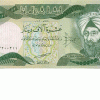
Two Iraqi parliamentary committees monitoring fiscal policy in Iraq have held two contradictory positions on the Iraqi currency “reset” project, which would delete three zeros from the currency. There has been much debate about the project's feasibility and the date of its implementation.
While the parliamentary Economic Committee believes that the deletion of three zeros from the Iraqi currency would strengthen it, the parliamentary Finance Committee fears that this project would open the door to counterfeit operations.
In a statement to Al-Monitor, Mudher Mohammad Saleh, former deputy governor of the Central Bank of Iraq, warned against the consequences of such a step if it is not implemented at the appropriate time.
Abdul Abbas Shayya, a member of the Economic Committee in the Iraqi parliament, told Al-Monitor, “Reforming the management of the Iraqi currency now requires the deletion of three zeros. This has been endorsed by the parliamentary Economy and Investment Committee."
Shayya, an MP for the State of Law Coalition led by Prime Minister Nouri al-Maliki, added that the Economic Committee "asked the government and the Central Bank to quickly replace the current Iraqi currency with another that is less [in value] by three zeros."
"The Iraqi currency is weak, and the money supply has amounted to multi-trillions because of the existence of these useless zeros," he said. "The country will witness a significant increase in oil revenues, financial earnings and high budgets. Thus, we need to print new banknotes, as estimated by the Central Bank."
Posted in Iraq Banking & Finance News, Security 89 Comments
Dinar Boosted by Iranian Election
Posted on 27 June 2013 .
By Mark DeWeaver.
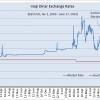
Since the beginning of 2012 the Iraqi dinar has been on something of a roller coaster ride. Changes in central bank policy combined with strong dollar demand from Iran and Syria have twice pushed the market rate above 1280. Both times, subsequent increases in dollar sales at the central bank’s currency auctions then steered the rate back toward 1200. (See chart. Data is from the Central Bank of Iraq website.)
In the most recent iteration of this cycle, the dinar appears to have gotten a boost from the Iranian election held on June 14. Hopes for an easing of US sanctions following the victory of moderate candidate Hassan Rouhani seem to have led to a significant drop in Iranian dollar demand both at home and abroad. The Iranian rial is reportedly up 20.7% post-election, rising from 36,200 to the dollar to 30,000. Iranians are now said to be selling down hoards of US dollar cash, the total value of which the Central Bank of Iran puts at USD 18 billion.
The effect on the dinar has been less dramatic but is still easy to see on the chart. The Iraqi currency rose 1.0% from June 13 to June 15 and was up 2.9% (to 1215) as of June 27.
How long this trend can continue remains to be seen, however. President Obama earlier this month signed an executive order that will take effect July 1 and is intended to increase the pressure on the rial.
Posted in Investment, Mark DeWeaver on Investments and Finance 16 Comments

Clyde & Co Launches Middle East Deal Study
Posted on 06 June 2013 .
Clyde & Co launched its inaugural Middle East Deal Study at an exclusive event hosted at the Ritz Carlton recently.
The study, the first of its kind in the region, analyses data from 86 of the Mergers and Acquisitions (M&A) and Joint Venture (JV) transactions the firm worked on in the region during 2012.
The study establishes a baseline for 'market practice’ in the Middle East, providing a unique insight into doing business in the Middle East, identifying trends and providing statistics. Interestingly, Joint Ventures remained as attractive as M&As in providing a route to market.
In fact, JV transactions occurred as frequently as M&A transactions which can be explained by the regulatory environment in the Middle East, where local partners and market knowledge is often required.
Overall, analysis of the deal study highlights an increase in market confidence, a rise in the use of the auction sale processes and an enthusiasm from new entrants trying to gain a foothold in the region. These elements have transformed the Middle East into a seller friendly market, with entrepreneurial businesses attracting international investors looking to access the Middle East market.
With possible reductions to the ‘barriers of entry’ in doing business in the Middle East market, brought about by either the new investment law which may increase foreign ownership limits or the eagerly awaited announcement by MSCI to upgrade the UAE and Qatar to emerging markets, has the potential to make the region even more attractive to international companies and investors.
This could have a positive impact on the regions deal market, invigorating the private sector to follow the upward investment trend seen through public sector spending in critical areas of the economy.
The study highlights that sellers and buyers should expect split signing and completion when doing an M&A deal. 31%of M&A deals took between three and six months to complete, bringing up a host of related issues such as walk away rights and management of the target during this period.
The study also found a clear tendency towards the use of English law, with M&A deals split between courts and arbitration (41% and 59% respectively) whilst arbitration remained the preferred forum for joint ventures (93%).
Philip O'Riordan (pictured), partner in Clyde & Co’s MENA corporate group, said:
"Globally, we see the importance of the public sector in stimulating growth and providing employment.
"The findings of the study show that regionally there is the emergence of a vibrant private sector, which we expect to grow on the back of increased public investment in critical areas of the economy such as energy, infrastructure and construction.
"We believe the deal study provides valuable information for any company planning and implementing a transaction in the region."
To request a copy of the deal study please email [email protected].
(Source: Clyde & Co)
Posted in Construction & Engineering In Iraq 1 Comment

Former Vice President Slams Iraq's Economic Policy
Posted on 23 May 2013 .
By Omar al-Shaher for Al-Monitor. Any opinions expressed are those of the author, and do not necessarily reflect the views of Iraq Business News.
Adil Abdul-Mahdi, the former Iraqi vice president who resigned from his post, vehemently criticized Iraq’s economic policy, describing it as a failure. Abdul-Mahdi warned that tampering with the balances of nature of the economy could lead to “tsunamis, desertification and misinterpreted fluctuations.”
Abdul-Mahdi is one of the most prominent figures of the Islamic Supreme Council headed by Ammar al-Hakim. He assumed the post of minister of economy during the mandate of former Iraqi Prime Minister Ayad Allawi, and was later appointed vice president before presenting his resignation due to political conflicts.
On his personal Facebook page, Abdul-Mahdi wrote about the dramatic fluctuation in the exchange rate of the Iraqi dinar against the US dollar since the beginning of April. “The high demand for the US dollar that we have seen for months has been widening the gap between supply and demand, at about $60 million-$70 million per day. A black market has emerged, in addition to two different exchange rates with a difference of 8%-10%.”
Since the beginning of April 2013, the exchange rate of the Iraqi dinar has entered a phase of decline against the US dollar, which hit its nadir last week when the dinar dropped from 1,200 per US dollar — the exchange rate registered in March — to 1,300 per US dollar.
Yet, the value of the dinar improved this week following news about a proposal presented by the parliamentary Financial Commission, which stipulates disbursing half of all state employees’ salaries in dollars.
Posted in Iraq Banking & Finance News, Iraq Industry & Trade News, Politics Comments Off on Former Vice President Slams Iraq's Economic Policy
Baghdad Struggles to Halt Devaluation of Iraqi Dinar
Posted on 21 May 2013 .
By Omar al-Shaher for Al-Monitor. Any opinions expressed are those of the author, and do not necessarily reflect the views of Iraq Business News.
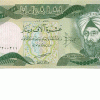
Over the last few days, the government in Baghdad has been preoccupied with attempting to control the exchange rate of the Iraqi dinar against the US dollar. The rate has been dropping since April, reaching its lowest at the beginning of this week.
During the preceding week on the local market, the dinar dropped against the dollar from 1,200 to 1,300, widening the gap against the official exchange rate by 121 dinars.
The Central Bank of Iraq (CBI) sells one dollar for every 1,179 dinars to authorized banks, which then sell it for 1,189 dinars to citizens traveling for medical treatment. Otherwise, traders and others looking to buy dollars must enter a public auction for hard currency sales managed by the CBI. This is one of a series of measures overseen by the Interior Ministry.
The CBI, the country's monetary policy authority, recently held a series of meetings with members of the country's Parliamentary Presidential Board — which consists of Speaker Osama al-Nujaifi, First Deputy Speaker Qusai al-Suhail and Second Deputy Speaker Aref Tayfur — to explain how to deal with the decline in the local exchange rate.
In a statement issued on May 12 and obtained by Al-Monitor, the Iraqi legislature announced that the parliamentary presidential board had met that day with Abdul Basit Turki, governor of the CBI by proxy and head of the Supreme Audit Board. It also proclaimed:
“The Parliamentary Presidential Board expressed its full support for the CBI scrutinizing the private banks’ activity, archiving information and taking reform measures, which include controlling the exchange rate of the dollar, reducing money laundering and strengthening the CBI’s capacity in economic development.”
Posted in Iraq Banking & Finance News 4 Comments

Why I Still Like North Bank
Posted on 17 May 2013 .
By Mark DeWeaver.
I thought Sansar Capital’s recent report on the Iraqi banks was excellent. But I was surprised by its somewhat negative take on North Bank (BNOR). In particular, I found myself not entirely convinced by the following three points, which form the basis for their bearish case:
- Insufficient collateral for overdraft lending is a significant risk. Actually, this is only true if the bank has no ability to assess the cashflow situation of its customers. This is unlikely to be true of BNOR’s corporate overdraft clients, which include large cash-rich companies such as Asiacell.
- The new Central Bank of Iraq (CBI) auction rules threaten the growth of BNOR’s forex business. This will only be true if the bank’s customers are unable to find a way around the rules. But in fact they have in the past displayed considerable ingenuity in adapting to the CBI’s ever-changing forex policies. It’s not clear why this time should be different.
- The absence of auditors’ qualifications in the English translation of the 2011 annual report implies an effort to mislead foreign investors. Maybe. But in the bank’s favor, it’s worth pointing out that (1) these qualifications did not appear in the Arabic version of the 2012 annual report, (2) unlike most of the other banks, BNOR has at least gone to the trouble of having its annual report translated, and (3) when meeting with the bank’s management in person I have always found them to be extraordinarily candid.
In addition to this, the bank is one of Iraq’s best capitalized, being one of only three to have reached the CBI’s IQD 250 bn share capital target. It has also been one of the top performing names in the Iraqi market. Adjusted for capital increases, the shares have risen by over 250% since 2009.
What’s not to like?
Posted in Investment, Iraq Banking & Finance News, Mark DeWeaver on Investments and Finance 2 Comments
Currency Auctions by CBI Called Into Question
Posted on 23 April 2013 .
By Omar al-Shaher for Al-Monitor. Any opinions expressed are those of the author, and do not necessarily reflect the views of Iraq Business News.
According to experts, the hard-currency auction governed by the Central Bank of Iraq (CBI) — the authority in charge of implementing monetary policy in the country — has ushered in the formation of financial groups, in which board members of Iraqi private banks are investing.
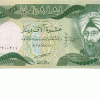
Every day since 2004, the CBI has held an auction through which hard currency is sold to banks, companies and traders in exchange for evidence of import and transaction receipts. The auctions aim to prevent market speculation and stabilize the exchange rate of Iraqi dinars to the US dollar. The CBI — which does not deal with individuals — sells $1 for 1,118 Iraqi dinars.
The exchange rate has been fluctuating following an arrest warrant issued against the former governor of the CBI, Sinan al-Shabibi, at the end of last year. During his term, Shabibi tightened the auctions as information leaked about smuggling money from Iraq to Iran to meet the latter’s needs for hard currency amid international sanctions.
As a way of dealing with the accusations, the CBI prohibited any bank or company with capital of less than $400,000 from taking part in the currency auction. Additionally, all participants had to submit their participations to the criminal division in the Ministry of Interior, the economic crime unit and the money-laundering division of the CBI for approval.
Posted in Iraq Banking & Finance News 12 Comments

Iraq to Auction Giant Nassiriya Oil Field
Posted on 09 April 2013 .
By John Lee.
Rigzone reports that the Iraqi oil ministry is planning to auction the giant 'Nasiriya Integrated Project' -- which involves the development of a $4.4-billion oil field and the building of a 300,000 bpd refinery in southern Iraq -- on 19th December.
At a workshop in Amman, Jordan, for international companies interested in the billion-dollar project, Abdul Mahdy al-Ameedi, head of the Petroleum Contracts and Licensing Directorate (PCLD) said a total of 52 international oil companies would be able to take part in the bidding round; those are the 45 firms already qualified from previous bidding rounds, plus the seven companies shortlisted last month.
Ameedi added that the ministry is also processing documents from a further five companies: Daelim; Essar; GS E&C; Pak-Arab Refining; and Maurel et Prom.
Mr. Ameedi briefed the companies on a preliminary draft contract prepared by the PCLD. According to the draft, terms will be different from the technical service contract awarded to companies during previous bidding rounds for oil and gas fields. The changes include amendments to investor costs and a pay-per-barrel remuneration fee.
Unlike the previous contract, the new one will offer investors a share in project revenues, but only when production begins. The ministry will pay recovery costs from the date of commencement of work, which differs from the previous contract where the costs were only paid when the contractor raised production by 10%.
According to Rigzone, investors would have to pay some 35% taxes on the profit they made from Nassiriya project, the same amount as in previous deals.
Oil firms have complained that the terms of ministry's previous contracts were tough and fell short of their expectations. They prefer production sharing contracts rather than the technical service deals that Baghdad previously signed with many of them.
Mr. Ameedi said Total was allowed to invest in the Nassiriya refinery but it wouldn't be allowed to work in the field unless it cancels its projects in Kurdistan. If Total and its partners win the Nassiriya project, it will be allowed to operate the refinery but not the field, he added.
Iraq's three aging refineries, Baiji [Beiji, Bayji], Doura [Daura] and Basra, are producing 560,000 bpd, or 70 percent of capacity, which is enough to meet 60- to 70 percent of Iraq's total needs.
(Source: Rigzone)
Posted in Construction & Engineering In Iraq, Iraq Oil & Gas News 2 Comments
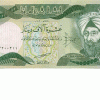
Iran's Role In Iraqi Dinar Devaluation
Posted on 20 March 2013 .
By Omar al-Shaher for Al-Monitor. Any opinions expressed are those of the author, and do not necessarily reflect the views of Iraq Business News.
There were conflicting accounts of the reasons for the rise in the value of the US dollar against the Iraqi dinar earlier this month. Politicians and economists have said that Iranian companies boosted the value of the dollar against the dinar by entering the Central Bank of Iraq’s (CBI) auction for hard-currency sales and buying large quantities in order to smuggle them into Iran. On the other hand, a former senior official at the CBI said the rise is linked to increased government revenue from oil sales, leading to an increase in government spending.
The weekly bulletin released by the CBI says 1,260 Iraqi dinars are now trading to the dollar, a level not been reached since last year.
A member of the Iraqi parliamentary finance committee said the value of the dollar increased against the dinar because some Iraqi banks have stopped converting dinars to dollars and have sold dollars to exchange companies at prices favorable to the banks.
Hussein al-Yasiri said some banks have stopped selling dollars to regular customers and instead have been selling them to exchange companies. This has prompted Iraqis to buy dollars from the exchange companies at prices favorable to the companies. The exchanges are not subject to government monitoring.
Ahmed al-Alwani, head of the Iraqi parliament’s economic committee, said Iran’s need for hard currency as a result of international sanctions has prompted Iran to mobilize Iraqi partners to help the country get dollars through the CBI auction.
Posted in Iraq Banking & Finance News 5 Comments