


Parsons Wins SOC Seawater Supply Project
Posted on 06 February 2015 .
By John Lee.
Parsons has announced that it was recently awarded the front-end engineering design (FEED) for South Oil Company’s Common Seawater Supply Project in southern Iraq.
This landmark project will provide 12.5 million barrels of water per day (bwpd) of treated seawater to oilfields in southern Iraq.
Parsons’ scope of work includes conducting 14 optimization studies and preparing the FEED for water intake and outfall structures, an approximate 500‑meter shipping channel and offloading facility, a 12.5‑million‑bwpd seawater treatment facility, and a gas turbine power plant.
Other support structures included in the FEED are living accommodations; administration buildings; potable water and sewage treatment systems; security, clinic, maintenance, and warehouse facilities; an emergency station; a mosque; and a helipad. Parsons will also design, construct, and operate a 9,200‑bwpd pilot plant at the site.
“Parsons is pleased to be engaged in the design of this facility, which is one of the largest facilities of its kind worldwide. Providing treated seawater to southern Iraqi oilfields will ensure proper oil reservoir maintenance and maximize oil recovery,” said Virginia Grebbien, Parsons Group President.
(Source: Parsons)
Posted in Construction & Engineering In Iraq, Iraq Oil & Gas News 6 Comments
IOCs seek Independent Water Facilities
Posted on 05 November 2014 .
By John Lee.
International oil companies (IOCs) in southern Iraq are seeking to push ahead with their own water injection facilities to meet production targets, according to a report from Platts.
Malaysia's Petronas, operator of the Gharraf [Garraf] oil field, is the latest to ask the Ministry of Oil for permission to build a standalone facility, as the new multi-billion dollar Common Seawater Supply Facility (CSSF) project remains stuck in the conceptual design phase.
The $5 billion first phase of the CSSF, which will provide 4 million bpd of treated water for the management of reservoir pressure, is not expected before the end of 2018 at the earliest, assuming the two contracts for design work are signed immediately.
Platts reports that project management consultants CH2M Hill had been hoping to award the front-end engineering and design (FEED) in the second quarter of 2013 and start the project in the third quarter of 2017, but the company is still waiting for details from the oil ministry, and its subsidiaries South Oil Company (SOC) and State Company for Oil Projects (SCOP), specifying the amounts of water required for each field and the time schedules.
This has been held up by delays to final agreements with the oil companies on their revised plateau targets. For the largest fields -- West Qurna-1 and Rumaila -- new deals were only reached in September, while negotiations are still going on with Shell for the Majnoon oil field.
Complicating matters further is the fact that only two firms are in the running for each of the main FEED contracts -- the US' Parsons for the water treatment plant and Austria's ILF Consulting Engineers for the pipeline contract.
The total cost of the various water schemes is put at more than $10 billion (12 trillion Iraqi dinars).
(Source: Platts)
Posted in Iraq Oil & Gas News Comments Off on IOCs seek Independent Water Facilities

Iraq Energy Sector: Reality & Expectations
Posted on 22 September 2014 .
Iraq Energy Sector: Reality & Expectations
by Ahmed Mousa Jiyad,
Iraq/ Development Consultancy and Research,
Phone: (+47) 5659 5699 Email: [email protected]
I was the guest speaker kindly invited by Brussels Energy Club (BrEC) for this season’s event that took place in Brussels on 11 September 2014.
The event was limited to BrEC members and personal invitations; attended by senior and representatives from the European Commission, Energy Charter Secretariat; international oil companies; consulting firms; the European Geopolitical Forum; European Federation of Energy Traders; Central Europe Energy Partners; East West Institute; Petroleum Policy Intelligence; Interfax among others.
The following is the abstract of my presentation.
The PowerPoint presentation was structured in two parts: the first part addresses the development in petroleum (oil and gas) by highlighting the main planed/ expectations in comparison with what has been achieved so far in the most up-to-date information, data and assessment of the performance reality.
This first part analyses the development in the following sub-sectors by identifying the main successes and failures and explaining the circumstances and factors that had contributed to such outcomes.
- Exploration efforts to augment proven reserves;
- Field development and production capacities for both oil and gas (associated and free);
- Refining and downstream, specifically refineries and associated gas utilization;
- Export outlets, capacities and market configuration;
This part provides also a brief review pertaining to foreign direct investment–FDI opportunities and governing legal frameworks in each of the aforementioned sub-sectors based on the existing legal instruments and contractual modalities.
The second part of the presentation focuses on the political and the geopolitical current issues and considerations in addition to logistical, infrastructural and human resource challenges that have and will continue to have very serious implication on the prospects of the country in general and the petroleum sector in particular, especially in short and medium terms.
This part covers two sets of challenges: existential threats and sector specific structural and operational challenges. The existential threats cover the interaction of the following pressing issues.
- The direct implications and consequences of IS/ISIS (known in Arabic as Da’ish) presence and their serious threats;
- The Federal Government and KRG acrimonious relationship and KRG political attitude in three distinct short phases: post 9/10 June 2014; Post Sinjar Mountain (first week of August 2014) and finally the commencement of “foreign military involvement and airstrikes”;
- The formation of the new government; oil portfolio; and the membership composition of the Energy (oil and gas) Committee in the Parliament.
The sector specific structural and operational challenges highlight the impacts of water injections requirements through the common seawater supply project-CSSP and other possible alternatives/ third river; tank farms and storage facilities at the Fao; and human resource limitations and identified skill, knowledge and capacity gaps.
The presentation ends by addressing the importance of international cooperation on energy matters on the bilateral levels and emphasizing, in this respect, the importance of timely execution of the EU- Iraq Energy Centre-EUIEC, which is currently in the final phase of the bidding process by the European Commission and scheduled to start on first December this year.
The discussion was rich, professional and very interesting during the presentation and afterwards; the event lasted for three hours and concluded with networking cocktail.
It was very fortunate that this BrEC event was convened a day after another important event took place, which I was cordially invited, through BrEC, and privileged to attend. “Gasunie” organized the “Shifting Powers: Energizing Europe Towards 2050” event on the 10 September at the Embassy of the Netherlands in Brussels. The topic was covered by the main speaker Dr. Patrick Dixon, Chairman of Global Change Ltd, followed by interactive debate by four senior panelists representing the European Commission, the EU Presidency, Government of the Netherlands and the CEO of Gasunie; and many interventions and questions from the audience.
The PowerPoint slides are posted on this IBN website and accessible by clicking on the following link:
Please click here to download Ahmed Mousa Jiyad's full presentation.
Date of submission: 22 September 2014
Posted in Ahmed Mousa Jiyad, Iraq Oil & Gas News Comments Off on Iraq Energy Sector: Reality & Expectations
Will CH2M Hill Replace Exxon in Water-Injection Project?
Posted on 13 October 2012 .
By John Lee.
According to press reports, Iraq's South Oil Company (SOC) has awarded CH2M Hill a $170 million consultancy contract for the water injection project in the country's southern oil fields, replacing ExxonMobil.
Al Bawaba quotes SOC Director General, Dhia Jaafar, as saying:
"The South Oil Company has selected CH2M Hill to offer consultancy for the management of the seawater injection project ... The South Oil Company will be the leader of the project. We will send the contract to the oil ministry to approve it."
Bloomberg reports that the head of the process department at the State Company for Oil Projects (SCOP), Zahra al-Hammadi, said talks with Exxon didn’t lead to an agreement.
But when contacted by Iraq Business News on Friday evening, a spokesman for CH2M Hill said the company was still in discussions.
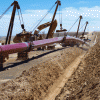
(Picture: CH2M Oil Pipeline operations in US)
Posted in Iraq Oil & Gas News Comments Off on Will CH2M Hill Replace Exxon in Water-Injection Project?
Iraqi Oil: Resource Curse or Glorious Blessing?
Posted on 31 August 2012 .
Our Expert Blogger Ahmed Mousa Jiyad talks to Robert Tollast about Iraq’s energy revolution.
RT: The involvement of major US IOC’s such as Exxon and Chevron in Iraqi Kurdistan has sparked a war of words between Baghdad and Erbil. Possibly concerned about a breakdown in relations between the KRG and Baghdad, the US State Department has warned US IOC’s to be cautious, as a US State Department spokesperson recently said:
We speak about it in Iraq. With regard to our own companies, we continue to tell them that signing contracts for oil exploration or production with any region of Iraq without approval from the federal Iraqi authorities exposes them to potential legal risk, and we continue to tell them – obviously, they’ll make their own business decisions, but unless and until we have federal legislation in Iraq governing these things, something that we’ve been urging, that there are risks for them. So that’s our message to our companies.
This has provoked a furious response from Kurdistan’s Minister for Natural Resources, Ashti Hawrami. Is it correct to say that US IOC’s should pay more attention to Iraqi politics and be a lot more careful?
AMJ- This question covers a plethora of issues.Firstly, it is my humble view that all IOCs should be careful and refrain from getting involved in the internal politics of any country, especially Iraq, and this is particularly true for IOCs with an unfavourable image in the national memory of Iraqis. They are oil companies and they should work as operators to develop the upstream petroleum sector as stipulated in their related service contracts, and thus should not assume any political or diplomatic function- it is not their job to do so. Politics should not be their preoccupation especially when their involvement in domestic politics will add more “fuel on the fire,” to borrow the title of an excellent book by Greg Muttitt.
Second, there is nothing new in the above position of the American administration on the issue under discussion. This citation reconfirms the content of a letter from the American President to Mr. al-Maliki answering the request of the latter for intervention in the ExxonMobil case with the KRG. However, misquotation, misinterpretation and different interpretations become probable depending on who reads this statement, how and why; and this applies to both sides of the isle. Nevertheless, this does not change the fact that production sharing contracts signed by IOCs with the KRG carry serious and daunting legal risks and face very serious uncertainties.
Third, with regards to ExxonMobil I believe the company might have made a grave error of judgement. The views expressed by my contacts among many Iraqi and non-Iraqi professionals suggest that ExxonMobil acted probably out of arrogance, short-sightedness, a misreading of Iraqi national memory and a disrespect for sovereignty with a covert and overt agenda.
We have to remember that ExxonMobil (along with Shell) did not win West Qurna 1 (giant Iraqi oil field- WQ1) during the first bidding round held in June 2009. It did so only after its competitor (Russia’s Lukoil) announced its decision to accept the ministry of oil’s remuneration fees of $1.9/barrel in October 2009. Then and only then ExxonMobil acted quickly by accepting the same term, which it refused in June, and proposed a higher production plateau target or PPT of 2.350 million barrels a day (mbd.) The ministry favoured ExxonMobil over Lukoil!
Posted in Ahmed Mousa Jiyad Comments Off on Iraqi Oil: Resource Curse or Glorious Blessing?

BP, Iraq Differ On Costs Of Water Injection Project
Posted on 14 September 2011 .
Dow Jones reports that Iraq and BP have not yet reached agreement on reimbursement of costs to build a multi-billion-dollar oil field water injection scheme in southern Iraq.
ExxonMobil was chosen to lead the project on behalf of foreign oil companies rehabilitating Iraqi oil fields.
Nihad A. Moosa, head of the State Company for Oil Projects (SCOP) told Dow Jones Newswires that international oil companies (IOCs) interested in the common water injection project include Lukoil and Shell, which is expected to join later.
"BP wants to start reimbursing the costs of the project when foreign firms increase output from these fields by 10%, while the ministry wants to pay back costs when they boost output by 20%," Moosa said.
But a BP spokesman said that it "strongly supports the common seawater project, the terms for which are defined in the Rumaila Technical Service Contract", and that it is "working with ExxonMobil and the government of Iraq to move it forward."
BP is developing Rumaila oil field, Iraq's largest, which is producing around 1.3 million barrels a day. Under the service contract it signed with Baghdad in 2009, BP would start reimbursing its costs when it increases output from the field by 10%.
ExxonMobil, Shell, Eni and Lukoil have no problem with agreeing to the payment terms of the project, Moosa said.
Foreign companies had suggested the cost would be a little more than $3 billion to build the first stage of the project which is designed to produce 4 million barrels of water a day, she said.
"We rejected the proposed cost of the project as the ministry can build the project at half that price," she added.
The oil ministry is also considering another solution, namely hiring a separate company to build the project, Moosa said. The ministry has approached a company that has built similar projects in Saudi Arabia, she added, without naming the company.
The foreign firms are, however, "adjusting and reviewing their position" in order to address all these concerns and they reassured the ministry that they are still committed to the project, she added.
The water injection project aims to provide water to maintain reservoir pressure to fields such as, Rumaila, West Qurna Phase 1 and 2, Zubair and Majnoon in southern Iraq.
(S0urce: Dow Jones)
Posted in Iraq Oil & Gas News Comments Off on BP, Iraq Differ On Costs Of Water Injection Project

$10 Billion for a Year of Hard Work
Posted on 22 February 2011 .
By Stan Harbison, Vice President of Research and Analysis at energy consultants EPRINC.
A year ago, Iraqi oil officials were no doubt justifiably proud of their achievement in 2009. Against all skepticism they had in hand contractual agreements with foreign oil companies to rapidly develop over 60 billion barrels of oil reserves. It was an historic achievement. In the past year Iraq has increased its oil production by 300 thousand barrels per day. Its production level is now over 2.7million barrels per day, the highest level in 20 years. In the past several weeks, this has been confirmed by detailed ship-by-ship export volumes. The incremental production will be worth $10 billion at current prices over 2011. This will bring total Iraqi export revenues to $80 billion, $20 billion more than current government projections in the Iraqi budget.
The greatest achievement is not the increased volumes of oil. It is the concrete confirmation that the Iraq’ new oil setup is working. Contracts ratified in the early months of 2010 are dictating on-time results in the field. Out of view of the press is a tremendous amount of work that has been done. The “Boards of Director” of each project, composed equally of Iraqi and oil company officials, have met on a quarterly basis. They have refined detailed development plans. They have approved the tenders for contracts to oil service companies for drilling, seismic evaluation, assessments of oil reservoirs, construction of field infrastructure, and the installation of production equipment. These are joint government-oil company achievements.
The projects have absorbed most of the thousands of workers of Iraqis largest regional oil company, the South Oil Company. Separately, the Iraqi oil ministry and the existing Iraqi companies under its wing have:
- nailed down a firm $700 million contract to build large new export facilities,
- rebuilt much of the country’s damaged storage tank and pipeline infrastructure,
- established a process to build a massive project which will pipe seawater needed for field operations in the future, and
- progressed on plans to build critically needed pipeline capacity to export facilities.
We suspect that all the people involved in these efforts feel a combination of pride, satisfaction, determination to proceed, as well as considerable anxiety about the barriers that need to be crossed to achieve continuing success. This is as it should be. The record so far supports a strong prognosis for continuing success.
Stan Harbison has been an oil and gas analyst since 1982. He has worked as a research investment analyst for a prominent US investment firm for BP, Louis Dreyfus Commodities Energy Trading and for the US. Department of Energy. He has met regularly with top managers in the world’s largest oil companies, key officials in more than ten of the world’s largest National Oil Companies and has attended many OPEC meetings. In the past year, he has devoted all of his time on Iraq’s oil development with EPRINC, (www.eprinc.org), an independent oil analysis firm in Washington DC, which provides analysis on critical emerging issues in the oil industry. Its work is read by the public, the US Congress and key US government officials.
Posted in Stan Harbison's Energy Analysis 2 Comments

Unlocking Iraq's potentials: strategy and constraints
Posted on 16 February 2011 .
By Tariq Abdell, Iraq's political risk analyst, and Founder & CEO of Mesopotamia Insight.
The opinions expressed here are those of the author, and do not necessarily reflect the views of Iraq Business News.
As Iraq-business news celebrates its one year anniversary, MENA region is witnessing a fundamental political upheavals and changes, costing Mubarak of Egypt and Ben Ali of Tunisia their presidencies, as result of decades of unpopular and undemocratic policies and, most importantly, for injudiciously disenfranchising a crucial segment of their societies: their younger constituents.
Unarguably, Iraq is undergoing major socio- economic changes, among them, the formation of a new and inclusive government, following months of political horse-trading, improved security conditions due to a strong and nonsectarian Army, and surge of foreign companies and investors' interest in Iraq's potentials. However, Iraq's severely languished infrastructure, lack of basic services, impoverished and disgruntle population - decades of wars and despair- could easily jeopardize its hard-earned achievements.
According to the Iraqi Institute for economic reforms, Iraq's agricultural output had fallen from 8% to 3.5%, industrial output from 7% to 1.5%, estimated poverty rate of almost 23%, unemployment still hover above 18%, the appropriation of credit to the economy as % of GDP is 3.37 % in 2008, current power output at 6,5000 megawatts is less than half of Iraq's needs, national debt amounts to $33 billion.
Given the aforementioned challenges, it's an absolute imperative for the Iraqi government to devise a comprehensive and inclusive post-conflict reconstruction strategy, taking into account the aspirations of its people and current budget constraints, which estimates overall expenditure at $81.86 billion and income at $68.56 billion, leaving a shortfall of $13.3 billion. Drawing on past experiences (BRIC countries, for instance) and the support of the international agencies (IMF and WB, for instance), Such a strategy ought to:
- Create a conducive and transparent business environment, compatible with Iraq's new constitution, that is legally and politically permissive (adoption of a new investment law, for instance), and susceptible to attract foreign capital, foster Iraq's political capital, and reinvigorate the efficiency of its institutions . According to the world bank, Iraq ranks 166 on the ease of doing business -next to Afghanistan.
- Institute an independent and inclusive Petroleum Council — reflecting the geographic distribution of Iraq’s energy resources — that is responsible for formulating oil strategies (hydrocarbon law, for instance), deflecting the politicization of the oil sector, enforcing transparency and accountability as bulwarks against corruption , and robust enough to reign in SOC, NOC, and IOCs.
- Set a mechanism that will allow for an equitable distribution of the oil revenues and avoid the resource-rich nations’ deleterious disease, the resource war. Historically, the bulk of Iraq’s oil revenues are distributed along ethno-sectarian, political, and tribal allegiances, as opposed to inclusive and growth-oriented economic policies.
- Foster strategic partnership with the private sector and academia. For instance, GOI could seek foreign companies’ expertise to help revamp its oil sector by introducing technological know-how, the industry best practices, and foster a professionally literate workforce. With such perspicacious initiative, Iraqi government will definitely enhance its oil sector efficiency, boost production, and, eventually, spur economic recovery.
- Revive Iraq's strategic industries(Petrochemicals, for instance) to curtail its dependence on a single commodity, fossil fuel, and, consequently, avoiding its hasty depletion. Furthermore, given Iraq's acute electricity and water crisis, direct solar energy is by far the most abundant renewable energy source in Iraq which can be used for power generation for domestic and international markets , and seawater desalination to help alleviate southern regions water shortage.
Conversely, in the absence of a concerted and inclusive national development strategy that reflects the needs of the Iraqi people (e.g., more jobs, better wages, universal access to basic services, health care, and education) and help resuscitate the country’s weakened economy, Iraq may risk reverting to its years of lawlessness, sectarianism, and chaos, which is far worse than Egypt and Tunisia combined. Irrefutably, "A nation’ s strength ultimately consists in what it can do on its own, and not in what it can borrow from others." Indira Gandhi
The opinions expressed here are those of the author, and do not necessarily reflect the views of Iraq Business News.
The author, Tariq Abdell, is an Iraq's political risk analyst, and Founder & CEO of Mesopotamia Insight
He can be contacted at: [email protected]
or
Followed on twitter: http://www.twitter.com/atariqx
Posted in Construction & Engineering In Iraq, Tariq Abdell 4 Comments

$10 Billion to be Spent on Oilfield Water Injection
Posted on 22 September 2010 .
An Iraqi government spokesman said on Tuesday that the water injection project to help boost production from Iraq's southern oilfields is expected to exceed $10 billion.
Reuters reports that Iraq's cabinet approved a plan on Tuesday to repay the cost of the scheme to the international oil companies that would need to initially fund the project.
Quoting government spokesman Ali al-Dabbagh, the report says Iraq still needs to negotiate how to make the repayment, which will be taken from the country's future oil revenues.
"This we need to negotiate with them. It depends on how to make the repayment structure, because it is huge amount. It will affect the revenue of Iraq," said Dabbagh after the weekly cabinet meeting.
U.S. oil major ExxonMobil had said it was taking the lead among oil companies that won development contracts for southern oilfields in two auctions last year, in coordinating initial studies for the project.
The cost of the project would be distributed among those majors, an Iraqi oil official said in April.
The water injection scheme could help raise extraction rates at Iraq's southern oilfields such as West Qurna, Majnoon, Zubair, and Rumaila. The fields are being developed by oil majors such as BP, Royal Dutch Shell , Lukoil , China's CNPC and Eni of Italy .
Water injection helps to increase the amount of crude that can be pumped from oilfields and will be a key to enabling the oil firms to reach ambitious production targets set in the oilfield development contracts.
The project aims to produce 10-15 million bpd of water and would use seawater, an Exxon executive told Reuters in July.
(Sources: Reuters, Platts)
Posted in Iraq Oil & Gas News 2 Comments
Exxon Says Iraq Delay Not Affecting West Qurna
Posted on 20 July 2010 .
ExxonMobil (XOM.N) and its partner Royal Dutch Shell (RDSa.L) have not been affected by a delay in the formation of Iraq's new government, and work on their West Qurna Phase One project is moving ahead, an Exxon executive said on Monday.
Exxon expects to tender later this year to drill new wells in the supergiant field and will award contracts for well services within four weeks, which could include some work-over, said ExxonMobil Iraq Vice President James Adams, according to a report from Reuters.
"Right now things seem to be going ahead fairly well," Adams told Reuters on the sidelines a conference in Baghdad between oil company executives and the Iraqi Oil Ministry.
Iraq held a general election in March that produced no outright winner and as yet no new government.
"No, it's not affecting us," Adams said.
The Exxon-Shell contract to develop the 8.7-billion-barrel West Qurna Phase One project was one of series Iraq has signed with international oil companies (IOCs) to develop its reserves.
Adams said Exxon was taking the lead among the international oil companies in coordinating initial studies into a water injection scheme that could help raise extraction rates at West Qurna Phase One, Majnoon, Zubair, Rumaila, Gharaf, and Halfaya oilfields.
"We are taking the lead in terms of coordinating and undertaking the initial studies, because you don't want each field or each IOC to be doing their own design," he said.
He said the aim would be to produce 10-15 million bpd of water and while the project was in the very early stages of concept evaluation, it would definitely use seawater.
He said it would cost billions of dollars and that such projects typically took at least three years to complete.
"The timeline right now is undetermined but the timeline will be very fast," he said.
(Source: Reuters)
Related articles:
Posted in Iraq Oil & Gas News 2 Comments