



Weekly Security Update 25 Feb - 03 Mar 2014
Posted on 04 March 2014 .
By Constellis Consulting www.constellis-consulting.com
Amid levels of violence in line with previous weekly averages, movements in the political sphere highlighted the different electoral strategies being followed by the government ahead of the parliamentary elections. On 25 February, Prime Minister Nouri al-Maliki stated the importance of maintaining the elections in April, confirming that the current timeframe is consistent with his best interests. Maliki’s position indeed appears relatively favourable with an improved security situation in the southern provinces, which the government will be able to capitalise upon to garner Shia support.
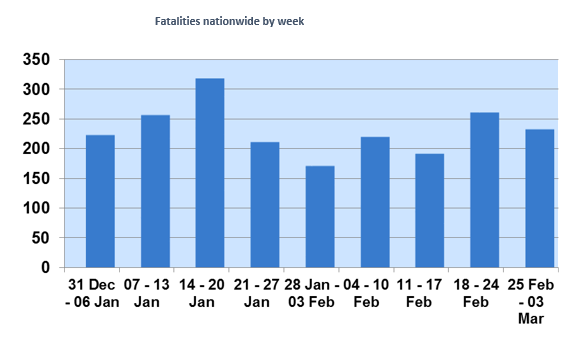
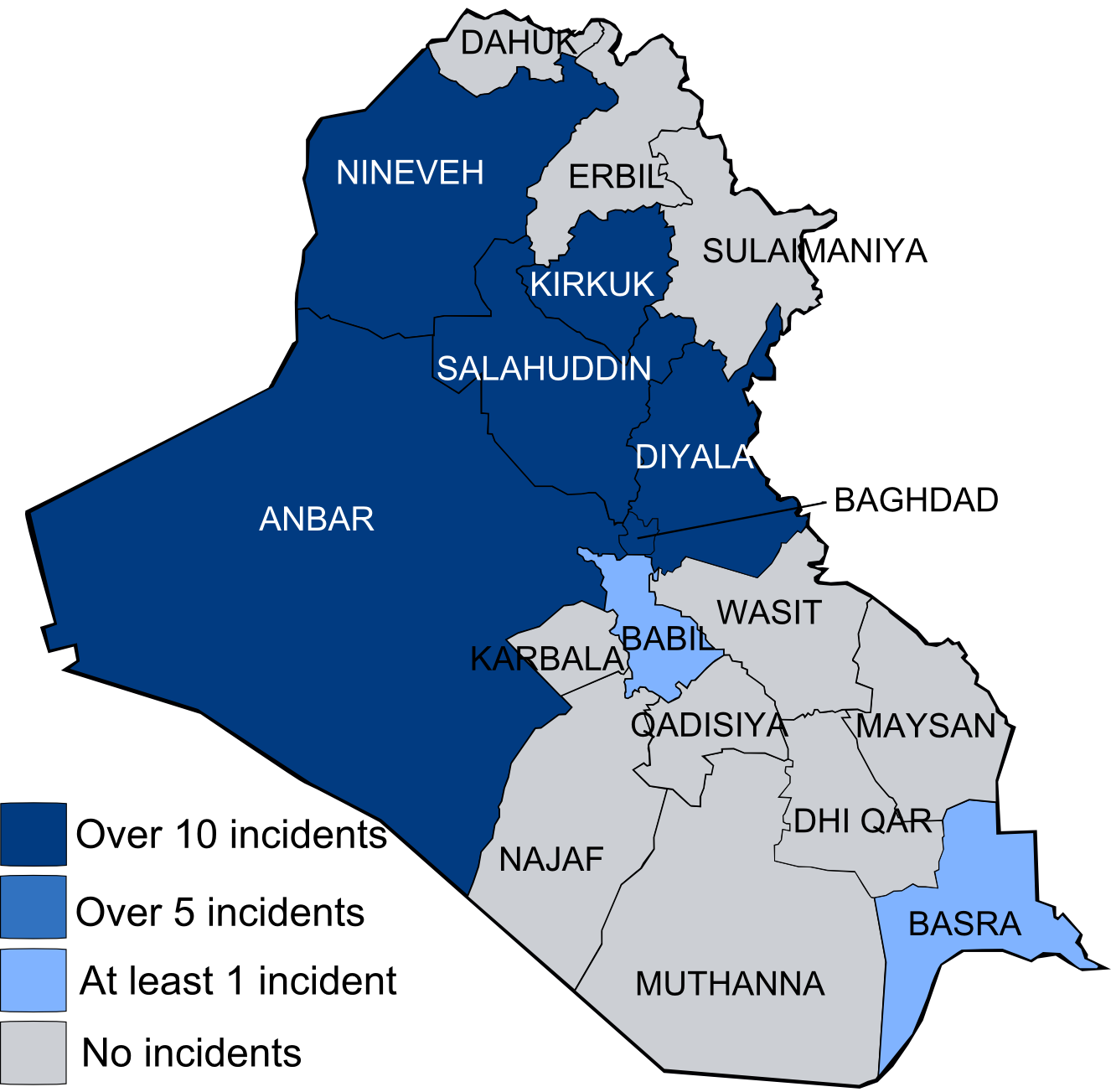 While the prospect of Maliki running for a third term is rejected by a majority of coalitions, the State of Law bloc has not put forward an alternative candidate for the premiership. With no credible opponent within Shia political parties and a sustained decrease in militant activity in the south, exploiting this opportunity to consolidate support will mitigate the importance of post-election alliances. Meanwhile, the dispute between Erbil and Baghdad over the control of oil revenues culminated with the withholding of Kurdistan’s annual budget. Reactivating the dispute with the KRG could allow Maliki to divert the attention of Iraqis from the ongoing insurgency in Anbar and levels of violence unseen since 2008.
On 1 March, the army agreed to extend the unilateral ceasefire in Fallujah by another week, following criticism from local Sunni tribes that airstrikes were hitting civilians. Although the government has been reluctant to favour political dialogue over military strikes, the changing dynamics of the conflict have forced the government to consider some concessions to bring Sunni tribes across to their side. The insurgency now appears to be spread across several regions, with groups of ISIL militants focused on attacking villages in Suleiman Bek district, Salahuddin governorate. This fighting on multiple fronts has contributed to an increase in casualties across central and northern governorates, which are likely to remain the focus of insurgents over the next weeks.
North
Most violent incidents continued to be concentrated in Nineveh and Salahuddin, owing to their proximity with militant bases. On 01 March, dozens of gunmen attacked the village of Maftool near Suleiman Bek, which was briefly occupied by insurgents in February. The militants destroyed several homes belonging to ISF elements and kidnapped three Sahwa members, without causing any casualties despite the detonation of several IEDs. In Nineveh, three car bombs hit areas in the vicinity of Mosul, causing injuries among civilians and soldiers. On 25 February, a VBIED killed two civilians and wounded four. The nature and scale of militant operations in Salahuddin indicates that the momentum of the Anbar insurgency has spread to other governorates and that the ISF does not have sufficient capabilities to contain militants within urban areas. This trend is likely to foster further violence across northern governorates, as militants seek to export the Anbar insurgency to neighbouring regions. Meanwhile, Kurdish provinces remained free from violence.
Central
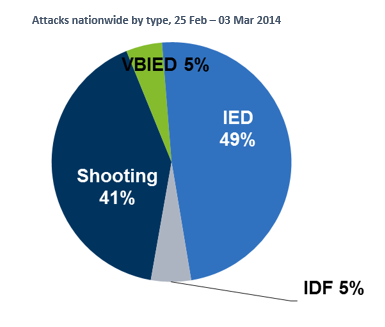 Central authorities appear to have acknowledged the necessity to form alliances with local tribes in Anbar, with the extension of the ceasefire in Fallujah likely to appease moderate Sunni factions. As a result of this shift away from Fallujah, militant operations were predominantly confined to Ramadi and Haditha. On 27 February, a VBIED detonated against the home of a local figure in Haditha district, killing six civilians and injuring 11 others. Unless a solid agreement is concluded between the government and local tribesmen, the deployment of militants to northern provinces is likely to divert the focus of ISF forces and provide militants with opportunities to strengthen their presence in Anbar. The increase in militant activity in the north has seemingly impacted on levels of violence in Baghdad, with only two VBIED incidents reported. The strategic locations of these detonations caused scores of casualties, with four civilians and six policemen killed in the first explosion, and 36 civilians injured. On 27 February, a second car bomb in Sadr City killed 30 civilians and injured 51 others. Given current security dynamics, central provinces are expected to witness similar levels of violence over the next weeks.
South
Incidents in southern governorates remained consistent with previous weekly assessments, as the region was largely insulated from militant attacks. The decrease in violence levels in Babil governorate is a further indication that insurgents are currently focusing on northern targets. Although the pattern of mass-casualty attacks across the south-eastern region has been disrupted, the capture of two VBIEDs in Basra on 02 February highlights the continued threat against Shia-dominated areas. In the lead-up to the elections, the motivations to strike Shia governorates will be heightened, as southern provinces have traditionally formed the core of Maliki’s electorate. Although southern provinces outside Babil are expected to remain free from major incidents over the next days, their longer term outlook is more uncertain and the security situation in the region will be determinant in the upcoming elections.
Posted in Weekly Security Update 3 Comments

Weekly Security Update 18 - 24 Feb 2014
Posted on 25 February 2014 .
By Constellis Consulting www.constellis-consulting.com
Amid continued unrest in the outskirts of Fallujah and Ramadi, ISF forces regained control of Sulaiman Pek, Salahuddin province, which was overrun by ISIL militants on 13 February. This outcome contrasts with the situation in Anbar, where a much more complex tribal landscape has prevented a direct assault on urban areas held by insurgents. While the focus of the government appears to be centred on containing the insurgency in the west, militants have continued to capitalise on the Anbar crisis to launch mass-casualty attacks in neighbouring provinces.
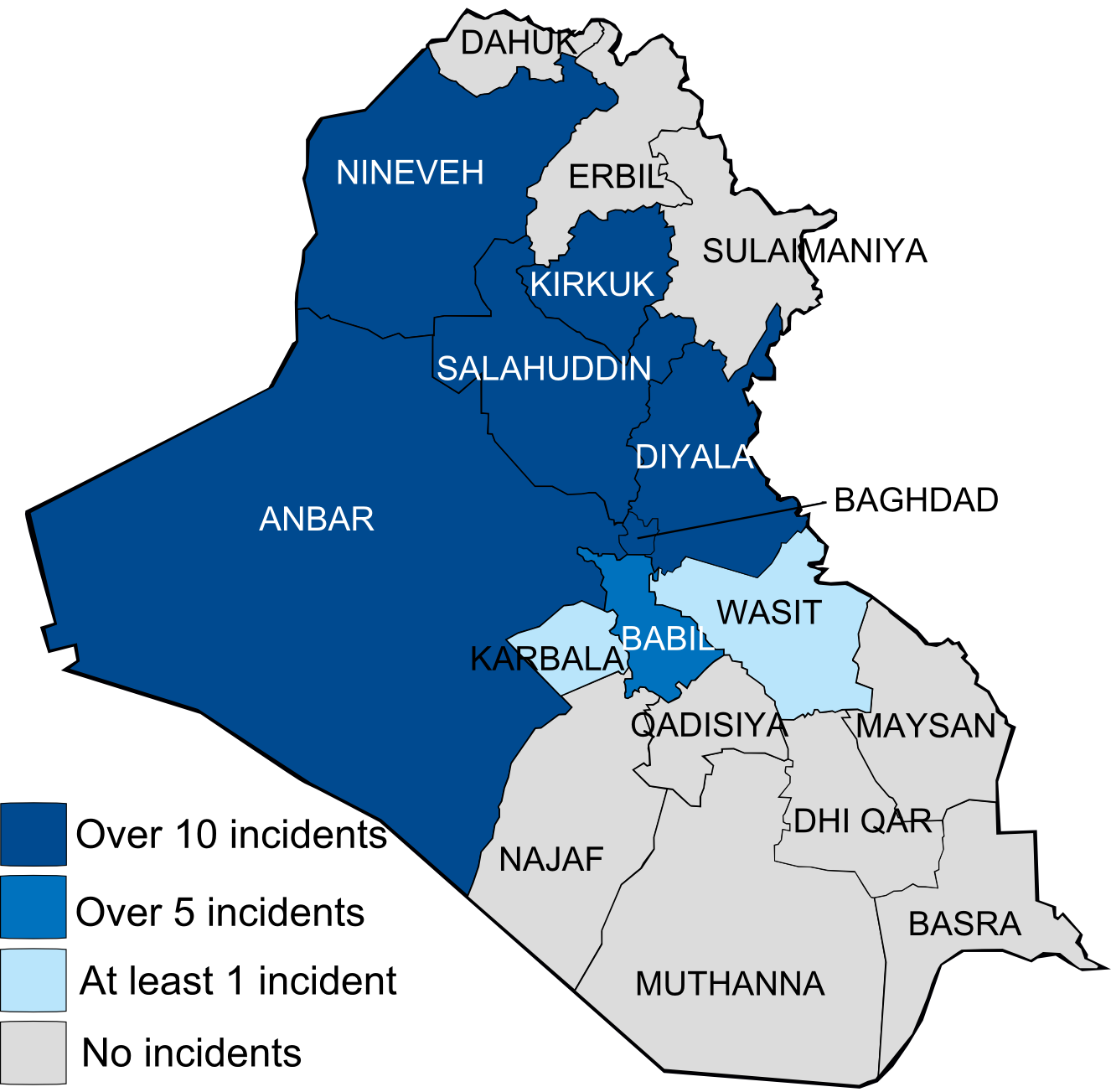 This tactic was reflected in high levels of violence across the country, and an unusual series of VBIEDs in Babil governorate. The Maliki administration, while cautious not to antagonise moderate Sunni factions, is primarily seeking to consolidate Shia support ahead of the April elections. In this perspective, the Anbar crisis has indirectly created a window of opportunity for Maliki. ISIL militants have indeed shifted their resources away from southern, Shia-dominated provinces, which have avoided sophisticated militant incursions since November 2013. Despite a deteriorating security situation elsewhere in the country, the relative calm across the south-eastern regions is set to benefit the ruling coalition in the lead-up to competitive elections.
In light of this change of pattern, it now appears in Maliki’s best interest to avoid any delay in organising the votes. With elections approaching, any progress in the political sphere will probably be determined by the nature of coalitions which will form in April. Stagnation will therefore continue to impact on levels of violence across the country, with northern and central governorates expected to attract most violent incidents.
North
Northern provinces continued to witness series of complex attacks, with unchanged patterns of violence as Nineveh and Salahuddin remained most vulnerable to militant activity. On 19 February, a VBIED detonated on an army patrol in Mosul, injuring three soldiers and a civilian. On 21 February, a car bomb hit the home of a Kurdish politician in Zummar district, resulting in material damage only. In Salahuddin, five VBIEDs detonated in several districts, killing scores of civilians and ISF elements. On 22 February, a sequence of car bombs killed four ISF members and wounded 18 civilians. Diyala governorate was not immune to sophisticated assaults, as a VBIED detonated in Baquba without causing any casualty. While ISIL militants remain committed to exporting the western insurgency to northern provinces, their efforts appear to be focused on governorates bordering Anbar. In contrast to the aftermath of the capture of Fallujah in December 2013, Kirkuk and Diyala governorates have indeed avoided mass-casualty attacks in recent weeks. Though this trend is likely to be repeated over the next reporting period as ISIL insurgents can deploy more easily in Salahuddin and Nineveh, all northern provinces will remain vulnerable to militant incidents. Meanwhile, Kurdish provinces remained free from violence.
Central
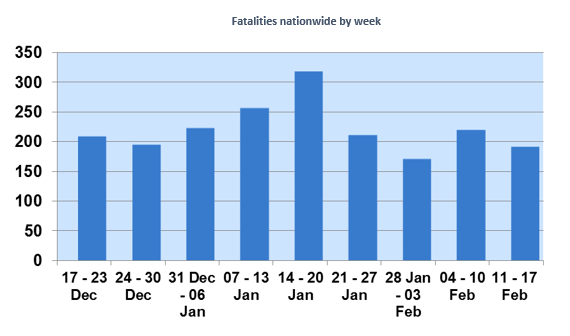
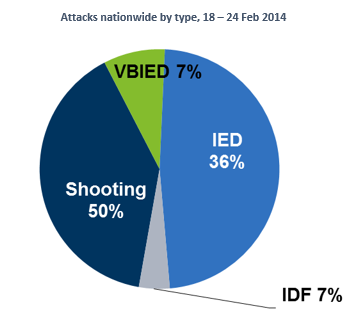 While car bombs detonated in the capital, their frequency remained below weekly averages as militant resources were distributed across several governorates bordering Anbar. Baghdad nonetheless attracted most deadly incidents, with series of IEDs killing scores of civilians, soldiers and police officers. On 18 February, a sequence of three VBIEDs hit a busy area of the capital, wounding at least 31 people. In Anbar, the situation remained unchanged as the standoff between insurgents and ISF forces continued to result in clashes in the outskirts of Ramadi and Fallujah. On 18 February, a VBIED hit a police vehicle in Haditha, injuring a police officer as well as five civilians. On 22 February, another car bomb killed six civilians and an ISF element, and destroyed five military vehicles. On 24 February, several soldiers were killed in eastern Ramadi after a car bomb hit their vehicle. A direct assault on urban areas controlled by ISIL insurgents remains unlikely before the elections, given the lack of intelligence support and the high probability to hit civilians, and the situation should therefore remain stagnant.
South
Incidents recorded across southern provinces remained consistent with the data collected over the previous reporting periods, with the situation in Babil contrasting with south-eastern governorates. Owing to its proximity with both Anbar and Baghdad governorates, increased levels of militant activity translated in VBIED sequences across several districts of Babil. On 18 February, seven car bombs injured at least 84 civilians and killed scores, in the most sophisticated incident in months. In Wasit, rounds of mortar fire killed 16 civilians and injured 73 others. These mass-casualty attacks contrasted with levels of violence seen elsewhere across the south, which remained free from major incidents including Basra. The fact that Shia strongholds have remained relatively safe for weeks is expected to benefit Maliki in polls and consolidate support around the government’s current strategy. Although south-eastern provinces are expected to remain calm given the trajectory currently followed by militants, it remains possible that insurgents will plan incursions into Shia provinces in a bid to undermine Maliki, especially if the Anbar crisis does not affect the elections.
Posted in Weekly Security Update 4 Comments

Weekly Security Update 11 - 17 Feb 2014
Posted on 18 February 2014 .
By Constellis Consulting www.constellis-consulting.com
Amid sustained levels of violence, this week was dominated by Muqtada al-Sadr’s withdrawal from politics. The announcement, made on 15 February, comes only two months before parliamentary elections for which Sadr was considered a serious candidate for the office of Prime Minister. While reasons behind his decision remain speculative, Sadr has routinely expressed his frustration towards the sectarian trajectory followed by Nouri al-Maliki, as well as his disillusionment regarding Iraq’s future. His retirement has created an unexpected opportunity for Maliki to consolidate Shia support ahead of the elections.
 Despite a worsening security situation in northern provinces and the disaffection of moderate Sunni elements, the government’s strategy to draw Shia votes has been consistent with an absence of mass-casualty attacks perpetrated across the south since November 2013. While ISF operations continue to take place in Anbar in order to contain ISIL insurgents and evacuate civilians, an exit to the crisis before the elections seems unlikely as a ground assault on Ramadi and Fallujah would risk antagonising moderate Sunni tribes established in urban areas.
The concentration of efforts in western provinces continued to provide militants with unchanged opportunities to strike neighbouring governorates, with series of complex attacks reported in Baghdad, Nineveh and Salahuddin. Aside from the Western insurgency, stagnation in the political sphere ahead of the April elections will continue to impact on levels of violence, with militant activity expected to be sustained over the next weeks.
North
Northern provinces continued to witness high levels of militant activity, with Nineveh and Salahuddin attracting most incidents. For the second time since December 2013, ISIL insurgents seized a town in the vicinity of Baghdad. On 13 February, Sulaiman Pek reportedly fell under the control of al-Qaeda militants, prompting the ISF to allocate resources to the area. Elsewhere in Salahuddin, a car bomb exploded while under construction and killed 20 gunmen. Meanwhile, a VBIED hit a checkpoint in Nineveh, injuring three policemen. On 15 February, two VBIEDs detonated in Mosul, causing scores of casualties and damage to government infrastructure. While complex assaults were mainly concentrated in these two regions, series of incidents involving small arms attacks and IEDs continued to plague all northern governorates. On 16 February, several IEDs detonated against an ISF patrol and caused scores of casualties. Following Sadr’s withdrawal from politics, the perception that PM Maliki has increased his chances to win a third term is likely to impact on violence levels across Sunni-dominated areas. As tensions grow between the government and Iraqi Sunnis, northern governorates are therefore expected to continue witnessing high levels of militant activity over the next weeks. Meanwhile, Kurdish provinces remained free from violence.
Central
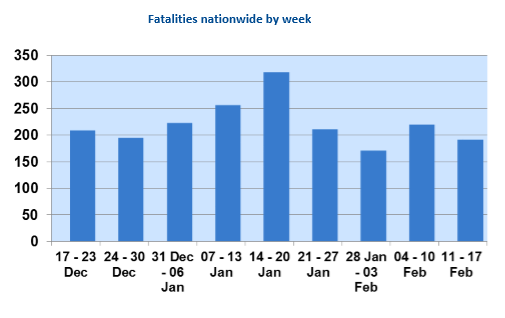
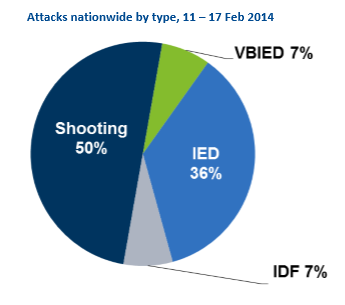 Although levels of violence remained high and Baghdad continued to attract series of militant attacks, the number of VBIED incidents noticeably decreased over the reporting period. Given the unchanged appetite to strike the capital with sophisticated assaults on civilians, this pattern is unlikely to be sustained, and probably followed a tactical choice to hit Baghdad more heavily in the next days. This assessment was illustrated by a series of car bombs on 17 February, which targeted gatherings in public areas as well as a medical complex in eastern Baghdad.
The attacks caused dozens of fatalities among civilians. Meanwhile, the fighting in Anbar continued to oppose pro-government factions to ISIL militants, though neither side seems capable of breaking the stalemate. On 17 February, a VBIED exploded against a police station in Ramadi, killing three policemen and wounding three others. Heightened tensions in the political sphere and the concentration of ISF efforts in Anbar will continue to provide a conducive environment for militant activity. Patterns of violence are therefore expected to be sustained over the next weeks.
South
Whilst southern governorates remained largely insulated from militant operations, levels of violence significantly increased in Babil province. Between 11 and 13 February, IED sequences detonated in urban areas, killing six soldiers and causing scores of casualties among civilians. On 12 February, a series of small arms attacks targeted ISF elements, killing a soldier and injuring another. Incidents across south-eastern governorates were only reported in Basra, with patterns of violence consistent with attacks routinely observed in the province. As the government seeks to consolidate Shia support ahead of the April elections, the improved security situation in the south is set to benefit Maliki and enable his coalition to boast their success in protecting Shia interests. Given the strategic importance of southern provinces in the upcoming parliamentary elections, militant penetration cannot be ruled out in the lead-up to the votes. Despite this possibility, the situation is unlikely to evolve in the next days, with Babil expected to continue attracting most of the violence.
Posted in Weekly Security Update 2 Comments

Weekly Security Update 04 - 10 Feb 2014
Posted on 11 February 2014 .
By Constellis Consulting www.constellis-consulting.com
Political tensions continued to escalate with the killing in Baghdad of Hamza al-Shimmari, a Shia politician running for parliament in the April elections and allied with the Sadrist bloc. On 10 February, Parliament Speaker and probable Presidential candidate Osama al-Nujaifi escaped an assassination attempt after his convoy was hit by a roadside bomb in Mosul. As the sectarian divide widens in the face of a deteriorating security environment and growing dissatisfaction with current elites, high-profile attacks against local politicians are likely to occur in the lead-up to the votes.
These tensions co ntinued to be reflected in levels of violence in central and northern governorates, with the highest number of car bombs recorded in months. Despite indications that militants would focus on southern provinces following VBIED incidents reported last week, attacks remained concentrated in Baghdad, Nineveh and Salahuddin. Although an assault on Fallujah was said to be imminent to dislodge militant cells from Anbar, the operation was abandoned and airstrikes ultimately preferred to contain the crisis. With a fragile support base ahead of competitive elections, the political cost associated with a ground assault in Fallujah would certainly be too high for the ruling coalition, which has repeatedly framed the unrest as a security matter.
As such, a failure to retake Fallujah would most probably ruin Maliki’s chances to win a third term, and the situation is therefore expected to remain unchanged until the elections. As the government continues to maintain important security precautions in the south in a bid to consolidate Shia support, opportunities to attack ISF elements will remain located in northern and central governorates. The following weeks are therefore expected to witness similar levels of violence.
North
Complex attacks returned to northern governorates following the disruption of this pattern last week. Nineveh attracted most of the violence, with series of car bombs causing multiple fatalities among civilians and ISF elements in Mosul. On 05 February, militants attempted to free prisoners held in the Badush prison, resulting in three civilians killed and scores injured. Whilst no one escaped, this attack is nonetheless indicative of the growing security vacuum in the region, with many areas outside government control. On the same day, a sophisticated operation involving a VBIED and two suicide bombers hit an ISF checkpoint, killing a soldier and injuring five others. Between 07 and 08 February, three car bombs detonated in Salahuddin, causing at least 32 casualties. On 06 February, a VBIED hit a district in Diyala and injured two civilians. Amid continued stagnation in Anbar and given the unchanged appetite to strike government targets in Sunni-dominated provinces, northern governorates are expected to continue witnessing high levels of militant activity over the next weeks. Meanwhile, Kurdish provinces remained free from violence.
Central
As the army remained focused on Anbar to contain the insurgency, invigorated ISIL militants launched a wave of assaults across several neighbourhoods of the capital. Baghdad witnessed its highest number of VBIED incidents in months as dozens of car bombs detonated in sequence against civilian gatherings and ISF elements. On 04 February, three VBIEDs hit streets busy with civilians, killing scores of civilians. On 05 February, two car bombs exploded simultaneously and injured 18. On 06 February, ten VBIEDs detonated in sequence, killing and wounding dozens. Additional VBIEDs struck districts of the capital between 08 and 10 February. Other militant operations included coordinated attacks carried out by suicide bombers, reinforcing the perception that the ISF lacks the capabilities to curb violence levels.
Whilst the situation in Anbar remained stagnant, both the government and ISIL militants appear to have an interest in maintaining the status quo in the restive province. An assault on urban areas would have little chance of success and would likely impact negatively on the government ahead of the April elections. At the same time, the focus of government resources on Anbar has allowed militants to strike neighbouring provinces with more decisive actions, posing a greater threat to central authorities. Levels of violence should therefore remain unchanged.
South
Levels of violence across southern governorates remained in line with weekly averages, despite concerns that VBIEDs would return after the detonation of a car bomb in Wasit. Whilst these incidents are typically followed by series of complex attacks in the south, this pattern has been disrupted in the aftermath of the Anbar crisis, seemingly prompting a tactical shift to focus more heavily on northern regions. Tribal disputes continued to account for most of the violence witnessed in Babil and Basra, causing some casualties amongst rival factions. In the lead-up to elections which are likely to oppose a substantial number of Shia parties, tribal violence is expected to be sustained. Whilst militant penetration cannot be ruled out, increased military presence should ensure that southern provinces remain relatively calm.

Posted in Weekly Security Update 4 Comments

Weekly Security Update 28 Jan - 03 Feb 2014
Posted on 05 February 2014 .
By Constellis Consulting www.constellis-consulting.com.
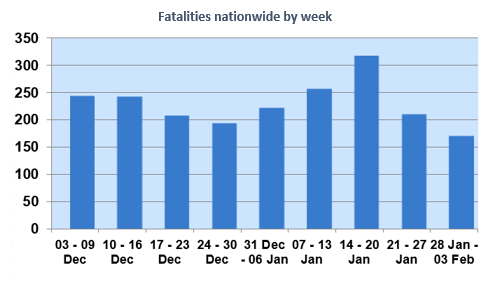
Amid reports that the Iraqi army is preparing an imminent assault on Fallujah, under control of ISIL militants for over a month, heavy shelling continued to strike key locations in restive Anbar governorate. Whilst the unrest absorbs government resources, political divisions have been increasingly apparent and the authority of Prime Minister Nouri al-Maliki openly challenged by prominent figures of the opposition.
In a recent visit to Washington, Parliament Speaker Osama Al-Nujaifi criticised Maliki’s position on the Anbar crisis, who refuses to address the grievances voiced by moderate Sunnis and rather focuses on the security dimension of the insurgency. On 04 February, members of Nujaifi’s Sunni coalition announced that they would only return to parliament if an emergency session is held on Anbar.
Political tensions continued to be reflected in high levels of violence across the country, with central and northern regions attracting most incidents. While sequences of VBIEDs 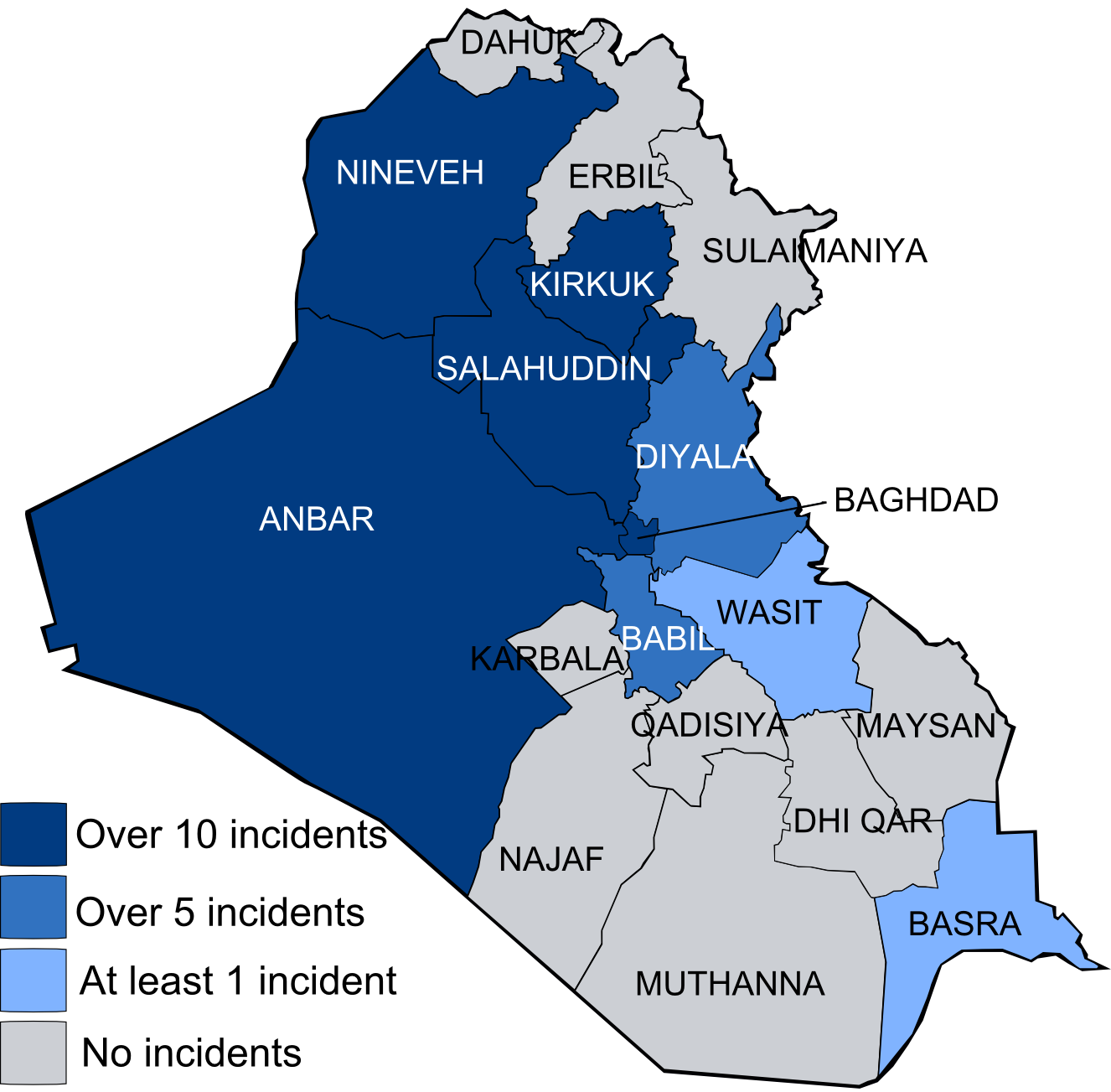 returned to Baghdad, patterns observed over the past month have been disrupted this week, with levels of violence across northern provinces consistent with data recorded in November 2013. Indeed, while the concentration of ISF efforts in Anbar had previously prompted ISIL militants to capitalise on the unrest and strike northern Sunni-dominated governorates with mass-casualty attacks, these tactics were largely avoided over the reporting period.
As the ruling coalition seeks to consolidate Shia votes ahead of elections in April, militants could be saving their resources to launch complex assaults in southern governorates, in a bid to undermine Maliki’s electoral strategy and relieve pressure in Anbar. Continued stagnation in the political sphere will continue to impact on levels of violence, whilst increased militant activity could also be recorded across southern governorates in the next days.
North
Although the situation in Anbar remained stagnant, with a decisive victory of ISF forces over ISIL insurgents implanted in the main cities increasingly unlikely, incidents in northern provinces returned to levels seen prior to the outbreak of the crisis. VBIEDs were only recorded in Salahuddin province, with two car bombs detonating on 29 January and resulting in scores of casualties. On 02 February, another VBIED targeted a police checkpoint, killing eight civilians and injuring dozens.
Elsewhere in northern governorates, IEDs and small arms attacks continued to hit ISF forces, with Nineveh witnessing most of the violence. The decrease in militant activity across northern governorates could signal a tactical shift decided by ISIL, and prompted as much by ISF operations launched in response to increased levels of violence in the north, as by the strategic opportunity to hit southern provinces. Whilst violence will undoubtedly continue to plague northern provinces, the near-absence of complex assaults could therefore be balanced with expeditionary mass-casualty attacks in the south. Meanwhile, Kurdish provinces remained free from violence.
Central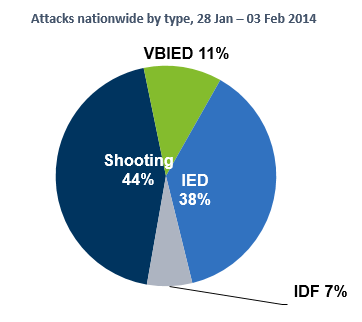
Following a trend which has been consistently sustained over the past weeks, Baghdad continued to attract most of the violence, with series of complex attacks and VBIEDs witnessed in several districts of the capital. Car bombs detonated in sequence in northern, southern and eastern neighbourhoods. On 29 January, a VBIED killed six civilians and injured 26 others. On 30 January, another device detonated in the Shaab area, killing one civilian and injuring 18. On 03 February, a series of car bombs caused dozens of fatalities.
Meanwhile, the continued unrest in Anbar prompted government forces to prepare an assault on the city of Fallujah, which has been at the hands of militants since December 2013. Whilst under-reported clashes continued to occur in the outskirts of urban areas, intensified shelling killed an undisclosed number of civilians, accelerating the humanitarian crisis in Anbar and further weakening the legitimacy of ruling elites. Due to a lack of internal support from Sunni tribes, an assault on Fallujah will do little to break the stalemate, and is only likely to fuel violence and invigorate militant cells present in surrounding provinces.
South
Whilst southern governorates remained largely insulated from militant operations, the relative absence of mass-casualty attacks in northern regions and the continuing unrest in Anbar could signal the imminence of sophisticated assaults in the south. Southern governorates represent the core of Maliki’s support base and its security is therefore essential in the lead-up to competitive elections scheduled in April. Furthermore, the concentration of ISF forces in Anbar and northern regions has created an opportunity which militants could seize and translate into attacks against civilian gatherings.
This trend was highlighted by incidents reported this week, with two VBIEDs dismantled in Basra on 02 February. On 03 February, three civilians were wounded when a car bomb detonated near Kut, in Wasit province. Whilst security measures will probably be reinforced following these incidents, levels of violence are expected to increase over the next reporting period.
Posted in Weekly Security Update 2 Comments

It's All About Risk versus Reward
Posted on 30 January 2014 .
While this week's Newsletter carries many reports of new investment in Iraq, there is still a perception among investors that the country is high risk, and there are some good reasons for this.
As Anders Jönsson, a policy analyst at the Organisation for Economic Cooperation and Development (OECD), told the Iraq Finance forum in Dubai:
“There appears to be something of a vicious cycle in Iraq today ... What Iraq needs to do is to lower this bar and to lower the risks so more projects get done.”
UAE's The National reports him as saying that until Iraq can fix its risk perception, it will limit itself to investors from sectors that have experience coping with contractual and security risks, such as oil and gas, or those that are undeterred by the risk because of high demand, such as finance and telecommunications.
Getting a grip on security, in all its form, must be a top priority for government and all in authority in Iraq.
And on the subject of security, this week on Iraq Business News we are delighted to welcome Constellis Consulting, who will give us a weekly update on security developments in Iraq.
You can read their first security update here, and we look forward to getting more of their perspectives on security in the country.
(Flag image via Shutterstock)
Posted in Blog 2 Comments

Weekly Security Update 21-27 Jan 2014
Posted on 30 January 2014 .
By Constellis Consulting www.constellis-consulting.com.
Clashes in rural districts of Anbar province and shelling on the cities of Fallujah and Ramadi continued to fuel Iraq’s cycle of violence, whilst over 140,000 civilians have reportedly fled their homes since the outbreak of the crisis in December 2013, in the most important displacement of population since 2006-2008.
Although levels of violence remained high, with northern and central provinces continuing to attract most incidents, mass-casualty attacks have been largely avoided this week, with only a few VBIEDs reported. In the midst of a security crisis which weakens the position of Prime Minister Nouri al-Maliki ahead of determinant elections in April, the government appears to be seeking new strategies to consolidate Shia support.
Indeed, as the situation in Anbar remains stagnant and Sunni-dominated areas across the country are increasingly vulnerable to militant attacks, political divisions have been exacerbated by levels of violence unseen since 2008. On 21 January, Maliki announced a plan to convert four administrative districts into provinces.
The decision concerns areas in Salahuddin, Nineveh and Anbar governorates. This controversial move is likely to be driven by electoral considerations, in an attempt to weaken Sunni strongholds and foster the perception that central authorities are protecting Shia interests, with two Shia-dominated districts incorporated in the plan.
 As ISIL militants continue to focus their efforts on northern provinces and shift away from southern governorates, such superficial measures could benefit Maliki and mitigate the political impact of the country’s worsening security environment.
The stalemate in Anbar will provide militants with unchanged opportunities to strike surrounding provinces, and levels of violence are therefore expected to be sustained over the next reporting period.
Posted in Weekly Security Update 4 Comments