


* At the time of writing and not included in the weekly statistics for this reporting period, the 23 July witnessed up to 40 attacks, primarily across central and northern Iraq. The attacks targeted approximately 33 different locations across seven provinces, killing an estimated 110 people, and injuring several hundred more. While the attacks were targeted against a mixture of civilian, Iraqi Security Forces (ISF) and government targets, the ISF appear to have taken the brunt of the attacks. A varied attack methodology was employed, including car bombs (VBIEDs), suicide attacks and small arms fire (SAF). The first attack occurred around 5am on 23 July and was followed thereafter by further attacks throughout the course of the morning. In terms of number of devices, and casualty figures, this is the largest series of coordinated attacks seen in 2012 by far. In particular, these latest attacks displayed even greater reach than previous coordinated attacks, reaching into more cities and into more remote areas such as the upper Diyala River Valley. Though no group has claimed responsibility, the complexity, spread and coordination of the attack heavily implicates Al-Qaida in Iraq (AQI). It is not without coincidence that on the 20 July, an online statement attributed to Abu Bakr Al-Baghdadi, the leader of the Islamic State of Iraq (ISI), was released in which he warned of a new phase of operations by ISI/AQI to free prisoners and assassinate government officials.
Northern Iraq (North and North Central Regions – including the KRG)
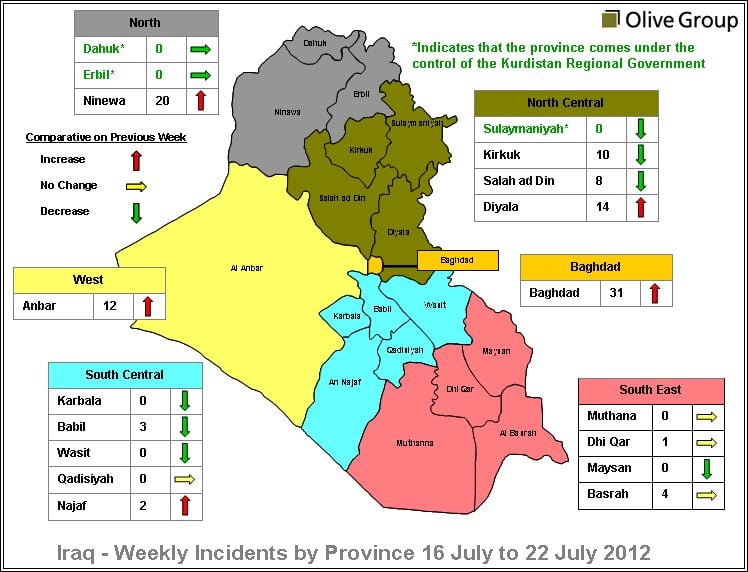
This week reported incidents in the North Region increased by one, bringing the total to twenty, which included thirteen shooting incidents, four improvised explosive devices (IEDs), one under-vehicle IED (UVIED) and a single VBIED. Violence was once again concentrated in Mosul, though there were also two shooting incidents in Badush, immediately north of the city, and a UVIED in Kisik northwest of Mosul – both areas where Kurdish control is actively resisted by Arab militants. In Mosul itself SAF dominated reporting, with an even geographical spread across eastern and western sides of the city and ISF being the primary target set. On 21 July it was reported that the Free Syrian Army (FSA) had gained control of the town of Yarubiya on the Syrian side of the border, which lies less than three kilometres from the Rabia crossing point in Ninawa province. On 22 July the pro-Assad Syrian military regained control of the town. These events follow similar battles for control over the Abu Kamal crossing point which borders the town of al-Qa’im in Anbar province. As with the loss of Syrian Government control in Dayr al-Zour district (over the border from Anbar), the escalating struggle between the Syrian military and rebel forces may have a significant impact on Iraqi border security in the coming months.
Comments are closed.