


Central Iraq (Baghdad and Anbar)
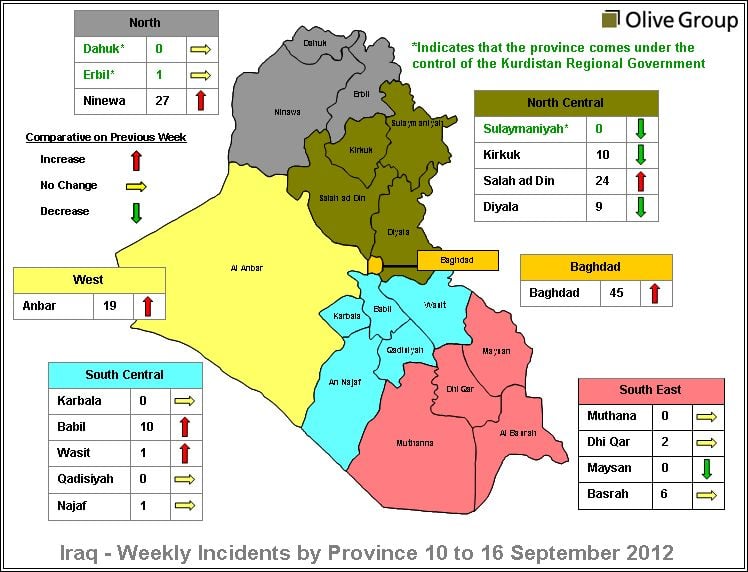
Baghdad recorded 45 incidents this week, some way above the current 2012 weekly average of 29. Following a two week reduction in violence in the capital at the end of August – to levels on par with the 2012 weekly average – violence now seems to have returned to the higher levels experienced during the month of Ramadan. A significant proportion of the incidents reported this week are assessed to be criminal and thus do not necessarily reflect increased insurgent activity so much as variable police coverage. However, targeted attacks on mid to senior level ISF also featured prominently – with 11 incidents recorded – including the targeting of a Brigadier and three Colonels. Such targeting is a characteristic feature of extremist activity in Baghdad. Despite the even geographical spread of violence, there were clusters of incidents in the Sunni hot-spots of Abu Ghraib, Rashid and Baghdad’s southern belts and in the Shia dominated district of Sadr City.
Activity in Anbar province increased this week to 19 incidents, the weekly average for 2012 remains 11. This marks the continuation of a steady increase in violence over the course of 2012, with security becoming particularly volatile since July - which is roughly coincidental with the deterioration of security on the Syrian side of the border - suggesting a possible causal link. This week’s unusually high figure was in part due to a mini attack series on 13 September, resulting in one car-bomb detonation in Ramadi and three more in Fallujah District, in addition to two potentially connected bomb attacks in Anbar. The targets of these attacks were primarily ISF, including a Major and a Colonel. On 10 September there was also a suicide car-bomb in Fallujah which detonated prior to entering a checkpoint. Anbar did not feature prominently in the previous reporting periods 9 September attack series, with only one failed device reported.
Comments are closed.