


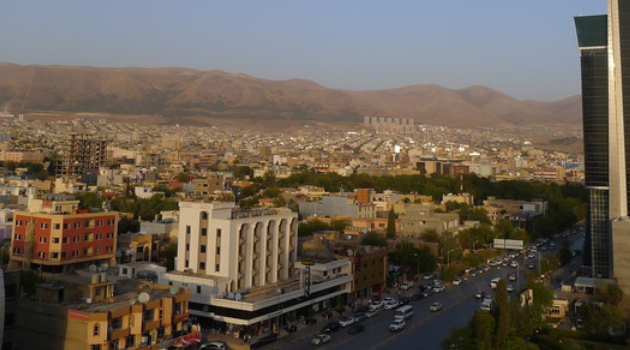
However, Hardi didn’t deny that this restiveness could have a negative impact on the city too.
“Political conflicts have negatively impacted the city’s economic and social development,” complains Yassin Mahmoud Rashid, the spokesperson for the Kurdistan Investors’ Union, an association of Iraqi Kurdish businesspeople. “It is like the city is infected with conflict. Every political and economic problem seems to start and end here.”
Mahmoud Rashid said that the statistics the Union collected confirm that political problems are bringing the city’s economy close to collapse.
There has been plenty of action in Sulaymaniyah over the past decade or so, including the PUK splintering, the growth of a genuine opposition out of that splinter group that came to be known as the Change movement and popular protests over wages and corruption. Many locals also believe that all the stalled projects and incomplete infrastructure are due to the fact that the relationship between the PUK and the Change movement, and the region’s other major political party, the Kurdistan Democratic Party, or KDP, is more tense at the moment; they say Sulaymaniyah’s reputation as the opposition party’s hometown and a town with a rebellious attitude mean that the city is being marginalized and incoming cash is being throttled by those in the KDP who control it.
“The economy of any city depends on its stability,” Iraqi Kurdish politician, Ali Hama Salih, a member of the anti-corruption Change movement and deputy head of the Iraqi Kurdish Parliament’s Economics Committee, says. “Sulaymaniyah hasn’t been stable for years though and its economy disintegrates day by day, as a result.”
Sulaymaniyah has industry and is also a major tourist attraction, particularly for visitors coming from inside Iraq. But those numbers have dropped as a result of Iraq’s security crisis.
Comments are closed.