



Lawmakers Focus on Eradicating Internet Porn
Posted on 23 August 2015 .
By Ali Mamouri for Al-Monitor. Any opinions expressed are those of the author, and do not necessarily reflect the views of Iraq Business News.
XXX trumps IS as Iraqi lawmakers focus on eradicating Internet porn
Abdul-Hadi al-Hakim, an Iraqi parliament member with the Citizen Coalition, announced July 28 that more than 150 parliament members' signatures had been collected to pass a bill calling on the authorities to block pornographic sites on the Internet.
Hakim said that most of the National Iraqi Alliance parliamentarians have signed the draft law, while most representatives of the Sunni National Forces Union and the Kurdistan Alliance refrained from signing.
Hakim justified the bill by stating, “Most problems youths face today are caused by surfing porn sites.” He added that pornographic sites have led to a 200% increase in divorce rates and a 50% decrease in marriage and contributed to the rise of sexual crimes, including rape and sexual harassment.
However, Hakim’s statement is based on mere speculation and not on scientific studies. In the same statement, he also invoked numerous other social problems to justify the bill, including early marriage, high unemployment and poverty rates and violence against women. It is worth mentioning that in 2014, Iraq came in last on a list of statistics issued by Pornhub, the largest pornography website on the Internet, which ranked the average amount of time spent on the site by visitors according to country.
Blocking pornographic sites is ineffective, as circumvention techniques are widely available to the public. For instance, the same Pornhub statistics showed that visitors from Iran and Saudi Arabia spend more time on the site than Iraqis, even though these states' religious regimes ban pornographic websites. Visitors in Iran registered an average of 7 minutes and 46 seconds per visit, while those in Saudi Arabia registered 8 minutes 23 seconds.
The announcement of the bill stirred controversy in Iraq. Some Iraqis welcomed the proposal and created a Facebook page to support the bill, while others believe it is an attempt to impose religious laws on the country and a preliminary step to gradually bring religious rule to Iraq, especially considering the bill was submitted at the initiative of Islamist members of parliament and justified from religious perspectives.
According to civil activists, this bill is not a priority in the midst of the current deteriorating security and political situation in Iraq. TV presenter Ali Wajih posted on Facebook on July 28, “Did our problems in Iraq end, and the only remaining one is porn sites? Isn’t our tragic situation in Iraq much worse than pornographic movies?”
Posted in Iraqi Communications News Comments Off on Lawmakers Focus on Eradicating Internet Porn

Iraqi Dates Shrivel Awaiting Processing
Posted on 16 August 2015 .
By Wassim Bassem for Al-Monitor. Any opinions expressed are those of the author, and do not necessarily reflect the views of Iraq Business News.
The Arabian Peninsula, which includes part of southern Iraq, was once known for having the most palm trees in the world. The documented panoply of dates comes from 600 types of palm trees, out of 2,000 types in total. However, Iraqis are now consuming imported dates.
Al-Monitor asked farmer Abdul-Hussein al-Ali about this paradox. Ali hails from Al-Mezeediah village south of Babylon, about 62 miles south of Baghdad, and owns an orchard containing 60 palm trees.
"The dates’ season started in July and will continue until mid-September. I am concerned over the accumulation of dates in the storeroom in my big house. I still have large amounts from last year's season, because I didn’t find buyers,” he said.
“It’s recession,” agricultural engineer Ahmed Abdul-Kadhim from Babylon told Al-Monitor. “Recession in the marketing of Iraqi dates has affected all farmers due to the lack of sufficient planning aimed at including dates in the food industry projects, such as canned dates, or at converting dates to other forms of goods, such as sugar, wine, pickles and jam.”
He said, “The canning and manufacturing efforts of the Iraqi Dates for Processing & Marketing Co. [IDP&MC] are not enough in light of the large quantities of dates produced, which amount to 200,000 tons per year, according to Ministry of Industry statistics.”
That figure matches current Ministry of Agriculture data, but older statistics indicated Iraq used to produce 881,000 tons per year in the 1990s. It seems that, at the time, IDP&MC did not face any problem marketing those quantities.
The company was founded in 1989; it buys dates from farmers and stores them to invest in the production of other types of food and beverages to be canned and exported based on Iraqi specifications.
Posted in Agriculture Comments Off on Iraqi Dates Shrivel Awaiting Processing
One year later, Struggle Continues for Yazidis
Posted on 14 August 2015 .
By Mohammed A. Salih for Al-Monitor. Any opinions expressed are those of the author, and do not necessarily reflect the views of Iraq Business News.
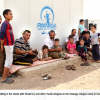
Izzat Abbas, along with a group of men and children, took refuge in the shade by a prefabricated cabin in a refugee camp for displaced Yazidis. They chat and occasionally laugh while they try to keep their spirits up. But their sunburned faces show more exhaustion than content.
The temperature is 47 degrees Celsius (116.6 Fahrenheit) and there is no electricity, which causes the camp residents to flee cabins they described as being as hot as "ovens."
"It's just unbearable," Abbas, 40, said of the excessive heat. “There is little electricity. We get it for three hours and then no electricity for the next three hours. We are given water [by the government] only one hour per day."
Ismael Mohammed, the deputy governor of Dahuk who is in charge of matters involving the refugees and internally displaced persons, told Al-Monitor that nearly 450,000 Yazidis have been scattered around 14 camps in Dahuk province since Aug. 3, 2014, when they were uprooted by the Islamic State (IS) from their historical homeland in Sinjar in western Ninevah province. He said, “Many have also settled in the cities or outside Dahuk.”
Those in the Rwanga camp, halfway between the cities of Dahuk and Zakho close to the border with Turkey, are perhaps among the luckiest. They are living in prefabricated cabins, while the majority of the other camps are sprawling tent cities with little protection against the forces of nature.
A sense of loss and despair is common in those camps. As if losing their homes and valuables was not enough, many have to grapple with systemic obstacles that make their lives much harder. In their haste to escape from the invading IS fighters, Khalaf and his family, like many other Yazidis, lost their Iraqi national identity documents. Khalaf has been trying to obtain a new one, as in the rigidly bureaucratic Kurdish system the national ID card is needed for almost everything.
Posted in Security 3 Comments
Security Situation Weighs on Iraq's Economy
Posted on 03 July 2015 .
By Omar al-Jaffal for Al-Monitor. Any opinions expressed are those of the author, and do not necessarily reflect the views of Iraq Business News.
The Iraqi army, backed by the Popular Mobilization Units, has been engaged in war for more than a year now against the Islamic State (IS, ISIS, ISIL). There do not seem to be any prospects that the war, which has affected the livelihoods and social realities of Iraqis, will end anytime soon.
The heavy costs incurred by Iraq to acquire weapons and pay fighters led to the declaration of the 2015 austerity budget, which subsequently raised poverty rates in the country.
The economic crisis is not new to Iraq. It started with Iraq’s eight-year war with Iran, which began in 1980, and then escalated with Saddam Hussein's occupation of Kuwait, the economic siege on Iraq and the Gulf War.
War in Iraq was renewed for the third time and ended with the US occupation of Iraq in 2003. Iraq is now waging a fourth war, this time against IS.
Indeed, the latest war is complex and draining a lot of Iraq’s resources because it is being waged amid a political divide, with administrative corruption hindering the country's development.
The Iraqi Ministry of Planning estimated that nearly 30% of Iraq’s population of more than 33 million lives below the poverty line because of Iraq’s conditions following IS taking control of more than a third of the country’s area in June 2014.
Posted in Iraq Industry & Trade News, Security 1 Comment

Iraqi Workers Protest for Wage Payment
Posted on 14 June 2015 .
By Adnan Abu Zeed for Al-Monitor. Any opinions expressed are those of the author, and do not necessarily reflect the views of Iraq Business News.
Since February, mechanical engineer Faiz al-Sultani has gone without a salary. The government textile plant in Hilla has been unable to pay his wages due to Iraq's fiscal deficit.
Dozens of textile and fabric shops are located in the local market of Hilla, 62 miles south of Baghdad. “The products of the Hilla textile plant used to flood the market with the finest fabrics in the 1980s and 1990s, bringing in profits for the Iraqi provincial councils' budget,” said Sultani.
“Today, the plant was forced to temporarily lay off its workers, including engineers and laborers. This came after it was unable to update its machinery and cover the cost of production and labor, becoming more of a consumer than a producer.”
As a result of these dismissals, plant employees held a demonstration Jan. 19, demanding their salaries be paid. A report published by the Worker-Communist Party of Iraq on Feb. 16 said that more than 24,000 workers in Babil had not received their salaries for the fifth month in a row.
Plant worker Saad al-Khafaji showed Al-Monitor a picture of himself standing behind a textile machine, dating back to the mid-1990s. Khafaji said that he has “spent 20 years in service, and now I am being thrown by the wayside.”
Workers have demonstrated in several Iraqi cities, including Basra, Sulaimaniyah and Babil. In Diwaniyah, workers renewed their demonstrations at the city's textile plant April 26, demanding the Ministry of Industry pay their salaries.
Posted in Construction & Engineering In Iraq, Employment, Iraq Industry & Trade News 4 Comments
Flagship Partnership to Revive Southern Iraq
Posted on 09 May 2015 .
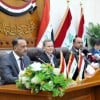
The Basra Compact, a flagship partnership to revive the economy in southern Iraq
The authorities of Basra and the UN Development Programme (UNDP) have signed a flagship agreement, the Basra Compact, aiming at strengthening participatory and accountable governance and reviving the economic activity in the southern governorate, which is not just oil-rich but needs to invest in its human capacity and private sector development. Protecting the cultural and ecological heritage of the Mesopotamian Marshlands is also a priority.
Despite being the richest governorate and hosting the main port in Iraq, Umm Qasr—the only shipping hub in the country—Basra is one of the most affected by poverty and chronic unemployment with 16.1% of the population living below the poverty line of US$ 2.5 per day and facing staggering challenges in terms of access to services.
The memorandum of understanding (MoU) signed with Basra authorities outlines future cooperation in the areas of decentralization, financial management and budget execution, environment protection, private sector development including micro, small and medium enterprises, and support to the governorate’s 5-year strategic planning.
“Basra’s cultural heritage and natural resources represent an unmatched wealth of opportunities that can actively contribute to the recovery of Iraq’s economy and national stabilization strategy,” noted Sabah Al-Bazouni, who leads this initiative as Head of the Provincial Council.
“This agreement is enhanced by a series of consultations and mutual exchange of information to capitalize on natural resources being progressively reinvested towards the advancement of human development,” he said.
Posted in Construction & Engineering In Iraq, Iraq Industry & Trade News, Iraq Oil & Gas News Comments Off on Flagship Partnership to Revive Southern Iraq

Move to Private Sector Vital For Progress
Posted on 05 May 2015 .
The financial losses being made by Iraq’s state owned enterprises are “not acceptable” and the Government is pushing through new legislation to prioritise the growth of the private sector, the Prime Minister’s Chief of Staff told a high-level business conference in Baghdad last week.
Speaking at the Iraq Britain Business Council (IBBC) event in the Iraqi Capital, Dr Mehdi Al Alak said the move was vital for the country.
“We are trying to move away from theories and bring a more practical approach to encourage and grow the private sector. This needs some legislation to be abolished and new laws to be created, but it is now a priority for my government and it cannot be delayed,” explained Mr Alak.
The man charged by the government with helping push through the reforms, Dr Hussein Anbaki, said they were now examining 176 state owned enterprises to see how they could be transferred from state control to private enterprise.
Dr Anbaki, the Chairman of the Prime Minister’s Advisory Committee, told the audience of senior Iraqi and UK business leaders that the government would no longer allow public enterprises to continue to operate if they are losing money.
“As well as making a profit, they must create jobs. To do this there will be certain challenges, for example the lack and regularity of power supply, infrastructure, and bureaucracy. The boards of these organisations should be in charge, but unfortunately we see the ministries in control which makes the whole thing more bureaucratic,” explained Dr Anbaki.
Bishr Baker, the managing partner for E&Y in Jordan and Iraq, said since 2003 publicly-owned companies in Iraq had taken $11 billion of government money but had made no profit.
“Over-employment in these companies ranges from 30% to 50% so you can imagine that when they come to be transferred into private ownership this will cause social issues with unemployment. They will need state benefits and training to find new jobs. It will be very difficult but the government must provide an essential safety net,” added Mr Baker.
Standard Chartered’s acting CEO in Iraq, Mohammed Al Delaimy, explained to the conference the steps needed to change a state-driven economy to the private sector. It was imperative to have the proper legislation in place for both the government and the private institutions – this was to protect the local product and also consumer rights.
Mr Delaimy said a full review of business practices was also necessary. “We need to ask ourselves if we have the right infrastructure. Do we have an adequate pool for skills and talented people? This is helpful for deciding why and when the next industry is privatised. We can also find out what kind of human resources are needed,” he explained.
Later in the day, the former Iraqi Deputy Prime Minister, now Minister for Higher Education, Dr Hussain Al Shahristani, called for British Universities and other international educational institutions to open branches in Iraq.
“We have 651,000 students currently studying for degrees, 42% of which are women. We have 40,000 instructors and teachers. 17.3% of students are aged between 18 and 23 and we’d like to increase this to 25% but unfortunately the lack of capacity of our universities hinders this position,” Dr Shahristani pointed out.
“We have the funds – around $3000 for each student – which can’t compare to Europe or the States but I believe are amongst the highest in the Middle East. We want more connection between universities in the UK and abroad and perhaps they would take into consideration opening branches here in Iraq? Under the former regime this was not possible, but we have now sent a draft law to Parliament to enable this to happen,” he added.
The European Union’s Ambassador to Iraq, Jana Hybaskova, said they had decided to invest in Iraq, not because it was rich in oil and gas, but rich in its people and its population.
Ms Hybaskova said the EU was spending six million Euros to help provide technical support for Iraqi educational establishments. Through UNESCO they were also investing a further 12 million Euros in reforming vocational training. “We want to enhance the skills of the Iraqi people, not only to combat terrorism, but to use computers, mobile phones, to learn about modern technology based on the needs of the private sector.”
The IBBC Executive Chairman, Baroness Nicholson, reaffirmed the organisation’s strong support for developing the educational sector in Iraq. She suggested IBBC member companies could play a big role in developing the country’s educational requirements.
“Iraq needs to expand its colleges and universities and to develop apprenticeship schemes. Maybe that would be the way IBBC companies could help the most? All run training schemes of their own and I believe there is a huge amount they could and would do.”
The Baroness thanked the Iraqi Federation of Chambers of Commerce and the National Investment Commission (NIC) for co-hosting the event. She particularly praised the Baghdad Chamber for their invaluable support. She said the organisation had done “an incredible” job to bring the cream of Iraqi and UK business together with leading politicians for the conference.
A spokesman for the Baghdad Chamber of Commerce said today: “We were determined to make this event very special and we are proud to say that it was. We had two days of incredible constructive debate which will benefit not only Iraqi and international business but the Iraqi people as well.”
(Source: IBBC)
Posted in Construction & Engineering In Iraq, Employment, Iraq Industry & Trade News, Iraq Oil & Gas News, Politics 10 Comments
Iran Nuclear Deal: Migrants Plan to Leave Iraq
Posted on 04 May 2015 .
This article was originally published by Niqash. Any opinions expressed are those of the author, and do not necessarily reflect the views of Iraq Business News.
Thanks to Nuclear Deal, Iranian Migrant Workers Plan To Leave Iraq
The nuclear compromise between Iran and Western powers is a chance to return home and be with our families, say Iranian labourers in northern Iraq.
In early April many Iranians took to the streets of Tehran to celebrate the announcement of a “framework agreement” on Iran's nuclear programme. But they were not the only Iranians to greet a possible thaw in international relations between Iran and Western powers so enthusiastically. Iranians living in the semi-autonomous northern region of Iraqi Kurdistan were also cheering. Because for these Iranians – usually migrant workers, mostly of Kurdish ethnicity - this might be the chance to return home they've been waiting for.
“The ordinary people here treat us well,” Habib Abdullah Torordi, who works as a baker in the Kurdish city of Sulaymaniyah, notes. “But the security forces do not. Mainly because there is no clear law that recognizes our presence here. The [framework] agreement will mean less pressure on Iran and it will lead to an improvement in the economic situation,” he says hopefully. “And when the conditions improve, we will return to our homes and our children. We don't want to continue living this way,” says the baker, who sends his wages back to his wife and son who live in the Iranian city of Marivan, home to a mostly Kurdish Iranian population and near to the Iraqi border.
Despite a shared Kurdish background, life for Iranian nationals working in the city of Sulaymaniyah in Iraqi Kurdistan, is not always easy. Things have changed a lot since they got here. Their reasons for coming to the semi-autonomous, northern region of Iraqi Kurdistan, which has its own borders, legislature and military, and basically works like a state within a state inside Iraq, were clear.
The Iranian economy was under pressure from international sanctions while, just over the border, in Iraqi Kurdistan, business was booming; at one stage, at least before Iraq's current security crisis, Iraqi Kurdistan was often optimistically described as “the new Dubai”.
Posted in Employment, Security Comments Off on Iran Nuclear Deal: Migrants Plan to Leave Iraq

Iraq's Brain Drain Continues
Posted on 22 April 2015 .
By Wassim Bassem for Al-Monitor. Any opinions expressed are those of the author, and do not necessarily reflect the views of Iraq Business News.
Youths in Iraq dream of leaving the country. The successive wars since 1980 and in particular the violence that has been part of daily life in Iraq since 2003 have caused waves of emigration over the years.
Iraqis have lived through many conflicts over the last few decades: the Iran-Iraq war of 1980-88, the Iraqi invasion of Kuwait in 1990 and the subsequent embargo and war, followed by the war in 2003 to topple Iraqi President Saddam Hussein.
The conflict between Iraqi forces and Islamic State (IS) militants, who occupied Mosul on June 10, 2014, have further escalated the violent situation Iraqis, young and old, live in today. Youths are again searching for a new place to live in, outside Iraq.
Social researcher Qassim Mohammad told Al-Monitor that the emigration issue has become a significant concern as “a lot of young people now believe that every war in Iraq gives birth to a new war, and that seeking a future in Europe or the United States is their best option.”
Luay Hamid graduated from the faculty of agriculture at the University of Baghdad in 2012. He told Al-Monitor, "Thinking about emigrating is not enough. One must have the money for it, [money] that a lot of young people don’t have. … I tried to emigrate to Europe in 2013 after I had saved $4,000. I traveled to Jordan and stayed there to find a way to be smuggled into Europe. … I met two smugglers who asked for $10,000 to get me to Germany or the Netherlands via Istanbul, Turkey. But I had to return to [Iraq] because I didn’t have that much money.”
According to a 2013 study by the International Organization for Migration in cooperation with the British Foreign Ministry, 99% of young people in southern Iraq and 79% of those in Iraqi Kurdistan wish to emigrate.
Posted in Employment, Iraq Education and Training News 4 Comments
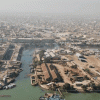
Basra "Takes Further Steps Toward Independence"
Posted on 12 April 2015 .
This article was originally published by Niqash. Any opinions expressed are those of the author, and do not necessarily reflect the views of Iraq Business News.
Kurdistan of the South? Basra Takes Further Steps Toward Independence Inside Iraq
Those who believe that the resource-rich province of Basra would be better off as a semi-autonomus region say the time is right to make this change. Others say any such project will endanger Iraq just when the country needs unity most.
The next few months will be crucial for one of Iraq's most resource-rich provinces. For some time now there have been calls to make the southern province of Basra a region – that is, it would become more independent from the federal government in Baghdad in a similar way to Iraqi Kurdistan.
“We have noticed that this idea is more widely accepted by social and tribal leaders who were against the plan in the past,” says politician, judge and legal expert, Wael Abdul-Latif, a former governor of Basra who's been campaigning for more independence for the province since 2008. “We have started to collect the votes of those who support the creation of a region of Basra. After this we will submit a request to the Independent High Electoral Commission.”
Now volunteers say they've already collected enough signatures to put forward a request to make Basra a region – and they say that they'll submit the proposal in mid-April.
To establish a region Article 119 of the Iraqi Constitution says certain steps must be taken – this involves either a tenth of all eligible voters in the province supporting the idea or one third of the provincial council members submitting the request. After this Iraq's Parliament decides whether to go ahead with turning a province into a more independent region with a vote.
And Basra has long been a candidate for this. In fact, the first request for regionalisation was submitted in 1921. “The rationale behind the petition was based on the economic and social characteristics of Basra, such as its having a seaport and economic vibrancy,” website Al Monitor reports.
Posted in Iraq Oil & Gas News, Politics, Security Comments Off on Basra "Takes Further Steps Toward Independence"