


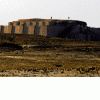
Unemployed Iraqis join in Looting of Antiquities
Posted on 01 April 2016 .
By Wassim Bassem for Al-Monitor. Any opinions expressed are those of the author, and do not necessarily reflect the views of Iraq Business News.
Iraq is a great mine of antiquities, with around 13,000 historical and archaeological sites. But today, they lack protection in the absence of law and the deteriorating security conditions in the country, and thieves are free to illegally dig at these sites.
On March 14, the authorities in Tikrit, north of Baghdad, arrested gang members who had intended to smuggle out of the city artifacts from the Assyrian Empire. This incident is only one of many looting operations, Capt. Fadel Abbas from the Babil police told Al-Monitor. He said, “Archaeological sites are spread in vast areas far from cities, which makes it difficult to protect them in the absence of modern surveillance techniques.”
Al-Monitor tried to meet with illegal archaeological explorers, but to no avail. However, although their operations are carefully guarded secrets, some artifacts smugglers are identifiable. Hassan Ali, a social worker from Babil, told Al-Monitor that there are many citizens taking part in illegal archaeological excavations, explaining that they justify the crime with rampant unemployment.
Ali continued, “Some people suddenly got extremely rich in Diwaniyah and Babil. They became known as artifacts traders, but no one dares ask them about this subject. And accusing any individual may lead to tribal disagreements.”
Abbas said, “The security services are following up on those [alleged traders], but they are not doing anything about it for lack of sufficient evidence, and thus everything that is said about them is mere accusation.”
However, he stressed that it is widely known that “since 2003, illegal explorers have taken advantage of the security forces’ preoccupation with terrorism, which allowed them to gain access to archaeological sites that are not protected by the police.”
Posted in Iraq Education and Training News, Security 3 Comments

How to Overcome Iraq’s Economic Crisis
Posted on 10 February 2016 .
By Ali Mamouri, for Al-Monitor. Any opinions expressed are those of the author, and do not necessarily reflect the views of Iraq Business News.
Iraq’s economic crisis is about to get worse. The government, which relies on oil for 90% of its revenue and 80% of foreign exchange earnings, faces plunging oil prices combined with rampant corruption and the exorbitant cost of battling the Islamic State (IS). Iraqi officials must come up with solutions that take all those circumstances into account.
The country's economic problem is influenced particularly by two factors. The first is related to Iraq's socialist economic system and its absence of an economic infrastructure and free active market correlated with global markets. The Iraqi infrastructure is significantly damaged as a result of long-term wars and sanctions.
The economic system was mostly controlled by the government for more than half a century. Although the private market has significantly grown since 2003, it remains weak. Moreover, the local private market does not contribute to the global market.
The second factor is linked to the general political and social situation of the country, which experienced years of dictatorship, from the military revolution in 1959 until 2003 and under several regimes, the last being that of Saddam Hussein. The country also suffered sanctions imposed following Iraq’s invasion of Kuwait in 1990. The sanctions were gradually lifted beginning in 2003.
Various institutions have studied potential solutions to the crisis affecting all of Iraqi society. For example, the Washington-based Consultative Group to Assist the Poor suggests potential solutions in a blog series covering different parts of the Arab world. The organization noted that comprehensive solutions become difficult to achieve in countries plagued by conflicts and vulnerable economic structures. But it said microfinance — "providing credit, savings, payments and insurance to low-income households and small businesses — is one intervention poised to promote local economic activity and help manage economic shocks."
Posted in Construction & Engineering In Iraq Comments Off on How to Overcome Iraq’s Economic Crisis
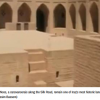
Caravan Stops Crumble Along Abandoned Silk Road
Posted on 06 February 2016 .
By Wassim Bassem, for Al-Monitor. Any opinions expressed are those of the author, and do not necessarily reflect the views of Iraq Business News.
Once-lively Caravan Stops Crumble Along Abandoned Silk Road
In an interview with Al-Monitor, 85-year-old Hussein Khazraji described how he used to cross the distance between his hometown, Najaf, and Karbala on foot in the 1950s. He would visit the holy shrines, especially that of Hussein bin Ali in Karbala, as part of the hajj.
He and other pilgrims would stop halfway on the nearly 47-kilometer (29-mile) journey between the two cities to spend the night at the enormous Khan al-Noss building dating back to 1774.
Khazraji still vividly remembers this ancient edifice that used to serve as a hostel, where “horses and other livestock would enter the khan’s vast courtyard during the night while people would sleep over in the dozens of rooms in the upper floor.”
This once grand building now lies in ruins. Al-Monitor visited the location only to find a shapeless structure of yellow bricks, surrounded by vegetation. On close inspection, the rubble's only remaining features were a flattened dome and the remnants of Islamic decorations that had fallen victim to the wind, rain and human negligence.
While there, Al-Monitor interviewed Haleem Yaseri, an archaeologist and history teacher at Babil High School who grew up in Karbala. He remembered of the building's entrance, “It had a wooden gate guarded by armed men, with a small door through which people would enter and exit. The gate would be locked during periods of unrest and at night to prevent thieves from attacking the khan.”
A tour inside the building revealed dozens of rooms adorned with Islamic arches surrounding a vast yard, where brick remnants were piled alongside the remnants of wells. Vegetation covered everything.
Posted in Iraq Industry & Trade News Comments Off on Caravan Stops Crumble Along Abandoned Silk Road
Rise in Unemployment in Iraqi Kurdistan
Posted on 03 December 2015 .
By John Lee.
A spokesperson for the Kurdistan Region's Syndicate of Investors has told BasNews that unemployment has risen sharply over the last two years and is now estimated at 20-25 percent with 700,0000 people losing their jobs in the private sector.
But the Head of Sulaymaniyah Directorate of Statics, Mahmoud Othman, rejected the claims, saying:
"Unemployment was at 7% in 2013 and it grew to 10% by the end of 2014 ... but reliable statics are not available for 2015."
He insisted that even though the financial crisis has affected employers, and salaries are delayed, people are still working.
(Source: BasNews)
(Oil Worker image via Shutterstock)
Posted in Employment 5 Comments

Iraq Improves in Prosperity Index
Posted on 03 November 2015 .
By John Lee.
Iraq has risen five places in this year's Legatum Institute Prosperity Index, ranking in 123rd place out of the 142 countries measured.
The index ranks countries in eight categories including economic success, opportunity, health, and personal freedom.
Norway finishes highest on the annual Prosperity Index for the seventh year in a row, with Switzerland ranking 2nd in the Index for the third year in a row, while Denmark has risen from fourth to third since last year.
The least prosperous country is the Central African Republic, which came just below Afghanistan and Haiti.
Nathan Gamester, Director of the Prosperity Index at the Legatum Institute, said:
“The Prosperity Index tells us that human progress goes beyond economics. Norway and other countries at the top of the Index provide opportunity and freedom to their citizens, access to quality healthcare and education, and provide safe environments for people to flourish in.
"By contrast those countries or regions of the world where people feel unsafe, where they are forced to flee from their homes, and where the education and healthcare systems are failing do not provide prosperity to their citizens. Sadly this year the Prosperity Index reveals that the world is becoming an increasingly dangerous place.
"A dramatic decline in Safety & Security in Africa and the Middle East threatens to undermine prosperity across the world. Many European countries are still struggling to grapple with unemployment. The Prosperity Index shows that the world is becoming more prosperous, but ominous developments suggest that this cannot be taken for granted.”
(Source: Legatum Institute)
Posted in Iraq Industry & Trade News 9 Comments

Lenders Rip Off Small Iraqi Businesses
Posted on 30 September 2015 .
By Omar al-Jaffal for Al-Monitor. Any opinions expressed are those of the author, and do not necessarily reflect the views of Iraq Business News.
In order to expand his men's shoe business, Mohammed Jizani had to borrow $100,000 from a loan shark. As is common in such cases, he was forced to pay the lender $4,000 a month in interest until the final payment on his debt.
Jizani, who owns four shops in Baghdad, imports most of the goods he sells from Turkey. He tried to get a loan from local banks, but lacked sufficient collateral. Even the feasibility study he prepared to outline the profits he expected from his business proved useless.
"Dealing with the usurer is easy," he said sarcastically, "while banks do not seem to be interested in small business expansion.”
Al-Monitor found out that the Iraqi moneylender Jizani dealt with owns a foreign exchange office in the Jamila area, east of Baghdad. He lends money to merchants like Jizani and has developed relationships with owners of small factories that produce foodstuffs as well as wholesale food stores.
Charging excessive interest, called "riba" in Arabic, is prohibited as a sin under Islamic law. But Jizani, a practicing Muslim, said a lack of liquidity can lead otherwise dedicated Muslims to make deals with predatory lenders.
Such was the case with Ahmed Jabbar of Baghdad. Extended unemployment led Jabbar to buy a taxicab with money from such a lender. But he said he believes the money he borrowed does not constitute an act of riba. He told Al-Monitor, “I took from one of the operators $10,000 and I will pay them back in Iraqi dinars with an interest amount equivalent to about $3,000.”
Posted in Investment, Iraq Banking & Finance News, Iraq Industry & Trade News 5 Comments

Iraq sees Exodus of Minorities
Posted on 22 September 2015 .
By Ali Mamouri for Al-Monitor. Any opinions expressed are those of the author, and do not necessarily reflect the views of Iraq Business News.
Media outlets are broadcasting the departure of hundreds of thousands of Syrians and Iraqis from their countries toward Europe by boat, train or on foot. The scenes of escape and displacement coupled with panic and catastrophe are reminiscent of the past eras of broad immigration.
The issue of the displaced Syrian people has received special interest, given the conflicting international stances on their situation. However, Iraqis, too, should be in the spotlight, as they share the same plight.
This is not the first time Iraqis have emigrated from their country, but the numbers have never been as large as they are today. The huge change will affect the demographic situation and raise questions about the fate of minorities. There are indications that the minorities of Iraq's social structure will be endangered if their displacement persists.
The Internal Displacement Monitoring Center in Geneva announced that the number of displaced Iraqis within Iraq reached 4 million in mid-June 2015, compared with 3.5 million in December 2014, according to a survey by UNHCR, the United Nations refugee agency.
In March 2015, UNHCR noted that as a result of the war in Syria and Iraq, asylum seekers in Europe reached their highest number in 22 years. Most Iraqi asylum seekers head to Turkey first, and continue their journey from there to a European country. The number of Iraqi asylum seekers in Turkey is below the total of Syrian asylum seekers. In 2014, 68,700 asylum requests were submitted by Iraqis to the United Nations, double the number in 2013.
The deputy head of the Iraqi parliament’s committee on displacement, Haneen al-Qaddo of Ninevah province, said in an Aug. 27 press statement, “The number of immigrants from Iraq is constantly on the rise due to the country’s security situation.” He said his committee does not have an accurate estimate because of the lack of official places to register them. He added, “Most of the immigrants are minorities whose regions are controlled by the Islamic State and they believe that their return is almost impossible.”
Posted in Security Comments Off on Iraq sees Exodus of Minorities

Moqtada al Sadr Demands Release of Turkish Hostages
Posted on 15 September 2015 .
By Simon Kent.
Shi'a cleric Moqtada al Sadr has again challenged the media image of himself as a radical "firebrand" by demanding the release of the 17 Turkish construction workers kidnapped in early September.
The cleric has long had a reputation for violent anti government, anti-western and sectarian politics, after running the militias the Jaish al Mahdi, and more recently Saraya al Salaam. But he surprised observers earlier this year by condemning what he called militia abuses, demanding punishment for offences against civilians and calling for restraint.
His recent statement refers to workers taken captive by suspected Shi'a militants calling themselves the "Death Division." The Turkish hostages--originally thought to number 18 Turks until it was revealed the 18th captive was Kurdish Iraqi, were working on a construction site, building a sports stadium in Sadr City. The area has high unemployment and frequent terror attacks from ISIS.
As such, Turkish hostages there would have been particularly vulnerable, given that news stories have circulated alleging Turkish support for ISIS. In a statement, the cleric noted,
"In my name and the name of all lovers of peace and Islam, I demand their release no matter the political or financial motives or other conflicts, and regardless of who the kidnapper was."
This is the latest in a series of attempts by Shi'a politicians to increase law and order after a proliferation of militias fighting ISIS may have used the war as cover for criminal or political terror operations.
Moqtada al Sadr's announcement comes after the most senior holy figure in Iraq, Grand Ayatollah Ali al Sistani, also called for the release of the hostages.
(Source: Reuters)
Posted in Security 5 Comments
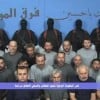
Terrorists Release Video of Turkish Hostages
Posted on 11 September 2015 .
By Robert Tollast.
A militia group calling itself "Firqat al Mawt" or "Death Division" has released a video (still shown above) of 18 Turkish construction workers who were kidnapped from their living quarters near Sadr City. The men were in Iraq working on the construction of a football stadium, in an area with high unemployment and a widespread local sentiment that Turkey supports ISIS.
Some analysts have speculated this is a splinter of a radical Shi'a group such as Kata'ib Hezbollah. In the video, the captives seem unharmed, and a couple even seem unconcerned.
However, the terrorists make several demands, some of which will be difficult, if not impossible to meet. They demand that Turkey releases more water from the Attaturk and Ilisu dams--projects known to be depleting Iraq's available freshwater.
They also accuse Turkey of "stealing" Iraqi oil--a reference to energy deals between the Kurdish region and Turkey.
They also claim that Turkey is assisting ISIS and threaten "severe violence" against Turkish interests in Iraq if their demands are not met.
(Source: Bloomberg)
Posted in Security 5 Comments
Baghdad Devolves Powers to Thi Qar Province
Posted on 07 September 2015 .
By Simon Kent.
This article was originally published by Niqash. Any opinions expressed are those of the author, and do not necessarily reflect the views of Iraq Business News.
Around a fortnight ago, in the southern Iraqi province of Dhi Qar, the Iraqi government ceremonially handed over many of its powers to the local authorities. It's something that's been on the drawing board for a while, mandated by Law 21 of 2008, and amended by the Iraqi Parliament in 2013, which gives provinces more control over their own finances and other powers.
“The transfer of powers will give local governments the autonomy to make their own decisions and to draw up development and planning policies without the interference of central government,” explained Dhi Qar's governor, Yahya al-Nassiri.
Al-Nassiri praised the move saying it would allow provincial authorities to complete basic service-related projects and revive projects that had been halted. And analysts generally see the move as a good thing, a way to decentralize the power that was claimed more and more by the previous government, headed by Nouri al-Maliki. It is also a move that is meant to appease those spearheading popular protests, pushing for government reform, that have been going on for several weeks now; these protests began in Shiite Muslim-majority areas like Dhi Qar.
The transfer of powers will apply to several ministries – including finance, health, employment, housing, education, transport, the environment, municipalities and public works, and youth and sports. According to the government in Baghdad, the transfer of powers will be gradual and supervised and will begin with only three portfolios: employment, health and municipalities and public works. After three months, the gradual handover of power in other ministries will also follow.
There are an estimated 2 million people living in Dhi Qar but many of the districts outside of the capital are plagued by poor services and unemployment. There is also a lack of water and other state services like power in the marshes in Dhi Qar, and the province's oil reserves are not being properly exploited yet, with local oil fields yet to produce at full capacity. Many hope that if the province can take care of its own business and manage its own budget, it will do a better job than distant managers in Baghdad.
But the transfer of powers to provincial authorities has come at a tricky time. There's been austerity policies instituted by the central government thanks to Iraq's problems with its national budget.
(Page 1 of 2)
Posted in Politics 8 Comments