


Weekly Security Update: 24 - 30 March 2015
Posted on 31 March 2015 .
National Overview
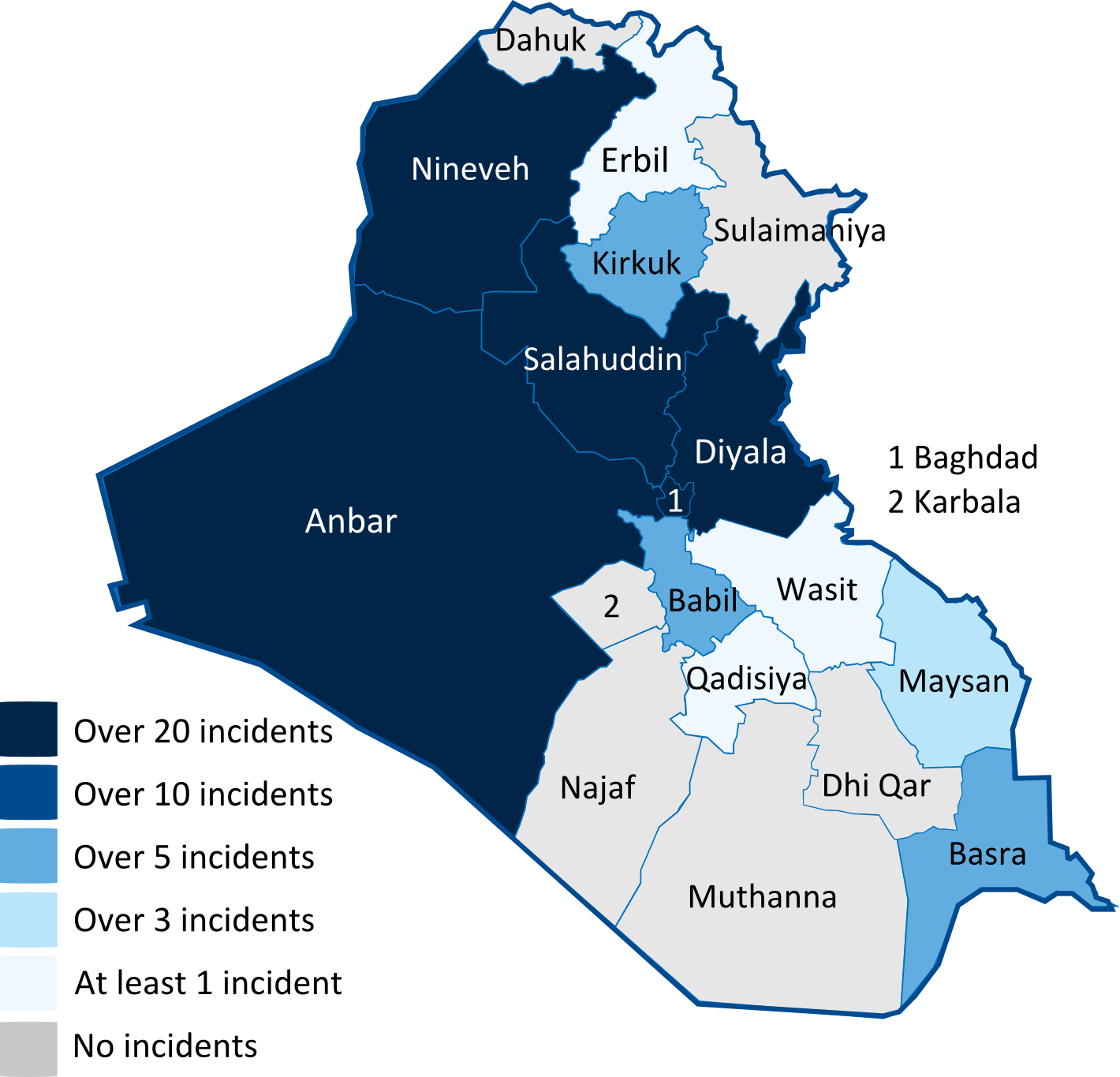
US involvement in Tikrit air campaign sparks discord within Shia PMU factions, as regional issues overshadow ongoing anti-ISIS offensive. Since Thursday 26 March, key players in Iraq’s Popular Mobilization Unit (PMU) alliance, including the Iranian-backed Badr Organization, Asaib al-Haq and Kitaib Hezbollah are understood to have withdrawn from the Tikrit theatre in protest at the coalition’s ongoing involvement in aerial bombing raids. While this does not appear to have significantly affected the pace of the offensive, and has in fact allowed the Iraqi Army to resume primary command on the ground, longer term successes against ISIS are likely to depend upon the manpower that the PMUs have provided up to now. Efforts by Prime Minister Abadi to renegotiate the return of these units (likely to depend upon the temporary suspension of US air activity in Tikrit) have also occurred amid increased sectarian tensions in the region, with GCC intervention against Houthi rebels in Yemen already sparking a series of pledges by smaller militia groups to support their Shia counterparts in the Arabian peninsula as they did during the Syrian civil war. With the majority of violent incidents confined to the battlegrounds of Salahuddin, Nineveh and Anbar this week, conditions in Erbil and the KRG cities (excluding Kirkuk) remained stable, with Peshmerga operations limited to frontline positions around Gwer and Sinjar town.
North
US aerial bombardment assists further advances into Tikrit as Peshmerga forces maintain defence against ISIS counter-attacks in Sinjar and Mosul. In total at least 39 airstrikes are reported to have occurred against ISIS targets in the city, with the scale of air raids increasing significantly from 26 March as US and coalition warplanes joined the Iraqi Air Force (IAF) to participate in coordinated operations. Under the cover of air support, ground forces then proceeded to enter Tikrit from three directions on the evening of the 26th, clearing houses and engaging militant checkpoints in a gradual advance over the next four days. According to official reports, some 137 neighbourhoods and districts of the city have now been cleared, largely in southern sections of Tikrit which on Monday 30 March witnessed Iraqi Army divisions raise the national flag over Tikrit hospital, approximately 2km from the city centre. Underpinning such gains has been a slow and methodical clearance of occupied buildings, which to date has uncovered more than 300 IEDs across the town and is likely to stall any rapid conclusion to the siege over the coming weeks. Unable to effectively flank the combined ground troops in central Salahuddin (an attempt by ISIS to recapture the Alas oilfields in NE Tikrit was foiled on Monday), militant units continued to harry Peshmerga positions adjacent to Sinjar town, mounting multi-pronged attacks on the Dohula Yazidi complex and outlying checkpoints in the face of ongoing coalition airstrikes.
Central
Conflict intensifies across Ramadi-Fallujah frontier as ISF continue to push back ISIS rocket positions, despite heavy resistance from militant groups. As reported in last week’s Iraqi update, the town of Karma, approximately 8km north-east of Fallujah remains the focus of ISF operations, with over 136 militant gunmen reported to have been killed between 24 and 27 March in protracted clashes east of the settlement. In response, ISIS affiliates have re-directed heavy VBIED assets to the Karma frontline and against ISF positions south of Fallujah, an indication of the level of vulnerability that militant assets are now under in the wake of the Iraqi army (IA) deployments. Despite heavy casualties among IA recruits however, the primary objective of the operation (that of curbing the missile threat to Baghdad) appears to have been met. Only one mortar strike was recorded in Baghdad governorate this week, a marked contrast from the situation one month ago when militant rockets repeatedly targeted Baghdad’s outlying Shula and Dour areas. ISF deployments also acted as an effective deterrent to VBIEDs entering from the Husseiniya and Tarmiya districts to the far north of the capital, though as before the threat of small arms fire and sporadic car bombings remains extant for north-eastern districts of the city.
South
IED threat resurfaces in former-ISIS supply zones around Babil, amid sporadic violence and SAF risks in the Midaina-Qurna area. Located close to the now ISF-held summer conflict sites of Latifiyah and Mahmudiya, northern Babil has seen a notable increase in the scale and frequency of militant attacks over the past two weeks, largely in the form of concealed explosives. While in most cases these have not resulted in casualties and are likely to be the product of a number of small remaining cells, at least one ISF officer is known to have died this week when an IED detonated in the Abid Wais area of Jurf Al Sakhar. At present, such cells are not believed to possess the manpower or military capabilities to challenge ISF control, though with ISF raids continuing to unearth large quantities of explosives on a weekly basis, the potential for high profile bombings (as witnessed in the twin VBIEDs attacks on 18 March) remains. An underlying threat of small arms fire (SAF) on commercial routes in northern Midaina (Basra governorate) has also emerged this week, following the third such attack against a PSC convoy since 08 January 2015. Unemployment issues, coupled with a wider increase in tribal volatility and armed conflict are likely to be the primary causes these attacks, although other explanations cannot be ruled out.
Posted in Weekly Security Update 8 Comments
Imported Goods Crowd Out Local Production
Posted on 29 March 2015 .
By Wassim Bassem for Al-Monitor. Any opinions expressed are those of the author, and do not necessarily reflect the views of Iraq Business News.
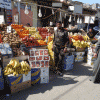
Qasim al-Rubaie, a teacher from Babil province, told Al-Monitor in front of a grocery store, “You will not find any Iraqi grown vegetables and fruits. Instead you'll find imported goods from Jordan, Turkey, Iran and the Gulf countries.”
In fact, Iraqi agricultural products are not found in many local grocery stores, as if Iraq is no longer producing food products. The same applies to locally manufactured products, such as tissues, luxury items and drinks, which cannot be found in the markets. Yet, markets are overflowing with all sorts of imported goods.
This phenomenon is not new, according to Alaa Najm, a merchant. He told Al-Monitor, “The presence of domestic goods in the markets began to decline in the late 1980s. The reason for that was the former regime’s military expenditures. Then agricultural and industrial production decreased, and the government’s support for these sectors vanished, factories became obsolete and agricultural land reclamation projects no longer exist.”
Najm began traveling to China in 2003, along with hundreds of Iraqi retail and wholesale traders, to import goods at a cheap price. Because of the traders’ import activities, foreign products have become abundant on the Iraqi market, in the absence of mechanisms to protect local production, obsolete production techniques and an unimplemented customs tariff law on imported goods.
In an interview with Al-Monitor, Maytham Elaibi, an economist and academic researcher at the University of Baghdad, said that the major collapse in the domestic production of goods is attributed to “the economic policies that have failed to support factories and farm owners in making their products profitable.”
Elaibi said, “The low salaries have prompted workers to move from the private to the public sector, which increased disguised unemployment, which is unproductive.”
Posted in Iraq Industry & Trade News Comments Off on Imported Goods Crowd Out Local Production
Iraq's Illegal Employment Agencies
Posted on 17 March 2015 .
By Omar al-Jaffal for Al-Monitor. Any opinions expressed are those of the author, and do not necessarily reflect the views of Iraq Business News.
Zaher Moussa, a producer at the Iraqi Beladi TV channel in Baghdad, has tried to contact employment agencies placing Asian workers in Iraq to interview them about the way they bring foreign labor into the country.
He got the agencies’ phone numbers from a website for foreign labor employment and social networking sites, but they refused to talk to him.
“Most of the agencies are not registered with the Iraqi government," Moussa told Al-Monitor. "They bring foreign workers into the country illegally.”
Moussa has also found out that the agencies’ addresses are incorrect, and most only operate over the phone, sending the Asian workers to the companies and shops that want to employ them.
Asian workers are brought exclusively through these illegal agencies, which are widespread in Iraq, before they are hired by other businesses.
In Baghdad, Bangladeshi and Indian workers can be found working in various businesses. They are employed in restaurants and cafeterias, as they receive lower wages and work long hours without complaining.
Ala Alwan owns the Rida Alwan cafe in Baghdad, which is a meeting place for Iraqi intellectuals, where three Bangladeshi workers are illegally employed.
Alwan told Al-Monitor, “These workers work without complaining and they accept reasonable wages.” The Bangladeshi workers are paid $400 per month, while Iraqis get $600.
Alwan has previously hired Iraqi workers, “but they complained about the long work hours and are slow in meeting customer orders,” he said.
Posted in Employment 3 Comments
Unemployment Rate Passes 25%
Posted on 04 March 2015 .
By John Lee.
The Iraqi Minister of Labour and Social Affairs, Mohammed Shayaa al-Sudani, has said that the unemployment rate in Iraq has passed 25 percent.
Ministry statistics also show that Iraq's population is now almost 36 million, two million of whom are internally displaced as a result of the conflict with Islamic State (IS, ISIS, ISIL).
According to a report from BasNews, the Planning Ministry reported in July 2014 that the unemployment rate was 16 percent.
(Source: BasNews)
Posted in Employment 8 Comments
74 Hotels Close in Iraqi Kurdistan
Posted on 04 March 2015 .
By John Lee.
BasNews quotes the Head of the Kurdistan Restaurant and Hoteliers Association, Hersh Ahmad, as saying that 74 of the region's 2,500 hotels have closed down in Erbil recently:
“The main reason is the fight against the Islamic State (IS) ... And those which still operate have fired 50% of their staff, increasing unemployment in the region.”
Nadr Rosti, for the Kurdistan Board of Tourism, said that due to financial and security problems, far fewer fewer tourists are expected to visit this year.
(Source: BasNews)
Posted in Leisure and Tourism in Iraq 2 Comments

Bogus University Grads Clog Job Market
Posted on 01 March 2015 .
By Adnan Abu Zeed for Al-Monitor. Any opinions expressed are those of the author, and do not necessarily reflect the views of Iraq Business News.
Meager employment opportunities have led Iraqi university graduates holding doctoral and master's degrees to despair, as they pursue fruitless searches for jobs in government ministries and the private sector.
In Babil province Feb. 3, some 200 unemployed university graduates attended a seminar in Murdoch Hall in Babil’s tourist resort. Also in attendance were the parliamentarian Haitham al-Jubouri as well as representatives from the Ministry of Higher Education and civil society organizations. The seminar included discussions about how to improve employment opportunities in Iraq.
Shabib al-Midhati, who has a master's degree in the plastic arts, told Al-Monitor at the seminar, “After my trip to the Ministry of Culture and Higher Education where I was looking for a job, I felt that it won’t be easy [to find work] especially in light of the financial crisis the country is going through.”
Mohammed Alaa, who hails from Baghdad and is a graduate of the Academy of Fine Arts at the University of Baghdad, told Al-Monitor, “Such meetings no longer work, as they mostly lead to promises that will not be kept. These are promises made for political campaigns only.” He stated, “The scarce opportunities are first and foremost given to the relatives and acquaintances of politicians and officials.”
On the sidelines of the seminar, Saad Hassan, who has a master's in education, said that bribery “is the nearest road to appointment” and admitted that he had “paid around $3,000 to a broker in order to get a teaching job.”
Iraqis with bachelor's and postgraduate degrees as well as graduates of institutes are actively organizing protests to compel the government to create job opportunities. Dozens of unemployed graduates demonstrated Feb. 3 in front of the provincial council building in Najaf, carrying banners demanding employment.
Posted in Employment, Iraq Education and Training News Comments Off on Bogus University Grads Clog Job Market

Kurdistan Needs $1.4bn to Stabilize Economy
Posted on 13 February 2015 .
The Kurdistan Region of Iraq Needs an Estimated US$1.4 billion this Year to Stabilize the Economy
The Kurdistan Regional Government (KRG) is facing an economic and humanitarian crisis as a result of the influx of Syrian refugees (starting in early 2012) and more recently the Internally Displaced Persons (IDP) in 2014.
According to a newly completed KRG – World Bank report, economic growth contracted 5 percentage points in the Kurdistan Region of Iraq (KRI), and poverty rate more than double increasing from 3.5 percent to 8.1 percent.
The report, Economic and Social Impact Assessment of the Syrian Conflict and ISIS Crisis, provides national and regional policy makers with a technical assessment of the impact and stabilization costs needed for 2015, associated with the influx of refugees and IDPs.
The stabilization cost for 2015 is estimated at US$1.4 billion [1.6 trillion Iraqi dinars] in additional spending above and beyond the KRG budget. This estimate could get much higher depending on how long the crisis persists. While the KRG has been responsive to addressing the needs of the displaced population up till now, more resources are needed to avert this humanitarian crisis and address the needs of the displaced population in the medium and long-term.
Impact refers to the immediate economic and fiscal effects on the KRG economy and budget, while stabilization cost refers to the additional spending that would be needed to restore the welfare of residents of the KRI.
“The international community remains deeply concerned by the circumstances facing the refugees and Internally Displaced Persons in the Kurdistan Region of Iraq,” said Robert Bou Jaoude, World Bank Special Representative for Iraq. “We hope that this assessment will support the KRG’s dialogue with its national and international counterparts and that a swift resolution to this problem will be identified.”
The study highlights how prices and unemployment have increased, and refugees and IDPs entering the labor market are pushing wages down. A surge in violence led to supply side shocks. The ISIS crisis has had a significant effect on trade of goods and services.
Posted in Iraq Banking & Finance News, Iraq Industry & Trade News, Iraq Public Works News, Security 12 Comments

Iraq's Female Nurses Struggle for Equality
Posted on 09 January 2015 .
By Wassim Bassem for Al-Monitor. Any opinions expressed are those of the author, and do not necessarily reflect the views of Iraq Business News.
Social media user Kamal Rahal expressed his wish for Iraqi nurses to “get married and have a happy life” on the "Iraq Nurse" Facebook page.
Rahal did not make this wish out of the blue. It was the automatic reaction of Iraqi society's harsh disapproval of female nurses and devaluation of their work.
Nurse Hassan Hatem, from Hilla in the center of Babil province, is looking for a woman to marry. It is only natural that he consider his colleagues at Hilla General Teaching Hospital, but, he told Al-Monitor in a Jan. 4 interview, “I was not able to marry a colleague who I used to love because my family refused our marriage.” He added, “I sought to persuade my father of the marriage but he categorically refused the idea of letting me marry a female nurse.”
Hatem attributed his father’s refusal to the fact that society still considers a woman who works as a nurse to be rebelling against moral values and the social customs that prohibit women from staying overnight outside the household or to have physical contact with men, even patients.
This conservative social idea holds that a woman's work place is in the home, and Iraq's culture of shame classifies women as "weak" individuals who must be kept isolated. The reluctance of many Iraqi women to work despite widespread unemployment, especially among women, is causing a shortage in Iraqi hospitals and prompting the Iraqi Ministry of Health to recruit nurses from India.
Nursing was introduced in Iraq in 1933 and according to the Iraqi Ministry of Health records, there are currently no more than 40,000 Iraqi nurses, 75% of them men.
Posted in Employment, Healthcare 4 Comments
Mosul Extremists Raid Homes, Arrest Journalists
Posted on 06 December 2014 .
This article was originally published by Niqash. Any opinions expressed are those of the author, and do not necessarily reflect the views of Iraq Business News.
Stifling Dissent: Extremists in Mosul Raid Homes, Arrest Journalists
Instead of reporting the news from inside the extremist-controlled city of Mosul, local journalists recently became the subject of news reports. Members of the extremist group, the Islamic State, are trying to silence all dissenting voices coming out of the city and recently initiated a wave of media arrests.
In the middle of the night, Mosul-based journalist Ahmed Abu Reeta got a phone call warning him that he was likely to be arrested by fighters from the extremist group known as the Islamic State at any moment.
Back in early June, the extremist Islamic State group had taken over the northern city of Mosul and some of its surrounds and they had started targeting journalists immediately; even before the group’s takeover of the city, their forerunners and allies had also been threatening and murdering journalists.
Abu Reeta and his sister decided to leave their home at once and they fled through neighbouring properties rather than on the street. They were just in time, the Abu Reeta tells NIQASH. Only a few minutes later fighters from the Islamic State, or IS, group arrived, searching for him. They did not find him but despite his mother’s protestations they confiscated his car.
Later Abu Reeta found out that the visit from the IS fighters was actually part of a concerted city wide raid on members of the media in Mosul. That night 12 other journalists were arrested, blindfolded and taken away by the IS fighters.
This attack on members of the press is not the first of its kind in Mosul. When the group first took control of the city in June, they detained five journalists – the group included one female television presenter. Nobody knows what has happened to those people.
The IS group has also been quick to confiscate the property of anyone working for the media. One example was the seizure of the home belonging to Jamal al-Badrani, head of the Sharqiya television channel’s bureau in Mosul. Ten other members of the media suffered a similar fate.
Posted in Iraqi Communications News, Security Comments Off on Mosul Extremists Raid Homes, Arrest Journalists

Freedom Square offers Refuge for Basra Residents
Posted on 26 November 2014 .
By Omar al-Jaffal for Al-Monitor. Any opinions expressed are those of the author, and do not necessarily reflect the views of Iraq Business News.
No one in the southern Iraqi province Basra believed that families would flock to Hurriyah (Freedom) Square to see and sit by the new monument after it was greatly ridiculed in newspapers and on social networking sites for its appearance — some described it as a large eggplant surrounded by horses.
People from out of town changed their opinions about the monument once they arrived in Basra and heard the residents’ stories about it.
The plan to build a "Freedom Monument" in Basra was announced together with plans for other statues in Iraq, which were also criticized.
Basra is the second-largest city in Iraq and the only Iraqi city with harbors overlooking the Arabian Gulf. The West Qurna oil field, which produces 360,000 barrels of oil per day, is located in the city. But Basra suffers from unemployment and lack of social services.
Life in Basra has become harder on the residents since militias have emerged in the city. Hurriyah Square, which has so far not been the scene of any fighting, has become a safe haven for young people who object to Sharia rule imposed by Islamic parties that are in control of various parts of the city.
On Sept. 11, the day of the square's inauguration, Basra Gov. Majid al-Nasrawi, said, “[This is] one of the successful projects in Basra … and [the square is] a breather for its residents.”
Posted in Construction & Engineering In Iraq, Iraq Public Works News, Security 2 Comments