


International Oil Symposium in Baghdad
Posted on 18 July 2010 .
Iraq's oil ministry is holding an international symposium beginning on Sunday to discuss the best ways for the government to co-ordinate and implement the country's oil expansion plans, a senior Iraqi oil official said Thursday.
Two oil licensing auctions last year awarded 11 deals to international oil companies that promise to add nearly 10 million barrels a day of capacity to Iraq's existing 2.5 million barrels a day by 2017.
"We will discuss the pace of implementation of the signed deals," Sabah Abdulkadhim al-Saaidi, head of legal and commercial office at the petroleum contracts and licensing directorate, told Dow Jones Newswires.
Saaidi said that the ministry has invited all the firms involved in the oil field projects to discuss their plans for development and the requirements and obstacles that lie ahead.
The symposium is expected to come out with recommendations that will be referred to the cabinet to be approved as guidelines for all ministries and relevant authorities to back the implementation of these oil field deals, Saaidi said.
"This intensive two-day program will issue recommendations to be referred to the cabinet to be approved as guidelines for all the ministries and relevant authorities to support the implementation [of the expansion]," Abdul Mahdy al-Ameedi, head of the Petroleum Contracts and Licensing Directorate, previously told International Oil Daily.
The two-day meeting is organized by the ministry of oil in co-operation with the cabinet's energy committee. The ministries of industry, trade, interior, finance and environment will send representatives to outline how they will support the oil ministry's efforts in implementing these strategic projects. In addition, officials from the local governments of Basra, Missan, Wasit and Dhi Qar and Nineveh will be also attending.
Iraq holds the world's third largest proven reserves of crude oil, with more than 115 billion barrels, but its oil infrastructure is creaking after decades of sanctions, war and neglect, and in dire need of boosting its oil production to help rebuild its war-torn infrastructure.
Baghdad signed late last year and early this year some 11 deals with international oil companies, including the majors such as BP PLC (BP), Royal Dutch Shell PLC (RDSA), Exxon Mobil Corp.(XOM), Total S.A. (TOT), Eni SpA (E) and Lukoil Holdings (LKOH.RS) among others.
(Source: Dow Jones, International Oil Daily)
Posted in Iraq Oil & Gas News Comments Off on International Oil Symposium in Baghdad
Shell to Award Deals to Develop Iraq's Oil Fields
Posted on 08 July 2010 .
Shell and its Iraqi state partner are in the process of awarding a deal to drill new oil wells at the super giant Majnoon oil field in southern Iraq, the head of Iraq's state-run South Oil Co., Dhiaa Jaafar, said on Tuesday.
Dow Jones reports that Shell, which partnered Malaysia's state-run Petronas to develop Majnoon, will also award engineering, procurement and construction contracts to build various production installations at the field, an Iraqi oil industry source familiar with the project said.
Jaafar told Dow Jones Newswires that both deals have not yet been awarded but they are "in process." He gave no further details.
Separately, an Iraqi oil industry source said that firms including Halliburton, Weatherford International, and Petrofac have been invited to submit bids for these two tenders.
A Shell executive contacted by Dow Jones refused to comment.
Shell said earlier that it was planning to drill 15 new wells over the next two years at Majnoon. This would help lift production to 175,000 barrels a day by 2012 from the current level of 45,000 barrels a day.
The Anglo-Dutch giant and Petronas were awarded a contract in December to develop the Majnoon field, which is located in Basra governorate and holds some 12.6 billion barrels of proven oil reserves. Shell owns 45% of the venture and Petronas 30%, with Iraq's state-run Missan Oil holding 25%.
Halliburton and Weatherford are already involved in oil services projects in southern Iraq. Petrofac said last month that it was establishing a presence in Iraq as it moves to increase its massive order book of projects.
World oil companies are moving ahead with development work at oil fields despite a political vacuum in Iraq after a general election in March produced no outright winner and raised concerns about increased violence in the country. U.S. Vice President Joe Biden concluded a visit to Baghdad on Monday, trying to mediate a solution among the various political blocs.
Shell is still keen to capture and sell gas in Iraq. As we reported last week, the Iraqi cabinet last week ratified a $12.5 billion deal with Shell and Mitsubishi to develop a gas-structure project in southern Iraq, paving the way for a final signature of the deal.
Iraqi officials said that the venture could produce up to 2.5 billion cubic feet a day when the project is developed.
Shell also partnered with ExxonMobil won a deal to develop the prized West Qurna Phase 1 oil field in southern Iraq. ExxonMobil holds the majority stake in that field.
(Source: Dow Jones)
Posted in Iraq Oil & Gas News Comments Off on Shell to Award Deals to Develop Iraq's Oil Fields

Former Iraq Oil Chief Blasts Baghdad’s New Crude Deals
Posted on 31 May 2010 .
Amman, 31 May 2010 - Dow Jones
The former head of Iraq’s largest state-owned oil company and advisor to the country’s oil ministry has criticised deals Baghdad signed with international oil majors to develop some of its biggest fields.
“There is no clear national plan on how to develop these huge oil fields,” Jabbar al-Luaiby told Dow Jones Newswires in an interview.
BP, Royal Dutch Shell and Cnooc Ltd, Exxon Mobil Corp and Italy’s Eni Spa. (ENI.MI) have bagged deals with Iraq to develop fields in the war-torn country, which holds the world’s third-largest proven oil reserves after Saudi Arabia and Iran, according to BP.
Al-Luaiby’s remarks could increase pressure on Baghdad to revise contracts awarded to foreign companies. Ayad Allawi’s Iraqiya bloc, which won the most seats in the recent parliamentary election, said it would like to review oil contracts signed with the majors.
“They’re huge deals that need the infrastructure, the potential and management which Iraq is currently lacking because of years of war, economic sanctions and destruction,” said al-Luaiby, who recently left his position as an advisor to Iraq’s oil minister.
Al-Luaiby added that international oil companies can still play a part in tapping Iraq’s vast resources once better infrastructure and oversight is in place. Foreign investment could help reverse the impact of two decades of war, sanctions and neglect on Iraq’s oil industry.
Posted in Iraq Oil & Gas News Comments Off on Former Iraq Oil Chief Blasts Baghdad’s New Crude Deals
West Qurna 1 to See 8 New Wells
Posted on 25 May 2010 .
The initial development plan agreed by Exxon Mobil (XOM.N) and its partners for Iraq's West Qurna Phase One oilfield includes drilling eight new wells and overhauling up to 50 wells this year to boost output, an Iraqi oil official said on Monday.
International oil service companies will be invited to drill four new wells and state-run Iraqi Drilling Company is already working on drilling the remaining four planned for this year to increase production beyond current output of 225,000 barrels per day (bpd), Bassem Abdul Karim, head of the Operation Department in the South Oil Co., told Reuters in an interview.
"We will issue a tender for the other four wells ... and there will be workover (tenders) for 45 to 50 wells until the end of the year," he said in his office in the southern oilfield of Zubair. (Reporting by Ahmed Rasheed, Rania El Gamal and Aref Mohammed; editing by Jim Loney)
( Reuters )
Posted in Iraq Oil & Gas News Comments Off on West Qurna 1 to See 8 New Wells
ExxonMobil to use water injection to enhance southern Iraqi oil ouput
Posted on 08 May 2010 .
The Iraqi Oil Ministry has awarded ExxonMobil a project to inject water in crude oil fields in an effort to enhance production. The contract, estimated at several billions of dollars, was meant to take place in oil fields in southern Iraq.
Officials said ExxonMobil would inject 12 million barrels of water per day from the Gulf into the wells. They said Exxon would share the costs of the project with companies selected to manage the wells, including Russia's LUKoil, Italy's Eni and Royal Dutch Shell
The Oil Ministry has determined that water-injection would be required to maximize production of the southern oil fields. Baghdad has sought to increase oil production to up to four million barrels per day.
Posted in Iraq Oil & Gas News Comments Off on ExxonMobil to use water injection to enhance southern Iraqi oil ouput
Iraq Oil Bases Sprout as Halliburton Chases Growth
Posted on 30 April 2010 .
The world’s biggest oilfield contractors are building bases in the deserts of Iraq in a bet they’ll profit as the country strives to boost crude oil output to rival Saudi Arabia.
Schlumberger Ltd., Halliburton Co. and Baker Hughes Inc. are among companies this past week that said they’re expanding operations in Iraq. Weatherford International Ltd., the fourth- largest oilfield-services provider by market value, will expand staff in Iraq to more than 1,000 by July, Chief Executive Officer Bernard Duroc-Danner told investors yesterday on a conference call.
The prize is a share of the billions of dollars to be spent as the war-torn country seeks within seven years to increase crude-oil production capacity to 12 million barrels a day, on a par with the world’s largest oil exporter, Saudi Arabia. Iraq’s current production is about 2.4 million.
“It’s all becoming more real, in that contract awards are getting closer,” said Jeff Tillery, an analyst at investment bank Tudor, Pickering, Holt & Co. in Houston. “It’s a big opportunity for these guys.” Revenue potential is high, he said. “The profit side is a little bit of a leap of faith.”
The risks are financial, legal and political. Contractors don’t yet have a firm grip on what costs might be, Duroc-Danner said. Last month’s parliamentary elections left no political party with enough seats to govern alone, and Iraq doesn’t have a law yet for how oil revenue will be distributed.
Second-Biggest Field
Iraq’s government has signed 10 contracts for oilfield development with London-based BP Plc, Exxon Mobil Corp. and other producers.
BP, which is leading development of Iraq’s biggest oil field, known as Rumaila, awarded $500 million in service contracts last month. Included were projects won by Geneva-based Weatherford and a partnership between Schlumberger, based in Houston and Paris, and state-owned Iraqi Drilling Co.
Rumaila may become the second-biggest oil field by production in the world, BP said earlier this year. Saudi Arabia’s Ghawar field is the largest.
Halliburton, which plans to invest $100 million in Iraq this year, said it’s in the process of securing its first major base in Iraq.
‘Plenty of Work’
“There’s going to be plenty of work in Iraq, and believe me, all the service companies will have opportunities there,” David Lesar, chief executive officer at Houston-based Halliburton, said on an April 19 conference call with investors. “So we’re going along at the pace we want, and we’re confident we’re going to be successful.”
Schlumberger’s base will have 300 people this year, and that number will double by early 2011, CEO Andrew Gould said last month.
“Competition will be fierce, start-up costs high, and we do not expect significant revenue before 2011,” Gould said at the Howard Weil Energy Conference in New Orleans. “The significance of Iraq will only really emerge once the post- election political landscape is understood and some form of oil law has been passed.”
Development of Iraq’s oil industry is moving ahead as security improves after decades of wars and sanctions.
Al-Qaeda
U.S. and Iraqi forces said yesterday that they killed two of al-Qaeda’s regional chiefs in raids. A day earlier, Prime Minister Nouri al-Maliki said Iraqi and U.S. forces killed the terror network’s two principal leaders in the country. “Iraq is probably the biggest opportunity, along with possibly Brazil, confronting the oil-services industry,” said James D. Crandell, an analyst at Barclays Capital in New York. “It’s a country that has a significantly higher capability of exporting crude oil, but it needs a lot of work done on its fields.”
Within five years, service providers may be competing for more than $5 billion annually in contracts, he said.
The four biggest oilfield contractors all rose 4 percent or more yesterday on the New York Stock Exchange. Schlumberger gained 17 cents to $68.02 today, and Halliburton fell 2 cents to $33.29. Baker Hughes climbed 60 cents to $50.89, and Weatherford dropped 59 cents to $16.62.
‘Surge’ coming
if anything, service companies are late in positioning themselves for the “upcoming surge” in oil contracts, said Nansen Saleri, CEO at Quantum Reservoir Impact in Houston and former reservoir-management chief at Saudi Arabia’s state oil company. “Iraq is pregnant for huge growth,” Saleri said yesterday.
The country has potential reserves of 200 billion to 300 billion barrels of oil, Saleri said, and “the early movers will be the big winners.”
“It presents a tremendous opportunity for the service companies,” Gene Shiels, a spokesman for Houston-based Baker Hughes, said yesterday.
All of the companies said investors shouldn’t be quick to judge results from their Iraq forays.
“It’s going to be a very expensive place to operate, at least initially, because you’ve got all your mobilization costs, you’ve got people you’ve hired, bases that you’ve built,” Shiels said. “It’s going to take some time.”
Posted in Iraq Oil & Gas News 1 Comment
Trade Bank of Iraq Welcomes American Investment
Posted on 26 April 2010 .
26 April 2010 - AME Info
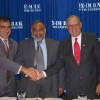
This week, the National U.S.-Arab Chamber of Commerce (NUSACC) and Meridian International Center hosted H.E. Hussein Al-Uzri, Chairman of the Trade Bank of Iraq. The dialogue focused on 'Iraq's Economic Forecast Post-Election: Updates on the Banking Sector, Investment Trends, and Key Drivers of Growth in Iraq.'
Chairman Al-Uzri noted: "Iraq is an under-banked country, having only 550 bank branches for a population of approximately 30 million. We have to increase the number of banks and put more Iraqis back into the banking sector. American finance banks and finance institutions can help us. A legal and financial infrastructure has now been created to set up Iraq for investments."
He also discussed the establishment of the Trade Bank of Iraq by the Ministry of Finance in July 2003, stressing the independence of the bank from the Government of Iraq. The role of the United States in reducing Iraq's debt -- along with the Central Banking Law, Financial Management Law, and greater transparency in the government's budgets -- are all significant improvements in developing Iraq's banking sector.
The roundtable meeting included approximately 35 high-level representatives from key banking institutions, including the Overseas Private Investment Corporation (OPIC), the Export-Import Bank of the United States, the Multilateral Investment Guarantee Agency of The World Bank, the U.S. Departments of Commerce and Treasury, and J.P. Morgan -- all of which are playing a role in supporting the revival of the banking and investment sector in Iraq.
Also in attendance were representatives of such major U.S. companies as Boeing, FedEx, Motorola, ExxonMobil, Chevron, and a wide variety of service-based institutions, including non-governmental organizations. U.S. Government officials from the U.S. Department of State, U.S. Department of Commerce, and the National Security Council discussed Iraq's future in banking and investment promotion.
Ambassador Stuart Holliday, President & CEO of Meridian International said, "We see great opportunities for expanding investment, trade, and development in Iraq through a coordinated effort of public and private sector."
Curtis M. Silvers, NUSACC's Executive Vice President, highlighted opportunities for an increase in growth in Iraq's banking and investment sector, with special emphasis on private sector banking in Iraq. Hon. Bijan R. Kian, Director of the Export-Import Bank of the United States, offered remarks on methods of externalizing risk.
Posted in Iraq Banking & Finance News 1 Comment
Exxon to Lead Water Injection Project in Iraq
Posted on 20 April 2010 .
Baghdad, 20 April 2010 ( Reuters )
Exxon Mobil has been picked to lead a "multibillion-dollar" water-injection project on behalf of international oil companies that won contracts in southern Iraqi oilfields, an official said on Monday.
The cost of the project would be distributed among those majors that won development contracts for southern oilfields in the two auctions Iraq held last year, said Abdul-Mahdy al-Ameedi, director of the Oil Ministry's licensing office.
Posted in Iraq Oil & Gas News 1 Comment
Iraq Announces New Gas Tenders
Posted on 19 April 2010 .
(Source: Petroleumworld.com)
Iraq Prepares New Gas Field Licensing, Cuts Oilfield Signatory Bonuses Retroactively
Iraq's Oil Ministry has released plans to tender three gas fields—previously part of the first and second licensing rounds—to 15 invited companies and has named Shell, Total, and KOGAS as frontrunners, while also confirming that signatory bonuses for the renegotiated West Qurna-1 and Zubair oilfields have been slashed.
IHS Global Insight Perspective
Significance
Iraq will invite 15 oil companies to bid for the Akkas, Siba, and Mansuriya gas fields later this year, and has already named Shell, Total and KOGAS as preferred bidders at this stage, while the ExxonMobil/Shell West Qurna-1 oilfield project and the Eni-led Zubair development are seeing their signatory bonuses slashed significantly now that the election has passed.
Implications
Oil companies said that Iraq's financial terms were significantly improved as contracts from the first licensing round were renegotiated in late 2009 and the second (more successful) licensing round was drawing near, although full details of the improvements have remained elusive. Meanwhile, Iraq needs to get some core gas fields onstream, mainly to raise north and central gas feedstock availability for power generation—but pronouncing frontrunners before the tender might prove controversial.
Outlook
As IHS Global Insight has previously written, lower signatory bonuses—reducing upfront risk exposure—were understood to be under discussion early on in the contract renegotiations at West Qurna-1 and Zubair, although too politically risky to present in Iraq before the election as the government was loath to appear to be giving in to corporate interests.
Gas Trio Re-Offered
Fifteen oil companies—expected to be mainly among the companies that pre-qualified for Iraq's first and second licensing rounds—will be invited to bid for three strategic gas fields in Iraq. The Akkas and Mansuriya gas fields were initially offered as part of Iraq's first licensing round in mid-2009, but failed to be awarded, while the Siba field was initially to be offered as part of the late 2009 second licensing round, but was removed as that round's focus changed somewhat under political pressure to encompass more border-area fields in the north and east.
The Akkas field has been thought for a long time to be the closest to development, with large expectations in 2007 and 2008 that the field would be offered to bidders on a singular project basis, given its relatively fast development and export revenue-generating potential. The Akkas field is located in Western Iraq, on the border with Syria, and has always been seen primarily as an export field, given the proximity to Syrian gas pipelines on the other side of the border and the expense of reaching Iraq's domestic market through the construction of a pipeline traversing the Western Desert into central Iraq. In the 1990s and early 2000s Total and Shell expressed interest in the field, but a consortium of Italy's Edison, Malaysia's Petronas, China's CNPC, KOGAS, and Turkey's state-owned TPAO was the only bidder for the field in the first licensing round, which thus failed to meet the government's maximum remuneration level.
The Siba field has previously been eyed by Kuwait as a source of imports, but after having initially sounded optimistic about a bilateral deal in the post-2003 war environment, the Iraqi government earmarked the field for domestic supplies. Mansuriya in the north could, in theory, be interesting for potential future gas exports across Turkey on to Europe—currently being prepared from some gas fields in Iraqi Kurdistan under the leadership of Dana Gas, OMV and MOL—but domestic demands for gas feedstock for Iraq's power generation, as the rebuilding of the electricity sector gathers pace, are likely to make exports from Mansuriya a relatively distant prospect for now.
| Iraqi Gas Fields On Offer | ||
| Gas Field | Reserves (tcf) | Production Capacity (mmcf/d) |
| Mansuriya | 3.3 | 330 |
| Akkas | 2.1 | 350 |
| Siba | . . | 125 |
Jumping the Gun
In a staggering pre-judgement of any competitive bidding, Sabah Abdul Kadhim, legal and commercial chief of the Oil Ministry's Petroleum Contracts and Licensing Directorate (PCLD) told Reuters that "we are keen to select international companies with experience with gas and which have gas projects across the world", adding however that "Shell, Total and KOGAS will be at the top of the list because they have good experience in the gas industry and gas operations worldwide". Thus jumping the gun, Kadhim might find himself the centre of criticism, as any suggestions that Iraqi contracts have not been completely competitively awarded (for example, at Shell's South Gas Project) have drawn significant—and often damaging—disapproval. Currently the attempts and negotiations to form a new Iraqi government in the aftermath of the March elections mean that the focus is elsewhere, but the politicisation of the oil industry is likely to return as a new government settles in—and with it attempts by parliamentarians to gain influence over oil policies and supervise the privatisation process. Being mentioned as a frontrunner by one of the licensing round's organisers before it has even started is thus probably not a blessing at all for the companies and could well backfire if they do indeed secure any contracts.
Cutting Bonuses
Meanwhile, Reuters is reporting that Iraq's Oil Ministry has also agreed to slash signatory soft-loan bonuses on two of the flagship projects significantly, albeit turning the remaining sums into unrecoverable payments. The long-term soft loan initially required will be cut from US$400 million at ExxonMobil's and Shell's West Qurna-1 project, to US$100 million, while the US$300-million soft-loan signatory bonus to be paid by the Eni-led consortium developing Zubair also will be cut to US$100 million—in both cases being changed into a straight non-refundable signatory bonus, according to Kadhim.
The contracts for the deals in question were signed in January and renegotiated (both mega-fields were initially unsuccessfully offered in the first licensing round) during the latter part of 2009, indicating that there has been an understanding regarding this term improvement since before the definitive signing. As oil companies came back to the Oil Ministry and renegotiated some of their failed first-round bids just ahead of the second licensing round, oil executives indicated that Iraq had relented on its excessively tight terms and helped forge compromises that made the contracts more attractive. Iraqi Oil Ministry personnel and Oil Minister Hussein al-Shahristani, however, maintained that Iraq had not eased terms in any material way, fearing a domestic political backlash ahead of the March elections if the Iraqi government was to be seen as going to oil companies cap in hand and caving in to their economic demands. While little since then has emerged on exactly what had made the contracts significantly more attractive—apart from certain changes to how taxes were applied—rumours of the signatory bonuses being cut prevailed.
Outlook and Implications
The signatory bonuses were always relatively unpopular, demanding that the companies pay large sums upfront at a time when political risk and legal uncertainty ahead of the 2010 elections still loomed large and the fear of political parties winning and later changing or scrapping the contracts as completely illegal could not be ruled out. Hence scrapping them, or lowering them significantly, was always going to have a huge impact on the companies' risk exposure as they approached the planning and waiting time between the early 2010 signings of their contracts and the deadline for full deployment, some time after the likely installation of a new government. For the Iraqi government and Oil Ministry political considerations were always at the heart of their financial negotiations, and the need for secrecy surrounding the concessions that would make deals possible were always clear—and impressed upon their counterparties.
Iraq's gas plans show that the Oil Ministry now is moving forwards with its attempts to tie up some of the remaining loose ends from its first and second licensing rounds. Iraq will need to raise its gas production fast in order to meet domestic demand from its electricity sector as it is rebuilt, and although a lot more associated gas is likely to be produced as the oil mega-projects begin, both Siba and Mansuriya have the geographical capacity to act as early stable producers—and later as buffers—while oil companies decide on how much associated gas they need for reinjection and how much they can spare. In the case of Akkas, however, exports remain the most cost-efficient option, given that the field is much closer to Syrian pipelines then to Iraqi demand and domestic markets. Appearing to jump the gun and declare three companies as frontrunners for the late 2010 auction—even if misinterpreted—might cause both the Oil Ministry and the named companies some level of later aggravation.
Posted in Iraq Oil & Gas News 2 Comments
Iraq Plans New Licensing Auction for 3 Gas Fields
Posted on 15 April 2010 .
15 April 2010 ( Dow Jones )
The Iraqi Oil Ministry is planning to hold this year a third licensing auction to develop three discovered gas fields Akkas, Mansouriya and Siba, a senior official at the ministry said Wednesday.
Abdul Mahdy al-Ameedi, director-general of the Ministry's Petroleum Contracts and Licensing Directorate, told Dow Jones Newswires that out of the 44 international companies pre-qualified for last year's first and second bidding rounds, only 15 will be invited to submit bids for the gas fields.
He didn't name them, but described them as "the large integrated firms which can develop both oil and gas fields and those specialized in developing gas fields."
Ameedi said he expected the licensing auction for these three fields to take place by the end of this year. The Oil Ministry is offering a 20-year long technical service contracts similar to those awarded during the first and second bidding rounds.
Iraq awarded 10 oil deals to international companies during the first and second bid rounds last year with the aim of boosting its crude oil production to 12 million barrels a day in six to seven years. Iraq is currently producing 2.4 million barrels a day.
Among the companies which won oil deals are Royal Dutch Shell PLC, BP PLC, Exxon Mobil Corp, Italy's giat Eni SpA, Russia's Lukoil OAO France's Total, Japan Petroleum Exploration Co., China National Petroleum Corp. and Malaysia's Petronas.
Both Akkas and Mansouriya fields were included in the first bid round last June.
A consortium led by Italy's Edison SpA, which was the sole bidder for the 4 trillion-cubic-feet untapped Akkas field in the western Anbar province, was rejected because it sought $38 for each extra barrel of oil equivalent produced while the ministry offered a maximum fee of $8.50 a barrel.
None of the 33 participating companies submitted a bid for the untapped 3.3 trillion-cubic-feet Mansouriya gas field located in the restive Diyala governorate in eastern Iraq.
Siba gas field, with estimated proven reserves of more than 3 billion cubic meters in Basra governorate near the border with Iran, was dropped from the list of oil and gas fields listed in the second bid round which took place last December.
Ameedi said it was decided to offer these gas fields for development because Iraq desperately needs gas to feed its power generators which are providing less than half of the country's need.
The announcement of the new bid round came only a few days after a senior Iraqi oil official said that a Shell gas development project was in trouble. Shell failed last month to sign a 25-year deal with Baghdad to produce gas from southern oil fields which is currently being flared. Both Iraq and Shell agreed to extend negotiations for another six months.
Iraq, which has proven natural-gas reserves of 3.15 trillion cubic meters, has a daily natural-gas production of 1.64 billion cubic feet, 70% of which is flared.
Posted in Iraq Oil & Gas News 1 Comment