



UNESCO Promoting Literacy In Iraq
Posted on 08 September 2010 .
On the occasion of International Literacy Day, UNESCO calls on national institutions and civil society to join forces to promote literacy for all as a tool for inclusive and sustainable development in Iraq.
“I take this occasion to call upon governments, international organizations, civil society and the private sector to scale up their support to literacy,” stressed Irina Bokova, Director General of UNESCO, in her message for the Day. “Literacy and women’s empowerment” is the theme for this year celebrations, which focus on the importance of literacy and gender equality as one of the global strategic priorities for sustainable development.
UNESCO Iraq Office will seize this opportunity to organize events throughout Iraq together with the Ministry of Education and National NGOs to ensure participation of all Iraqi citizens and invites them to express their views towards the development of a national literacy strategy in Iraq. Activities will take place during last week of September due to celebration of the Muslim holiday of Ramadan and will include: Roundtables and conferences with Members of Parliament, community leaders, literacy practitioners and coordinators to discuss policy options to reduce illiteracy in Iraq; organizing community plays about literacy and women’s empowerment in national theaters; dissemination of awareness raising material on best literacy stories; and screening of TV spots in the UNESCO supported educational TV among others.
“Literacy is the necessary tool for social development and peace building,” said Mohammed Djelid, Director of the UNESCO Iraq Office, adding that “the achievement of the Literacy goal of reducing illiteracy by 50% by 2015 relies on the development of an effective strategy and implementation of inclusive policies for literacy.”
National illiteracy rates are estimated at 20% in Iraq. Women are particularly affected by illiteracy, especially in rural areas, where close to 50% of women aged between 15 and 24 are illiterate, compared to 28%-20% of women living in urban and metropolitan areas. The Government of Iraq (GoI) has responded to the literacy gap with the development of new literacy textbooks, the introduction of accelerated learning programs, and the opening of new literacy centres. However, equal access and attendance remain obstacles to progress on literacy in Iraq.
To address these challenges, the UNESCO Iraq Office in 2010 launched the Literacy Initiative for Empowerment (LIFE) for Iraq with funding from the Office of Her Highness Sheikha Moza bint Nasser Al-Missned, First Lady of Qatar and UNESCO’s Special Envoy for Basic and Higher Education. LIFE, which is a 4 year project with a budget of US$ 6,300,000, will contribute to strengthening the capacity of the Iraqi Government and civil society to deliver sustainable and empowering literacy for all.
For Further Information Please Contact:
Alberto Biancoli, Education Project Manager, UNESCO Iraq Office [email protected]
Tel: +962 59 02 340
Posted in Iraq Education and Training News Comments Off on UNESCO Promoting Literacy In Iraq
Lending still anemic at foreign-invested banks
Posted on 07 September 2010 .
Last month, Central Bank of Iraq governor Al-Shibibi told AFP he was hoping foreign banks would play a bigger role in developing Iraq’s financial system. From the banks’ point of view, he said, “the prospects are good, except for security.”
But the foreign institutions that have already entered the Iraqi market through investments in local banks don’t yet seem to be finding all that many good opportunities to grow their lending businesses. In fact, their loan-deposit ratios tend to be even lower than those of their wholly locally owned counterparts.
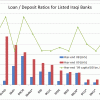
Consider the 13 ISX-listed banks in the chart, for example, of which the following five (the starred ones) have foreign investors: BMNS (National Bank of Qatar holds 23%), BBOB (Burgan Bank, 50.6%), BCOI (Ahli United Bank, 49%), BNOI (Capital Bank, 59.2%), and BDSI (HSBC, 70.1%). As of the end of last year, the last four of these had the lowest loan/deposit ratios in the sample. Only one of the five had a ratio above 20%, while the subsidiary of global giant HSBC ranked last with a ratio of just 4%. (The ratios are computed by dividing the “monetary credit” by the “current and deposit accounts” balance sheet items given in the companies’ 2009 annual reports.)
And while capital adequacy might be a constraint on lending even for banks with large deposit bases, this doesn’t appear to be the explanation for the poor showing of the foreign-invested banks as they don’t tend to have less capital. In fact, from the chart you could only conclude that capitalization and the L-D ratio are completely unrelated.
So why aren’t the foreign-invested banks lending? Presumably security is not the primary issue for banks that have already entered the market. More likely reasons can be found in the responses of executives polled by the Economist Intelligence Unit last July, 64% of whom said they would not invest in Iraq. In addition to violence and lack of infrastructure, they were deterred by “corruption, the bureaucracy, inadequate contract protection, and credit risks.” (See Joel Wing’s August 30 “Musings on Iraq” post at http://musingsoniraq.blogspot.com for more on the EIU survey.)
If these are the main obstacles to bank lending as well, the real problem is not the security situation but the weakness of the Iraqi state. Until there is some improvement on this front, it would not be surprising if lending remained anemic at private-sector banks in general, whether foreign-invested or wholly locally owned.
AAIB View
William Wakeham, Managing Director at A.A.I.B. Insurance Brokers, a company specialising in Iraq commented; the apparent conservative lending policies of the private sector banks may well be influenced by the perceived problems in the wider environment such as corruption, bureaucracy, contract protection rights, credit risks etc – all important elements to consider, but there are also other forces at play here.
It’s acknowledged that banks can play an important role in recycling savings deposits into productive loans, however the Iraqi private banks are small by international standards and are still in a market that is evolving and is emerging from years of conflict.
At this stage of market maturity it may well be the case that the lending opportunities available to them are now too limited, or that those opportunities that do exist do not meet with the lending criteria that have been drawn up – the potential rewards of advancing funds are simply not worth the risks to which the banks would be exposed to.
It will also be the case that some potential borrowers will be better served by other financial institutions, such as development banks or micro finance schemes and so the banks will avoid them, whilst some other potential borrowers will not stand up to scrutiny – a poor track record of the borrower, unacceptable amount, terms, or use of the requested loan, insufficient collateral used as backing, the high risk of potential for default etc.
A proper balance needs to be struck between playing a positive role in helping to revitalise the private sector, or help meet public borrowing needs, versus productively managing the assets of the bank and safeguarding the interests of its shareholders.
The banks themselves are competing for capital. Investors will assess the respective risks, prospects and potential returns before investing in banks, and banks also will consider their lending opportunities and how these fare against their risk assessment criteria.
Prudent lending policies and (low bad debt provisions or loan write offs) will help deliver the assurance to investors that capital is being well managed and productively applied rather than eroded.
Across the world banks are increasingly under pressure from regulators to bolster capital adequacy and improve capital management and to improve internal risk management standards - and lending policy and practices play a key part of this. Over the last two years we have seen in Europe the Middle East and elsewhere a tightening up of credit availability and a constrained ability to finance lending to commercial customers and to private customers.
The banks are there for the long term. They have branch networks to operate, payment services to deliver, credit management duties etc – banks of all types play a central role in an economy. Fundamentally commercial banks exist to generate adequate returns to shareholders, commensurate with the risks taken. Finally, at the core of any banking system is a need for trust and confidence in the regulation, institutions, management and the policies that they follow. If conservative lending practices help create and maintain these things, then they are to be applauded.
Posted in Iraq Banking & Finance News, Mark DeWeaver on Investments and Finance Comments Off on Lending still anemic at foreign-invested banks

New Blog Series - Construction in Iraq
Posted on 06 September 2010 .
Iraq, 1980. The Iranian F15s swooped around the partially constructed Ishtar Sheraton, followed the Tigris river beside Abu Nawas Street and launched their missiles at Al Dora refinery. Thirty years of war and unrest had begun. I know because I was there – I was the project quantity surveyor then, working for the State Organisation of Tourism. On the other side of the table, and working for the contractors was my future business partner, Evan Anderson, so our firm is truly founded on its Iraq experience.
Now it is 2010 and we all hope that a new, peaceful phase for the Iraqi people can start. The US army is leaving, and democratic elections have been held. The conditions of working and security are not yet ideal but those of us who have affection for Iraq and perhaps a long strategic vision mixed with optimism must try to be positive and provide support wherever we can.
Of course, commercial benefit is the driver, but there is also an element of goodwill that motivates me to participate. Iraq has been good to me, financially and professionally. Maybe soon I can return some of the debt owed. I hope so.
So, my blog starts, but it will quickly develop and convert to the blog of my company, Blair-Anderson Iraq. But first then a bit more history of how we got here.
My name is Stewart Blair. I am the joint owner of the Blair-Anderson Group, www.blair-anderson.com who have many years experience in the construction industry in what is known as the Middle East. We have provided cost management services to clients from the UAE to Saudi Arabia, Bahrain, Qatar, Kuwait and Egypt. We have been established for almost 25 years in this field.
In 2003 our company joined forces with an Iraqi civil engineer with whom we had worked in Dubai on several projects successfully, and a business bond had been created. We decided then that the combination of our international experience, including a credible Iraq and Haider’s enthusiasm to become involved in his native Iraq would demonstrate our ability to handle assignments in Iraq. Haider Al-Ali is the managing director of the company.
This blog will try to track our business development efforts and also try to impart and share some construction cost and risk knowledge as we discover it.
Let us start with a construction oriented look at the Iraq market. Why Iraq? Well, the projects I was on, such as the Ishtar, Palestine and Babylon hotels, the Rashid hotel, Taji Island and Baghdad University were probably the last to benefit from modern peaceful technology. The highest of these was 22 floors, perhaps 75 metres. We have now completed several towers in the UAE exceeding 75 floors!
The ambitions of Iraq need to be serviced by modern technology therefore. In our opinion, every urban facility and service is needed. For construction, the best way to view the market is as an island, where everything needs to be imported. Of course there will be local materials and skilled labour and workforce, but a lot has to be done to catch up so that proper construction and maintenance can be achieved.
The first conclusion then is that it will be expensive. We will explore all the various cost heads as our blog progresses, but we are also cautious as all development needs a return, and until the economy can afford to provide that by an accelerated increase in earnings per capita and so GDP, we suspect private development will not be as fast as may be expected or hoped for.
Even now, we are experiencing a significant level of difficulty. As our services tend to be at the front end of the procurement process, we notice a lack of confidence in government agencies in their own buying processes. We understand that there will be a certain nervousness – why not, no significant purchases of international services have been made for years, and the “I will not be ripped off “ syndrome is strong.
The construction and development procurement process is in our view then a priority. Therein lies our conflict of interest though, so until others take up this issue there is not much, that service providers like us can do. This blog may reach such others then, and that is our hope, so they can assess the value of our services without the pressure of a sales pitch. We look forward to sharing our experiences, and perhaps success with our readers over the coming months.
Stewart Blair is founder and director of Blair-Anderson Holdings, specialising in project reviews, management and control systems feasibility/viability studies, cost planning and the management and settlement of disputes on major international projects. He has been involved in sensitive dispute management assignments both in the Middle East and Internationally. He has also been responsible for successful cost planning and cost control on several major projects comprising high rise, commercial, hotel and touristic developments.
Posted in Construction & Engineering In Iraq 3 Comments

Saudi Firm Eyes Oil Investments in Iraq
Posted on 19 July 2010 .
Saudi industrial and energy services company Taqa (TAQA.AD) is considering investing $1.6 billion in pipelines and $133 million in offshore platforms in Qatar and Iraq, an Arabic newspaper said on Friday.
Officials from Taqa told the Saudi-owned daily Asharq al-Awsat they were considering investing in the gas industry in Qatar and the oil industry in Iraq by building platforms and pipelines for companies already working in the two countries. Taqa, 40 percent owned by the Saudi government, said it has already invested 500 million riyals ($133.3 million) in offshore oil and gas platforms in Saudi Arabia.
Officials said interest has increased since one of the company's main partners, the Italian oilfields services company Saipem (SPMI.MI), won a $10 billion contract to develop fields in southern Iraq.
Taqa has recently been on the acquisition trail, buying a 40% stake in Oman's Sohar Aluminium for $400m, and some of Suncor Energy’s assets in Canada for C$285 million.
(Source: Reuters, BusinessWeek)
Posted in Iraq Oil & Gas News Comments Off on Saudi Firm Eyes Oil Investments in Iraq
WiMAX Improves Communications in the Arab World
Posted on 16 July 2010 .
By end of June 2010, 26 out of 55 operators licensed to offer WiMAX offered the service. WiMAX is commercially available in Algeria, Bahrain, Iraq, Jordan, Kuwait, Lebanon, Libya, Morocco, Saudi Arabia, Tunisia and the UAE. Moreover, Yemen and Oman are slated to WiMAX services in the second half of 2010.
WiMAX stands for World Interoperability for Microwave Access. WiMAX/IEEE 802.16 is a global standard-based technology for Broadband Wireless Access. WiMAX is a broadband wireless technology that is largely supported by the computer and the telecom industry. Its guarantee is that it is engineered to deliver ever-present fixed and mobile services such as VoIP, Information Technology and Video at relatively low cost. Furthermore, WiMAX vendors state that WiMAX systems are able to cover a large geographical area (up to 50 km) and to deliver significant bandwidth to end-users at up to 40 Mbps. WiMAX technology can be deployed as a Point Multi-Point in last mile connection and as part of the backhaul to the PSTN and Internet access points.
The first commercial deployment of WiMAX in the Arab World was in Algeria in 2007. Moreover, by end of June 2010, a total of 26 service providers in 11 countries (including Algeria) in the MENA region offered WiMAX. The Arab Advisors Group expects an increase of 3 operators, at least, by end of 2010. A new report, “WiMAX in the Arab World 2010” was released to the Arab Advisors Group’s Telecoms Strategic Research Service subscribers on June 19th, 2010. This report can be purchased from the Arab Advisors Group for only US$ 950. The 37-page report, which has 51 detailed exhibits, investigates the availability of WiMAX regulations in 18 Arab countries, the frequencies used, entities that have tested WiMAX or pre-WiMAX services, and vendors for equipment. The report covers the following Arab countries: Algeria, Bahrain, Egypt, Iraq, Jordan, Kuwait, Lebanon, Libya, Mauritania, Morocco, Oman, Palestine, Qatar, Saudi Arabia, Syria, Tunisia, UAE, and Yemen. Any investment in this report will count towards an annual Strategic Research Service subscription should the service be acquired within three months from purchasing the report. Please contact the Arab Advisors Group to get a copy of the report’s Table of Contents. “There are still no detailed regulations specific to WiMAX in some Arab countries. Still, a few have specified the type of license that needs to be obtained to provide WiMAX service. For example, in Algeria, the company should have a VoIP authorization and the regulator’s specified band for WiMAX. In Jordan, the company should have an individual license needed to use the frequency (a scarce resource) as well as win the spectrum auction for WiMAX.” Alaa Numair, Research Analyst at Arab Advisors Group noted in the report.
The top three frequencies allocated to operators in the Arab world are 3.5 GHz, 3.6 GHz and 2.6 MHz. The 3.5 GHz band, allocated to 19 out of 55 licensed operators to provide WiMAX, is the most common allocated frequency in the Arab countries. 3.6 MHz and 2.6 MHz followed with 8 and 7 licensed operators, respectively. Tareq Masarweh, Research Analyst at Arab Advisors Group added. The Arab Advisors Group’s team of analysts in the region has already produced over close to 1,920 reports on the Arab World’s communications and media markets. The reports can be purchased individually or received through an annual subscription to Arab Advisors Group’s (www.arabadvisors.com) Strategic Research Services (Media and Telecom). To date, Arab Advisors Group has served over 600 global and regional companies by providing reliable research analysis and forecasts of Arab communications markets to these clients.
Posted in Iraqi Communications News Comments Off on WiMAX Improves Communications in the Arab World
Iraq Oil and Gas Report
Posted on 28 June 2010 .
Business Monitor International (BMI) forecasts that Iraq will account for 9.00% of Middle East (ME) regional oil demand by 2014, while providing 11.08% of supply. Regional oil use of 7.47mn barrels per day (b/d) in 2001 rose to an estimated 10.64mn b/d in 2009. It should average 10.98mn b/d in 2010 and then rise to around 11.95mn b/d by 2014. Regional oil production was 22.83mn b/d in 2001 and averaged an estimated 24.66mn b/d in 2009. It is set to rise to 27.18mn b/d by 2014. Oil exports are growing steadily, because demand growth is lagging the pace of supply expansion. In 2001, the region was exporting an average 15.36mn b/d. This total had eased to an estimated 14.02mn b/d in 2009 and is forecast to reach 15.23mn b/d by 2014. Iraq has the greatest production growth potential, followed by Qatar.
In terms of natural gas, the region consumed an estimated 367.6bn cubic metres (bcm) in 2009, with demand of 492.5bcm targeted for 2014, representing 28.7% growth. Estimated production of 429.9bcm in 2009 should reach 657.8bcm in 2014 (+39.8%), which implies net exports rising to 165.0bcm by the end of the period. In 2009, Iraq consumed an estimated 1.36% of the region’s gas, with its market share forecast at 1.47% by 2014. It contributed 1.86% to estimated 2009 regional gas production and by 2014 could account for 3.04% of supply.
We are sticking with our forecast that the OPEC basket of crudes will average US$83.00/bbl in 2010. Wide variations in crude differentials so far in 2010 make forecasting tricky for Brent, West Texas Intermediate (WTI) and Urals, but we believe the three benchmarks will average around US$85.11, US$88.22 and US$83.62/bbl respectively, with Dubai coming in at US$83.14. By 2011, there should be further growth in oil consumption and more room for OPEC to regain market share and reduce surplus capacity through higher production quotas. We are assuming a further increase in the OPEC basket price to an average US$85.00/bbl. For 2012 and beyond, we continue to use a central case forecast of US$90.00/bbl for the OPEC basket.
The BMI assumption for premium unleaded gasoline in 2010 is an average global price of US$96.83/bbl. The year-on-year (y-o-y) rise in 2010 gasoline prices is put at 38%. Gasoil is expected to average US$92.45/bbl in 2010, with the full-year outturn representing a 37% increase from the 2009 level. For jet fuel in 2010, the annual level is forecast to be US$95.58/bbl. This compares with US$70.66/bbl in 2009. BMI puts the 2010 average naphtha price at US$82.46/bbl, up 39% from the previous year’s level. BMI is assuming a 3.9% rise in Iraq’s real GDP in 2009, which will be followed by forecast growth of 4.5% in 2010. We are assuming average annual growth of 6.0% in 2010-2014. We expect estimated oil demand of 780,000b/d in 2009 to rise to 1.08mn b/d in 2014, depending on investment in infrastructure and the development of domestic production. International oil companies (IOCs) are signing production sharing agreements (PSAs) with the state, which should help accelerate the growth in oil output. Based on the efforts of national oil industry bodies, we are forecasting average oil production of 2.49mn b/d in 2010. March 2010 production was 2.25mn b/d, with 1.79mn b/d of exports. Further field reactivation work and the initial IOC efforts point to output of an estimated 3.01mn b/d in 2014. The government has much more ambitious targets, aiming for 0.5mn b/d annual output expansion and a long-term goal of 6.0mn b/d. However, there are major risks involving attacks on oil installations, Iraq’s OPEC entitlement and the success of new energy policy in stimulating IOC investment.
Between 2010 and 2019, we are forecasting an increase in Iraqi oil production of 73.0%, with crude volumes rising steadily to 4.30mn b/d by the end of the 10-year forecast period. Oil consumption between 2010 and 2019 is set to increase by 61.4%, with growth slowing to an assumed 5.0% per annum towards the end of the period and the country using 1.37mn b/d by 2019. Gas production is expected to climb to 37bcm by the end of the period. With 2010-2019 demand growth of 133.9%, export potential should rise to 25bcm by 2019. Details of the BMI 10-year forecasts can be found in the appendix to this report.
Iraq ranks fourth, just ahead of Iran, in BMI’s composite Business Environment Ratings (BERs) table, which combines Upstream and Downstream scores. It still occupies a respectable third place in BMI’s updated Upstream Business Environment Ratings, but is now four points behind the UAE and lacks the immediate potential to move higher. The country’s score benefits from exceptional oil and gas output growth potential, a substantial hydrocarbons reserves base and the region’s highest reserves-to-productionratio (RPR). Government control of the upstream industry and a high level of country-specific riskprevent Iraq from achieving a better overall score. Iraq is still at the bottom of the league table in BMI’s
Downstream Business Environment Ratings, with few high scores and near-term progress up the rankings unlikely. It is ranked just below Kuwait, thanks largely to country risk factors that outweigh a reasonable showing in terms of oil demand, oil and gas demand growth and likely refining capacity expansion.
The full report runs to 88 pages, and is available at a price of £590 directly from Business Monitor International.
Posted in Iraq Oil & Gas News 1 Comment

Oil Price High Enough to Encourage Investment
Posted on 07 June 2010 .
Crude oil prices are high enough to encourage investments in marginal fields, Iraqi Oil Minister Hussain al-Shahristani said.
Iraq, holder of the world’s third-largest oil reserves, is producing oil at “far below” its potential and plans to add four oil refineries with 750,000 barrels of capacity a day to tap rising demand from Asia, al-Shahristani said at the Asia Oil and Gas Conference in Kuala Lumpur today.
“It’s not expected that there will be much oil available from other parts of the world,” he said. “Any additional demand, particularly from Asia, will have to be met by Iraq.”
The Middle East nation is seeking foreign investors to boost output after six years of conflict and prior sanctions destroyed its infrastructure. The country completed two bidding rounds for oil development rights last year and has awarded a dozen contracts to international companies.
The country will receive $150 billion in investments from fields awarded last year, al-Shahristani said.
Nations counting on oil for revenue and investments have seen income fell as crude prices declined on concern slower growth will sap demand for energy. The price of crude oil in New York lost 14 percent in May, the biggest monthly drop in 18 months, partly on concern the euro region’s debt crisis will slow economic recovery. U.S. crude oil inventories have risen every week but two since the week ended Jan. 22, according to data from the U.S. Department of Energy.
Refinery Study
Foster Wheeler AG said last week that it won a contract for a feasibility study and the engineering and design of an oil refinery at Nassiriyah in Iraq, as the Middle Eastern country seeks to boost its capacity to meet domestic demand and allow for some exports.
Iraq plans to build a 300,000 barrel-a-day facility at the southern city of Nassiriyah, Foster Wheeler said in a Business Wire statement June 2. The company didn’t disclose the value of the contract.
“Within a couple of years Iraq should be an exporter of petroleum products rather than an importer,” al-Sharistani said.
Iraq consumed about 638,000 barrels a day of oil products in 2008, up from 596,000 barrels daily in 2007, according to a report from the U.S. Energy Department.
OPEC Meeting
The Organization of Petroleum Exporting Countries, which supplies 40 percent of the world’s oil, isn’t planning any emergency meeting before its next scheduled meeting, he said. The next scheduled gathering is on Oct. 14.
Oil prices are “reasonable” and there is no shortage of supply, Mohamed al-Hamli, the United Arab Emirates oil minister. said June 2.
OPEC is set to reduce shipments this month as demand from Europe and the U.S. remains weak, according to tanker-tracker Oil Movements.
OPEC will ship 23.47 million barrels a day in the four weeks to June 19, the consultant said in a report on June 3. That’s down from a revised figure of 23.6 million for the four weeks to June 12 and 23.7 million in the four weeks to June 5. The data exclude Ecuador and Angola.
OPEC’s members are Algeria, Angola, Ecuador, Iran, Iraq, Kuwait, Libya, Nigeria, Qatar, Saudi Arabia, the United Arab Emirates and Venezuela. Iraq is exempt from the quota system.
Posted in Iraq Oil & Gas News 1 Comment
Iraq ...... a New Aviation and Hospitality Destination
Posted on 31 May 2010 .
As markets continue to saturate in the region, Iraq emerges as a new destination for investors in the hospitality and aviation sectors, eagerly searching for new territories to conquer.
This weekend alone saw two major announcements with Abu Dhabi-based Rotana Hotels and Resorts poised to build a luxury property in Baghdad by 2012, while German carrier Lufthansa announced plans to jet into the Iraqi capital from September.
And even though the state-owned Iraqi Airways' bankruptcy declaration on Thursday could prove to be a setback for Iraq, the country's first private carrier, Alnaser Airlines, continues to forge ahead with its expansion plans after launching flights to Dubai earlier this month.
Earlier, Emirates Business had reported that Iraq's hospitality sector alone was expected to see an influx of $145 billion (Dh532.1bn) over the next fives years, with an estimated 22 per cent of that investment originating from the UAE.
Iraq's government-run National Investment Commission (NIC) revealed the figures, adding that an amendment in the law will now also allow foreign ownership of land to attract more international hospitality clientele.
"NIC plans to draw $500bn into Iraq over the next five years, with 29 per cent of that attributed to the hospitality industry alone," said NIC's Dr Ayser Fahd, Manager, Economic Department. "We expect foreign investment from the UAE to account for nearly 22 per cent in this sector."
Rotana, along with Marriott and Kempinski, are just some of the high-profile brands that have signed up or in the process of expanding their properties into Iraq.
While Rotana and Kempinski have already broken ground for four and five-star properties in Kurdistan - with the former hotel opening this summer - Marriott's entry is also on the cards, which Fahd confirmed, adding: "We have already processed the paperwork for Marriott International. I'm sure an announcement should follow soon."
Talking about their expansion into Iraq, Rotana's President and CEO Selim El Zyr told the paper earlier: "The opportunity arose when we were approached to manage two new five-star projects, one in the city of Erbil, located in the Iraqi Kurdistan region and the other in Baghdad, located within the International Green Zone, which is the heavily guarded diplomatic/government area in central Baghdad.
"Based on our research and market study, we believed that these markets were emerging and saw them as an opportunity."
The group's 205-roomed Erbil Rotana, in partnership with Lebanon's Malia group, is set to open in the first quarter of 2010, said El Zyr.
The 250-room five-star Baghdad property is scheduled for an early 2012 opening, in partnership with Summit Hotel Limited.
Other hotel properties scheduled for Iraq include Abu Dhabi investment company, Noor Capital's, plans to build a $100 million five-star hotel apartment project in Karbala, with United Kingdom hospitality developer Range Hospitality.
The project, called The Range, is expected to be completed in 2013.
Turkey-based Divan Hotels, which also recently announced plans to open a $90m five-star hotel in Northern Iraq in the first half of 2011.
Chairman Sarp Turanlıgil said: "We believe that an international-standard chain hotel such as Divan Erbil will meet an unserved need in this market and for that reason we resolved to make this investment."
Flight connections
Deutsche Lufthansa, Europe's second-biggest carrier's announcement this weekend to restart regular services to Baghdad makes is the first for a western European and US carrier to resume flights to the capital.
Turkish Airlines became the first carrier in Europe to resume Baghdad flights in October 2008. The airline is offering one daily connection, according to its website. Bahrain-based Gulf Air began serving the Iraqi capital in September 2009, while Abu Dhabi's Etihad Airways followed last month.
Etihad also announced earlier it would launch services to Erbil from Tuesday, subject to government and regulatory approvals.
James Hogan, Etihad Airways Chief Executive, said: "We expect to see strong demand on these routes, particularly from government and business travellers, as well as people from Iraq visiting family and friends around the world.
"We launched a cargo operation to Baghdad in September 2009, and have recently commenced additional cargo flights to Erbil, which we expect will perform well for Etihad."
According to industry figures, Baghdad Airport currently manages around seven million passengers a year.
Meanwhile, Erbil could be served by nearly 30 international airlines by year's end according to media reports, with flydubai and Qatar Airways, each portraying interest in Iraq's Kurdistan region.
"Iraq is definitely on our radar. We've been there a few times," Fly Dubai's CEO told The Associated Press in an interview.
"It's currently underserved," said Ghaith Al Ghaith. Qatar Airways CEO Akbar Al Baker announced at the Arabian Travel Market earlier this month that his airline has permission to fly to Baghdad, Erbil, and Najaf.
Meanwhile, Alnaser Airlines, Iraq's first private airline established in 2009, started its daily flights from Dubai to Iraq earlier this month. The flights are running to their full capacity of 140 passengers.
The airline, owned by an Iraqi national, Shaikh Hussain Al Khawam, has started a joined venture with the US-owned FK Gryphon Airlines, which in 2008 started commercial operations in Iraq and Kuwait.
Posted in Construction & Engineering In Iraq, Iraq Transportation News 1 Comment
Iraq to Sign Transportation Agreement with Qatar
Posted on 31 May 2010 .
Ali al-Dabbagh, the official spokesperson of the Iraqi government has said that the transportation minister has been authorised by the cabinet to sign an aviation transportation agreement with Qatar, Aswat al-Iraq has reported.
The agreement aims to overcome difficulties and delays in aviation transportation between the two countries, he said.
( AME Info FZ LLC )
Posted in Iraq Transportation News Comments Off on Iraq to Sign Transportation Agreement with Qatar
Iraq - An Overview
Posted on 27 May 2010 .
Gavin Jones, Partner with Upper Quartile,writing for The EIC
Iraq is fast becoming the engine for the oil and gas industry and is likely to hold this position for the next 10 years at least. I hope that this article will address the scale and speed of development of this market for the engineering industry.
The scale of the opportunity is difficult to put accurate numbers to but is always in the hundreds of billions. BP, Shell, Petronas, ENI, Lukoil, Statoil, Gazprom, China National Petroleum, Sonangol and Total are all rolling out development plans for fields with reserves quoted in the billions and production in the thousands of barrels.
International oil companies will manage many billions of contract value but make relatively little. The 1st licence round in June 2009 was heavily criticised – Iraq had not allowed production sharing agreements, they were unreasonable in what they were prepared to pay, they were expecting the oil industry to do too much rebuilding. The Wall Street Journal announced that the licence round had flopped. BP was the only company to accept what was on offer at half of what they bid then paid $500 million as a signature bonus. The 2nd licence in December 2009 round saw all available licences taken up and fees reduced to between $1.49 and $1.15 per barrel for the big fields: a remarkable change from the $40+ demanded initially. The Iraqi Government has commitments to produce 12 million barrels of oil a day and $2 billion in cash commitments from the oil industry – guaranteeing commitments and in May agreed to set up a National Oil Company to manage these relationships. Oh …. And then the Government launched a 3rd round of bids for 3 gas fields on the 19th May.
What about the service industry? The working environment, the structure of the licences and the obligations mean that most of the work is going to be subcontracted in large chunks – at least in the early years. Work has already begun, accommodation camps are being built, airlines have started commercial flights into Basra, Al Faw Port is being refitted at a cost of $4 billion, BP announced $600 million of drilling and down-hole service contracts and in addition Iraq will have to build floating oil terminals, clear land at Greenfield sites, repair pipelines, rebuild terminals, set up water-treatment plants for well injection, build oil-processing plants, lay pipelines, install gas-gathering equipment and power generators, haul in water and truck out fuel until pipelines are built. Water and power infrastructure remain major constraints, considerable spend on skills and CSR is also anticipated. Schlumberger started recruiting 600 staff in May and Petronas is recruiting “hundreds” of staff. Capital spending on oilfield services in 2011 alone is estimated to be five times that of Saudi Arabia, Bahrain, United Arab Emirates, Oman, Qatar and Kuwait combined.
What about the problems? Well there are plenty and they keep coming. Currently in the election aftermath there are calls to revisit licence awards. This will cause some discomfort but I think the licences will stay – they are an excellent deal for Iraq with about 98% of the oil revenue remaining in the country and the required laws will be passed when the internal deals are done. There will be ongoing discussions with OPEC – Iraq will challenge the pecking order in OPEC and weaken Saudi dominance as the world’s “swing producer” (the single mega-producer has been able to tweak the global price of oil by adjusting its own production). Iraq is on course to pass Iran as the Gulf’s second-largest producer causing a significant realignment of power in the region. Any decision on OPEC will be postponed until Iraq is in a much stronger negotiating position – my guess - at around 4½ mbbd and increasing. Security issues remain but are changing in objective, increasing in magnitude but decreasing in number. Iraq remains a dangerous place but security services are improving. The biggest problem is getting all this easy-to-produce oil out of the country and into the international markets – deals are being done with Turkey and Ports are being rebuilt. The oil is easy enough to produce but you still have to get the stuff to the big consumers like China. This is the next big phase.
And the money? If Iraq hits their 12 million barrel target this should tip $222 billion into the coffers annually but is going to take a few years. Meantime the Government have negotiated a World Bank loan – on condition that they privatise the 240 State companies –and have been told that they can manage the $180 billion oil-for-food fund that the UN was holding over from the old days of sanctions and of the $120 billion in debts $55 billion - and 80% of whatever they owed China - have been written off. The current state owned infrastructure and services are unable to respond to existing demand, the systematic dismantling of the private sector under the previous regime means there is no prospect of increasing capacity quickly.
My view is that the Iraqi Government has been a great deal more astute than many of the Governments advising them – they have sorted out the critical pieces of infrastructure (airports and ports); they have sorted out their income generation (oil) at a pace that would embarrass most developed Governments; they have put the gas gathering on the back burner (important but does not generate income) and are now starting to focus on the infrastructure to export oil; the next will be the schools, roads, hospitals and electricity to keep its citizens content. 20:20 hindsight is wonderful – but we have come a long way since the world announced last years licence round as a flop
Gavin Jones
Posted in Blog Comments Off on Iraq - An Overview