


Your Comprehensive Guide to the Chilcot Report
Posted on 06 July 2016 .
By John Lee.
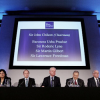
The Chilcot Report into the Iraq War was finally published on Wednesday. The report covers the background to the decision to go to war, whether troops were properly prepared, how the conflict was conducted and what planning there was for its aftermath.
Among the main findings are:
- That the UK chose to join the invasion before all peaceful options for disarmament had been exhausted;
- That Intelligence had not established beyond doubt that Saddam Hussein had continued to produce chemical and biological weapons; and,
- That the planning and preparations for Iraq after Saddam Hussein were wholly inadequate.
The full report is 2.6 million words long and would take an average reader weeks to read, but you may find the following resources useful:
Official documents:
- Official Iraq Inquiry site
- Executive Summary
- Full Report
- Search the Report and Declassified Documents
Summaries:
- From The BBC (UK)
- From The Telegraph (UK)
- From The Guardian (UK)
- From The Washington Post (US)
- From Russia Today
Editorials and Opinion pieces:
Posted in Politics, Security 4 Comments
Iraq Receives more Russian Military Helicopters
Posted on 03 July 2016 .
By John Lee.
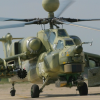
Iraq has received its final batch of Russian Mi-28 NE Night Hunter military helicopters, TASS news agency has reported.
A blog run by Russia's independent Center of the Analysis of Strategies and Technologies, reported that the latest shipment contained the final four of the 15 helicopters ordered by the Iraqi government.
A $4.2 billion package of arms deals between Russia and Iraq was signed in 2012, becoming the third biggest agreement for Russian arms sales since the 1991 collapse of the Soviet Union, the Reuters news agency reported.
(Source: The Moscow Times)
Posted in Security 4 Comments

Lukoil in Talks on Iraq Petrochemical Project
Posted on 22 June 2016 .
By John Lee.
Russia’s Lukoil is in talks with Shell and Total regarding their participation in a petrochemical complex in southern Iraq.
President Vagit Alekperov (pictured) told TASS:
"To create a petrochemical complex - now the negotiations are under way with Shell and with Total. The Iraqi side supports our efforts."
He added that Iraq is ready to start negotiations to improved contract terms.
(Source: TASS)
Posted in Iraq Oil & Gas News 6 Comments
KRG, Russia discuss Cooperation in Energy Field
Posted on 20 June 2016 .
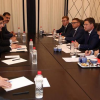
On the sidelines of the SPIEF'16 - St. Petersburg International Economic Forum, Kurdistan Region Prime Minister Nechirvan Barzani and his delegation met Mr. Alexander Novak, Russian Minister of Energy.
Minister Novka welcomed the participation of Prime Minister Barzani and his delegation at St. Petersburg International Economic Forum, stressing the need to further develop the old relations between the two sides.
He pointed out that the energy sector in Kurdistan Region could be further developed and that Russia wishes that its energy companies contribute to this development.
Prime Minister Barzani thanked Mr. Novka for the warm reception and highlighted the historical ties between the two sides, which he said can be developed in various fields.
He explained the situation in Kurdistan Region, its current financial crisis, the war against ISIS and the issue of accommodating a large number of refugees and displaced persons, who fled ISIS repression and took refuge in Kurdistan Region.
He thanked the Russian government for its support and assistance for the Kurdistan Region in its fight against terrorism.
Prime Minister Barzani offered his government’s support to Russian companies that invest in energy and other sectors in the Kurdistan Region.
He said that despite the situation in the Kurdistan Region, Gazprom Neft continues its operations and that his government will provide the needed facilities in order to expand its activities in the Region.
In an earlier meeting with Prime Minister Barzani, Gazprom Neft Board Chairman Alexander Dyukov expressed desire to expand their activities in the Kurdistan Region.
(Source: KRG)
Posted in Iraq Oil & Gas News 3 Comments
Lukoil plans to offset Iraq costs in August
Posted on 20 June 2016 .
By John Lee.
Russia’s Lukoil plans to offset the costs on Iraqi fields in August, company President Vagit Alekperov (pictured) told TASS on Friday.
He added that Iraq is ready to start negotiations to improved contract terms.
(Source: TASS)
Posted in Iraq Oil & Gas News 5 Comments

Tatneft interested in Projects in Iraq
Posted on 18 June 2016 .
By John Lee.
The chief executive of Russia's Tatneft has said the company is interested in projects in Iran and Iraq.
Nail Maganov (pictured) was speaking to Reuters on Friday on the sidelines of the St Petersburg International Economic Forum (SPIEF).
(Source: Reuters)
Posted in Iraq Oil & Gas News Comments Off on Tatneft interested in Projects in Iraq
Badra to hit 115,000 bpd in 2017
Posted on 17 June 2016 .
By John Lee.
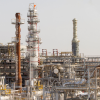
The First Deputy Chief Executive Officer of Russia's Gazprom Neft has said that the company plans to boost oil production at Iraq's Badra oil field from 65,000 barrels per day at present to 115,000 bpd "in the next year".
Vadim Yakovlev told the St. Petersburg International Economic Forum (SPIEF) on Thursday that production may increase further to 170,000 bpd.
According to TASS, it was reported earlier that Gazprom Neft plans to fully compensate its Badra project costs in 2018.
The oilfield development project is designed for 20 years with an optional 5-year extension.
(Source: TASS)
Posted in Iraq Oil & Gas News 2 Comments
Lukoil eyes further Investment in Iraq
Posted on 08 June 2016 .
By John Lee.
The Chief Executive of Russia's Lukoil has said he expects further investment in Iraq, now that the country "actively repaying" the international oil companies for their investment in the country.
Vagit Alekperov (pictured) told Reuters:
"Iraq is very actively repaying the operators. The situation has changed dramatically.
"We know about the IMF talks and we know that the IMF makes it conditional for Iraq to pay back the contractors.
"We hope they pay back all debts by November so we can start a new investment cycle before the end of the year. Our long-term Iraqi production goal remains intact - 1.2 million barrels per day. Iraqi fields have huge potential."
Lukoil is producing 0.4 million bpd in Iraq and if it did triple output at the West Qurna field, the country would be able to produce more than 5 million bpd.
(Source: Reuters)
Posted in Iraq Oil & Gas News 2 Comments

LukOil Attributes Higher Production to West Qurna-2
Posted on 06 June 2016 .
By John Lee.
Russian oil company Lukoil has announced that, in the first quarter of 2016, the Group received 2.6 million tonnes of compensation crude from Iraq's state-owned South Oil Company as cost compensation within the West Qurna-2 project (in the first quarter of 2015, the Group received 2.3 million tonnes of compensation crude oil).
It also attributed the increase in the company's international production to higher production at West Qurna-2.
Lukoil gave the following summary of the company's involvement in project:
On 12 December 2009, a consortium of a Group company and Statoil won the tender for development of the West Qurna-2 field in Iraq, one of the largest crude oil fields discovered in the world, with estimated recoverable oil reserves of 12.9 billion barrels (1.8 billion tonnes). The service agreement for West Qurna-2 field development and production was signed on 31 January 2010 and then ratified by the Ministry cabinet of the Iraq Republic. After Statoil withdrew from the West Qurna-2 project in May 2012, the parties of the project are Iraq's state-owned South Oil Company and a consortium of contractors, consisting of a Group company (75% interest) and Iraq's state-owned North Oil Company (25% interest).
The Group launched the "Mishrif Early Oil" stage on the West Qurna-2 field and reached the planned production of 120 thousand barrels per day in March 2014. According to the service agreement, costs are compensated after this level of production is achieved and maintained during any 90 days within a 120-day period. In June 2014, we met this term and from the second quarter of 2014 started to receive cost compensation. The project's target production level is 1.2 million barrels per day and the total term of the contract is 25 years.
Accounting for the cost compensation within the West Qurna-2 project in the Group consolidated statement of profit or loss and other comprehensive income is as follows. The crude oil sales revenue is recognized after the Iraqi party has approved the actual invoice for the spending quarter. The invoice total amount depends on crude oil production volumes and the market prices for crude oil during the period. It also includes our remuneration fee. Subsequently, crude oil purchases based on actual crude oil shipments by the Iraqi party against its debt for cost compensation are recognized in Cost of purchased crude oil, gas and products. This crude oil is either sold to third party customers or delivered to our refineries. After realization of these products, respective sales revenues are recognized.
The West Qurna-2 project's summary is presented below:
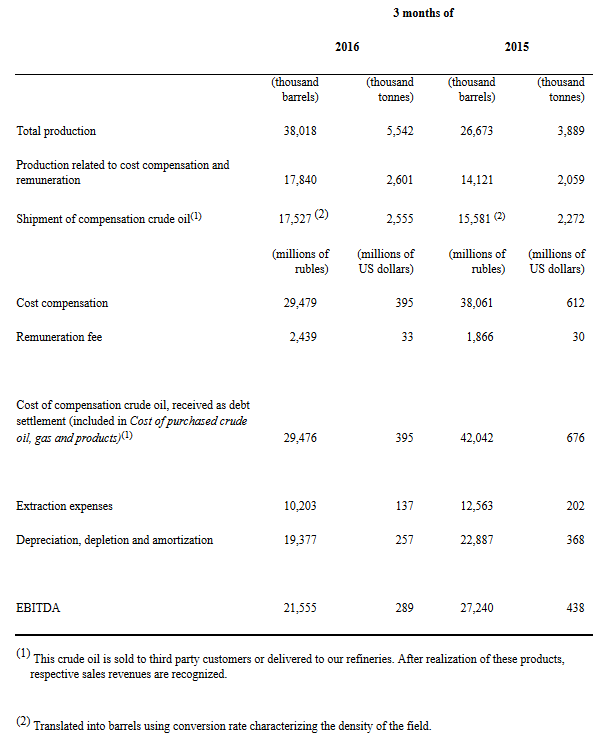
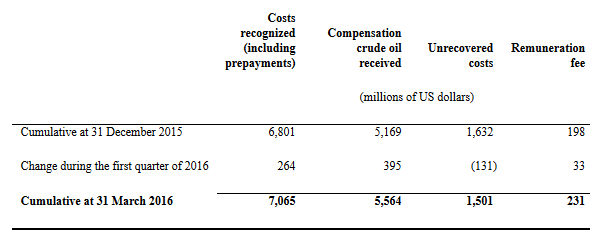
The following table summarizes the amount of capital and operating cost recognized, compensation crude oil received, costs yet unrecovered and remuneration fee.
The Group is exposed to various risks due to its operations in Iraq. Management monitors the risks associated with the projects in Iraq and believes that there is no adverse effect on the Group's financial position that can be reasonably estimated at present.
Posted in Iraq Oil & Gas News 3 Comments
Iraq becomes Turkey's Biggest Market for Citrus Fruit
Posted on 30 May 2016 .
By John Lee.
Iraq has taken over from Russia as Turkey's biggest market for citrus fruits.
In 2015, Russia took $90.52 million worth of the product, while so far in 2016 Iraq has taken citrus fruit to the value of $84.54 million.
(Source: Fresh Plaza)
(Picture Credit: Layth Mahdi)
Posted in Agriculture Comments Off on Iraq becomes Turkey's Biggest Market for Citrus Fruit